Matthew Potolsky is Professor of English at the University of Utah, specializing in nineteenth-century literature and literary theory. His career spans from 1998 Lecturer at Harvard University to current University Professorship. He earned a BA in Comparative Literature and Philosophy (1990), followed by MA and PhD in Comparative Literature (1992, 1997) from UC Irvine. Chair of English Department (2013-2016) University Professor (2014-2016) Research focuses on Decadence , Mimesis , Finance-Aesthetics intersections , and Government Secrecy . His work traces connections between financialization and decadent aesthetics, revealing how economic cycles influence artistic production. Key themes include: Decadent anti-realist literary movements Finance capital's cultural impact Decadent counterpublic formations Victorian aesthetic education debates Sublime aesthetics in national security Cosmopolitanism in literary communities Recent publications analyze: Decadent style as financialization rhetoric Reintroduction of verisimilitude theory Decadent responses to financial crises Mimetic labor in artistic production Decadent cosmopolitan counterpublics Historical parallels between financialization and literary decadence
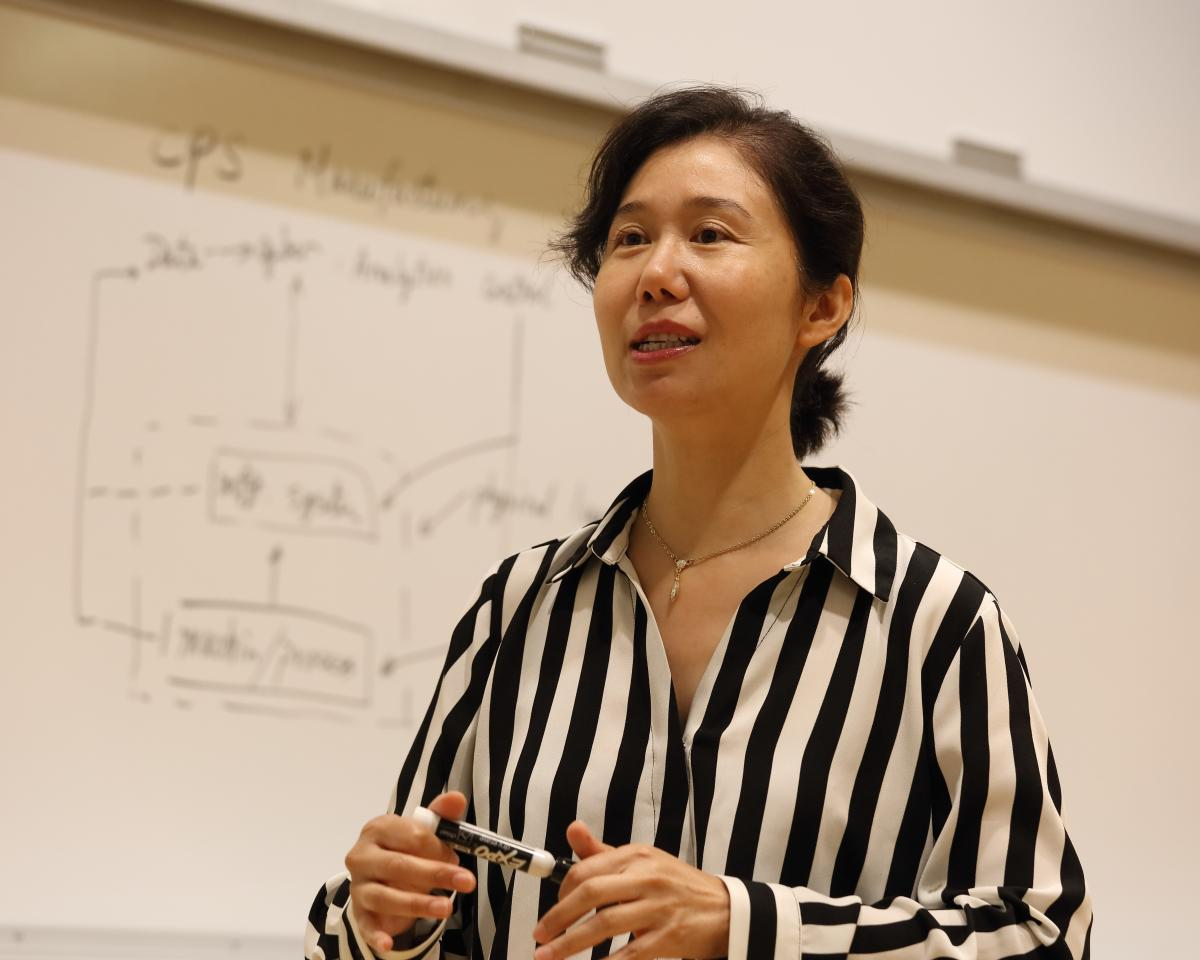
Qing (Cindy) Chang is a Professor in the Department of Mechanical and Aerospace Engineering at the University of Virginia, where she directs the Intelligent Systems Lab. She joined UVA in 2019 after serving as an associate professor at Stony Brook University. Prior to academia, she spent a decade at General Motors R&D, receiving their highest innovation awards. Education: M.S. from University of Wisconsin-Madison Ph.D. in Manufacturing from University of Michigan Research Focus: Chang's work integrates math-based modeling and data-driven methods to optimize manufacturing systems. Key areas include: Adaptive control and machine learning for production efficiency Human-robot collaboration frameworks Sustainable manufacturing through energy management Real-time control of cyber-physical production systems Reinforcement learning applications in industrial automation Research Trends: Her recent publications (2024-2025) demonstrate strong focus on AI-driven manufacturing optimization, with 80% leveraging reinforcement learning/LLMs for robotic control. Key themes include multi-agent coordination (67% of papers), energy efficiency (53%), and flexible production systems (47%). Awards & Recognition: Inducted as SME Scholar (2024) 20 Most Influential Professors in Smart Manufacturing - SME (2020) NSF CAREER Award (2014) Three-time GM Boss Kettering Award winner (2005,2006,2008) ASME and SME Fellow Leadership & Funding: Serves on NAMRI/SME Board of Directors with editorial roles across ASME/IEEE/SME journals. Research supported by NSF (including CAREER), Department of Energy, and multiple industry partners. Leads projects on human-robot collaboration and sustainable manufacturing. Lab & Collaboration: Directs the Intelligent Systems Lab at UVA, focusing on industrial AI applications. Collaborates with automotive and energy sectors to translate research into practical solutions for smart factories.
Prof. Dr.-Ing. Rüdiger Daub serves as Professor and Chair of Production Engineering and Energy Storage Systems at the Technical University of Munich (TUM), operating within the Department of Mechanical Engineering. His leadership encompasses research direction, academic supervision, and strategic development of battery production technologies at TUM's Garching campus (Boltzmannstr. 15), with active industry collaborations driving innovation in sustainable manufacturing. Daub's research program pioneers advanced production methodologies for lithium-ion and solid-state batteries, focusing on electrode manufacturing, electrolyte filling, and cell assembly processes. His work investigates critical parameter interdependencies affecting battery safety and performance, developing inline monitoring systems and digital twin technologies for real-time process optimization. Key contributions include moisture control in electrode production, electrochemo-mechanical characterization of solid-state systems, and robotics solutions for deformable object assembly, all integrated with machine learning for quality assurance in industrial settings. Analysis of his 2023-2025 publications reveals a dominant research trajectory toward solving production bottlenecks in next-generation energy storage. The work demonstrates increasing integration of computational modeling with empirical validation, particularly in solid-state battery manufacturing and high-voltage electrolyte systems. A notable trend is the cross-pollination of robotics, computer vision, and uncertainty quantification techniques to address complex assembly challenges and distribution shifts in quality monitoring, reflecting industry's urgent need for adaptable, data-driven production systems. Leading TUM's specialized laboratories for battery cell production, Daub's team maintains comprehensive facilities for electrode calendering, electrolyte filling, and cell assembly with integrated tracking and tracing capabilities. The research infrastructure supports collaborative projects with automotive OEMs and battery manufacturers to develop scalable production processes, emphasizing environmental sustainability through water-based electrode production and footprint optimization. Current initiatives focus on digital factory modeling and prelithiation technologies for next-generation battery systems.
Francesco Pilati is an Associate Professor at the Department of Industrial Engineering, University of Trento, where he serves as local coordinator for the scientific field ING-IND/17 (Industrial Plants and Logistic Systems). He chairs the research group on Industrial Plants, Production Systems, and Logistics, and teaches courses in Industrial Plants and Design of Digital Production and Assembly Systems. As coordinator of the Master's program in Management and Industrial Systems Engineering and University Coordinator for the EIT double degree in Zero-Defect Manufacture, Pilati bridges academic leadership with advanced manufacturing research. He has also served as Invited Lecturer at universities in Vienna and Göttingen. His research focuses on integrating environmental sustainability with technical-economic criteria through multi-objective optimization and impact assessment. Key areas include: Distribution networks and warehousing systems Manufacturing and assembly line design Hybrid energy production systems Digitization of manual production processes using depth cameras Recent publications highlight applications of Industry 4.0 technologies to pandemic safety, logistics optimization, and smart manufacturing. Pilati has received significant recognition including the Philip Morris Italia Empowering Research Award (2016) and Autostrade per l'Italia academic recognition. His editorial contributions include guest editing special issues on Digital Twins and Smart Factories in Q1 journals.
Dr. Md Manjurul Ahsan serves as a Research Assistant Professor in the Department of Industrial & Systems Engineering at the University of Oklahoma, where he develops AI-driven solutions for healthcare diagnostics and advanced manufacturing optimization. His work bridges theoretical AI advancements with practical industrial and medical applications. Education: Ph.D. in Industrial and Systems Engineering, University of Oklahoma M.S. in Industrial Engineering, Lamar University B.S. in Industrial and Production Engineering, Shahjalal University of Science and Technology Research Focus: Dr. Ahsan specializes in Artificial Intelligence with technical depth in Machine Learning , Deep Learning , and Computer Vision to solve critical challenges in healthcare diagnostics and additive manufacturing . His research emphasizes Explainable AI to enhance model trustworthiness and deployment efficiency across Cyber-Physical-Social Systems, with significant contributions to Aerospace and Defense applications. Publication Trends: Recent work (2023-2025) reveals a strategic expansion from core manufacturing applications into medical AI (diffusion models for diagnostics), cultural preservation (NLP for Dravidian languages), and geopolitical AI analysis. His publications consistently address data imbalance challenges while advancing digital twin integration in quality control systems. Scientific Recognition: GCOE Dissertation Excellence Award (2023) International Student Scholarship (2022) Outstanding Academic Achievement in Engineering (2022) IEEE IEMCON Best Paper Award (2020) Netti Vincent Boggs Engineering Excellence Award (2020) Research Leadership: As director of the Sooner Additive Manufacturing Laboratory , Dr. Ahsan leads cross-disciplinary teams developing real-time monitoring systems using FARO arms and CMM metrology. His postdoctoral work at Northwestern University (2023-2024) advanced AI deployment frameworks, resulting in 60+ peer-reviewed publications with multiple papers ranking in engineering's top 1% for citations.
Prof. Dr. Stefanie Hellweg serves as a Full Professor for Ecological Systems Design at the ETH Zürich , Department of Civil, Environmental and Geomatic Engineering. She is Deputy Head of the Institute of Environmental Engineering and leads groundbreaking research at the intersection of industrial ecology, life cycle assessment, and circular economy systems. PhD in Environmental Engineering (ETH Zürich, 2000) Industrial Engineering Degree (Karlsruhe University, 1996) Her research develops advanced methodologies for environmental impact assessment of products and technologies, focusing on: Life Cycle Assessment (LCA) with correlated uncertainty modeling Circular economy implementation in chemical and energy sectors Industrial symbiosis optimization for heat and nutrient flows Urban wastewater systems redesign for resource recovery Chemical pollution analysis in plastic materials Key publication trends reveal expertise in: Hybrid wastewater treatment systems Energy-efficient greenhouse cultivation Exergy analysis for sustainability metrics Machine learning applications in environmental modeling Policy-relevant industrial ecology studies She actively participates in global sustainability initiatives as: President of the International Society of Industrial Ecology (ISIE) Member of UN Environment's International Resource Panel Editorial board member for leading environmental journals
Brandon M. Stewart is an Associate Professor of Sociology at Princeton University with extensive interdisciplinary affiliations. He serves as Director of the Statistics Core at the Office of Population Research and maintains formal connections with the Politics Department, Princeton Institute for Computational Science and Engineering, Center for Information Technology Policy, and Center for the Digital Humanities. Stewart holds editorial leadership as Co-Editor-in-Chief of Political Analysis and Associate Editor at Sociological Methods & Research . His educational background includes: Ph.D. in Government from Harvard University (2015) Master's degree in Statistics from Harvard University (2014) Stewart's research pioneers innovative quantitative methods for social science applications, specializing in automated text analysis and modeling complex heterogeneity in regression. His methodological frameworks enable researchers to uncover hidden structures in large datasets that were previously too costly or impossible to analyze. While his recent work has focused on using newspaper archives to study propaganda mechanisms in contemporary China, his tools are deliberately designed for broad applicability across diverse domains including education, human trafficking, forced migration, international relations, constitutional law, and psychology. His publication record demonstrates consistent innovation at the intersection of statistics, machine learning, and social inquiry. Stewart's work shows a clear trajectory from foundational methodological development to practical implementation across numerous substantive areas, with recurring themes of enhancing causal inference with textual data, developing robust topic modeling techniques, and creating accessible computational tools for social scientists. Stewart's scholarly excellence has been recognized through multiple prestigious awards: 2024 Leo Goodman (Early Career) Award from the Methodology Section of the American Sociological Association 2023 Emerging Scholar Award from the Political Methodology Society Edward R Chase Dissertation Prize Gosnell Prize for Excellence in Political Methodology Political Analysis Editor's Choice Award Recognition for Excellence in Mentoring Graduate Students As a mentor, Stewart has guided several successful graduate students to faculty positions at institutions including UCLA and Georgetown. His collaborative approach is evident in numerous multi-author projects spanning disciplines from political science to computational linguistics. His leadership extends to the Sociology Statistics Reading Group, which he founded to foster interdisciplinary methodological exchange, and his summer methods camp that trains social scientists in advanced quantitative techniques.
Professor Daniel Eyers is a Professor of Manufacturing Systems Management at Cardiff Business School, Cardiff University , where he also serves as Director of Quality Assurance & Enhancement. He is co-director of the Centre for Advanced Manufacturing Systems (CAMSAC) and Cardiff University RemakerSpace , highlighting his leadership in sustainable and advanced manufacturing innovation. Professor of Manufacturing Systems Management, Cardiff University (2024–present) Co-Director, Centre for Advanced Manufacturing Systems (CAMSAC) (2024–present) Co-Director, Cardiff University RemakerSpace (2020–present) External Advisor, Open University (2022–present) His research focuses on the strategic management of advanced manufacturing technologies , particularly Additive Manufacturing (3D printing) , within operations and supply chain contexts. He explores how digital technologies enhance supply chain flexibility, sustainability, and performance. His work spans flexible manufacturing systems, servitization, and change management in industrial settings. His recent publications (2020–2025) reveal a strong trajectory in AI-human collaboration in decision-making , sustainable manufacturing , urban logistics , and the integration of 3D printing in circular economies. Themes include risk management, digital transformation, and the strategic impact of emerging technologies on operations. He frequently publishes in top-tier journals such as International Journal of Operations and Production Management , Production Planning and Control , and Omega . CEng, Engineering Council (UK) FHEA, Higher Education Academy ESRC Early Career Impact Acceleration Fellowship Daniel Eyers actively supervises PhD, MSc, and MBA students and has attracted over £2.5 million in research funding from research councils, the Welsh Government, and industry. He contributes to academic program design and quality assurance, serving on university committees and as an external examiner for other institutions. He is deeply engaged in applied research with industrial partners, reflecting his background in commercial manufacturing. His leadership in research centers and commitment to sustainability, digital innovation, and education underscore his role as a key figure in modern operations management scholarship.
Stephanie Wilson is a Professor of Human-Computer Interaction at City St George's, University of London, and Co-Director of the Centre for HCI Design (HCID). She co-founded the EPSRC Centre for Doctoral Training in Diversity in Data Visualization (DIVERSE CDT) and contributes to the Institute for Creativity and AI. Her research emphasizes inclusive interaction design, data visualization, co-design, and innovative digital technologies for healthcare, particularly for people with aphasia. She has supervised 17 PhD students to completion and led significant projects like EVA Park and INCA, which explore accessible virtual worlds and digital tools for aphasia. Her work has earned multiple awards, including ACM SIGCHI Honorable Mention Awards and the Tech4Good Accessibility Award Finalist. Stephanie has secured over £10 million in research funding, including grants from EPSRC and Innovate UK, and actively contributes to academic governance through roles like Chair of the Research Degrees Committee and establishing the Women++ group. She advocates for participatory design and ethical research practices in healthcare technology.
Sabine Waschull is an Assistant Professor of Operations Management at the Faculty of Economics and Business, University of Groningen. She holds a MSc and PhD in Operations Management from the same institution. Her research focuses on human-centric design in Industry 4.0/5.0 contexts, including AI integration, digitalization, and work system evaluation. She is a member of the IFIP WG 5.7 working group on Production Management Systems. Her teaching includes courses such as Smart Industry Operations, Technology-Enabled Innovation, and Operations Strategy & Technology across bachelor and master programs. Her work emphasizes human-AI synergies and co-creation methodologies in manufacturing systems. Recent research trends highlight AI-driven enterprise interoperability, socio-technical evaluation of manufacturing systems, and human-centric design of augmented reality tools. Collaborations with co-authors like Christos Emmanouilidis and Joost Bokhorst explore AI ethics, digital twin integration, and assembly process optimization.
Rong Pan is a Professor at the School of Computing and Augmented Intelligence, Arizona State University (ASU). He holds a Ph.D. in Industrial Engineering from Pennsylvania State University (2002), an M.S. from Florida A&M University (1999), and a B.S. in Materials Science from Shanghai Jiao Tong University (1995). His research focuses on quality and reliability engineering, design of experiments, time series analysis, and statistical learning theory. Key projects involve NSF-funded research on reliability prediction, accelerated life testing, and degradation modeling. He serves as an Associate Editor for the Journal of Quality Technology and has authored over 80 publications. Courses taught include Reliability Engineering, Design of Experiments, and Statistics for Data Analysts. His academic service includes roles as a referee for IEEE Transactions and IIE journals. Research interests emphasize statistical methods for reliability improvement, with recent work on Bayesian inference models, optimal experimental design, and machine learning applications in industrial systems. Grants include collaborations with the NSF, Arizona Department of Transportation, and Science Foundation Arizona. His work bridges theoretical advancements and practical applications in manufacturing, energy systems, and semiconductor reliability. Education: Ph.D. (2002), M.S. (1999), B.S. (1995) Key Research Areas: Reliability Engineering, Bayesian Methods, Time Series, DOE Active Grants: NSF CMMI, SUNY IT Visiting Scholar Program Teaching: IEE 573 Reliability Engineering, DSE 501 Statistics Service: Journal of Quality Technology (Associate Editor), IEEE Transactions (Referee)
Professor Alan Sangster is Chair in Accounting History at the University of Aberdeen's Business School, where he is actively engaged in research, teaching, and supervision of PhD students. His work centers on the historical evolution of accounting systems, particularly double-entry bookkeeping, and the pedagogical aspects of accounting education. University: University of Aberdeen School: Business School Position: Chair in Accounting History Email: alan.sangster@abdn.ac.uk Alan Sangster holds a BA in Business Studies, MSc in Operational Research, PhD in Accounting Education, and is a Chartered Accountant (CA). His academic journey reflects a deep commitment to understanding the historical roots of modern accounting practices. His research interests encompass Accounting History , Business History , and Accounting Education , with a focus on medieval and Renaissance accounting systems, the work of Luca Pacioli, digital methodologies in historical research, and ethical issues in accounting scholarship. He advocates for rigorous historical methodology and critical reassessment of established narratives. The 15 most recent publications highlight a sustained and influential research trajectory in accounting history, with a strong emphasis on the origins and diffusion of double-entry bookkeeping, digital transformation of archival research, and critical reflections on historiography. His work bridges historical analysis with contemporary pedagogical and ethical concerns in accounting. Professor Sangster has received numerous accolades recognizing his exceptional contributions: 2022: Outstanding Accounting Educator Award (American Accounting Association) 2022: Outstanding Contribution to Accounting & Finance Education Award (British Accounting & Finance Association) 2021: Barbara D. Merino Award for Excellence in Accounting History Publication 2015: Hourglass Award (Academy of Accounting Historians) 2014: Premio Enrique Fernández Peña de Historia de la Contabilidad 2013: Life-Time Achievement Award (British Accounting and Finance Association) He serves as Editor-in-Chief of Accounting Education (Routledge), Deputy Chair of the BAFA Accounting History SIG, and Trustee of The Academy of Accounting Historians. These roles underscore his leadership and influence in shaping the field globally. Although no specific students or grants are mentioned, his active supervision of PhDs and extensive publication record indicate a vibrant research program. He is not associated with any lab or team in the provided text, but his collaborative publications suggest active academic networks.
Southeastern Oklahoma State UniversityUnited States
Marc Sachon is a Full Professor and Director of the Department of Operations, Information, and Technology at IESE Business School, University of Navarra . He serves as Academic Director for Advanced Management Programs (AMP) and specialized courses like Successful Change Management and Industry 4.0 . His leadership extends to the annual IESE Automotive Industry Conference (since 1986) and consulting engagements with global firms such as BMW Group , Phoenix Group , and Traton Group . PhD in Industrial Engineering and Engineering Management from Stanford University MBA from IESE Business School Master's in Aerospace Technology from University of Stuttgart His research focuses on operations strategy , particularly in the automotive industry , and the impact of Industry 4.0 on manufacturing and logistics. He explores how digital transformation reshapes value chains, emphasizing human-machine collaboration and supply chain resilience. His work spans academic journals like IEEE Transactions and business publications like IESE Insight , with case studies on companies such as Porsche and Netflix . Professor Sachon has received multiple teaching awards and maintains an active consulting practice across industries including airlines , pharmaceuticals , and logistics . He previously worked at Airbus and IBM , and currently advises a mobility startup board. His recent publications highlight trends in electric mobility , 3D printing , and supply chain sustainability .
Dr. Sarah Bay-Cheng is Dean and Professor of Theatre & Performance Studies at York University’s School of the Arts, Media, Performance & Design (AMPD). Her research focuses on intersections between theatre, media, and digital technologies, with over 100 academic essays, lectures, and reviews. She authored or edited four books, including *Performance and Media: Taxonomies for a Changing Field* (2015) and *Mapping Intermediality in Performance* (2010). Prior to her role at York, she was Chair of Theater and Dance at Bowdoin College and Founding Director of the Techne Institute at the University at Buffalo. She holds a BA from Wellesley College and a PhD from the University of Michigan. Research Interests: Digital Humanities, intermediality, performance historiography, film studies, and technology’s role in contemporary performance. Awards include a 2015 Fulbright Senior Scholarship in Media and Cultural Studies. She serves on boards for Factory Theatre and StageView.com. Her work bridges historical and emerging digital practices, emphasizing how media shapes performance’s past, present, and future.
Cecilia R. Aragon is a Professor in the Department of Human Centered Design & Engineering at the University of Washington, where she also serves as an Adjunct Professor in Computer Science & Engineering, Electrical and Computer Engineering, and the Information School. She is additionally a Senior Data Science Fellow at the eScience Institute. Aragon directs the Human-Centered Data Science Lab and has made significant contributions at the intersection of human-computer interaction and data science. Her research interests focus on human-centered data science, human-centered artificial intelligence, human-centered machine learning, human-computer interaction (HCI), computer-supported cooperative work (CSCW), visual analytics, aviation and astronautics sociotechnical systems, and emotion in informal text communication. Aragon's work bridges technical and social aspects of data science, particularly examining how humans interact with and gain insight from large datasets through both quantitative and qualitative methods. Aragon's recent publications demonstrate a strong focus on understanding online communities, sentiment analysis, distributed mentoring systems, and the ethical implications of AI. Her work spans multiple disciplines including social computing, data visualization, and astrophysics data analysis, showing her interdisciplinary approach to human-centered data science. Presidential Early Career Award for Scientists and Engineers (PECASE) 2008 Fulbright Fellowship 2017-18 HCDE Faculty Innovator in Research Award, University of Washington, 2015 Distinguished Alumni Award, Computer Science, University of California, Berkeley, 2013 Top 25 Women of the Year, Hispanic Business Magazine, 2009 Aragon has secured over $28 million in research funding from organizations including the National Science Foundation, National Institute of Standards and Technology, Department of Energy, Gordon and Betty Moore Foundation, Alfred P. Sloan Foundation, Washington Research Foundation, and industry partners like Microsoft and Intel. Her educational background includes a Ph.D. in Computer Science from UC Berkeley (2004), an M.S. in Computer Science from UC Berkeley, and a B.S. with Honors in Mathematics from Caltech. She leads the Human-Centered Data Science Lab and is affiliated with the eScience Institute, the Nearby Supernova Factory, and various research groups focused on data-intensive scientific collaborations. Her work on collaborative visual analytics systems like Sunfall has had significant impact in both academic and applied settings.