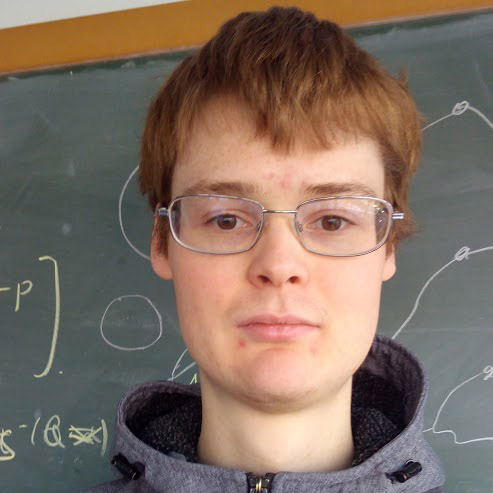
Ewain Gwynne is a Professor of Mathematics at the University of Chicago, affiliated with the Committee on Computational and Applied Mathematics (CCAM) and the Statistics Department. He previously held postdoctoral positions at the University of Cambridge and earned his Ph.D. from MIT in 2018 under Scott Sheffield. His research focuses on probability theory, particularly random geometric structures in statistical mechanics, including Schramm-Loewner evolution (SLE), Liouville quantum gravity (LQG), and random planar maps. Education: Ph.D. in Mathematics, MIT (2018); M.Sc., MIT (2015); B.Sc., Northwestern University (2013). Research Interests: Random geometric objects in statistical mechanics Liouville quantum gravity and its metric properties Random planar maps and their scaling limits SLE and its relationship with LQG Random walks on random planar maps Percolation and permutons His recent articles explore topics such as supercritical LQG, Gaussian curvature on random maps, and harmonic balls in LQG. He has advised multiple Ph.D. students and serves as an associate editor for Probability and Mathematical Physics . His work bridges probability theory, geometry, and mathematical physics, with applications to understanding critical phenomena in random systems.
David Croydon is an Associate Professor at the Research Institute for Mathematical Sciences (RIMS), Kyoto University. His research focuses on probability theory, particularly diffusions on random fractals and scaling limits of random walks on random graphs. He also investigates discrete integrable systems with random initial conditions. Dr. Croydon's primary research interests span several areas of probability theory and mathematical physics. His work centers on diffusions on random fractals and how these processes can be constructed as scaling limits of related random walks on random graphs. He has made significant contributions to understanding random walks on critical structures including Galton-Watson trees, uniform spanning trees, and percolation clusters. More recently, he has developed a growing interest in the behavior of discrete integrable systems such as the box-ball system, particularly when started from random initial conditions. His research often bridges theoretical probability with applications in statistical physics and mathematical physics. Dr. Croydon's recent publications demonstrate a dual focus on theoretical probability and mathematical physics. His work on random walks spans various structures including binary trees, critical percolation clusters, and uniform spanning trees. He has made significant contributions to understanding aging phenomena, heat kernel fluctuations, and scaling limits in random media. Simultaneously, his research on discrete integrable systems explores the connections between probability theory and soliton theory, particularly through the lens of the box-ball system and related models. These two research strands converge in his investigations of scaling limits and invariant measures for complex stochastic systems. Dr. Croydon's scientific contributions have been recognized through publications in top-tier journals across probability theory and mathematical physics, though specific awards are not mentioned in the available information. Dr. Croydon has supervised several doctoral students to completion, including Adam Bowditch (2017), George Andriopoulos (2019), Eleanor Archer (2020), and Takumu Ooi (2024). He has also served in advisory roles for other students including John Sylvester (2017). His collaborative research spans multiple international institutions, suggesting involvement in various research grants supporting his work in probability theory and mathematical physics. While specific lab names aren't mentioned, Dr. Croydon is part of the vibrant probability theory research group at the Research Institute for Mathematical Sciences (RIMS) at Kyoto University. His extensive collaborations with researchers worldwide, particularly in the UK, France, and Japan, indicate active participation in international research networks focused on stochastic processes, random media, and discrete integrable systems.
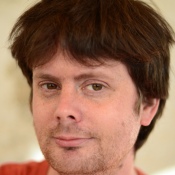
Alan Hammond is a Professor in the Department of Statistics at the University of California, Berkeley. His research focuses on rigorous mathematical probability techniques applied to problems in statistical mechanics, including percolation theory, polymer models, and random growth processes. He has contributed to understanding critical phenomena, phase transitions, and universality classes in stochastic systems. Hammond's work spans topics such as KPZ universality, Brownian motion, and the geometry of random media. He has investigated models like last passage percolation, self-avoiding walks, and tug-of-war games, often uncovering deep connections between stochastic processes and nonlinear PDEs. His teaching includes courses on stochastic processes and statistical theory at both graduate and undergraduate levels. Notable research highlights include studies on fractal properties of Airy processes, stability in dynamical last passage percolation, and the behavior of geodesics in random environments. His contributions bridge probability theory with applications in physics and combinatorics.
Steven Zucker is the David & Lucile Packard Professor of Biomedical Engineering & Computer Science at Yale University, with additional appointments in Applied & Computational Mathematics. His work bridges computational vision, neurophysiology, and differential geometry to model human visual perception and cortical computation. Research Interests : Zucker's research focuses on computational vision , leveraging differential geometry to develop theories for curve detection, shading analysis, stereo vision, and 3D shape description. He also explores interdisciplinary applications in plant biology through auxin dynamics and political science via diffusion geometry. Article Trends : Recent publications emphasize 3D shape estimation from shading and texture flows curvature-driven neural computation models applications in plant venation and heart myofibril geometry psychophysical studies of color and orientation flows Scientific Contributions : Recognized as a Packard Professor, Zucker has pioneered Hamilton-Jacobi skeletons and curve indicator random fields . His work spans computer vision, neuroscience, and mathematical modeling.
Scott Armstrong is a Professor of Mathematics at the Courant Institute of Mathematical Sciences, New York University. His research focuses on partial differential equations, calculus of variations, and probability theory, with a specialization in stochastic homogenization of PDEs in random media and related statistical mechanical systems. He holds a Ph.D. from UC Berkeley (2009) and a B.S. from Texas A&M University (2002). Education: Ph.D. in Mathematics, University of California, Berkeley, USA (2009) B.S. in Mathematics, Texas A&M University, USA (2002) Research Interests: Scott's work addresses fundamental questions in homogenization theory, including quantitative estimates for elliptic and parabolic equations in random media, renormalization group methods, and applications to statistical mechanics. His contributions bridge analysis, probability, and mathematical physics, with a focus on rigorous mathematical frameworks for understanding macroscopic behavior from microscopic models. Publications: His recent work includes studies on anomalous diffusion, renormalization group techniques, and quantitative homogenization in high-contrast media. Over 50 peer-reviewed articles highlight his expertise in stochastic PDEs, elliptic regularity, and variational methods. Awards: No specific awards listed in the provided text. Advising & Grants: No student advisees or grant details explicitly mentioned in the text. Labs/Teams: No dedicated labs or collaborative teams explicitly noted, though his research likely involves interdisciplinary collaborations within the Courant Institute.
Gregory F. Lawler is the George Wells Beadle Distinguished Service Professor in the Department of Mathematics at the University of Chicago. He also maintains appointments in the Department of Statistics and has affiliations with Computational and Applied Mathematics and Financial Mathematics programs. His academic background includes: B.A. (1976) from the University of Virginia Ph.D. (1979) from Princeton University under Edward Nelson Professor Lawler is a leading researcher in probability theory with a focus on conformally invariant processes , particularly the Schramm-Loewner Evolution (SLE) and various forms of random walks. His work bridges pure mathematics and statistical physics, establishing rigorous connections between discrete models and their continuous scaling limits. He has made fundamental contributions to understanding loop-erased random walks, Brownian motion, and the geometric properties of random curves, with applications in statistical mechanics for understanding two-dimensional critical phenomena. Analysis of his recent publications reveals a sustained focus on the mathematical foundations of SLE, with particular attention to natural parametrization, loop measures, convergence questions, and the relationship between discrete models and their continuous limits. His work consistently combines complex analysis with probabilistic methods to establish rigorous results about random curves. Professor Lawler is actively involved in mentoring through the University of Chicago's REU program and has developed extensive educational materials for students at all levels. His notes on probability theory and stochastic calculus are widely used resources within the mathematics community. He has authored several influential books including "Random Walk and the Heat Equation," "Conformally Invariant Processes in the Plane," and "Random Walk: A Modern Introduction" (with Vlada Limic), which have become standard references in probability theory.
William Newman is a Professor in the Department of Earth, Planetary, and Space Sciences at the University of California, Los Angeles (UCLA), currently on sabbatical at the Institute for Advanced Study in Princeton. His primary academic home resides within UCLA's geoscience and planetary science division. His educational credentials include: B.Sc. (Hon.) in Physics from the University of Alberta, Canada (1971) M.Sc. in Physics from the University of Alberta, Canada (1972) M.S. in Astronomy and Space Science from Cornell University (1975) Ph.D. in Astronomy and Space Science from Cornell University (1979) Professor Newman applies theoretical physics and applied mathematics to solve critical real-world problems across multiple disciplines. His research spans statistical techniques for climate change assessment, earthquake hazard modeling, solar system evolution (including collision risks from trans-Jovian bodies), astrophysical jet dynamics, and pattern emergence in complex systems. This interdisciplinary work bridges geophysics, planetary science, and astrophysics through rigorous mathematical frameworks. His publication record (2024-2016) reveals three dominant research thrusts: (1) Semiconductor electron emission physics (GaAs nanotips, photoemission sources), (2) Solar system dynamics and celestial mechanics (N-body simulations, impact hazards), and (3) Complex systems analysis (earthquake patterns, statistical record-breaking events). These intersect physics, earth sciences, and computational mathematics through shared methodologies in statistical modeling and nonlinear dynamics. At UCLA, Newman developed innovative courses including a natural disasters undergraduate GE course (satisfying diversity requirements) and graduate-level planetary atmospheres and continuum mechanics curricula. His academic contributions include over 100 refereed papers and graduate textbooks published by Princeton and Cambridge University Presses, focusing on mathematical methods for geophysics and space physics.
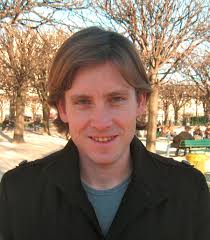
Vincent Vargas is a French mathematician and Associate Professor at the University of Geneva, where he joined in 2021 after holding a research position at CNRS. He completed his PhD in mathematics at Paris-Diderot University under the supervision of Francis Comets. His primary research interests include: Probability Mathematical Physics Statistical Mechanics Quantum Field Theory Gaussian Multiplicative Chaos Liouville Quantum Gravity Vargas has made significant contributions to the rigorous probabilistic construction of Liouville field theory and the proof of the DOZZ formula, work that was featured in Quanta Magazine. His research bridges mathematics and theoretical physics through probabilistic methods applied to quantum gravity. Analysis of his recent publications reveals a strong focus on mathematical structures underlying conformal field theory, with particular attention to Liouville quantum gravity across various geometries and the connections between probability and quantum physics. His notable scientific achievements have been recognized with prestigious awards: Marc Yor Prize (2019) George Pólya Prize (2022) Vincent Vargas has mentored several PhD students including Romain Allez, Yichao Huang, Guillaume Rémy, and Tunan Zhu. He has been actively involved in the academic community through organizing conferences and workshops, including a trimester at the Institut Henri Poincaré in 2015 and a conference on 'Probability and quantum field theory' in 2019. His professional activities extend to industry applications through his previous consultancy with Capital Fund Management (2007-2013) and his current role on the board of their research foundation.
Professor Tomasz Kapitaniak is a distinguished academic in the field of nonlinear dynamics and theoretical mechanics. He serves as a Professor of Theoretical and Applied Mechanics and Head of the Division of Dynamics at the Faculty of Mechanical Engineering, Technical University of Lodz, Poland. His career spans over three decades at the university, where he has made significant contributions to the understanding of nonlinear systems, chaos theory, and mechanical oscillations. Professor Kapitaniak holds advanced degrees in both mechanics and applied mathematics from the Technical University of Lodz and the University of Lodz. His educational background includes: M.Sc. in mechanics, Faculty of Mechanical Engineering, Technical University of Lodz (1982) M.Sc. in applied mathematics, Faculty of Mathematics, Physics and Chemistry, University of Lodz (1985) Ph.D. in mechanics, Faculty of Mechanical Engineering, Technical University of Lodz (1985) D.Sc. in mechanics, Faculty of Mechanical Engineering, Technical University of Lodz (1988) Professor of technical science, title given by the President of Poland (1995) His research focuses on nonlinear dynamics, with particular emphasis on mechanical oscillations, stability, bifurcations and chaos, stochastic dynamics, and applications of nonlinear dynamics in mechanical engineering. Professor Kapitaniak is renowned for his work on the development of methods for controlling chaos without feedback, identification of new types of bifurcations, synchronization mechanisms in coupled mechanical oscillators, and explaining the origin of randomness in mechanical systems. His research has evolved from fundamental theoretical work to increasingly applied studies involving complex networks, biological systems, and engineering applications. Professor Kapitaniak has published over 300 scientific papers in renowned journals, cited over 8,000 times. His work exhibits a consistent focus on understanding complex nonlinear phenomena across various physical systems. The trend in his recent publications shows continued exploration of synchronization phenomena, extreme events in dynamical systems, and applications of nonlinear dynamics to biological, mechanical, and physical systems. His most recent work demonstrates a growing interest in multistability, chimera states, and the prediction of tipping phenomena in complex systems. Among his notable scientific achievements and distinctions are: Election as a member of the Polish Academy of Sciences (corresponding member in 2013, ordinary member in 2019) Election to Academia Europaea in 2021 Honorary doctorates from Saratov State University (Russia, 2001) and Lublin University of Technology (Poland, 2014) Multiple prestigious fellowships including the British Council Fellowship (1989), King Abdul Aziz Award Fellowship (1990), and Fulbright Fellowship (1997) Editorial roles including Associate editor of Chaos, Solitons and Fractals since 1990 and member of editorial boards of several other prestigious journals Throughout his career, Professor Kapitaniak has been actively involved in mentoring the next generation of researchers, having supervised numerous PhD students including Jerzy Wojewoda, Anton van Wyk, Barbara Błażejczyk-Okolewska, Andrzej Stefański, Andrzej Kozłowski, and Przemysław Szumiński. He has secured significant research funding from various national and international sources including the Ministry of Science and Higher Education (Poland), Deutscher Akademischer Austauschdienst, The Royal Society of London, and others. His research team has maintained strong international collaborations with institutions worldwide, including universities in the United States, United Kingdom, Germany, Brazil, Russia, and Ukraine. He leads the Division of Dynamics at the Technical University of Lodz, which serves as a hub for research in nonlinear dynamics, mechanical oscillations, and related fields. The division maintains strong international collaborations with institutions worldwide and continues to produce cutting-edge research in the field of nonlinear dynamics and its applications.
Roland Ketzmerick is a Professor of Computational Physics at Technische Universität Dresden since 2002, with a Max Planck Fellow position at the Max Planck Institute for the Physics of Complex Systems (2010–2020). He was spokesperson for the DFG Forschergruppe FOR760 on Scattering Systems with Complex Dynamics (2010–2013). His research focuses on quantum chaos in mixed systems, power-law trapping in Hamiltonian systems, Floquet systems , Hamiltonian ratchets , mesoscopic physics , fractal spectra , and Bloch electrons in magnetic fields . His work bridges classical and quantum dynamics, exploring tunneling, wavefunction statistics, and nonequilibrium phenomena. His publications demonstrate a strong emphasis on chaotic resonance states , dynamical tunneling , multifractal analysis , and quantum transport in complex systems. Recent articles (2022–2025) address dielectric cavities, ultracold atom entanglement, and 4D Hamiltonian structures. Scientific Awards : Otto-Klung-Prize (1999)
Shuangping Li is an Assistant Professor in the Department of Statistics and Data Science at Yale University. She was previously a Stein Fellow in the Department of Statistics at Stanford University (2022–2025). Her research lies at the intersection of probability theory, high-dimensional statistics, theoretical machine learning, and the theory of algorithms. Ph.D. in Applied and Computational Mathematics, Princeton University (2022) B.Sc. in Mathematics, University of Hong Kong Her research interests include probability theory , high-dimensional statistics , theoretical machine learning , and theory of algorithms . She investigates foundational aspects of random constraint satisfaction problems, neural networks, spectral methods, and phase transitions in high-dimensional models. Her work often draws from statistical physics and combinatorics to explain algorithmic behavior. The recent articles highlight a strong focus on binary perceptrons , clustering in network models , and algorithmic phase transitions . Keywords across publications include probability, theoretical computer science, machine learning, and statistical inference. Subfields reveal deep engagement with spin glass theory, discrepancy minimization, spectral embedding, and information-computation gaps. Scientific awards include: Stein Fellow, Department of Statistics, Stanford University (2022–2025) She has advised and taught at both Stanford and Yale, including courses such as Advanced Probability , Theory of Probability , and Stochastic Processes . She has organized seminars at Stanford and has delivered invited talks at institutions including Cornell, Duke, UC Berkeley, and Princeton. Her collaborative research involves prominent scholars such as Allan Sly, Emmanuel Abbe, and Tselil Schramm. There is no mention of external grants, but her postdoctoral fellowship suggests research funding support. She is involved in academic service through organizing the Stanford Statistics and Probability Seminars. She maintains an active research presence with publications in top venues like STOC, FOCS, COLT, ICLR, and journals such as Annals of Probability and Annals of Statistics .
Professor Yonathan Shapir is a full Professor in the Department of Physics at the University of Michigan, with a joint appointment in Chemical Engineering. Since his arrival in 1985, he has advanced from Assistant Professor to full Professor, pursuing theoretical condensed-matter physics and statistical mechanics. Education: B.Sc. in Physics, Tel-Aviv University (1971) Ph.D. in Physics, Tel-Aviv University (1981) Research Interests: Professor Shapir’s work centers on understanding complex disordered systems through statistical mechanics. His investigations encompass critical phenomena in spin-glasses and random-field systems, classical and quantum transport in dirty metals leading to the metal-insulator transition, polymer statistics, fractal properties of percolation clusters, and kinetic models of surface growth and aggregation. These themes are unified by a deep interest in scaling laws, universality, and the emergent geometry of random media. Publication Trends: Between 2001 and 2010, his articles reveal a concentrated effort on diffusion in dynamically disordered environments, scaling behavior of growing surfaces, and the morphology of organic thin films such as pentacene. Earlier work (1996–2000) explored critical dynamics of dendrimers, surface growth on disordered substrates, and transitions in crystalline roughness. The breadth spans from fundamental statistical-physics questions to applications in materials science and organic electronics. Scientific Awards: Fulbright Award (1981) Bourse Joliot-Curie (1982) Visiting Compton Fellowship at the Technion (1989–1990) Advising & Grants: No explicit lists of students or current funding are provided in the material; however, his extensive publication record with numerous co-authors suggests active mentoring and collaboration. Future directions likely continue along the interface of statistical mechanics and nanoscale materials. Labs & Teams: While no specific laboratory names are given, Professor Shapir’s joint appointment implies active participation in both the Physics Department and the Chemical Engineering program, fostering interdisciplinary teams working on materials growth, transport phenomena, and computational statistical physics.
Prof. Wojciech Sobieski is a faculty member at the Department of Mechanics and Fundamentals of Machine Design within the Faculty of Technical Sciences at the University of Warmia and Mazury in Olsztyn . His research focuses on fluid mechanics, numerical modeling, and porous media analysis, with applications in environmental engineering, hydraulic systems, and 3D printing. Academic Rank: Professor Scientific Discipline: Mechanical Engineering Key Research Areas: Tortuosity Analysis, Multiphase Flow, DEM Simulations His recent publications highlight advancements in computational methods for granular porous media, fluid flow modeling, and thermodynamic applications. Notable trends include the use of the Waterfall Algorithm for geometric analysis and sensitivity studies of numerical models like the Eulerian multiphase approach. He has contributed to understanding Forchheimer's laws and cavitation phenomena in hydraulic systems. Prof. Sobieski oversees the PathFinder Project , a research initiative focused on numerical modeling of porous media. His laboratory maintains infrastructure for multiphase flow simulations and particle-scale modeling. He has supervised 2 doctoral students to completion but currently has no active advisees.
Sebastian Andres is Professor of Stochastics at TU Braunschweig's Institute of Mathematical Stochastics. His research focuses on random processes in disordered media, including homogenization of random walks, percolation theory, and heat kernel analysis. He holds a habilitation from University of Bonn and previously held positions at University of Cambridge and University of Manchester. Research Themes: Quantitative homogenization, invariance principles for degenerate random walks, and applications to mathematical physics. Teaching: Current courses include Probability Theory and Discrete Financial Mathematics; authored lecture notes on Martingale Theory for Finance.
Professor Tony Roberts is the Head of School in the School of Mathematical Sciences at Queensland University of Technology (QUT). He holds a PhD from the Australian National University and is a Fellow of the Australian Mathematics Society. His research focuses on the interplay between material microstructure and macroscopic properties, with emphasis on topology optimization, random structure modeling (e.g., Gaussian fields, percolation models), and material property analysis such as conductivity, diffusion, and fluid flow. He develops computational methods for analyzing experimental techniques like 3D statistical reconstruction and small-angle scattering. His recent work includes optimizing piezoelectric materials for robotics, studying diffusion dynamics in fractal networks, and modeling material failure mechanisms. Key contributions span multi-functional piezoelectric components, anisotropic elastic properties of additively manufactured alloys, and fracture mechanics in perforated materials. Awards include his fellowship in the Australian Mathematics Society. Supervision interests include structural optimization, diffusion in random media, and porous material failure modeling. Education: PhD (Australian National University) Affiliations: Faculty of Science, School of Mathematical Sciences Research Themes: Material science, computational modeling, fracture mechanics, stochastic systems