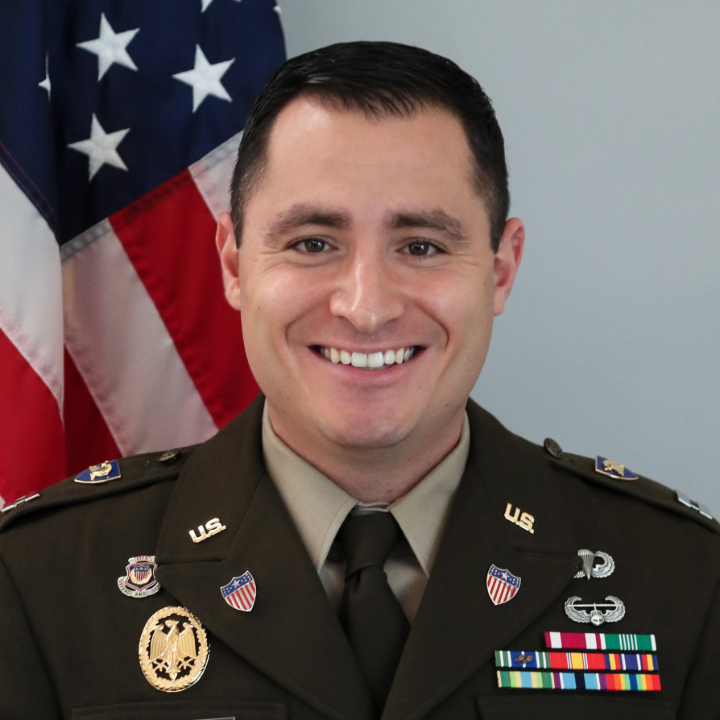
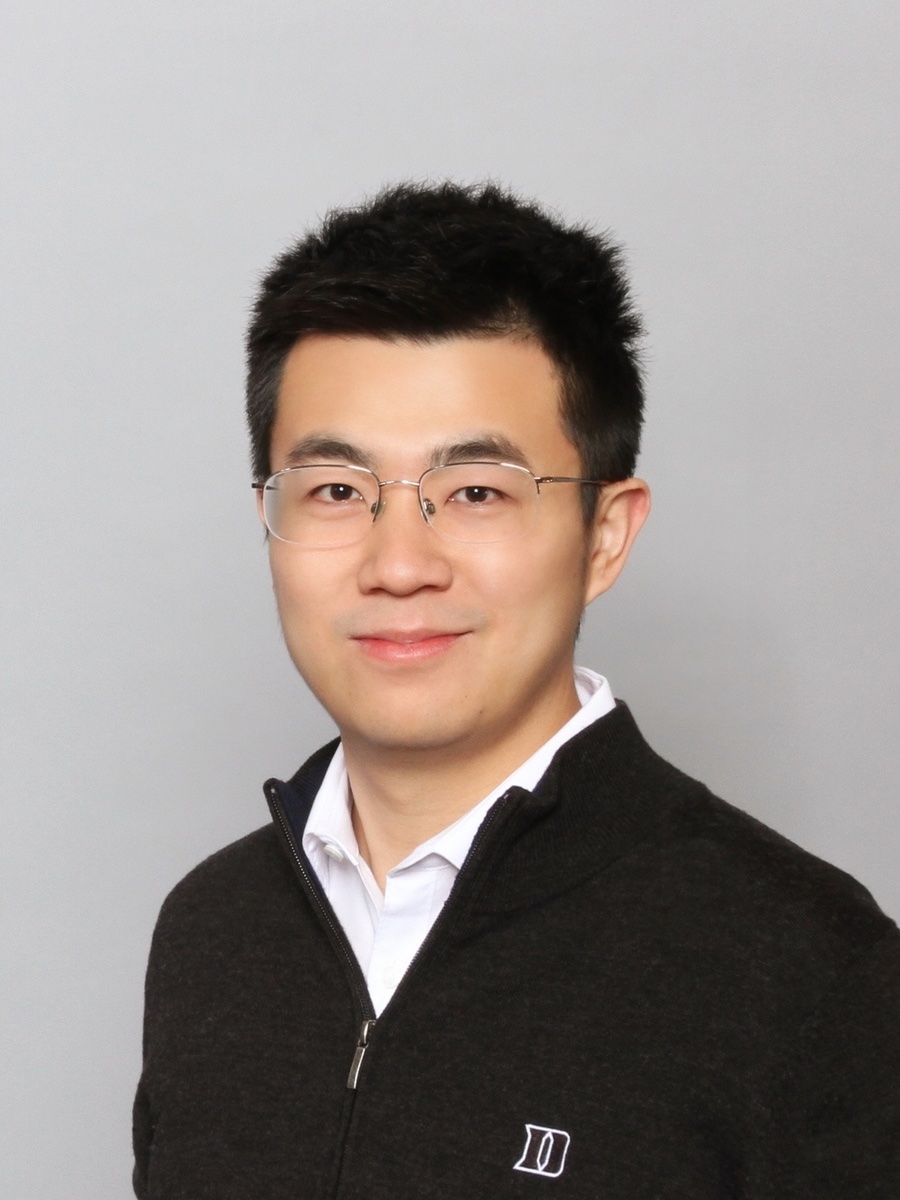
David A. Glinbizzi is a Lecturer in the Department of Law and Philosophy at the United States Military Academy (USMA), where he teaches courses in ethical reasoning and political philosophy. He also serves as a department academic counselor, honor representative, and Officer in Charge of the West Point Speech and Parliamentary Debate Team. Military Career: Began as enlisted infantryman (2011), commissioned as Artillery Officer (2015), held leadership roles in 10th Mountain Division, and transitioned to Adjutant General Corps (2019). Academic Roles: Teaching Assistant at University of Pennsylvania (2021), Graduate Associate at Perry World House (2022), and led Academic Individual Advanced Development (AIAD) internship (2024) focused on AI ethics. His research centers on just war theory , artificial intelligence ethics , and political philosophy , with practical applications in military and technological domains. Courses taught include: PHIL 1433 (TA): The Social Contract PY201: Philosophy and Ethical Reasoning PY189X (Course XO): Independent Study in Philosophy (AI Ethics) Recent work integrated institutions such as the Office of the Undersecretary of Defense for Policy (OUSD-P), DARPA, and the Army's AI Integration Center (AI2C) to provide cadets with interdisciplinary exposure to emerging technology ethics.
Prof. Dr.-Ing. Ahmad Osman is a Professor at the Saarland University of Applied Sciences (htw saar), specializing in Test Technologies and Test Methods within the Faculty of Engineering. He also holds an Adjunct Professor position at Laval University in Quebec, Canada, in the Department of Electrical Engineering and Computer Science. His research focuses on Artificial Intelligence applications in Signal and Image Processing for Non-destructive Testing (NDT) , with extensive work on Deep Learning , 3D Ultrasound Tomography , and Sensor Data Fusion in industrial contexts. Engineering Artificial Intelligence Signal Processing Image Processing Non-destructive Testing Quality Control Augmented Reality Osman leads the AutomaTiQ research group and serves as Head of the Algorithms/Signal and Data Processing Department at Fraunhofer IZFP . His recent publications (2017–2022) emphasize Deep Learning for defect detection in CFRP , Terahertz Imaging for artwork diagnostics, and Acoustic Sensors for agricultural quality control. He has organized international conferences on Structural Health Monitoring and contributed to Springer books on NDT technologies. His projects include ComforTex-AI (2024) and development of 3D positioners for ultrasound measurements. Collaborations span institutions in Germany, Canada, Italy, and Brazil, with advisory roles in the German Society for NDT and technical committees for conferences in Montreal and Egypt.
Dr. Catrin Lundström is an Assistant Professor of Ethnicity and Migration at the Department of Migration, Ethnicity and Society (REMESO) within the Department of Culture and Society (IKOS) at Linköping University's Faculty of Philosophy. Her research focuses on the intersection of migration, whiteness, and gender, examining how Swedish women experience transnational migration and return migration processes. Dr. Lundström received her PhD in Sociology from Uppsala University in 2007 and became an Associate Professor (Docent) in Sociology there in 2011. Her academic journey includes teaching and research positions at multiple Swedish institutions including Uppsala University, Stockholm University, Mälardalen University, Södertörn University, Umeå University, and Linköping University. She has also been a visiting researcher at the University of Arizona and the University of California. Dr. Lundström's research centers on whiteness as both a place-bound and transnational construction. She challenges conventional migration studies by focusing on privileged Swedish women migrants, developing the concept of 'white capital' to understand how whiteness functions as transferable cultural capital across national borders. Her work examines how racial privilege, gender, and class intersect in migration experiences, particularly among women who migrate for lifestyle, companionship, or professional reasons. Her recent publications demonstrate an expanding focus on the relationship between race, whiteness, and educational systems in Sweden, as well as critical examinations of contemporary political debates through the lens of critical race theory. Lundström's work increasingly addresses how colorblind discourse operates in Swedish society while simultaneously exploring the politics of national identity in a globalized world. Dr. Lundström has led significant research projects including: 'White Migrations: Gender, Whiteness and Privilege in Transnational Migration' (2014) 'Tre faser av hegemonisk vithet' (Three Phases of Hegemonic Whiteness) with Tobias Hübinette 'Att återintegrera svenskheten' (Reintegrating Swedishness) on returning Swedish migrant women, funded by the Swedish Research Council Her research has been supported by organizations including the Sweden-America Foundation and the Swedish Research Council. Dr. Lundström is actively involved in several academic networks: IMISCOE Standing Committee on Gender, Migration and Transnational Lives White Spaces Network at Leeds University Lifestyle Migration Hub, an international network of researchers studying lifestyle migration She regularly lectures within and outside academia, both in Sweden and internationally, and has received significant media attention for her research on school segregation, colorblind language, and gender equality in migration contexts.
Sapha Barkati, MD, MSc is an Assistant Professor at the Department of Medicine, Faculty of Medicine and Health Sciences, McGill University , and an Investigator at the RI-MUHC Glen site . Her work bridges clinical practice and research in tropical medicine, focusing on parasitic diseases affecting vulnerable populations. Affiliations: Assistant Professor, McGill University Investigator, Research Institute of the McGill University Health Centre (RI-MUHC) McGill International Tuberculosis Centre Research Focus: Specializes in neglected tropical diseases like strongyloidiasis and tegumentary leishmaniasis, particularly among migrants and immunocompromised individuals. Studies include: Physician awareness of Strongyloides screening Prevalence patterns in non-endemic countries HTLV-1 co-infection treatment response Cost-effective screening strategies Scientific Contributions: Key publications address tropical disease management in non-endemic settings, mpox outbreak dynamics, and SARS-CoV-2 immunity patterns. Her work emphasizes evidence-based guidelines for: Parasite screening in transplant recipients Leishmaniasis treatment protocols Traveler disease prevention Collaborative Networks: Partners with institutions like Universidad Peruana Cayetano Heredia and participates in GeoSentinel surveillance. Leads studies on: Covid-19 health disparities Vaccine effectiveness against variants Remote patient monitoring systems
Julius L. Chen, PhD is an Assistant Professor in the Department of Health Policy and Management at Columbia University's Mailman School of Public Health. His research employs empirical microeconomics to evaluate innovative health care delivery and financing strategies, with a focus on value-based care and provider payment models implemented by Medicare, Medicaid, and employers. Dr. Chen's educational background includes: BA in Economics with highest honors from the University of California, Berkeley (2010) MS and PhD in Applied Economics and Managerial Science from The Wharton School, University of Pennsylvania (2013, 2016) EdM in Education Leadership, Organizations, and Entrepreneurship from Harvard University (2025) His research spans Healthcare Policy , Health Economics , and Value-Based Care , with specific interests in chronic disease management, provider payment systems, and biostatistical methods. He investigates how payment and delivery innovations impact patient health and economic outcomes, particularly for vulnerable populations and in Medicare/Medicaid contexts. Analysis of his publications reveals consistent focus on health disparities, chronic condition management, and structural factors in primary care. His work frequently examines Medicare beneficiaries using observational designs to assess real-world policy impacts, with recent studies addressing racial disparities, nurse practitioner workforce issues, and pandemic-related utilization changes. Dr. Chen has received notable recognition including: Calderone Health Equity Award (2021) Calderone Award for Junior Faculty Development (2021) Columbia Public Health Innovation Fund Award (2020) He teaches graduate courses in health care finance, provider payment systems, and organizational behavior. As Faculty Lead for the Mailman School Admissions Committee and affiliate of the Center for Healthcare Delivery Research and Innovations and Columbia Population Research Center, he actively contributes to institutional initiatives while maintaining professional memberships in the American Economic Association and American Public Health Association.
Hedvig Kjellström is a Professor at the Division of Robotics, Perception and Learning within the School of Electrical Engineering and Computer Science at KTH Royal Institute of Technology. She holds significant affiliations with the Swedish e-Science Research Centre and the Max Planck Institute for Intelligent Systems in Germany. Her work spans multiple interdisciplinary domains and she serves as Editor-in-Chief for CVIU and was Program Chair for CVPR 2025. Her research centers on Computer Vision as a sub-field of AI, with three interconnected themes: Computational Aesthetics (exploring aesthetic aspects of human communicative behavior), Communicative Behavior (developing models of how humans and animals perceive and produce non-verbal communication), and Embodied Artificial Intelligence (creating methodologies for robots and autonomous agents to perceive the world through sensors, primarily vision). Her work has significant applications in medical diagnostics, animal welfare, human-robot interaction, and creative arts. Analysis of her recent publications reveals a strong trend toward multimodal AI systems that integrate vision, language, and action understanding. Her research increasingly focuses on animal-centered applications, particularly equine pain detection and behavior analysis, while maintaining strong foundations in human communication modeling, gesture recognition, and 3D reconstruction techniques. The interdisciplinary nature of her work bridges computer science with veterinary medicine, neuroscience, and performing arts. Hedvig Kjellström actively supervises numerous PhD and Master's students across various projects and maintains extensive collaborations with institutions including Karolinska Institutet, Swedish University of Agricultural Sciences, and international partners. Her research is supported by major funding bodies including WASP, VR, and SeRC. She leads or participates in several notable projects including OrchestrAI (communication between conductor and orchestra), ANITA (Animal Translator), MARTHA (3D horse motion analysis), and STING (synthesis and analysis with transducers and invertible neural generators). Her work with ACAI (Animal Centered Artificial Intelligence), which she co-founded and directs, demonstrates her commitment to applying AI for animal welfare.
Vibhu Sahni, Ph.D., is an Assistant Professor of Neuroscience and Lab Director of the Laboratory for Cell Fate Specification and Circuit Development at the Burke Neurological Institute, an affiliate of Weill Cornell Medicine. His research focuses on understanding molecular mechanisms underlying corticospinal circuit development and regeneration, particularly after injuries like spinal cord injury or stroke. His work integrates developmental neuroscience principles to identify strategies for repairing neural circuits involved in motor control. Research interests include axon guidance, segment-specific neural circuit formation, and the molecular basis of neural regeneration decline during development. Key projects investigate how genes like Cbln1 direct axon targeting to thoraco-lumbar regions and why long-distance regenerative ability varies across spinal segments. Recent publications highlight discoveries in segmental axon targeting specificity and the dynamic loss of regenerative capacity in corticospinal neurons. His lab employs advanced techniques such as single-cell RNA sequencing, in vivo electroporation, and microsurgical lesion models to study these processes. Current grants include funding from the Craig H. Neilsen Foundation and Wings for Life Spinal Cord Research Foundation to advance molecular strategies for corticospinal circuit repair.
Federica De Stefano is an Associate Professor of Organisation Studies at Saïd Business School, University of Oxford, and a Research Fellow of Green Templeton College. She serves on editorial boards for Organization Science , Human Resource Management , and Human Resource Management Review , while holding roles in the Strategic Management Society (SMS). Previously, she was an Assistant Professor at HEC Paris and a Post-Doctoral Fellow at Wharton People Analytics. She earned a PhD from Bocconi University, with additional degrees from Fudan University and Bocconi. Her research focuses on people management's impact on organizational and individual outcomes, including employee mobility, workplace safety, and social sustainability. Using quantitative methods and large datasets, her work has been published in top journals like Academy of Management Journal and Strategic Management Journal . She has received the Marie Curie Individual Fellowship and recognition as a top 40-under-40 MBA professor. Teaching focuses on people analytics and management, with a 2023 completion of the International Teachers Program (ITP). Her research grants and collaborative work at Wharton People Analytics underscore her commitment to advancing strategic human capital practices. Federica's work bridges academic rigor with real-world organizational challenges, emphasizing ethical and sustainable workforce strategies.
Jennifer Keys serves as Senior Director of the Searle Center for Advancing Learning and Teaching at Northwestern University, where she holds a courtesy appointment as Teaching Professor in the Department of Sociology. She joined the university in 2021, focusing on strategic priorities such as reflective pedagogy, student-centered course design, and curricular assessment to enhance learning outcomes and instructor vitality. Keys earned her doctorate in sociology from the University at Albany—State University of New York. Previously, she served as Assistant Provost of Teaching and Learning and inaugural Director of the Center for the Advancement of Faculty Excellence at North Central College. Her research interests emphasize educational development as a career pathway, faculty engagement in high-impact practices, and college transition dynamics. Her recent publications explore midlevel administrators' roles in reducing emotional labor, the impact of learning centers on faculty capacity, and course design's role in faculty renewal. Keys actively participates in university committees, including co-chairing the Assessment and Accreditation Council, leading the STEM Education Advisory Board, and steering the Generative AI initiatives at Northwestern.
Prof. Dr. Dennis Herhausen is a Full Professor of Marketing and Head of the Marketing Department at Vrije Universiteit Amsterdam’s School of Business and Economics. Previously, he held positions as Associate Professor at KEDGE Business School, Visiting Professor at the University of St. Gallen, and Assistant Professor at the University of St. Gallen. His research focuses on digital communication, customer journeys, multichannel management, and social media strategies, with publications in top-tier journals like the Journal of Marketing and Journal of Marketing Research. His work addresses critical issues such as online firestorm mitigation, complaint de-escalation, and gig economy communication. He has been awarded multiple prestigious prizes, including the 2021 CBSIG Consumer Research Award and the 2019 William R. Davidson Award. Education: PhD in Marketing from University of St. Gallen (2011) Teaching: Courses on Customer Experience Management, Survey Research Methods, and Thesis Guidance Research Interests: His work explores digital marketing strategies, customer-centric innovations, and the dynamics of online platforms. Recent studies address topics like business-to-investor marketing signals, privacy orientation measurement, and machine learning biases in marketing. He actively contributes to editorial boards of journals including Journal of Marketing and Journal of Interactive Marketing. Awards: 2021 CBSIG Consumer Research in Practice Award 2021 Retail & Pricing SIG Best Paper Award 2021 SERVSIG Best Services Article Award 2020 William R. Davidson Award Grants & Editorial Work: His research has been funded by national/international grants, and he serves on multiple editorial boards. Notable datasets include studies on online retailer strategies and virtual brand sabotage responses.
Stephen Bach is an Assistant Professor in the Computer Science Department at Brown University, where he leads the BATS (Bach's Awesome Team of Students) research group. His research focuses on improving how humans teach computers through programmatic weak supervision and methods for learning from fewer examples like zero-shot and few-shot learning. His primary research interests include weak supervision, data programming, probabilistic soft logic (PSL), statistical relational learning (SRL), information extraction, zero-shot learning, and few-shot learning. Bach's work often focuses on exploiting high-level, symbolic or semantically meaningful domain knowledge, with applications in information extraction, image understanding, scientific discovery, and data science. Bach's recent publications show a strong focus on language models, weak supervision techniques, and multimodal learning, particularly examining the capabilities and limitations of models like CLIP. His research has increasingly emphasized practical applications in low-resource settings and cross-lingual scenarios. Best Paper Award at NeurIPS Workshop on Socially Responsible Language Modelling Research (SoLaR) 2023 Larry S. Davis Doctoral Dissertation Award Selected for oral presentation at ICLR 2024 Best of VLDB 2018 paper selection Bach advises numerous Ph.D., Master's, and undergraduate students, many of whom have gone on to positions at leading tech companies, research institutions, and graduate programs. His research group has developed several influential frameworks including Snorkel (for weak supervision), PSL (Probabilistic Soft Logic), T0 (for zero-shot task generalization), ZSL-KG (for zero-shot learning with knowledge graphs), TAGLETS (for semi-supervised learning with auxiliary data), and WISER (for programmatic weak supervision in sequence tagging).
Zhengjie Miao is an Assistant Professor in the School of Computing Science at Simon Fraser University (SFU). His research focuses on data management and artificial intelligence, particularly developing algorithms and tools to enhance data science pipelines. He is part of the SFU Data Science Research Group and previously worked as a Research Scientist at Megagon Labs. Education: PhD in Computer Science from Duke University (advisors: Sudeepa Roy, Jun Yang), M.S. from Columbia University (advisor: Eugene Wu), B.S. from Peking University. Research interests span data management systems, machine learning integration in data science, and human-in-the-loop data preparation. His work emphasizes improving data usability through techniques like data lineage tracking, explainable query systems, and fairness-aware data processing. Recent publications highlight advancements in collaborative annotation with LLMs, automated data standardization, and contrastive learning frameworks for column annotation. Key contributions include the Rotom framework for meta-learned data augmentation, the Watchog system for column annotation, and CAPE for query explanation. His research bridges database theory with practical applications in education and industry.
Aishwarya Ganesan is an Assistant Professor at the Siebel School of Computing and Data Science, University of Illinois Urbana-Champaign. Her research focuses on distributed systems, storage systems, and fault tolerance mechanisms, with emphasis on high-performance computing and datacenter infrastructure. She leads projects addressing challenges in replicated storage, consensus protocols, and system resilience. Her work explores fault tolerance in disaggregated datacenters, log abstractions for low-latency applications, and novel replication strategies for modern storage systems. She has developed frameworks like LazyLog and IONIA to improve system efficiency and reliability. Her research also extends to automatic reliability testing for cluster management controllers and analyzing distributed storage vulnerabilities. Key contributions include demonstrating how redundancy alone does not guarantee fault tolerance, and proposing consistency-aware durability mechanisms for storage systems. She received the NSF CAREER Award in 2024 for her research on storage-aware fault tolerance. Her work spans 21 peer-reviewed publications, with notable contributions in conferences like SOSP, EuroSys, and FAST. Current projects investigate fault tolerance in emerging memory technologies and system recovery protocols for consensus-based storage.
Susanne Iwarsson is a Professor in Gerontology and Care for Older People at Lund University's Faculty of Medicine, holding the Mary and Seved Ribbing Professorship since 2005. She also serves as Director of the Centre for Ageing and Supportive Environments (CASE) and Coordinator of the Swedish National Graduate School for Competitive Science on Ageing and Health (SWEAH). Her academic journey includes a PhD in Medical Science (1997) and promotions to Associate Professor (1999) and Professor (2003). She has held leadership roles such as Pro-dean of the Faculty of Medicine (2006-2011) and Coordinator of the strategic research area MultiPark (2012-2014). Her research focuses on environmental gerontology, housing accessibility, and proactive ageing strategies. Key contributions include the Housing Enabler assessment tool and studies on ageing populations' participation in society. She has supervised 18 PhD students and 6 licentiates, with ongoing supervision of 4 current PhD candidates. Major projects include the Home, Health and Disability longitudinal study (2002-present) and the UserAge program exploring user participation in ageing research. Awards include the Excellent Teaching Practitioner title (2010) and Doctor Honoris Causa. Her work addresses UN Sustainable Development Goals related to health, sustainable cities, and reduced inequalities. Collaborations span universities in Sweden, Finland, Latvia, and the U.S., with partnerships in healthcare and municipal sectors.
Christian Kowalkowski is Assistant Professor of Marketing at Hanken School of Economics, affiliated with the Centre for Relationship Marketing and Service Management (CERS) in Helsinki. He obtained his PhD in 2008 from Linköping University and holds adjunct professorships in Industrial Marketing and Service Management. His research focuses on service infusion in product firms, relationship dynamics in B2B contexts, service innovation frameworks, solutions marketing strategies, and value-creation methodologies. His work bridges theoretical concepts with practical business applications. Kowalkowski's publications primarily explore the evolution of service-oriented business models, technological impacts on service operations, and pricing strategy development. His research demonstrates consistent focus on service ecosystem development and organizational transformation. Awards recognizing his scholarly contributions include: The Service Industries Journal Best Paper Award (2014) Emerald Citations of Excellence (2015) Literati Network Award for Excellence (2012) Månadens forskare (Researcher of the Month, 2011) He serves in editorial roles for multiple journals including Journal of Services Marketing and Industrial Marketing Management , and participates in PhD supervision and examination committees.