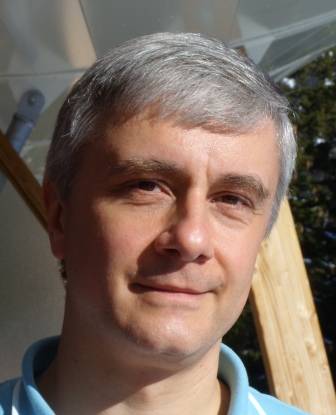
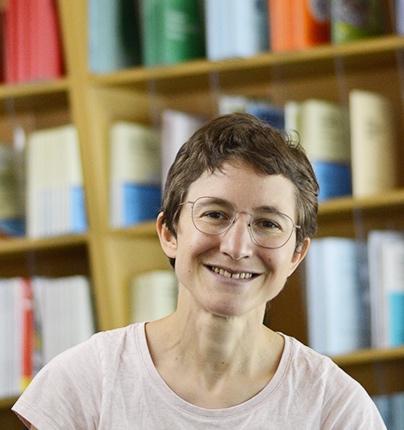
Anush Tserunyan is a Professor of Mathematics at McGill University, Canada, and a Visiting Professor at the Unit of Pure and Applied Mathematics (UMPA) at École normale supérieure de Lyon from December 1, 2024, to January 31, 2025. She holds a bachelor's and master's in computer science and applied mathematics from Yerevan State University (2005–2007) and a Ph.D. in Mathematics from UCLA (2013), focusing on finite generators for group actions, equivalence relations, and recursive program complexity. Research Interests: Anush Tserunyan specializes in Ergodic Theory , Combinatorics , and Group Actions , with notable contributions to graph theory, hypergraphs, and Ramsey theory. Her work bridges combinatorial structures with analytic methods, particularly in dynamical systems and descriptive set theory. Collaborations: During her visit to UMPA, she collaborates with teams in Geometry, Groups and Dynamics , and Number Theory , alongside researchers like Benjamin Schraen and Sophie Morel. Her stay includes seminars on GGD, Number Theory, and the 'Actions!' working group. Publications: Her research spans topics like ergodic theorems, disjoint matchings in graphs, and algebraic hypergraphs, reflecting a focus on foundational mathematical structures and their applications.
Sylvain Lombardy is a Professor at the University of Bordeaux, affiliated with the Laboratoire Bordelais de Recherche en Informatique (LaBRI) and the Enseirb-Matmeca engineering school within the Institut Polytechnique de Bordeaux. His research focuses on automata theory, formal languages, and theoretical computer science, particularly in weighted automata, formal methods, and algebraic properties of automata. He leads the Formal Methods research team at LaBRI and contributes to projects like the Awali and Vaucanson software platforms for automata manipulation. Education: PhD in Computer Science (2001, ENST Paris), Habilitation à Diriger des Recherches (2005, University of Paris Diderot). His work bridges theoretical foundations with practical tools, emphasizing algorithmic and algebraic aspects of automata. Notable contributions include studies on automata minimization, determinization, and the interplay between rational expressions and automata constructions. Research Interests: Automata Theory, Formal Power Series, Weighted Automata, Tropical Semirings, Algebraic Automata Theory, and Computational Models for Discrete Systems. His recent work explores two-way automata, Hadamard series, and applications in formal verification. Publications highlight contributions to the structure and properties of automata, with a focus on formal methods and algorithmic decidability. Key works address unambiguity, determinism, and the minimization of weighted automata across various semirings. Collaborations include projects on automata-based kernels for machine learning and XML formats for automata descriptions. He has developed influential software tools such as Awali (finite-state machine platform) and Vaucanson (automata manipulation framework), demonstrating practical applications of theoretical research. His work is supported by grants exploring automata in computational linguistics and discrete mathematics.
Eric Breton is a Professor of Health Promotion at the French School of Public Health (EHESP) in Rennes, where he conducts research at the Arènes laboratory (UMR CNRS 6051) and the Research on Health Services and Management team (RSMS: INSERM U1309). Holding a Doctorate in Public Health, he brings extensive international research experience from Canada, Australia, and the UAE to his work on health promotion systems and social determinants of health. His educational background includes a Master of Arts and Doctorate in Public Health, with professional development through the Santé publique France Chair (2010-2018) and co-authorship of the seminal reference manual Health Promotion: Understanding to Act in the French-speaking World (Presses de l'EHESP, 2017). Dr. Breton's research focuses on strengthening local health promotion capacities to address upstream social determinants of health inequalities, with expertise in realist evaluation methods and policy analysis. His work examines community health systems, tobacco control advocacy, sugary drink taxation impacts (SODA-TAX project), and intergenerational addiction prevention (PATTERN project), emphasizing intersectoral action and health equity. His recent publications reveal dominant trends in community-based health promotion evaluation, Health in All Policies implementation, and local health contract mechanisms for reducing social inequalities. Key themes include realist program evaluation frameworks, health equity impact assessment methodologies, and contextual factors influencing policy transfer in public health. PATTERN 2 project (2022-2023, €64k): Prevention of intergenerational transmission of addictive behavior through "A Family Affair!" program PATTERN project (2020-2021, €98k): Intervention research on addictive behavior transmission SODA-TAX project (2019-2023, €164k): Analysis of France's sugary drink tax implementation and effects CLoterreS project (2017-2020, €200k): Local health contracts as mechanisms for territorializing regional prevention policies National Cancer Institute projects (2017, €29k; 2012-2016, €400k): Reducing social inequalities in cancer prevention As Educational Manager of EHESP's Population Health Promotion Certificate and coordinator of multiple Master of Public Health modules (including "Health promotion and disease prevention program planning"), Dr. Breton shapes public health education internationally. He contributes to national health governance through the High Council for Public Health (HCSP), serves on the Supervisory Board of Brittany's Regional Health Agency, and was Associate Editor for Health Education & Behavior (2018-2021). His research operates within the Arènes laboratory (CNRS) and RSMS team (INSERM), focusing on health services organization and policy implementation. He co-organizes the annual Global Community Health Workshop with UNESCO's Chair in Health & Education, fostering international collaboration on community-based health promotion strategies.
Slim Essid is a Full Professor at Télécom Paris, leading the Audio Data Analysis and Signal Processing (ADASP) group. He holds a Doctorat (Ph.D.) and Habilitation from Université Pierre et Marie Curie (UPMC). With 15+ years of research experience, he has advised 15 PhD graduates and currently co-advises 10 others. His work focuses on machine learning, signal processing, and multimodal systems, publishing over 150 peer-reviewed papers. He serves as a reviewer for top journals/conferences (e.g., IEEE Transactions) and research funding agencies. Education: State Engineering Degree, École Nationale d’Ingénieurs de Tunis (2001) M.Sc. (D.E.A.) in Digital Communication Systems, École Nationale Supérieure des Télécommunications, Paris (2002) Ph.D., Université Pierre et Marie Curie (2005) Habilitation (HDR), UPMC (2015) Research Interests: Multimodal learning, self-supervised representations, audio-visual segmentation, music structure analysis, domain generalization, and speech enhancement. Recent publications highlight innovations like TACO (training-free sound-prompted segmentation) and CLOUDS (domain-generalized semantic segmentation framework using foundation models). His work bridges audio processing with vision and language models, emphasizing unsupervised/zero-shot approaches. Key achievements include state-of-the-art methods in sound event detection, speaker diarization, and music segmentation. He collaborates with 14 post-docs and leads projects funded by French/EU agencies.
Luc Segoufin is a Research Professor at INRIA (French National Institute for Research in Computer Science and Automation), affiliated with the Department of Computer Science at École Normale Supérieure (ENS) in Paris. He leads the VALDA research team, focusing on theoretical computer science foundations. His research spans: Database theory: Query answering, consistency, and enumeration complexity Logic and automata: Finite model theory, automata over data structures Computational complexity: Fine-grained analysis and lower bounds Formal methods: Verification and logic-based modeling His recent publications (2022–2024) concentrate on: Dichotomy theorems for query answering under constraints Constant-delay enumeration algorithms for structured data Decidability in logic fragments over trees and graphs Connections between automata, algebra, and complexity No scientific awards are mentioned in available sources. He collaborates extensively within the VALDA team and international researchers on projects involving database theory, logic, and automata. No student advising details are provided.
Louis Duvivier is a Senior Lecturer at the University of Grenoble Alpes since October 2024, affiliated with the Science Department Drôme Ardèche. He is associated with the Coordination, Cooperation & Control of Complex Systems (CO4SYS) team within the Systems Design and Integration Laboratory (LCIS). Former ATER at École Centrale de Lyon (2023–2024) Postdoctoral Fellow at ENS Lyon (2022–2023) ATER at Institute of Financial and Insurance Science (2021–2022) His research focuses on network modeling , graph analysis , and statistical inference , particularly in stochastic block models , community detection , and temporal graph analysis . His recent work explores probabilistic validation techniques and geometric interpretations of network structures. Publications demonstrate expertise in Bayesian inference , model selection , and sensor network estimation . Earlier contributions to distributed estimation and link prediction date back to 2019. He teaches courses in complementary computing , algorithms , numerical analysis , and statistics at both bachelor's and master's levels.
Thomas Conrad is a Lecturer in the Department of Literatures and Language at the École Normale Supérieure (ENS) in Paris, where he has been teaching since 2015. He is affiliated with several research entities including La République des savoirs: Lettres, Sciences, Philosophie and the Centre de Recherches sur les Relations entre Littérature, Philosophie et Morale. As a former student of the ENS himself, Conrad brings deep institutional knowledge to his academic work. Conrad holds an agrégé in modern literature and a doctorate in French literature. His scholarly focus centers on the poetics of novel cycles (sequels, series, trilogies), with particular emphasis on 19th and 20th century French literature from Balzac and Dumas to contemporary authors. His research spans theoretical frameworks including narrative structure, literary sociology, and the representation of time and space in fiction. Analysis of Conrad's extensive publication record reveals a consistent scholarly trajectory focused on Balzac studies, with significant contributions to understanding novel cycles, narrative structure, and 19th century French literary production. His work demonstrates expertise in both theoretical literary analysis and close reading of canonical texts, with particular attention to how narrative form reflects social and historical contexts. Conrad's scholarship shows remarkable continuity in exploring how literary cycles function as complex narrative systems that reflect broader cultural patterns. While specific scientific awards are not documented in the available information, Conrad's substantial publication record in prestigious journals and with respected academic presses demonstrates significant scholarly recognition. His work appears regularly in specialized Balzac and 19th century literature journals, as well as in broader literary theory publications. Though specific details about student supervision are not provided in the available documentation, Conrad's position as a lecturer at ENS suggests involvement in graduate education and potentially doctoral supervision. His extensive research output and specialized knowledge in 19th century French literature would position him as a valuable mentor for students working in this field. Conrad is actively involved with several research collectives, most notably La République des savoirs: Lettres, Sciences, Philosophie, which serves as an intellectual hub for interdisciplinary work connecting literature, philosophy, and moral studies. His participation in this collective and the Centre de Recherches sur les Relations entre Littérature, Philosophie et Morale suggests engagement with broader theoretical questions that extend beyond strictly literary analysis.
Nicolas PRAT is an Associate Professor at ESSEC Business School specializing in Information Systems, Data Analytics and Operations. He serves as Head of the Information Systems Track at the Cergy campus and has been with ESSEC since 1995, progressing from Lecturer to his current position as Associate Professor since 2006. His academic credentials include: Accreditation to supervise research (Université Paris Dauphine-PSL, 2012) PhD in Information Systems (Université Paris Dauphine-PSL, 1999) Specialized Master in Information Systems (ESSEC Business School, 1991) MSc in Management (ESSEC Business School, 1990) International Teachers Programme (Stockholm School of Economics, 2004) PRAT's research focuses on conceptual modeling, design science research, business intelligence, and knowledge management with increasing attention to emerging technologies like AI and blockchain. His work bridges theoretical foundations with practical applications, examining how data and knowledge engineering can support organizational decision-making processes. He has made significant contributions to understanding the evolution of conceptual modeling and taxonomy development for complex technologies. His recent publications demonstrate a clear research trajectory toward exploring generative AI's impact on business intelligence, sustainability frameworks for design science research, and advanced methods for taxonomy development in complex emerging technologies. These works reflect his ongoing engagement with cutting-edge developments while maintaining strong theoretical foundations in information systems research. Scientific recognition includes: Qualification to the function of full Professor in the French University system (Computer Science, 2013) PRAT has supervised doctoral research, including Demigha S. at Université Paris 1 Panthéon-Sorbonne in 2005. His academic leadership includes serving as Academic Director for specialized programs and Head of the Information Systems Track. He actively contributes to the scholarly community through editorial board memberships for "Systèmes d'Information et management" (since 2022) and "Journal of Database Management" (since 2013).
Inka Wissner is a Lecturer in the DEFLET department at the University of Franche-Comté, France, affiliated with the research pole on Didactics and Education. Her work is centered in the CLA (Centre de Langues et d'Apprentissages) and she holds a CNU section 7° affiliation. She is actively involved in research and academic service, leading pedagogical initiatives and contributing to international scholarly discourse in variational linguistics and lexicography. Her research interests are deeply interdisciplinary, focusing on variational linguistics , sociolinguistics , lexicography , and literary discourse analysis . She investigates diatopic (regional) variation in French across the Francophone world, from the Vendée in France to Quebec, the Caribbean, and the Indian and Pacific Oceans. Her work combines corpus linguistics , fieldwork methodology , and statistical analysis to study prepositional adverbials, regional vocabulary (e.g., viticulture), and the representation of regionalisms in literature. She is a key contributor to projects on the historical development of Romance languages, particularly the 'Third Way' of prepositional adverbials. The trends in her recent publications reveal a sustained and evolving focus on methodological rigor in linguistic field research, especially for understudied phenomena in Romance languages. Her work bridges historical linguistics, descriptive grammar, and sociocultural analysis, with a strong emphasis on data collection, statistical processing of small samples, and the development of standardized tools for pan-Romance studies. Her research consistently addresses the pragmatic and sociolinguistic functions of language variation. Expert reviewer for journals such as Studia linguistica romanica , Corela , and Expanding Romance Linguistics . Member and organizer of scientific committees for international colloquia on linguistic policies, linguistic innovations, and complexity in multilingual contexts. Dr. Wissner has held significant pedagogical responsibilities, serving as the Program Director for the undergraduate program since 2020 and the Pedagogical Director for the first year of the Master's program since 2019. Her research is supported by her expertise in field methodology and data analysis, contributing to major collaborative projects like 'The Second Way' and 'La Troisième Voie'. She has not received any scientific awards listed in the provided text. She is a member of the ELLIADD research team and the 'Contexte, Langages Didactiques' research pole at the University of Franche-Comté. She also collaborates internationally, notably with the University of Graz, Austria, on projects concerning prepositional adverbials in Romance languages.
Radu Mateescu is a Research Director at Inria Grenoble - Rhône-Alpes where he heads the CONVECS research team. He has been with Inria since 1998, previously working as a researcher in the VASY project-team. His research focuses on formal methods, particularly model checking and verification of concurrent systems. Mateescu holds a PhD in Computer Science from INPG (Institut National Polytechnique de Grenoble) with a thesis on "Verification of the temporal properties of parallel programs". His educational background includes a graduate engineer diploma from the POLITEHNICA University of Bucharest in Automatic Control and Computers. He has been instrumental in developing several formal verification tools including XTL, CAESAR_SOLVE, EVALUATOR, and BISIMULATOR. His research interests span formal specification and verification of temporal properties of concurrent systems, temporal logics extended with data-handling primitives, on-the-fly model checking, equivalence checking, diagnostic generation, partial order reduction, and massively parallel verification. He served as chairman of the FMICS (Formal Methods for Industrial Critical Systems) Working Group of ERCIM from 2011 to 2014. Mateescu has published extensively in formal methods, with recent work focusing on applications in autonomous vehicles, IoT systems, and hardware verification. His publications show a consistent trend toward applying formal verification techniques to increasingly complex real-world systems, particularly in safety-critical domains. Test-of-Time Tool Award at ETAPS'2023 Inria - Académie des Sciences - Dassault Systèmes Innovation Prize Information Technology Award from Fondation Rhône-Alpes Futur Mateescu has taught courses at ENSIMAG (Grenoble), ESIREM (Dijon), and the University of Savoie. He has contributed to major research projects involving industrial applications of formal methods, particularly through the CADP toolbox which has been used to verify numerous critical systems including the IEEE-1394 FireWire protocol, Bull's cluster file system, and autonomous vehicle systems. His work bridges theoretical formal methods with practical industrial applications.
Irène Marcovici is a Professor at the University of Rouen Normandy, affiliated with the Raphaël Salem Mathematics Laboratory (LMRS) and leading the Probability and Dynamic Systems Team. Her research spans probability theory, cellular automata, stochastic processes, and combinatorics, with a focus on ergodicity, percolation, and self-organization phenomena. She collaborates with institutions like the GDR Fundamental Computer Science and its Mathematics and has contributed to journals such as Probability Theory and Related Fields, Annales Henri Lebesgue, and Theoretical Computer Science. Education: Habilitation à Diriger des Recherches (2021, University of Lorraine), PhD in Mathematics (2013, University of Paris Diderot) Research Focus: Marcovici's work explores probabilistic cellular automata, percolation models, and their applications in physics, computer science, and mathematics. Key projects include analyzing stability regions in queueing systems, developing decentralized diagnostics, and studying self-descriptive sequences. Her articles highlight interdisciplinary connections between discrete mathematics and stochastic dynamics. Notable Collaborations: She has co-authored publications with researchers like Jérôme Casse, Régine Marchand, Nazim Fatès, and Mathieu Sablik. Her team participates in the ALEA and SDA2 working groups under GDR Fundamental Computer Science and its Mathematics.
Marcilio Pereira de Souto is a full professor at the University of Orléans , leading the Fundamental Computer Science Laboratory (LIFO) . His research focuses on machine learning, cluster analysis, and bioinformatics, with a strong emphasis on data complexity and hybrid intelligent systems. He has previously held positions at institutions including the Max Planck Institute of Molecular Genetics and the Federal University of Rio Grande do Norte (UFRN). Education: B.Sc. in Computer Science (UFRN, 1991), M.Sc. in Computer Science (UFPE, 1995), Ph.D. in Electrical Engineering (Imperial College London, 1999) Research Interests Marcilio's work spans machine learning (supervised, unsupervised, and ensemble methods), cluster analysis (multi-objective, constrained, and fuzzy clustering), data complexity (measuring classification difficulty, imbalanced datasets), and bioinformatics (gene expression analysis, cancer data clustering). He also explores hybrid intelligent systems combining multiple techniques for improved performance. Publication Trends His publications (h-index 18) emphasize clustering algorithms, data complexity metrics, and hybrid approaches applied to bioinformatics and computational biology. Recent work focuses on explainable AI for image captioning, while earlier contributions analyze missing data imputation strategies and meta-learning for algorithm selection. Labs & Teams Currently leads research at LIFO , a fundamental computer science laboratory at the University of Orléans. Previously contributed to the Department of Informatics and Applied Mathematics (DIMAp) at UFRN and the Department of Computational Biology at the Max Planck Institute.
François Jacquenet is a Professor of Computer Science at the University of Saint-Etienne, where he is a member of the Machine Learning Team at the Hubert-Curien Laboratory. His research focuses on machine learning and data mining applications for natural language processing, with significant contributions to privacy-preserving systems including Hippocratic Multi-Agent Systems and Automata-Based Sequence Mining. His research interests span Machine Learning , Data Mining , Natural Language Processing , and Privacy-Preserving Systems . Jacquenet has led multiple research projects including the PASCAL II Network of Excellence (2008-2012), the Bingo2 project (2008-2010), and the Web Intelligence project (2006-2008), where he focused on ethical web design and privacy protection techniques. His work bridges theoretical foundations with practical applications in areas like fraud detection, meeting summarization, and video tag correction. Analysis of his recent publications reveals a consistent research trajectory in deep learning applications , privacy-preserving techniques , and cross-modal learning . His work shows a progression from foundational research in grammatical inference and automata theory to contemporary applications in neural networks and self-organizing systems. The publications demonstrate strong interdisciplinary connections between computer science, physics, and security applications. Best AI Paper Award at Conference (2006) Professor Jacquenet has supervised numerous PhD students including Maria Galvan, Hoang-Tung Tran, Ludivine Crépin, and Stéphanie Jacquemont. His research has been supported by significant grants including the French Research Agency (ANR), the Rhône-Alpes region, and international networks like PASCAL. He has organized multiple conferences including Privacy on the Web at the ACM Symposium on Applied Computing and the PASCAL Workshop on Teaching Machine Learning. He is actively involved with the Machine Learning Team at Hubert-Curien Laboratory , contributing to the PASCAL Network of Excellence and the REWERSE Network. His research group focuses on developing practical applications of machine learning while addressing fundamental theoretical questions in pattern mining and language learning.
Julie Bourbeillon is a Lecturer in Computer Science at Institut Agro Rennes-Angers , where she co-directs the Department of Statistics and Computer Science. Her work bridges Bioinformatics , Computer Vision , and Data Integration with applications in Plant Biology and Horticulture . She has developed educational frameworks for integrating digital skills into horticultural training using the PiX framework . Education : PhD in Computer Science (2007, Université Grenoble 1), Master of Science and Engineering for Health and Medicine (2004), Engineer (2002, INAPG) Her research focuses on semantic distance , heterogeneous data integration , and data visualization for biological datasets. She leads the DIVIS project for handling complex phenotypic data and co-developed ELVIS and QuaDS software tools. Key projects include: DIGITOM (2024-2027): Digital twins for climate-resilient agriculture ERICA (2025-2026): Robotic climate mapping in greenhouses GRIOTE (2014-2018): Bioinformatics collaboration
Floris van Doorn is a Professor at the University of Bonn's mathematical institute, where he leads the Formalized Mathematics workgroup. His research focuses on making it viable to formalize research mathematics in proof assistants that can check the correctness of such proofs. His main research interests include: Formalized Mathematics Proof Assistants (particularly the Lean Theorem Prover) Homotopy Type Theory Automated Theorem Proving Mathematical Logic Formal Verification Van Doorn's recent publications demonstrate significant trends in formalizing advanced mathematical concepts. His work consistently bridges foundational theoretical development with substantial applications across mathematical disciplines. Notably, he has led formalizations of deep results like Carleson's theorem in analysis, the sphere eversion theorem in topology, and the independence of the continuum hypothesis in set theory. These projects reveal an evolution from foundational work on type theory toward increasingly sophisticated formalizations of mainstream mathematical research, demonstrating that proof assistants can handle complex geometric and topological reasoning beyond purely algebraic domains. His notable recognition includes: Skolem award (2025) for "The Lean Theorem Prover (System Description)" As an educator and mentor, van Doorn has supervised multiple researchers who have joined his formalization group in Bonn, including Maria, Michael, and Arend as of October 2024. He has developed significant educational resources for the community, including the Natural Number Game and the book "Mathematics in Lean." His leadership in developing and maintaining the mathlib library has been instrumental in establishing Lean as a leading platform for formalized mathematics. Van Doorn leads the Formalized Mathematics group at the University of Bonn, which focuses on ambitious collaborative projects. Recent initiatives include the Carleson project (formalizing Carleson's theorem), the Polynomial Freiman-Ruzsa Conjecture formalization completed in November 2023, and the sphere eversion project that formalized Gromov's h-principle. These projects involve large-scale international collaborations and demonstrate how formal verification can contribute to mathematical understanding while pushing the boundaries of what's possible with proof assistants.