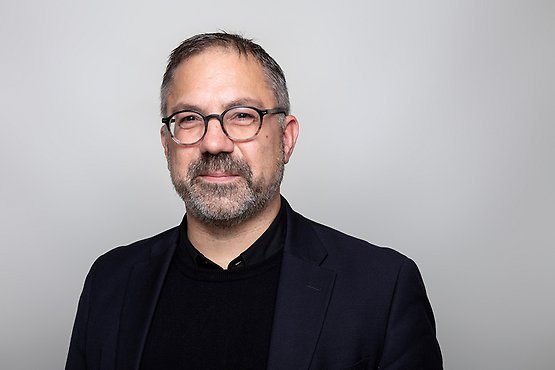
Rodrigo Caballero Augi is Professor of Dynamic Meteorology at Stockholm University's Department of Meteorology (MISU), where he leads research on atmospheric dynamics and climate systems. His work spans from planetary-scale waves to cloud droplet motion, examining how these processes shape past, present, and future climates. He maintains strong affiliations with the Bolin Center for Climate Research and the Swedish e-Science Research Centre. Caballero received his Laurea in Physics (1994) and PhD in Physics (1998) from La Sapienza University in Rome, Italy, under the guidance of Alfonso Sutera. His academic journey continued with postdoctoral positions at the University of Copenhagen and University of Chicago, followed by faculty roles at University College Dublin before joining Stockholm University in 2011. His research focuses on understanding atmospheric dynamics in the context of climate change, with particular emphasis on Arctic climate where warming occurs at more than twice the global average rate. His group investigates circulation systems that co-evolve with ice sheets, mountain ranges, and carbon redistributions between climate system compartments. Using a combination of simple models, general circulation models, observational data analysis, and statistical modeling, his team explores how atmospheric dynamics influences energy and material exchanges across the climate system. Recent publications reveal a strong focus on Arctic climate processes, particularly moist intrusions, cloud feedbacks, and polar amplification mechanisms. His work spans multiple disciplines including atmospheric physics, climate dynamics, and polar meteorology, with significant contributions to understanding storm tracks, cloud albedo asymmetries, and energy transport mechanisms in changing climates. Caballero has mentored numerous PhD students and postdocs who have gone on to successful careers at institutions worldwide, including University of Arizona, Uppsala University, Chalmers University of Technology, and UQAM in Montreal. His research group continues to investigate critical climate questions through projects like Arctic Climate Across Scales, North Atlantic Deep-Water formation, and storm track-cloud feedback relationships.