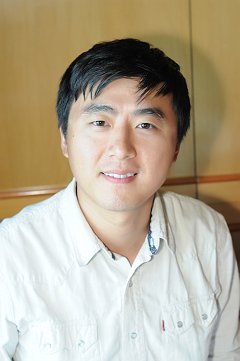
Dave Andersen is an Associate Professor at the School of Computer Science, Carnegie Mellon University , with research focusing on memory and power-efficient computing, robust distributed systems, and networked environments. He also serves as CTO of Enriched Ag . Education: Ph.D. and M.S. in Computer Science from MIT (2001, 2004), B.S. in Computer Science and Biology from the University of Utah (1995). Research Trends: Explores systems design in the post-Moore's Law era, emphasizing concurrency, low-latency geo-replicated storage, and RDMA in datacenters. Key projects include MemC3, Eiger, Cuckoo Filter, and FAWN. Teaching: Courses in Advanced OS, Distributed Systems, Low-Power Computing, and Network Security. Professional Service: Program committee roles at SOSP, NSDI, SIGCOMM, and DARPA ISAT advisory group. Personal: Active in running, climbing, and outdoor activities with detailed route guides for Pittsburgh and Boston.
Rodrigo Fonseca is an Associate Professor with Tenure in the Computer Science Department at Brown University's School of Engineering. He received his PhD from UC Berkeley in 2008 under Ion Stoica, focusing on execution tracing for distributed systems. His educational background includes a PhD in Computer Science from UC Berkeley (2008). Fonseca's research focuses on distributed systems, networking, and operating systems, with particular interest in understanding complex system behavior. His work spans distributed tracing and debugging (X-Trace, Pivot Tracing), network management in datacenters (2DFQ, Planck), power management in mobile systems (Quanto, Application Modes), and software-defined networking (Participatory Networking, Simon). His research integrates theoretical insights with practical implementations that have influenced both academic and industrial systems. His publication record shows a strong focus on distributed system instrumentation, with recurring themes of causal tracing, resource management, and network monitoring. The most recent publications demonstrate continued innovation in data-aware indexing structures, in-network packet analysis, and context propagation techniques for distributed systems. Fonseca has received significant recognition including an NSDI Test of Time Award for X-Trace, an NSF CAREER Award, and a Best Paper Award at SOSP for Pivot Tracing. His work has been consistently published in top-tier venues including SIGCOMM, NSDI, SOSP, and OSDI. He has mentored numerous graduate students, with five PhD graduates as of 2019 who have gone on to positions at Google, Microsoft, Apple, and MPI-SWS. His research has been supported by funding from the National Science Foundation, Google, Intel, and Microsoft Research, where he also spent visiting periods. He is actively involved in the research community, having served on program committees for major conferences and co-organizing workshops including HotCloud and the New England Networking and Systems Day. In 2019-2020, he served as PC co-chair for HotNets and General Chair for SoCC'2020.
David Andersen is a Professor in the Computer Science Department at Carnegie Mellon University, with research spanning systems, databases, distributed systems, networking, and security. He holds a Ph.D. and M.S. from MIT, and B.S. degrees in Computer Science and Biology from the University of Utah. Education: Ph.D./M.S., MIT (Computer Science); B.S., University of Utah (Computer Science, Biology). His research focuses on networked systems , emphasizing robustness , energy efficiency , and scalable architectures . Key projects include FAWN (low-power clusters), XIA (secure internet architecture), and MemC3 (memory-optimized hashing). Recent publications highlight trends in machine learning integration , storage innovations , and datacenter networking . Professional activities include leadership roles in conferences like OSDI, SOSP, and NSDI, and advisory positions in DARPA’s ISAT group. He is also founder and CTO of BrdgAI and previously co-founded a deep-learning startup and an ISP. Personal interests include running, triathlons, and rock climbing, with notable contributions like the Pi Searcher and running route guides for Pittsburgh and Boston.
Dr. Ryan Grant is an Assistant Professor in the Department of Electrical and Computer Engineering at Queen’s University, Canada. He leads the Computing at Extreme Scale Advanced Research (CAESAR) lab and is affiliated with the Ingenuity Labs Research Institute. His expertise spans cloud computing, high-performance networks, low-level hardware-software interfaces, and energy-efficient supercomputing systems. Dr. Grant holds a PhD from Queen’s University (2012) and previously worked at Sandia National Laboratories (2012–2021), where he contributed to critical supercomputer communication protocols now deployed globally. He has authored over 80 peer-reviewed articles and received prestigious awards including the R&D100 Award and Queen’s University’s 125th Engineering Alumni Award. His research emphasizes advancing Canada’s supercomputing infrastructure to support AI, climate science, and national security applications. Education: PhD in Computer Engineering, Queen’s University (2012) MSc in Computer Engineering, Queen’s University (2005) BSc in Computer Engineering, Queen’s University (2004) Research Interests: Dr. Grant’s work focuses on optimizing supercomputing architectures for extreme-scale systems, with an emphasis on: High-performance networking and MPI communication protocols Power/energy management in HPC systems AI-driven network traffic prediction and resource disaggregation GPU-accelerated computing and cloud infrastructure integration National sovereignty in supercomputing for sensitive applications (e.g., defense, healthcare) Awards & Recognition: R&D100 Award (Oscars of Research) U.S. Defense Programs Awards Public Good Innovator Award Queen’s University 125th Engineering Alumni Award Grants & Labs: Dr. Grant directs the CAESAR lab, one of the world’s leading supercomputing architecture research groups. His work is supported by grants from Canadian and international agencies, focusing on sovereign supercomputing and HPC-AI convergence. Labs/Teams: CAESAR Lab (Queen’s University) Ingenuity Labs Research Institute
Bijan Jabbari is a Professor in the Department of Electrical and Computer Engineering at George Mason University, affiliated with the Volgenau School of Engineering. He holds a PhD from Stanford University and has dual MS degrees in Electrical Engineering and Engineering Economics from Stanford, along with a BS from Arya-Mehr University. His research focuses on wireless networks, IoT, machine learning applications in networking, and cognitive networks. Notable contributions include work on LTE/5G systems, edge computing, and spectrum management. He has led projects funded by the National Science Foundation, Naval Research Laboratory, and KDDI Corporation. Jabbari is a Fellow of IEEE and IET, recipient of the IEEE Third Millennium Medal, and has pioneered initiatives like the Heart’s Delight charity event. Jabbari teaches graduate courses including ECE 528 (Random Processes), ECE 642 (Computer Network Design), and ECE 629 (Wireless Networks). He directs the Communications and Networks Laboratory and collaborates with Telecom ParisTech. His work emphasizes resilient network design, cross-layer protocols, and machine learning-driven optimization in telecommunications. Research Grants: Secure MAC Layer Protocols (NRL, 2016–2018) Cross-Layer Resilient Networking (NRL, 2012–2015) Network Virtualization (KDDI, 2010) Awards: Washington DC Engineer of the Year Award GMU Outstanding Faculty Research Award Labs/Teams: Communications and Networks Lab (CNL) at GMU Collaborations: Telecom ParisTech (France)
Hamed Rezaei is an Adjunct Professor in the Department of Computer Science at the University of Wisconsin-Milwaukee, affiliated with the College of Engineering & Mathematical Sciences. He works as a full-time researcher at Rockwell Automation, focusing on computer networks, particularly congestion control and low-latency applications. Education: PhD in Computer Science, University of Illinois at Chicago MS in Computer Science, University of Illinois at Chicago BS in Computer Science, Razi University, Iran His research interests include: Congestion Control Software Defined Networking (SDN) Network Function Virtualization (NFV) Programmable Data Planes Publications highlight expertise in datacenter networking, congestion control, and low-latency systems. Key areas include network protocols, SDN-based traffic management, and security frameworks for large-scale networks. His work spans both theoretical and applied domains, including contributions to datacenter topologies (Superways), flow scheduling (ResQueue), and DDoS detection mechanisms. Contact: rezaeih@uwm.edu
Christodoulopoulos Konstantinos is an Assistant Professor at the Department of Informatics and Telecommunications, National and Kapodistrian University of Athens. His research focuses on optical communications, networking, and machine learning applications in network optimization. He has contributed to advancements in resource allocation, quality of transmission (QoT), and cybersecurity through quantum key distribution (QKD). His work includes field demonstrations of encrypted networks, techno-economic studies in metro-core systems, and scalable industrial network solutions. Education details are not explicitly provided in the text, but his academic role suggests a Ph.D. in a related field. Key research interests span optical network design, SDN-enabled architectures, and hybrid optical-electrical data centers (e.g., NEPHELE projects). He has published extensively on topics like slotted optical datacenter networks, machine learning for QoT estimation, and marginless optical network operations. Notable contributions include experimental demonstrations of disaggregated white-box networks, real-time SDN control frameworks, and collaborative projects with institutions like the University of Patras. His work emphasizes practical implementations, such as industrial-grade PONs and fault localization in optical networks.
Conor McArdle is an Assistant Professor in the School of Electronic Engineering at Dublin City University (DCU). His research focuses on telecommunications networks, datacentre architectures, and optical switching technologies, supported by EU and SFI grants. He has co-authored over 40 publications and co-supervised four PhD students and one MEng student in topics like high-speed optical networks and packet switching protocols. His teaching includes object-oriented programming, network modeling, and algorithms. Research Interests: Optical networking for data centers Energy-efficient network design Telecommunications security Network performance analysis Recent publications emphasize agile optical data center networks, reconfigurable architectures, and hybrid buffering systems. He collaborates with industry on network management and security aspects of mobile networks. Grants & Awards: Extensive EU/SFI-funded projects on network performance and energy efficiency. No specific awards listed. Teaching: Coordinates modules in Algorithms for Engineers (EE324), Network Analysis (EE517), and Programming (EE219).
Adam Belay is an Associate Professor in the Department of Electrical Engineering and Computer Science (EECS) at MIT, affiliated with the Computer Science & Artificial Intelligence Laboratory (CSAIL). He holds the Jamieson Career Development Chair and focuses on operating systems, runtime systems, and distributed systems, with a particular emphasis on optimizing datacenter efficiency, security, and resource utilization. His work bridges theoretical systems research with practical implementations in cloud environments. Before joining MIT, Belay completed his Ph.D. at Stanford University and worked at Google on datacenter networking. His research addresses challenges such as latency reduction, resource fungibility, and carbon-aware software design. He leads the Parallel and Distributed Operating Systems (PDOS) group and contributes to the Systems Community of Research (CoR) at MIT. His recent publications highlight innovations like Quicksand (resource-efficient datacenter systems), Junction (kernel-bypass networking), and Hermit (low-latency remote memory systems). These projects emphasize real-world scalability and sustainability, reflecting his commitment to advancing both academic and industrial systems. Awarded the 2014 OSDI Best Paper for IX (a protected dataplane OS), Belay has advised numerous students and postdocs, many of whom now hold prominent roles at top universities and companies like Google, Microsoft, and UCSD. He actively serves on program committees for top systems conferences (e.g., OSDI, NSDI, SOSP) and teaches graduate-level OS seminars and undergraduate systems courses.
Dr. John Liagouris is an Assistant Professor at Boston University's Faculty of Computing and Data Sciences, appointed since July 2022. Previously, he served as an Adjunct Assistant Professor (2020–2022) and held roles at BU’s Hariri Institute for Computing, ETH Zurich’s Systems Group, UC Berkeley’s RISELab, and the University of Hong Kong. His research focuses on distributed systems, databases, and secure analytics, with a strong emphasis on privacy-preserving technologies in cloud environments. He earned a 5-year diploma in Electrical and Computer Engineering (2008) and a PhD (2015) from the National Technical University of Athens (NTUA). His academic journey includes visiting scholar positions at UC Berkeley and the University of Hong Kong, alongside research roles at the Athena Research Center in Greece. Liagouris’s research spans cryptographic cloud analytics, streaming state management, and spatial RDF data systems. His work on frameworks like Queryshield and TVA demonstrates expertise in securing distributed data processing. Recent trends in his publications emphasize multi-party computation and latency-conscious distributed systems. His contributions to fault-tolerant systems (e.g., Lineage Stash) and incremental routing logic (DeltaPath) highlight a focus on optimizing distributed workflows. Though no formal advising records are listed, his roles suggest active involvement in training researchers in distributed computing and cybersecurity. Labs and teams associated with his work include BU’s Hariri Institute and collaborations with institutions like ETH Zurich’s Systems Group, reflecting a networked approach to academic research.
Salim Abdi is a University Researcher specializing in Electrical Engineering with a focus on Photonics and Nanotechnology at Eindhoven University of Technology (TU/e). His work contributes to UN Sustainable Development Goals related to affordable and clean energy, and industry innovation. He holds a PhD from TU/e (2025), with research centered on wafer-scale 3D integration of InP-based photonic and electronic systems for advanced datacenter applications. Research Interests: Abdi’s expertise spans semiconductor photonics , materials science , and optoelectronic integration . He investigates challenges in adhesive bonding , waveguide fabrication , and thermal management for high-performance photonic-electronic systems. His recent work emphasizes low-loss optical filters , polarization-insensitive amplifiers , and waferscale distortion analysis . Publications Trends: His 2023–2025 publications focus on overcoming technical barriers in InP-Si 3D integration and high-density photonic interconnects . Key themes include optimizing thermal expansion mismatches , improving adhesive bonding precision , and developing low-cost fabrication techniques for scalable production. Grants & Labs: While specific grants are not listed, his involvement in multi-authored works suggests collaboration with industry partners. His experimental work likely leverages TU/e’s state-of-the-art cleanroom facilities for nanophotonics fabrication.
Anders Blomdell is a Professor in the Department of Control Engineering at the Faculty of Engineering, Lund University. His work bridges theoretical control systems with practical applications in real-time, embedded, and cloud-based environments. He is actively involved in research projects focusing on autonomous systems, industrial automation, and networked control. His research interests include Control Systems , Real-Time and Embedded Systems , Networked Control , Industrial Automation , Robotics , and Cloud-Controlled Systems . These areas reflect his focus on scalable, adaptive, and secure control solutions for complex, interconnected systems. The recent publications highlight a strong trend toward event-based control , large-scale optimization , autonomous adaptation , and secure cloud integration . His work often combines control theory with computer science, particularly in distributed and real-time settings, showing a consistent effort to address challenges in latency, scalability, and robustness. Scientific Awards: Advising and Grants: While specific students are not listed, Anders Blomdell leads and participates in major research initiatives such as WASP, ELLIIT, and the Nordic University Hub on Industrial Internet of Things (HI2OT). These projects involve significant funding and collaboration with industry and academia, indicating active mentorship and leadership in training next-generation researchers. Labs and Teams: He is associated with RobotLab LTH and contributes to the development of tools like TrueTime and LabComm , which are widely used in real-time and networked control research. His work supports both academic and industrial innovation in automation and intelligent systems.
Dr. Heming Cui is an Associate Professor at the Department of Computer Science, University of Hong Kong, affiliated with the School of Computing and Data Science. He joined HKU in 2015 after completing his PhD at Columbia University, following bachelor's and master's degrees from Tsinghua University. His research focuses on distributed systems, operating systems, and high-performance computing, with a strong emphasis on reliability and security. Dr. Cui leads projects in distributed AI training systems, blockchain frameworks, and secure execution environments, collaborating closely with industries like Huawei. He has received notable awards including the Croucher Innovation Award (2016), HK$5 million RGC Research Impact Fund (2023), and best paper awards at ICSE and ACSAC. His work has led to commercialized systems such as Huawei's MindSpore integration of Fold3D and TICS' UTEE component derived from his secure systems research. Dr. Cui actively recruits PhD students specializing in systems security and database systems, prioritizing candidates with strong systems-building backgrounds. Key grants include leadership in projects totaling HK$30 million, including flagship collaborations with Huawei and RGC grants targeting transaction/analytical processing in edge computing and cloud security. His research spans over 50 publications in top venues like SOSP, NSDI, and IEEE journals, emphasizing reproducibility and industrial impact.
Henry Hoffmann is Professor and Liew Family Chair of the Department of Computer Science at the University of Chicago. He serves as Chair of the department and leads research in self-aware and adaptive computing systems. His work bridges traditional computer systems areas with control theory and machine learning to create systems that automatically adapt to meet high-level goals. Hoffmann received his Ph.D. from MIT in 2013 under advisors Anant Agarwal and Srinivas Devadas, with his dissertation titled "SEEC: a framework for self-aware management of goals and constraints in computing systems." He earned an S.M. from MIT in 2003 and a B.S. with highest honors and distinction from UNC-Chapel Hill in 1999. Hoffmann's research focuses on developing self-aware computing systems that understand high-level goals and automatically adapt their behavior to meet those goals optimally. His recent work has shifted toward applying these techniques to control machine learning and AI systems, building learning systems that dynamically adapt their internal structure and resource usage to meet accuracy, energy, performance, and security goals at inference time. His interdisciplinary approach combines operating systems, computer architecture, control theory, and machine learning. Analysis of Hoffmann's recent publications reveals a clear trajectory toward increasingly sophisticated applications of self-aware computing principles. His work has evolved from foundational resource management to cutting-edge applications in AI/ML systems, quantum computing, and security. The publications demonstrate a consistent theme of using control theory and machine learning to create adaptive systems that optimize multiple competing objectives like performance, energy efficiency, and reliability. Recent papers show expanding applications into large language models, quantum algorithms, and privacy-preserving techniques. Presidential Early Career Award for Scientists and Engineers (PECASE) 2019 DOE Early Career Award 2015 Samsung Security Hall of Fame recognition IEEE Micro Top Picks Honorable Mention awards FSE Test of Time Honorable Mention ASPLOS Hall of Fame recognition Hoffmann has mentored numerous PhD and Master's students who have gone on to successful careers in academia and industry. His research has secured over $19 million in funding for the University of Chicago. He co-founded Config Dynamics in 2019 to commercialize aspects of his self-aware computing research. His work has practical applications across data centers, edge computing, AI systems, and quantum computing. Hoffmann leads the SEEC (Self-aware, Energy-Efficient Computing) research group at the University of Chicago. The group focuses on developing frameworks and techniques for building self-aware computing systems that can dynamically adapt to changing conditions and requirements. The group maintains strong collaborations with industry partners and other academic institutions, particularly in the areas of quantum computing, AI systems, and energy-efficient computing.
Harry Xu is a Professor in the Computer Science Department at the University of California, Los Angeles (UCLA), with a research focus on computer systems spanning programming languages, compilers, runtime/operating systems, distributed systems, and computer architecture. Prior to UCLA, he was an Associate Professor at UC Irvine (UCI). His current work centers on infrastructures for future cloud computing (user-defined clouds) and scalable, cost-effective AI/ML systems. Education : Ph.D. in Computer Science and Engineering from Ohio State University (2011) His research has pioneered techniques for combating software bloat, optimizing data analytics through programming language innovations, and developing systems like Yak GC, VQPy, and Niijima. He co-founded BreezeML, a startup for GenAI risk management, and has held visiting roles at Microsoft Research and IBM Watson Research Center. Recent publications include work on resource-disaggregated datacenters, cloud computing fault tolerance, and ML system scalability, presented at top venues like SOSP, OSDI, and NSDI. He has advised numerous Ph.D. and M.S. students, many of whom now hold academic or industry roles. Awards : 2018 Dahl-Nygaard Junior Prize, ACM Distinguished Scientist Harry actively contributes to academic service as a committee member and co-chair at conferences like PLDI, SPLASH, and VMCAI. He maintains the VQPy project and other open-source systems.