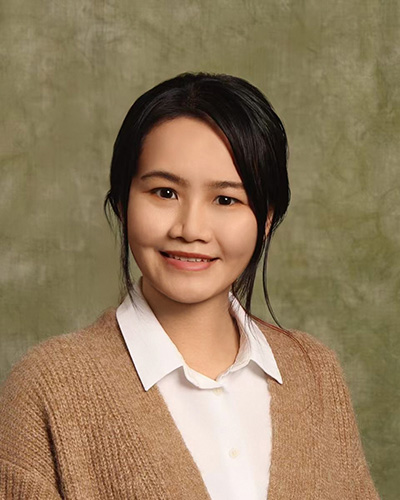
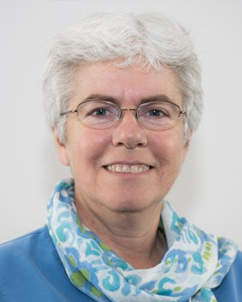
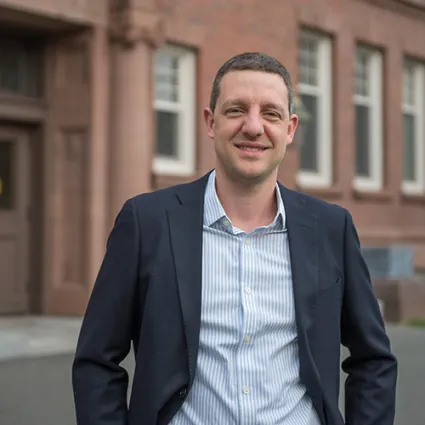
Jujun Huang is an Assistant Professor in Management Information Systems at Binghamton University's School of Management. She earned her PhD in Business Administration with a specialization in Information Systems & Analytics from Stevens Institute of Technology. Education: PhD (Stevens Institute of Technology), MS in Business Intelligence & Analytics (Stevens Institute of Technology), BBA (Shanghai University of International Business and Economics) Her research focuses on design science approaches to data science problems, utilizing techniques like natural language processing and deep learning in financial technology and social media analytics contexts. Recent work examines financial fraud detection through disclosure pattern analysis and linguistic convergence in human-chatbot relationships. Key publication trends show expertise in: Temporal analysis of financial disclosures Human-AI interaction modeling Econometric approaches to data science Text mining applications in fintech Machine learning for social media analytics Interdisciplinary design science methodologies Awarded Best Student Award at the 2021 Workshop on Information Technology and Systems, she has also taught graduate courses in business intelligence and undergraduate/masters courses in data wrangling.
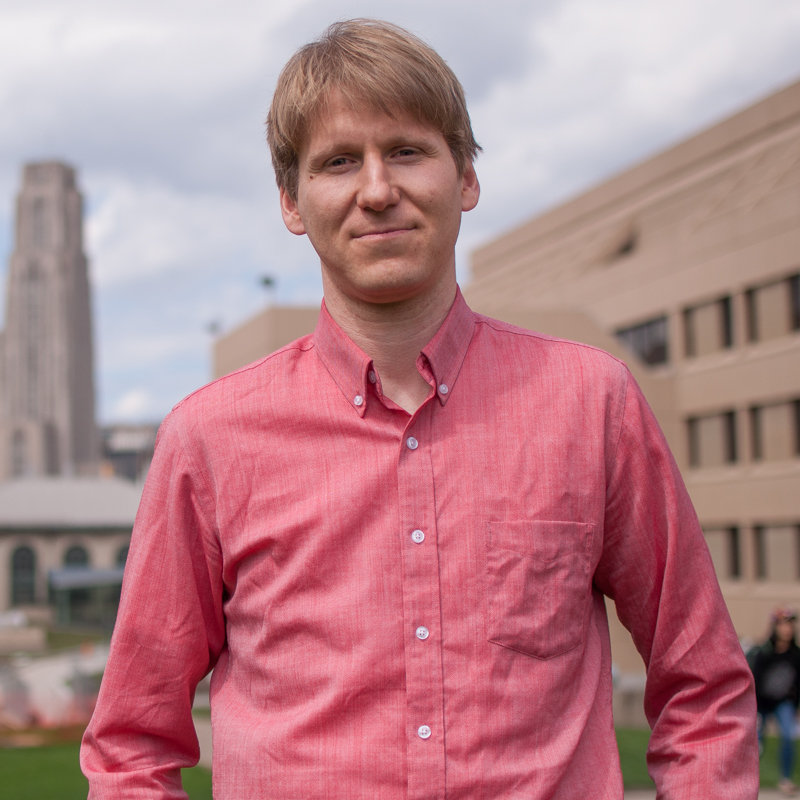
Kathleen Fisher is a Professor in the Computer Science Department at Tufts University. Previously, she held positions as a Principal Member of the Technical Staff at AT&T Labs Research, a Consulting Faculty Member at Stanford University, and a program manager at DARPA where she started and managed the HACMS and PPAML programs. Professor Fisher's research focuses on advancing programming language theory and practice, with particular emphasis on domain-specific languages for managing ad hoc data. Her main contributions include the Hancock system for efficiently building signatures from massive transaction streams and the PADS system for managing ad hoc data. Recently, she has been exploring synergies between machine learning and programming languages, and applying programming language advances to build more secure systems. The Fisher Lab specifically focuses on using programming language techniques such as domain-specific languages, program synthesis, and formal methods to make it easier, safer, and faster to ingest untrusted or ill-formed data. Analysis of her recent publications reveals a consistent focus on formal verification, parser technology, bidirectional transformations, and domain-specific language design. Her work spans theoretical foundations while maintaining practical applications in data management and security. A notable trend in her research is the application of programming language techniques to solve real-world data challenges, particularly in handling unstructured or ill-formed data. Her scientific recognition includes: ACM Fellow Professor Fisher has held significant leadership roles in the programming languages community, including serving as program chair for FOOL, ICFP, CUFP, and OOPSLA, and as General Chair for ICFP 2015. She was past Chair of the ACM Special Interest Group in Programming Languages (SIGPLAN), past Co-Chair of CRA's Committee on the Status of Women (CRA-W), and has served as an editor for the Journal of Functional Programming and as an Associate Editor for TOPLAS. She has also been active in mentoring through PLMW (Programming Languages Mentoring Workshop), focusing on topics like work/life balance, career options, and time management. Her laboratory work centers on creating tools and techniques that bridge the gap between theoretical programming language research and practical data management challenges, with particular emphasis on making data ingestion safer and more efficient.
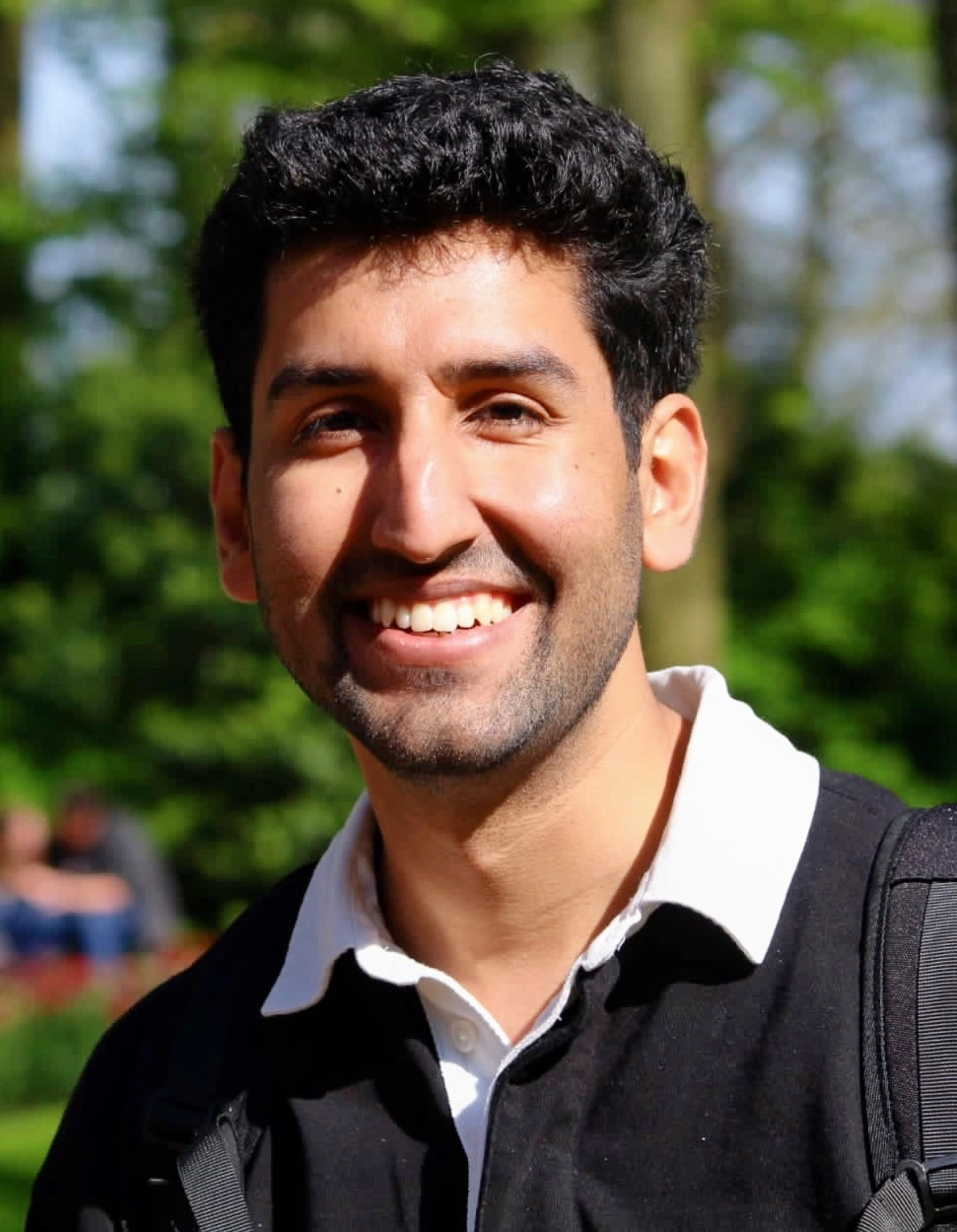
Christian Kästner is an Associate Professor in the Software and Societal Systems Department (S3D) within Carnegie Mellon University's School of Computer Science, where he also serves as the director of the CMU Software Engineering Ph.D. Program. His work bridges software engineering and machine learning, focusing on the practical challenges of building production systems with ML components. His research spans several interconnected areas: software engineering for AI-enabled systems (particularly "Machine Learning in Production"), sustainability and fairness in open source communities, and software-supply-chain security. He investigates the limits of modularity and complexity caused by variability in software systems, with applications in quality assurance, interoperability, and feature interactions. His approach combines rigorous empirical research with program analysis and tool building. His recent publications reveal a strong trend toward ML systems engineering, with numerous papers on building reliable ML products, understanding open source sustainability challenges, and securing software supply chains. His work often involves large-scale empirical studies and the development of practical tools to address real-world software engineering problems. He has received multiple distinguished paper awards at top software engineering conferences including ICSE and FSE for his work on dependency abandonment, supply chain security, and collaboration challenges in ML systems. As an educator, he created and teaches the "Machine Learning in Production" course, which formed the basis for his MIT Press book of the same name. He has advised numerous PhD students and mentored many REU students, with several former students now holding faculty positions or working at major tech companies. His service to the community includes extensive program committee work for major software engineering conferences and editorial roles, demonstrating his significant influence in the field.
Ujjwal Sharma is a Post-Doctoral Researcher at the University of Amsterdam , working at the Research Center for Sustainable Investments and Insurance (a joint center with ASR Nederland). His research focuses on building AI systems for business applications, particularly analyzing abstract themes in large-scale multimodal data. Key Contributions: Co-created Exquisitor, a visual search system for millions of images/videos; developed AI techniques for analyzing restaurant review images and corporate sustainability messaging. Research Interests: His work spans artificial intelligence, business analytics, and multimodal data analysis. He specializes in end-to-end AI pipelines from data wrangling to production deployment. Notable Projects: drone-recon: 3D model reconstruction from monocular images nlp-mm: Image captioning using recurrent units generative_models: Implementation of Naive Bayes and VAE for MNIST dataset Technical Expertise: TensorFlow, Python, C++, GPU/OpenMP programming, VAEs, multimodal systems, and production-scale deployments.
Sanjay Somanath is a Research Fellow at Chalmers University of Technology's Department of Architecture and Civil Engineering. His research focuses on computational approaches to urban social sustainability, specializing in activity-based accessibility modeling, GIS applications, and digital tool development for neighborhood planning. He collaborates with sustainable building researchers including Alexander Hollberg and Holger Wallbaum. Education PhD (2024) - Chalmers University of Technology: 'Instruments of Inquiry for Urban Social Sustainability' M.Arch Digital Architecture and Tectonics (2018) - University of Nottingham B.Arch (2017) - BMS College of Engineering, Bangalore Research Focus Somanath's work centers on operationalizing urban social sustainability through digital frameworks. He develops computational instruments like activity-based accessibility models that simulate resident behaviors to evaluate neighborhood equity. His research bridges social theory with technical implementation, creating tools for participatory urban planning and sustainability assessment. Recent work explores digital twins for multi-domain urban simulation, machine learning for urban quality inference, and procedural generation of 3D city models. These contributions advance data-driven approaches for evaluating social infrastructure coverage and environmental impacts. Projects & Collaborations Developed Twinable: Interactive tool for socially sustainable neighborhood planning Contributed to DecarbonAIte: AI-based urban modeling for energy and environmental factors Collaborates with Sustainable Building research group at Chalmers
Dr. Sarah Sutton is an Associate Professor at the School of Library and Information Management (SLIM) at Emporia State University. She holds a Ph.D., M.L.S., and B.S. in Library Science. Her research focuses on librarian competencies, scholarly communication in digital environments, information behavior analysis, and educational assessment. Sutton has been a key contributor to defining core competencies for electronic resources librarians through her work with NASIG. She has presented widely on E-Resources management, technology integration, and data analytics in libraries. Sutton’s professional development efforts emphasize flexibility, collaboration, and effective communication in dynamic library environments. Education: Ph.D. (Texas Woman’s University), M.L.S. (Texas Woman’s University), B.S. (Washington University) Key Contributions: Pioneered NASIG’s core competencies framework, led E-Resources lifecycle studies, and developed strategies for digital user engagement Presentations: Delivered workshops on ER lifecycle management, data wrangling, and vendor negotiations Her work bridges theory and practice in electronic resources, emphasizing user-centered design and policy development. Sutton is active in professional organizations, advocating for librarian competencies in evolving digital landscapes.
Dong Deng is an Associate Professor in the Department of Computer Science at Rutgers University, School of Arts and Sciences. He joined Rutgers University in 2019 as an Assistant Professor and has since been promoted to Associate Professor. His research is conducted through the Data Curation Lab within the Database Group. Dong Deng received his PhD from Tsinghua University and completed postdoctoral training at MIT CSAIL. His academic journey has positioned him as a leading researcher in database systems and data management. Dong Deng's research focuses on data management, data science, and database systems, with an emphasis on developing novel algorithms and building practical systems to address data problems. His primary research areas include scalable data curation (covering textual, structured, and feature data curation), data manipulation and wrangling at scale, data integration, data cleaning, data discovery, and scientific dataset management. His work bridges theoretical foundations with practical implementations, particularly in the areas of similarity search, approximate nearest neighbor algorithms, and data integration techniques. His research has significant applications in big data processing, entity resolution, and data lake management. Dong Deng has published extensively in top venues including SIGMOD, PVLDB, and ICDE. His recent publications demonstrate a strong focus on near-duplicate detection, efficient algorithms for similarity search, and data curation techniques. His work shows a consistent trajectory toward more complex and scalable solutions for data management challenges, with increasing emphasis on high-dimensional data and large language model applications. NSF III: Small: Large-Scale High Dimensional Dense Vector Management (2022) NSF CDSE: Computation-Informed Learning of Melt Pool Dynamics for Real-Time Prognosis (2022) SIGMOD Student Programming Contest 2022 Second Place Dong Deng has secured significant research funding and actively mentors students. He has served in various leadership roles within the academic community including Digital Platform Chair for VLDB 2023 and Student Mentorship co-Chair for SIGMOD 2022 and 2021. He teaches advanced courses in database systems and data management at Rutgers University. Dong Deng leads the Data Curation Lab, which focuses on developing innovative solutions for data management challenges. The lab has produced influential research with practical applications across multiple domains requiring sophisticated data processing capabilities.
Dr. Lan Du is an Associate Professor in the Department of Data Science & AI at Monash University's Faculty of IT. His research focuses on cross-disciplinary applications of machine learning and AI, particularly in text analytics, uncertainty estimation, knowledge distillation, and multi-modal learning. He leads projects addressing real-world challenges in public health, marketing, and clinical decision-making. Key collaborations include work with Victoria Police, Monash Health, and the National Health and Medical Research Council (NHMRC). Education: PhD in Computer Science (ANU, 2012), Bachelor of Information Technology (ANU, 2007), and B.Communication & IT (Flinders University, 2006). Research Interests: Machine/deep learning for NLP, active learning strategies, uncertainty quantification, and AI-driven solutions for healthcare and business analytics. His work bridges theoretical advancements with practical implementation, emphasizing translational research. Recent Projects (2021–2026): Includes AI models for predicting fracture outcomes (NHMRC-funded PRAISE study), risk prediction tools for pregnancy complications, and medical surveillance systems. He also collaborates on business insights derived from unstructured customer data. Teaching Commitment: Served as Chief Examiner and Lecturer for courses like FIT5149 (Applied Data Analysis) and FIT5196 (Data Wrangling). Lab/Team Involvement: Leads initiatives in AI for healthcare analytics and cross-modal learning, with active participation in Monash's research networks.
Catherine Plaisant is a Research Scientist Emerita at the University of Maryland's Institute for Advanced Computer Studies (UMIACS) and a member of the Human-Computer Interaction Lab (HCIL). She holds a Doctorat d’Ingénieur from Université Pierre et Marie Curie and has been affiliated with HCIL since 1988. Her work focuses on user interface design, information visualization, and healthcare informatics, emphasizing usability, accessibility, and interdisciplinary collaboration. Education: PhD (Doctorat d’Ingénieur), Université Pierre et Marie Curie. Research Interests: User interface design/evaluation, information visualization, medical informatics, digital libraries, and temporal data analysis. Key projects include EventAction, Twinlist, and PAOHVIS. Articles Trends: Recent work emphasizes visual analytics for temporal event sequences, healthcare decision-making tools, and historical HCI preservation. Key themes include explainable AI, cohort comparison, and user-centered design. Scientific Awards: IEEE VIS Career Award (2020), ACM SIGCHI Lifetime Service Award (2020), ACM SIGCHI Academy membership (2015), and multiple Test of Time Awards for influential papers. Grants & Advising: Collaborations with INRIA and industry sponsors. Advised on projects like SHARP-C and EventFlow. Retired from direct student mentoring but remains active in research. Labs/Teams: HCIL and UMIACS. Collaborates internationally with institutions like INRIA (France) on projects such as PKclustering and Dynamic Hypergraph visualization.
Daniel Barowy is an Associate Professor in the Department of Computer Science at Williams College. His academic journey includes a Ph.D. in Computer Science from the University of Massachusetts Amherst (2017), an M.S. in Computer Science from UMass Amherst (2013), a B.S. in Computer Science from Boston University (2010), and a B.A. in Legal Studies and Philosophy from UMass Amherst (2002). Education: Ph.D. Computer Science, University of Massachusetts Amherst, 2017 M.S. Computer Science, University of Massachusetts Amherst, 2013 B.S. Computer Science, Boston University, 2010 B.A. Legal Studies and Philosophy, University of Massachusetts Amherst, 2002 Daniel Barowy's research focuses on programming languages, particularly in the domain of end-user programming and human-computer interaction. His work centers on improving spreadsheet programs' reliability and enhancing human-in-the-loop algorithms. He explores how programming language technology can be applied to emerging domains such as crowdsourcing and data analysis. His research often blends traditional programming language techniques like program analysis with statistical methods to create tools that make programming more accessible and robust for non-experts. His publication record shows a consistent focus on improving spreadsheet reliability (ExceLint, CheckCell, FlashRelate) and integrating human computation with programming languages (AutoMan, VoxPL). His work spans multiple prestigious venues including PLDI, OOPSLA, CHI, and USENIX ATC, demonstrating both theoretical rigor and practical impact. The most recent work (Riker) focuses on build systems, showing an expansion of his research interests while maintaining the core theme of improving software reliability. Scientific Awards: Best Paper Award at USENIX ATC 2022 for "Riker: Always-Correct and Fast Incremental Builds from Simple Specifications" PLDI 2015 Distinguished Artifact Award for "FlashRelate: Extracting Relational Data from Semi-Structured Spreadsheets Using Examples" Research Highlight in Communications of the ACM for AutoMan Verified artifact badges for CheckCell, ExceLint, and FlashRelate Barowy actively mentors students, as evidenced by his detailed process for providing letters of recommendation. His teaching portfolio includes core computer science courses like Principles of Programming Languages (CSCI 334) and Introduction to Computer Security (CSCI 331). He has developed educational tools like SWELL for introductory programming education. His research is supported by grants from the National Science Foundation (CCF-1144520, CCF-0953754) and DARPA (N10AP2026), with additional support from Microsoft Research. Barowy leads research projects that often result in open-source software tools including ExceLint (an Excel plugin for finding formula errors), AutoMan/VoxPL (a DSL for crowdsourcing), and several related tools for spreadsheet analysis and crowdsourcing integration. His work bridges theoretical programming language concepts with practical applications that directly benefit end-users.
Edward Abel is an Associate Professor in the Department of Design, Media and Educational Science at the University of Southern Denmark. His research focuses on computational approaches to decision-making, fairness, and explainability in AI systems, particularly in how these systems influence human choices. He explores technical algorithm design alongside ethical implications, emphasizing transparency and accountability. Abel holds a PhD in Computer Science and participates in external roles such as the Steering Committee of the eXplainable Artificial Intelligence Hub. Education : PhD in Computer Science His research interests span computational decision-making systems, recommender systems, and the intersection of computer science with humanities disciplines. He investigates how AI can be designed to align with user needs while addressing equity and interpretability challenges. Notable contributions include studies on fairness in pandemic policy decisions and the development of the VADA architecture for data wrangling. Abel’s work often bridges technical innovation with critical social inquiry, aiming to ensure AI systems are both effective and ethically robust. His recent projects include analyzing UK COVID-19 restrictions through dominance-based rough sets analysis and exploring diversity in music recommendation systems. He collaborates extensively with interdisciplinary teams and has published over 30 peer-reviewed articles. His datasets, such as the UK COVID-19 restriction dataset, are widely referenced in academic research and policy discussions.
Ben Baumer is a Professor of Statistical & Data Sciences at Smith College, co-director of the Journalism Concentration, and an Accredited Professional Statistician™. He holds a Ph.D. in Mathematics from CUNY (2012), an M.A. from UC San Diego, and a B.A. from Wesleyan University. Previously, he served as the New York Mets' first full-time Statistical Analyst (2004–2012). His research focuses on data science, sabermetrics, network science, and statistics education. He co-authored influential works like The Sabermetric Revolution and Modern Data Science with R . He received the Waller Education Award (2019), the ASA Significant Contributor Award (2019), and the 2016 Contemporary Baseball Analysis Award. As PI, he led a $1.2M NSF Data Science Corps grant for workforce development. His work integrates computational and statistical methods, emphasizing reproducibility and ethics. He co-organizes the ASA Five College DataFest and develops open-source tools like infer and tidychangepoint . Teaching spans data wrangling, visualization, and predictive modeling.
Dr. Emi Tanaka is a Senior Lecturer at the Australian National University (ANU), affiliated with the Biological Data Science Institute and the Research School of Finance, Actuarial Studies and Statistics. She holds dual roles as Deputy Director and Executive Editor of the R Journal. Her research focuses on experimental design, mixed models, bioinformatics, and statistical software development. She is a leader in open science and reproducible practices, contributing numerous R packages and educational resources. Education: PhD in Statistics (University of Sydney, 2015), BSc (Adv Maths) with Honours (University of Sydney, 2010). Affiliations: ANU Biological Data Science Institute, R Consortium, Statistical Society of Australia (ACT Branch Council Member). Her research interests span experimental design, data visualization, and applications in plant breeding and bioinformatics. She actively bridges statistical methods with interdisciplinary fields through workshops and open-source tools. Notable achievements include the SSA President’s Award for Leadership and recognition in Significance magazine. Grants & Projects: Lead investigator in the $1.5M ‘Analytics for the Australian Grains Industry’ project. Collaborates with institutions like Monash University and the University of Sydney. Labs/Teams: Core member of the ANU Statistical Support Network and rOpenSci Champions Program, advancing reproducible research and software engineering.
Steve Buyske is a Professor at Rutgers University's Department of Statistics where he serves as Co-Director of both the Undergraduate Statistics Program and the Undergraduate Data Science Program. His office is located in Hill Center 578 at Rutgers University in Piscataway, New Jersey. Dr. Buyske earned his BA from Haverford College and holds PhDs from both Brown University and Rutgers University. His academic journey began in mathematics (differential geometry) before transitioning to statistics, where he initially focused on psychometrics, particularly item response theory and latent variable models, before moving toward statistical genetics and biostatistical collaborations. His research spans statistical genetics, biostatistics, psychometrics, and experimental design. He is particularly noted for his work on polygenic risk scores, genome-wide association studies, and genetic research in diverse populations, with special attention to health disparities in Black American and other underrepresented groups. A native of New Jersey, he has made significant contributions to understanding genetic factors in diseases like type 2 diabetes and obesity. His recent publications show a strong focus on statistical genetics and biostatistics, particularly in polygenic risk scores, genome-wide association studies, and multi-ethnic genetic research. Much of his work addresses health disparities in diverse populations, with particular attention to Black Americans and other underrepresented groups in genetic research. School of Arts and Sciences Award for Distinguished Contributions to Undergraduate Education Dr. Buyske co-directs the Rutgers University Genetics Coordinating Center (RUGCC) with Dr. Tara Matise and has been involved in major research initiatives including the PAGE Study (Population Architecture using Genomics and Epidemiology) and the Genome Sequencing Program. In 2023, they launched a research study on the genetics of breast cancer, which is accessible through the websites https://rugcc.rutgers.edu/breast_cancer/ and http://bcstudy.rugcc.org/. His teaching responsibilities include Statistics 295: Data Wrangling and Management with R, Statistics 365: Bayesian Data Analysis, and other courses in experimental design and data science. He is actively involved with the Rutgers University Genetics Coordinating Center (RUGCC) and has leadership roles in the PAGE Study and Genome Sequencing Program, contributing significantly to large-scale genetic research initiatives with focus on diverse populations.
Dmitry Zinoviev is a Professor in the Mathematics & Computer Science Department at Suffolk University. He teaches courses such as Architecture of Computer Systems , Operating Systems , and Introduction to Data Science , with office hours available both in-person and via Zoom. Education : PhD and MS from SUNY at Stony Brook, MS from Lomonosov Moscow State University His research spans Complex Networks , Computational Social Science , and Digital Humanities , focusing on network modeling, social dynamics, and interdisciplinary data analysis. Publications highlight Python-based network analysis, semantic modeling, and computational health informatics. Recent articles emphasize applications of network theory in social systems, fraud research, and product categorization. He has authored/ co-authored over 60 publications, including books on Python programming and computational methods. Contact: dzinoviev@suffolk.edu | Phone: 617-305-1985 | Office: 73 Tremont St., Rm. 8086