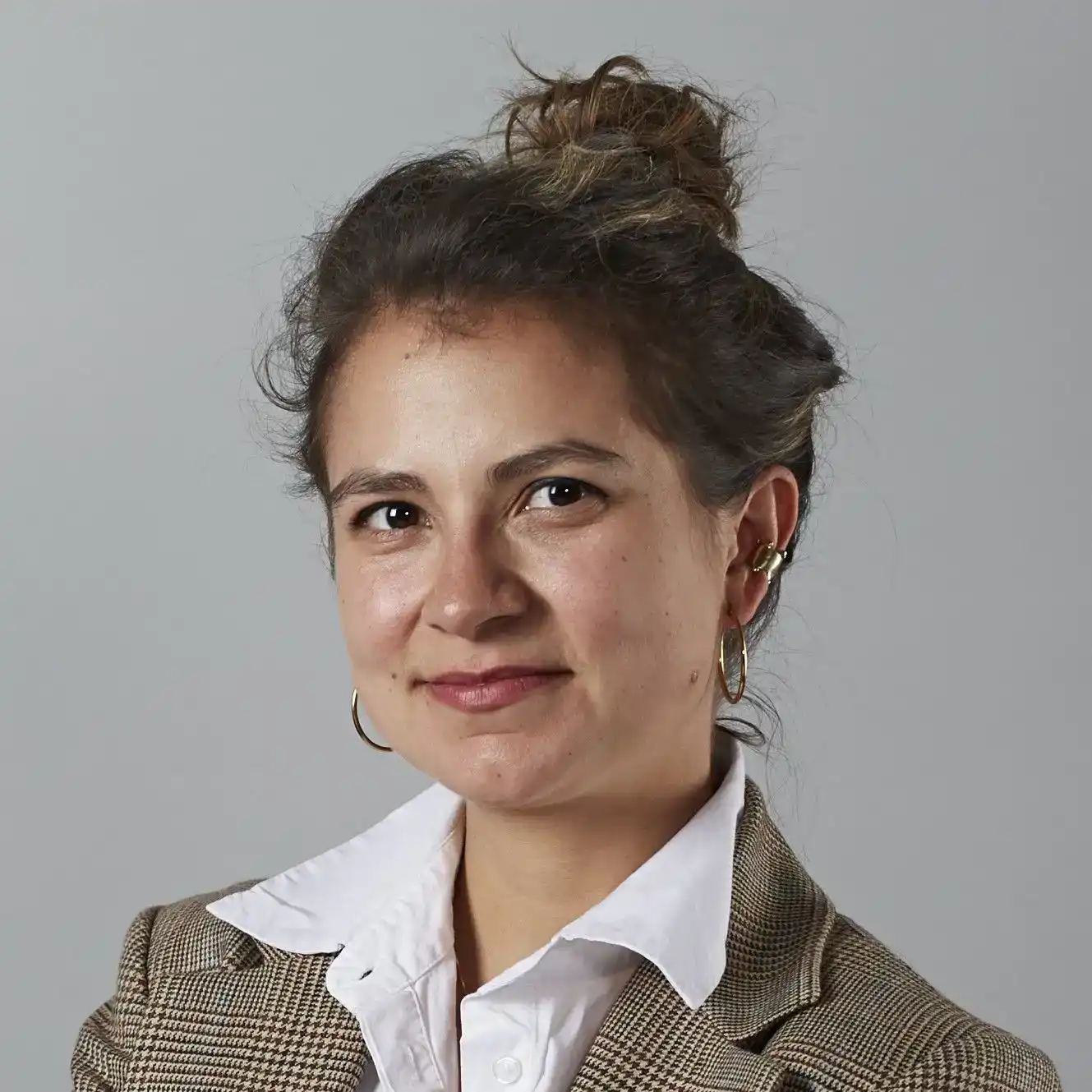
Beatriz Botero Arcila is an Assistant Professor of Law at Sciences Po Law School and a Faculty Associate at the Berkman Klein Center for Internet and Society at Harvard University. She specializes in the governance of data, artificial intelligence, and digital surveillance. LLM and Doctorate from Harvard Law School Research Focus : Law of the Digital Economy Privacy Law / Global Data Law Surveillance Law Legal Theory Scientific Awards : Future of Privacy Forum's 14th Annual Privacy Papers Award (2024) Labs & Teams : Co-founder of The Edgelands Institute, a pop-up institute incubated at the Berkman Klein Center focused on digital surveillance and cities.
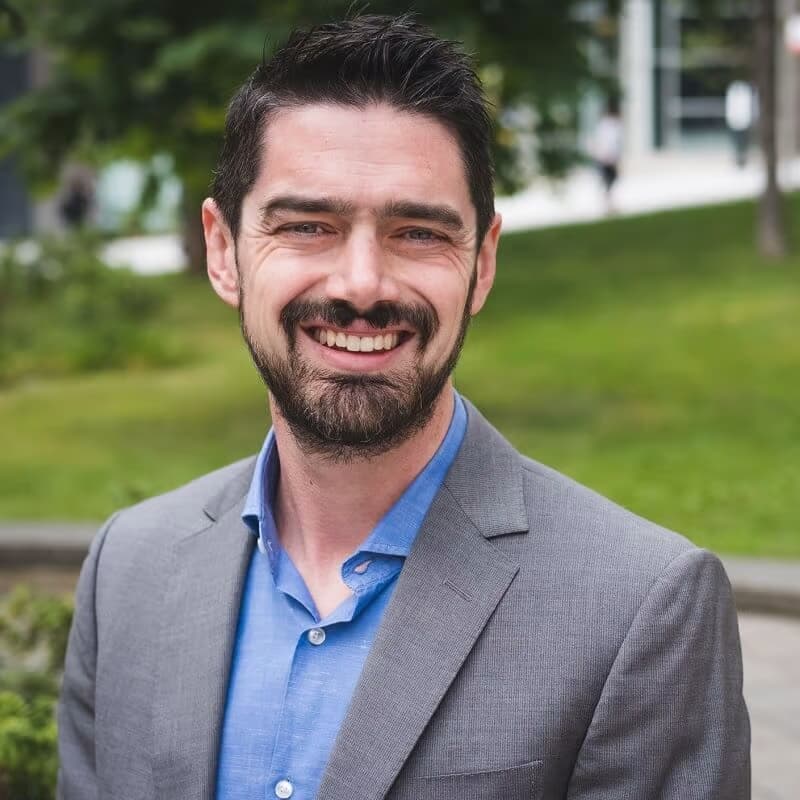
Jason Hein is an Associate Professor in the Department of Chemistry at the University of British Columbia's Faculty of Science. His research focuses on the development of automated reaction analysis technology and self-driving laboratories that integrate robotics with synthetic organic chemistry. Dr. Hein leads the Hein Lab, which pioneers innovative solutions for mechanistic organic chemistry, catalytic reaction mechanisms, and chemical manufacturing processes. His research interests center on creating modular robotic tools and integrated analytical hardware for automated reaction profiling, with applications in pharmaceutical manufacturing, battery materials processing, and sustainable chemistry. The lab's work combines advanced robotics, artificial intelligence, and process analytical technology to develop self-optimizing chemical systems that accelerate discovery and improve manufacturing efficiency. Analysis of Hein's recent publications reveals a strong focus on AI-driven laboratory automation, with particular emphasis on crystallization optimization for battery materials, computer vision for process monitoring, and interoperable software systems for self-driving laboratories. His work bridges fundamental mechanistic understanding with practical industrial applications, particularly in lithium extraction from waste brines and pharmaceutical process development. NSERC Postdoctoral Fellowship Dr. Hein's research program includes significant grant funding supporting the development of self-driving laboratory technologies and their application to challenging chemical problems. His lab actively collaborates with industry partners in pharmaceuticals and clean energy sectors to translate fundamental insights into deployable technologies. Current projects focus on battery-grade lithium carbonate production, continuous manufacturing processes, and AI-optimized chemical synthesis. The Hein Lab operates as a multidisciplinary research environment combining expertise in organic chemistry, robotics engineering, computer science, and data analytics to create the next generation of autonomous chemical discovery systems.
Benjamin Recht is a Professor in the Department of Electrical Engineering and Computer Sciences and Department of Statistics at the University of California, Berkeley. Previously, he was an Assistant Professor in the Department of Computer Sciences at the University of Wisconsin-Madison. Recht received his BS in mathematics from the University of Chicago and his MS and PhD from the MIT Media Laboratory, followed by a postdoctoral fellowship at Caltech's Center for the Mathematics of Information. His research interests span Machine Learning, Optimization, Control Theory, and Statistics , with a focus on both theoretical foundations and practical applications. Recht's work addresses fundamental questions in reproducibility, generalization, and robustness of machine learning systems, while also developing novel methods for control, computer vision, and data analysis. Recht's recent publications reveal a strong focus on reproducibility in machine learning , with papers like "The Mechanics of Frictionless Reproducibility" (2024), alongside continued contributions to statistical learning theory ("Interpolating Classifiers Make Few Mistakes", 2023) and computer vision ("Plenoxels", 2022; "K-planes", 2023). His work increasingly addresses societal implications of AI , including papers on systemic harm detection and post-deployment evaluation. NSF Career Award Alfred P. Sloan Research Fellowship 2012 SIAM/MOS Lagrange Prize in Continuous Optimization Presidential Early Career Award for Scientists and Engineers 2014 Jamon Prize 2015 William O. Baker Award for Initiatives in Research 2017 and 2020 NeurIPS Test of Time Awards Recht has advised numerous PhD students who have gone on to faculty positions at top universities and research roles at leading technology companies. His work on optimization algorithms has been widely influential, including the development of methods like HOGWILD! for parallel stochastic gradient descent. He co-founded the Conference on Learning for Decision and Control and has served on editorial boards for the Journal of Machine Learning Research and Mathematical Programming. His research group spans both theoretical and applied work, with connections to healthcare (adaptive medication tapering), computer vision (radiance fields), and social impact (systemic harm detection in deployed systems).
Macartan Humphreys serves as director of the Institutions and Political Inequality group at the WZB Berlin Social Science Center and holds honorary professorships in social sciences at both Trinity College Dublin and Humboldt University Berlin. His research focuses on methodological innovations in social science, particularly in causal inference and mixed-methods approaches. Humphreys has developed frameworks that integrate causal modeling with Bayesian updating for both qualitative and quantitative research traditions. Humphreys' recent publications reveal expertise in creating systematic approaches that connect theoretical frameworks with empirical analysis. His work emphasizes transparency in research design and the integration of information from diverse data sources. Key Contributions: Development of causal modeling frameworks for qualitative and mixed-methods research Advancement of Bayesian approaches to case-level causal inference Creation of tools for research design, diagnosis, and optimization Integration of process tracing with broader causal inference frameworks Leadership Positions: Director, Institutions and Political Inequality group, WZB Berlin Social Science Center
Shahrokh Valaee is a Professor and Associate Chair for Undergraduate Studies in the Edward S. Rogers Sr. Department of Electrical and Computer Engineering at the University of Toronto, part of the Faculty of Applied Science and Engineering. He founded and directs the Wireless and Internet Research Laboratory (WIRLab). Education: BSc and MSc in Electrical Engineering from University of Tehran PhD in Electrical Engineering from McGill University Research Interests: Focuses on wireless networks (vehicular/sensor networks, B5G/6G), signal processing (indoor localization, machine learning for medical imaging), and integrated sensing/communication. His work spans: Localization in GPS-denied environments Machine learning for healthcare with limited/imbalanced data Reconfigurable Intelligent Surfaces (RIS) and drone networks Publications: Recent articles (2014-2016) show strong focus on indoor localization techniques, vehicular network protocols, and network coding, with emerging trends in machine learning applications for wireless systems and healthcare. Awards: Connaught Award (2012, 2013) NSERC Discovery Accelerator Award (2010) MaRS Innovations cPOP Award (2012) IEEE Fellow (FIEEE) Engineering Institute of Canada Fellow (FEIC) Leadership: Advises graduate students at WIRLab, where research combines theory with practical implementation (GPU-based ML, Android localization). Manages projects in integrated sensing/communication, ML for health, and B5G networks. Labs/Teams: Directs WIRLab with focus on wireless signal processing, networking, and ML implementations. Current team includes postdocs and PhD students working on localization, B5G networks, and medical ML applications.
Horatia Muir Watt is a Full Professor at Sciences Po's Law School, where she is a leading figure in private international law and comparative law. She is Co-Director of the Global Governance Studies program and founder of the PILAGG research group. Her scholarship is widely published in top legal journals, and she serves as Director of the Revue critique de droit international privé , the premier French-language journal in her field. She is affiliated with the Institute of International Law and the Institut Universitaire de France. PhD in Private International Law, University of Panthéon-Assas Paris 2 (1985) Agrégation in Private Law, ranked second (1986) Former faculty at University of Tours, Paris XI, and Paris I Panthéon-Sorbonne Appointed to Sciences Po in 2009, instrumental in founding its Law School Her research centers on international private law in global governance , comparative law with new theoretical approaches , and fundamental rights . She critically examines the role of law in transnational disputes, arbitration, migration, and environmental justice. Her work often explores the philosophical and cultural dimensions of legal reasoning, including alterity, translation, and ecological jurisprudence. Her recent publications, spanning 2023–2024, demonstrate a consistent focus on the evolving landscape of private international law. Key themes include jurisdiction in transnational litigation, the recognition of foreign judgments, the impact of war on family law, and the ethics of legal publishing. Her articles appear predominantly in the Revue critique de droit international privé , with additional contributions to journals like Rabels Zeitschrift and Transnational Legal Theory . The body of work reflects a blend of doctrinal precision and critical theory, engaging with EU regulations, comparative methodologies, and global legal challenges. Member of the Institute of International Law (since 2013) Member of the Institut Universitaire de France (since 2018) Horatia Muir Watt has supervised numerous PhD candidates and leads the PILAGG research group, which has produced several influential books with publishers such as Oxford University Press and Edward Elgar. She is part of the core faculty at the Institute for Global Law and Policy (IGLP) and serves on the editorial boards of multiple international legal journals, including the Journal of Private International Law and Transnational Legal Theory . Her work is supported by institutional affiliations and collaborative research projects rather than specific grant mentions in the text. She directs the PILAGG (Private International Law and Global Governance) research group at Sciences Po, which fosters interdisciplinary and critical approaches to transnational law. The group has organized collective research projects resulting in major publications and contributes to shaping contemporary discourse in private international law.
Jeffrey K. Mullins is an Assistant Professor in the Department of Information Systems at the Sam M. Walton College of Business, University of Arkansas. His research explores the intersection of emotion, cognition, and ethics in information systems, with a focus on how digital technologies blur boundaries between work and play through gamification and metaverse development. Ph.D. in Information Systems, University of Arkansas Director of Ph.D. Program, Walton College Research interests span: Emotion and cognition in digital environments Ethics of biometric and gamification technologies Metaverse development and Web3 transitions Work-life convergence in IS-enabled contexts His publications in MIS Quarterly , Journal of Business Ethics , and Journal of the Association for Information Systems reflect these themes. Recent work examines AI biometrics policy and immersive learning applications. 2024 Walton College Executive MBA Teacher of the Year 2020 ACM SIGMIS Doctoral Dissertation Award 2016 Outstanding Lecturer Award With over a decade of IT experience at a Fortune 100 firm, he teaches graduate courses in IT management and multivariate analysis while maintaining certifications like ERPsim Level 2 Training.
Prof. Noam Noked is an Associate Professor at the Faculty of Law, The Chinese University of Hong Kong, specializing in tax law and policy. He serves as Director of the Faculty’s Ph.D. and M.Phil. programs and is an Honorary Secretary of Hong Kong’s Joint Liaison Committee on Taxation. Education: Doctor of Juridical Science (S.J.D.), Harvard Law School LL.M. (requirements fulfilled, degree waived), Harvard Law School LL.B., Tel Aviv University Faculty of Law B.A., Accounting Department, Tel Aviv University Research Interests: Tax policy and international taxation Tax administration and compliance Law and economics intersections His work focuses on combating offshore tax evasion, mandatory disclosure rules, and aligning domestic tax frameworks with global minimum standards. Scientific Awards: Research Excellence Award (2023-24) Young Researcher Award, CUHK (2020) John M. Olin Prize for Best Paper in Law & Economics (2010) Research Grants: HK$481,000 General Research Fund (2023-2025): "New Ways to Compete: How Hong Kong Can Adapt to the New International Tax Order" HK$475,000 General Research Fund (2021-2023): "Mandatory Disclosure Rules: Development, Policy Analysis, and Implications for Financial Centers" HK$470,000 Early Career Scheme (2019-2021): "Regularization of Tax Noncompliance: Comparative Legal Analysis and Proposal for China"
Hamish van der Ven is an Assistant Professor of Sustainable Business Management of Natural Resources at the University of British Columbia (UBC) within the Department of Wood Science and Faculty of Forestry. He leads the Business, Sustainability and Technology Lab and maintains affiliations with the Environmental Governance Lab at the University of Toronto, the Earth System Governance Project, and the United Nations Forum on Sustainability Standards. PhD in Political Science from University of Toronto Previous roles at McGill University and Yale University Research focuses on sustainable supply chain governance, eco-labeling, transnational environmental governance, corporate social responsibility, and digital technology impacts His recent work analyzes indirect climate impacts of generative AI and social media, transparency mechanisms in fast fashion, stakeholder influence on sustainability standards, and governance dynamics in buyer-driven supply chains. His 2019 book Beyond Greenwash? Explaining Credibility in Transnational Eco-Labeling (Oxford University Press) critiques eco-labeling efficacy. Van der Ven's research has been funded by grants including SSHRC Insight Grant (2025-2030), SSHRC Explore Grant (2023), SSHRC IDG Grant (2021-2023), FRQSC Collaborative Grant (2018-2021), and SSHRC Postdoctoral Fellowship (2016-2017). He examines both broad trends in global environmental governance and specific case studies across agriculture, aquaculture, and retail sectors.
John Basl is an Associate Professor of Philosophy at Northeastern University and Associate Director of the Northeastern Ethics Institute, where he leads initiatives in AI and data ethics. He holds affiliate roles at Khoury College of Computer Science, the Institute for Experiential AI, and Harvard's Edmond and Lily Safra Center for Ethics. His research focuses on applied ethics, particularly in AI, machine learning, data ethics, and environmental ethics. He is the author of The Death of the Ethic of Life (Oxford UP) and has contributed to interdisciplinary projects on AI governance, including the NSF-funded AI & Data Ethics (AIDE) Graduate Training Program and the National Internet Observatory. His work explores ethical challenges posed by emerging technologies, such as moral obligations to AI systems, transparency in automated decision-making, and the ethical implications of autonomous vehicles. Basl’s research also engages with environmental ethics, addressing questions about species partiality, ecological justice, and the moral status of non-human entities. He actively collaborates with technologists, policymakers, and ethicists to ensure ethical considerations are integrated into technological development. His media engagements include talks on AI ethics at institutions like the University of Toronto and the Web Summit, and articles in outlets like Aeon Magazine. Current projects include grants focused on training the next generation of AI ethics scholars and analyzing the societal impacts of generative AI. Basl advocates for accessible, interdisciplinary approaches to ethics in technology, emphasizing practical solutions to real-world challenges.
Jessica Fjeld is a Clinical Lecturer at Harvard Law School and Managing Director of the De|Center, an initiative addressing digital authoritarianism. She is affiliated with the Berkman Klein Center for Internet & Society and previously served as Assistant Director of the Cyberlaw Clinic. Her work focuses on AI governance, digital rights, and the intersection of technology with human rights and creativity. Fjeld holds a JD from Columbia Law School, an MFA in Poetry from UMass, and a BA from Columbia University. Affiliations: Harvard Law School, Berkman Klein Center, Cyberlaw Clinic Roles: Clinical Lecturer, Managing Director (De|Center), Legal Scholar Research Interests: AI ethics and governance frameworks Content moderation challenges for marginalized communities Legal aspects of AI-generated art and intellectual property Corporate accountability in tech sectors Freedom of expression in digital spaces Key Projects: Principled Artificial Intelligence Project (mapping global AI ethics principles) Online Identity Help Center (supporting marginalized users in content moderation disputes) Advocacy against facial recognition misuse in Boston Awards: Hamilton Fellow & James Kent Scholar (Columbia Law School) Poetry Society of America Recognition 92nd Street Y/Boston Review Discovery Prize
Ben Green is an Assistant Professor at the University of Michigan School of Information and holds a courtesy appointment at the Gerald R. Ford School of Public Policy. He is also a Faculty Associate at Harvard’s Berkman Klein Center for Internet & Society and a Fellow at the Center for Democracy & Technology. Green earned his PhD in Applied Mathematics from Harvard University with a secondary field in Science, Technology, and Society. His research focuses on the ethics of government algorithms, emphasizing algorithmic fairness, human-algorithm interactions, and AI regulation. He advocates for design and governance practices that prevent algorithmic harms and advance social justice. His work includes critiques of overreliance on technology in urban planning, as highlighted in his book The Smart Enough City , and ongoing projects on equitable AI policies. Green’s contributions extend to publications analyzing human oversight in AI systems, privacy in public health contexts, and the societal impacts of smart city technologies. His interdisciplinary approach bridges computer science, law, and public policy to address real-world challenges in technology governance. As a Fellow at the Center for Democracy & Technology and through his academic roles, Green collaborates on initiatives promoting ethical technology use in government and urban environments. His research has informed policy discussions on data privacy, algorithmic accountability, and equitable technology deployment.
Dr. Ying He is a Senior Lecturer at the School of Electrical and Data Engineering, University of Technology Sydney (UTS). Her research focuses on wireless communication networks, particularly integrating machine learning with satellite and terrestrial systems. She holds a BEng from Beijing University of Posts and Telecommunications (2009) and a PhD from UTS (2017). Prior to her academic role, she worked on TD-LTE chip design at the Chinese Academy of Sciences. Affiliations : Faculty of Engineering and Information Technology Global Big Data Technologies Centre (GBDTC) Education : BEng in Telecommunications Engineering, Beijing University of Posts and Telecommunications (2009) PhD in Engineering (Telecommunications), UTS (2017) Her research interests include satellite communication (GEO-LEO integration), spectrum sharing, vehicular communication, and applying machine learning to physical layer algorithms. Notable contributions include optimizing beam design in LEO networks and developing secure IoT systems. She supervises PhD/Master’s students and teaches courses like CCNA and capstone projects. Funded projects span satellite networks, IoT security, and supply chain tracking. Recent grants include SmartSat CRC initiatives and collaborations with industry partners like Intel and Ericsson. Her work addresses challenges in 6G, UAV-enabled computing, and resilient quantum algorithms.
Jessica Hammer is an Associate Professor of Learning Sciences at Carnegie Mellon University, jointly appointed in the Human-Computer Interaction Institute (HCII) and the Entertainment Technology Center (ETC). She directs the Center for Transformational Play, focusing on games that provoke meaningful change in players' perspectives and behaviors. Her research explores how virtual reality (VR), serious games, and interactive narratives can address complex societal issues like environmental awareness, mental health stigma, and AI ethics. She is also an award-winning game designer, with projects including Eye into AI , Monsters of Appalachia , and Project Echo of the Abyss . Hammer's academic background integrates computer science, education, and design thinking. Her work spans diverse domains such as healthcare through games, gender-inclusive game narratives, and AI literacy education. She has advised students including Erica Cruz, Noor Hammad, and Beatrice Maggipinto, mentoring them in projects that bridge technology and humanistic goals. Current research initiatives include: AI Ethics: Developing frameworks like RAD to help youth critique algorithmic systems VR for Education: Creating deep-sea exploration experiences to foster ecological empathy Inclusive Design: Addressing accessibility in game streaming for vision-impaired users Her projects often involve collaboration with interdisciplinary teams across CMU's schools, leveraging partnerships with game developers, educators, and social scientists. Hammer's work has been featured in venues like CHI and The Link magazine, reflecting her commitment to both academic rigor and real-world impact.
Prof. Dr. Anne Lauscher is an Associate Professor of Data Science at the University of Hamburg Business School, specializing in fair, inclusive, and sustainable conversational AI systems. Her research focuses on improving algorithmic fairness through demographic factors in NLP systems and exploring ethical implications of large language models. She holds a PhD from the University of Mannheim, where her work on computational argumentation was awarded summa cum laude, and has conducted research at Grammarly and the Allen Institute for AI. Key contributions include gender-fair machine translation datasets (e.g., Building Bridges), bias detection frameworks (e.g., SHADES), and multilingual benchmarking tools like MultiQ. Her work has been recognized with the Maria Gräfin von Linden-Award and inclusion in the '100 Brilliant Women in AI Ethics' list. Research spans ethical NLP, multilingual AI, and societal impacts of AI technologies. Education: PhD in Data and Web Science (University of Mannheim, 2021), Postdoc at Bocconi University's NLP group (2021-2022). Academic roles include adjunct positions and international collaborations across Europe and the US. Research Interests: Conversational AI fairness, multilingual NLP systems, ethical AI evaluation, bias mitigation in LLMs, and interdisciplinary applications of machine learning in scientific discovery. Publications (select highlights): Over 55 peer-reviewed works in top-tier venues like ACL, EMNLP, and AAAI. Recent focus on LLM hallucination analysis, cross-cultural NLP benchmarks, and gender-neutral language resources. Awards: 2021 Maria Gräfin von Linden-Award (Baden-Württemberg), 2023 '100 Brilliant Women in AI Ethics', 2022 Dissertation Award Nominee (GI). Labs/Teams: Leads the UHH Data Science Research Group, collaborating with industry partners like Grammarly and academic institutions worldwide. Active in initiatives promoting gender equity in STEM and sustainable AI development.