Krisjanis Steins is a Lecturer at Linköping University's Department of Science and Technology (ITN), affiliated with the Communications and Transport Systems (KTS) division. His research focuses on healthcare logistics, emergency response systems, and quantitative modeling of transportation and healthcare systems. He specializes in applying discrete-event simulation to optimize emergency department accessibility, disaster response logistics, and healthcare resource planning. His work addresses challenges such as bleeding control kit placement, ICU resource allocation, and hospital operational efficiency. Key research affiliations include the Center for Advanced Research in Emergency Response (CARER). His publications span topics like resilient transport systems, crisis management, and sensor technology integration in emergency logistics. He actively collaborates with institutions on projects involving simulation-based solutions for healthcare and transport infrastructure.
Martin Waldemarsson is an Associate Professor at Linköping University, affiliated with the Department of Science and Technology (ITN) and Communications and Transport Systems (KTS). His work focuses on quantitative logistics, particularly in emergency response and sustainable supply chains. Education: Ph.D. in Production Economics, Linköping University (2014) Licentiate of Engineering in Production Economics (2012) M.Sc. in Industrial Engineering and Management (2008) Martin’s research emphasizes quantitative methods for planning problems in energy-intensive industries and emergency logistics. He participates in projects like EMMUNE for managing multiple natural hazards and PAKT for climate-adapted systems. His work includes forecasting, resource allocation, risk analysis, and profit maximization, integrating energy considerations to enhance sustainability and efficiency. Notable Contributions: Developed optimization models for aerial firefighting resource locations Created decision support frameworks for multi-hazard emergency response Studied energy price impacts on pulp and steel industry supply chains He teaches advanced supply chain planning, logistics for sustainable development, and decision models, while mentoring degree projects in logistics and transport systems.
Peter Gustafsson is a Lecturer at the Department of Statistics and Mathematical Statistics at Lund University. He also serves as the Health and Safety Representative for the Department of Statistics and the Main Health and Safety Representative for the Lund University School of Economics and Management (LUSEM). His academic roles are complemented by extensive teaching and research activities. His research focuses on computer-intensive methods in circular statistics, particularly involving Bessel functions for calculating distribution functions. He also develops statistical models in marketing and Markov chain applications for analyzing customer behavior. His teaching spans probability and inference theory, applied statistics, biostatistics, stochastic processes, econometrics, and statistical computations. His research outputs reflect interdisciplinary engagement, including contributions to visualization techniques (e.g., Euler diagrams), directional data analysis, and environmental statistical methodologies. Notable works include studies on customer behavior modeling and vegetation analysis in agricultural contexts. Peter has supervised numerous bachelor and master theses, demonstrating a commitment to student mentorship. His work bridges theoretical statistical methods with practical applications in diverse fields.
Dr. Daniel Ocic Ihrmark is a faculty member at Linnaeus University's Faculty of Arts and Humanities, Department of Cultural Sciences. His research focuses on Digital Humanities, corpus linguistics applied to literary analysis, and educational linguistics. He leads projects like The Lost Generation Corpus (studying 1920s American authors) and 'Trolling the Library' (analyzing threats to public libraries). Active in interdisciplinary groups like Data Intensive Digital Humanities and Educational Linguistics, his work bridges computational methods with literary studies. Education: Completed a PhD in 2023 titled Automated Text Analytics in Swedish English Classrooms . Research interests include corpus stylistics of Hemingway and Fitzgerald, LGBTQ+ literature representation, and low-code tools for linguistic analysis. He teaches Digital Humanities methodologies and English language pedagogy. Notable contributions include KNIME workflow applications for text analysis, cultural studies of horror narratives, and collaborative projects on social media's impact on language use. His publications span journals like Journal of Documentation and Education for Information , focusing on corpus-driven literary analysis and educational technology.
Diego Perez-Palacin is a Senior Lecturer in the Department of Computer Science and Media Technology at Linnaeus University, Sweden. He holds a PhD in Computer Science from the University of Zaragoza, Spain. Previously, he served as a postdoctoral researcher at Politecnico di Milano (2013-2016) and a Senior Researcher at the University of Zaragoza (2017), contributing to European (FP7/H2020) and Spanish national research projects. Research Interests: His work focuses on software quality properties, self-adaptive systems, model-based analysis using formal methods, and resilience engineering. Key areas include cyber-physical systems, digital twins, and uncertainty management in adaptive systems. His research groups include AdaptWise (self-adaptive software), Cyber-Physical Systems (CPS), and Engineering Resilient Systems (EReS). Projects: Current projects include developing Digital Twins of Organizations (DTO) and aligning architectures for DTO (Aladino). Completed projects include Smart-Troubleshooting in the Connected Society. His work often involves collaboration with interdisciplinary teams in data-intensive applications and smart industry. Publications: Over 30 peer-reviewed articles in journals like ACM Transactions on Autonomous and Adaptive Systems, IEEE Access, and Journal of Systems and Software. Recent work emphasizes digital twin frameworks, antifragile systems, and uncertainty propagation in adaptive systems.
Aline Novais is a Researcher affiliated with the Department of Physics at Lund University, specifically within the Division of Astrophysics . She holds a dual role as a Postdoc and Postdoctoral fellow in the eSSENCE: The e-Science Collaboration initiative. Her contact details include email aline.novais@fysik.lu.se and office A403. Her research interests align with astrophysical studies and computational methods, leveraging interdisciplinary approaches through e-Science frameworks. No specific grants, awards, or advised students are listed in available records. She is part of the Astrophysics division and contributes to eSSENCE, a collaborative effort advancing data-intensive research in Sweden. Current projects and future work remain unspecified in the provided materials.
Danny Weyns is a Professor at Linnaeus University's Department of Computer Science and Media Technology, Faculty of Technology. He leads the AdaptWise research group focusing on self-adaptive software systems and contributes to the Linnaeus University Centre for Data Intensive Sciences and Applications. His work spans cyber-physical systems, digital twins, and formal methods for system adaptation. Education: Extensive academic background in computer science, with a focus on multi-agent systems and distributed computing. Notable projects include the Aladino project on digital twins and PROSSES on secure systems. Research interests emphasize self-adaptive systems, runtime decision-making, and integrating AI with adaptive mechanisms. His publications address challenges like adaptation space reduction, uncertainty management, and industry applications of self-adaptation. Key contributions include the ActivFORMS framework for model-based adaptation and the development of methodologies like ASPLe for systematic reuse in self-adaptive systems. He collaborates internationally and chairs conferences like SASO and SEAMS.
Jonas Lundberg is a Senior Lecturer in Computer Science at Linnaeus University since 2000, holding a Ph.D. in Theoretical Physics (Umeå University, 1994) and a second Ph.D. in Computer Science (Linnaeus University, 2012). He teaches foundational and advanced courses in programming, machine learning, and compiler design. His research focuses on data-intensive computing, program analysis, and cross-disciplinary projects like the Nordic Tweet Stream (NTS), analyzing social media data from Nordic countries. He leads the Computer Engineering program and participates in CDIO initiatives. Education: Ph.D. in Theoretical Physics, Umeå University (1994) Ph.D. in Computer Science, Linnaeus University (2012) Research interests include machine learning applications in software engineering, program analysis techniques for large codebases, and digital humanities projects leveraging big data. He co-founded the DISA research center (2016) to address challenges in data collection, analysis, and utilization. Recent work involves developing memory-efficient program analysis frameworks and detecting anti-democratic discourse in social media. Key projects include managing the Master's program in Computer Science and advancing self-adaptive systems engineering. His contributions span 70+ publications in venues like IEEE Transactions, Journal of Systems and Software, and conferences such as SAC and DHN. He is affiliated with research groups like Data Intensive Software Technologies (DISTA) and co-leads the Nordic Tweet Stream initiative. His work bridges computational methods with humanities, emphasizing real-time data analysis and cross-disciplinary collaboration.
Cornelia Witthöft is a Professor of Food Science at Linnaeus University, affiliated with the Department of Chemistry and Biomedicine and the Faculty of Health and Life Sciences. Her research focuses on food quality, nutrient characterization, and developing healthy foods, with a long-standing specialization in folate bioavailability and legume-based products. She also serves as Deputy Vice-Chancellor for Research at Linnaeus University since 2021. Her work bridges food chemistry, nutrition, and sustainable dietary practices, aiming to improve public health through science-driven food development. Research interests include the effects of food processing on nutrients, diet-health relationships, and the role of legumes in sustainable diets. She leads projects such as 'Health-promoting legumes' and 'Relative Energy Deficiency in Sports (REI project)', and collaborates with national agencies like the National Food Agency. Her expertise spans analytical methods for nutrient assessment, interdisciplinary food systems research, and policy development for nutritional guidelines. Publications highlight studies on folate metabolism, gut microbiota interactions, and the health impacts of dietary components like legumes and berries. Her work emphasizes translating scientific findings into practical food solutions and policies. She also contributes to educational initiatives, teaching food chemistry, nutrition, and entrepreneurship to undergraduate and postgraduate students. Grants & Projects: Leads EU-funded initiatives, national research projects on sustainable diets, and collaborations with industry and regional development centers. Labs/Teams: Active in the Food Science research group and the Linnaeus University Center for Data Intensive Sciences and Applications.
Catharina Frank is a researcher at Linnaeus University, Sweden, where she is an active member of the Center for Interprofessional Collaboration and Collaboration in Acute Care (CISA). She leads and contributes to several projects focusing on ethical and participative dimensions of acute care, particularly for older patients. Research Focus Frank’s scholarly work centers on nursing ethics, patient participation, and interprofessional collaboration in emergency and critical care settings. Through qualitative methodologies, she explores how patients, families, and healthcare professionals experience and negotiate care processes in high-acuity environments such as emergency departments, ambulance services, and intensive care units. Key Projects Ethically good/sound care for older persons with acute health problems (EVA/ECA project) Center for Interprofessional Collaboration and Collaboration in Acute Care (CISA) Publication Trends Across more than a decade of publications, Frank has consistently addressed patient autonomy and participation in emergency and critical care, with a recent emphasis on geriatric perspectives and ethical competence among pre-hospital and emergency clinicians. Her studies integrate empirical data with ethical analysis, offering actionable insights for clinical practice and policy. Doctoral Training & Mentoring Frank defended her doctoral thesis "Opportunity makes participation: Patients' and caregivers' experiences of patient participation in the emergency department" at Linnaeus University Press in 2010. The work combined descriptive, method-developing, and evaluative approaches, laying the groundwork for her subsequent research portfolio.
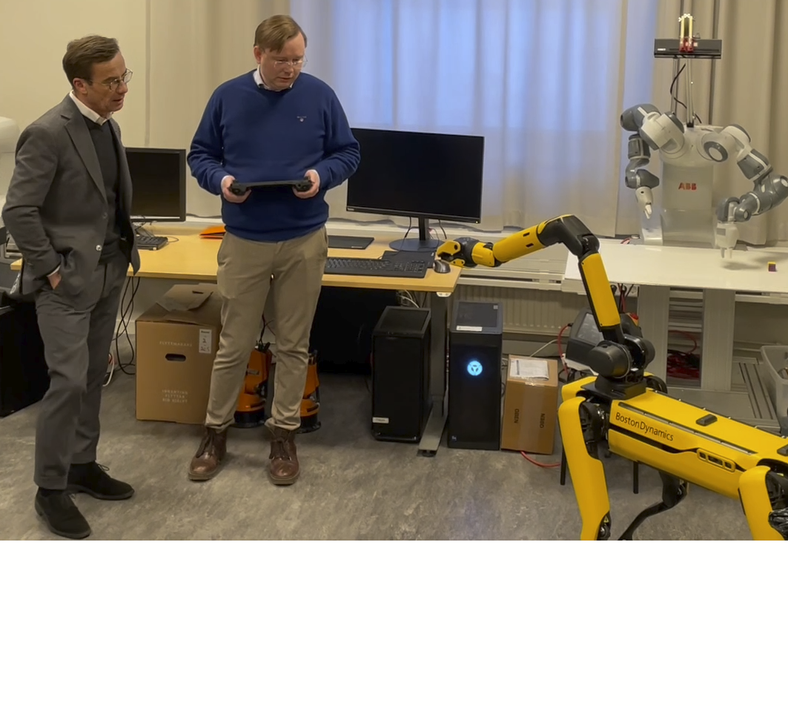
Olov Andersson is an Assistant Professor and WASP Fellow in AI for Autonomous Systems at KTH Royal Institute of Technology, leading the Division of Robotics, Perception and Learning. His research focuses on Embodied AI for autonomous robots and vehicles, combining advancements in Vision-Language Models (VLM), Large Language Models (LLM), and real-world navigation challenges. Key projects include the DARPA SubT Challenge-winning team CERBERUS and the EU H2020 Heron project for robotic road repair. He supervises multiple PhD students and postdocs, including Timon Homberger, Finn Lukas Busch, and Jesper Eriksson. Research interests emphasize full-stack autonomy in dynamic environments, including planning, mapping, and navigation. Notable contributions include the OneMap real-time open-vocabulary mapping system and self-supervised scene flow methods like Seflow. He has been recognized for technical leadership in autonomous systems through awards like the WASP Fellowship. Professional activities include co-chairing the 2024 IROS workshop on robot perception in dynamic environments and advising the Swedish Prime Minister’s AI initiative. Teaching roles span multiple graduate courses in machine learning, robotics, and systems engineering at KTH.
Professor Peter Schantz holds a position at the Department of Physical Activity and Health at GIH - The Swedish School of Sport and Health Sciences. He earned his Dr. med. sc. from the Karolinska Institute in 2015 and serves as Director of Gymnastics. His research focuses on the intersection of physiology, behavior, and environment, with emphasis on active commuting (walking/cycling), green environments, and sustainable development. He leads the 'Movement, Health and Environment' research unit and collaborates with Stockholm and Umeå universities. Education: Dr. med. sc. in Human Biology (Karolinska Institute, 2015) Research Interests: Integrative research on physical activity's role in public health and sustainability. Key areas include: Active commuting health impacts Green environments' health benefits Exercise physiology in real-world settings Grants: Swedish Research Council for Health, Working Life and Welfare (2012-2015): 'Potential for enhanced public health via car-to-cycling shifts' Labs/Teams: Research unit leader for 'Movement, Health and Environment', exploring urban mobility and health linkages.
Hans Linderholm serves as Professor and Head of the Department of Earth Sciences at the University of Gothenburg, Sweden, with office located at Medicinaregatan 7B, Gothenburg. His leadership position and active research portfolio demonstrate his central role in the university's earth sciences initiatives, focusing on climate system dynamics across multiple continents. Linderholm's research program centers on reconstructing past climate (last 2000 years) and projecting future climate (next 100 years) in Europe and Asia using dendrochronological methods. His work examines temperature, drought, and precipitation patterns through tree-ring analysis, with particular emphasis on large-scale atmospheric and oceanic circulation systems. Fieldwork spans North Europe, China, Canada, and North Africa, investigating how natural climate variability informs understanding of anthropogenic climate change and ecosystem impacts. Analysis of his 2023-2025 publications reveals dominant themes in dendroclimatology (especially blue intensity techniques), climate extremes reconstruction, and interdisciplinary climate-society interactions. His work increasingly connects paleoclimate data with contemporary climate change impacts on agriculture, public health, and marine ecosystems, demonstrating methodological innovation across temporal scales. No scientific awards were specified in the available information. While specific student advisees are not listed, Linderholm's extensive multinational collaborations—including the Sino-Swedish Centre for Tree-Ring Research—indicate active mentorship and significant grant funding for climate research projects. His editorial roles further demonstrate leadership in academic knowledge dissemination. He directs the Gothenburg University Laboratory for Dendrochronology (GULD) and participates in the Regional Climate Group and Sino-Swedish Centre for Tree-Ring Research, which provide critical infrastructure for high-resolution climate reconstruction studies across diverse geographical contexts.
Patrik Hernvall serves as an Associate Professor at Stockholm University's Department of Computer and Systems Sciences, holding dual expertise in pedagogics and media technology. His academic work spans teaching Human Sciences within MDI, Scientific Methodology and Communication in Computer and Systems Sciences, and Empirical Research Methodology for Computer and Systems Sciences, while supervising Bachelor's and Master's level students. His research interests focus on children's conditions in technology-dense environments, technology-supported learning, and school development opportunities, with particular emphasis on norm-critical theory and children's perspectives in research. Hernvall actively contributes to two major research groups: the Learning Analytics and AI for Education Group, which investigates data-driven methods to strengthen education, and the ReVisE Research Group, which explores how emerging technologies like IoT, AI, VR, and MR can enhance educational practice. Hernvall's recent publications reveal significant trends in educational technology research, with particular focus on emergency remote teaching during the pandemic, work-life boundary experiences in technology-mediated workplaces, assessment of multimodal texts, and children's understanding of digital economics. His work consistently bridges theoretical frameworks with practical educational applications, often employing design-based research methodologies. National research school in visual pedagogy and craft pedagogy (FoBoS) [2020 ff] Teacher movement patterns project [2022] IoT Hub School project [2018-2021] Children and the Digital Economy (BoDE) project [2016-2018] His advisory work includes supervision at Bachelor's and Master's levels, with research collaborations spanning schools and industry partners across Sweden. Hernvall's lab work centers around the ReVisE group's exploration of emergent technologies in educational contexts, with particular focus on innovative visualizations and real-world applications that enhance teaching and learning experiences.
Lawrence Sacco is a Researcher at Stockholm University's Department of Psychology, working within the Division for Epidemiology. His research focuses on stress-related illnesses and health problems in and outside the workplace, with particular emphasis on how health, physical activity, and work conditions change around retirement. Dr. Sacco's research interests span several interconnected domains: How providing informal care affects health and wellbeing Lifecourse influences on socioeconomic and health inequalities among older adults The potential disadvantages and benefits of ageing societies Work transitions and job quality in late career and post-retirement periods Caregiving and its relationship to sleep disturbance and quality of life His recent publication activity (2018-2023) demonstrates consistent productivity with a clear thematic focus on retirement transitions, informal caregiving, and late-career work quality. His work frequently employs cross-national comparative approaches, particularly examining differences between Sweden, Japan, and the United States. Dr. Sacco has made significant contributions to understanding how work beyond pensionable age is characterized by more flexible, rewarding, and less stressful employment. Dr. Sacco's scientific contributions include: Methodological advances in understanding publication overlap in umbrella reviews Empirical evidence on the relationship between caregiving intensity and health outcomes Cross-national comparisons of job quality in late career Analysis of wealth inequalities related to bridge employment As a supervisor, Dr. Sacco would offer expertise in gerontological research methods, longitudinal data analysis, and comparative aging studies. His work demonstrates strong collaboration with international researchers and engagement with policy-relevant questions about aging populations and workforce participation. His research group within the Division for Epidemiology focuses on improved understanding of how stress-related illnesses and health problems arise and can be prevented.