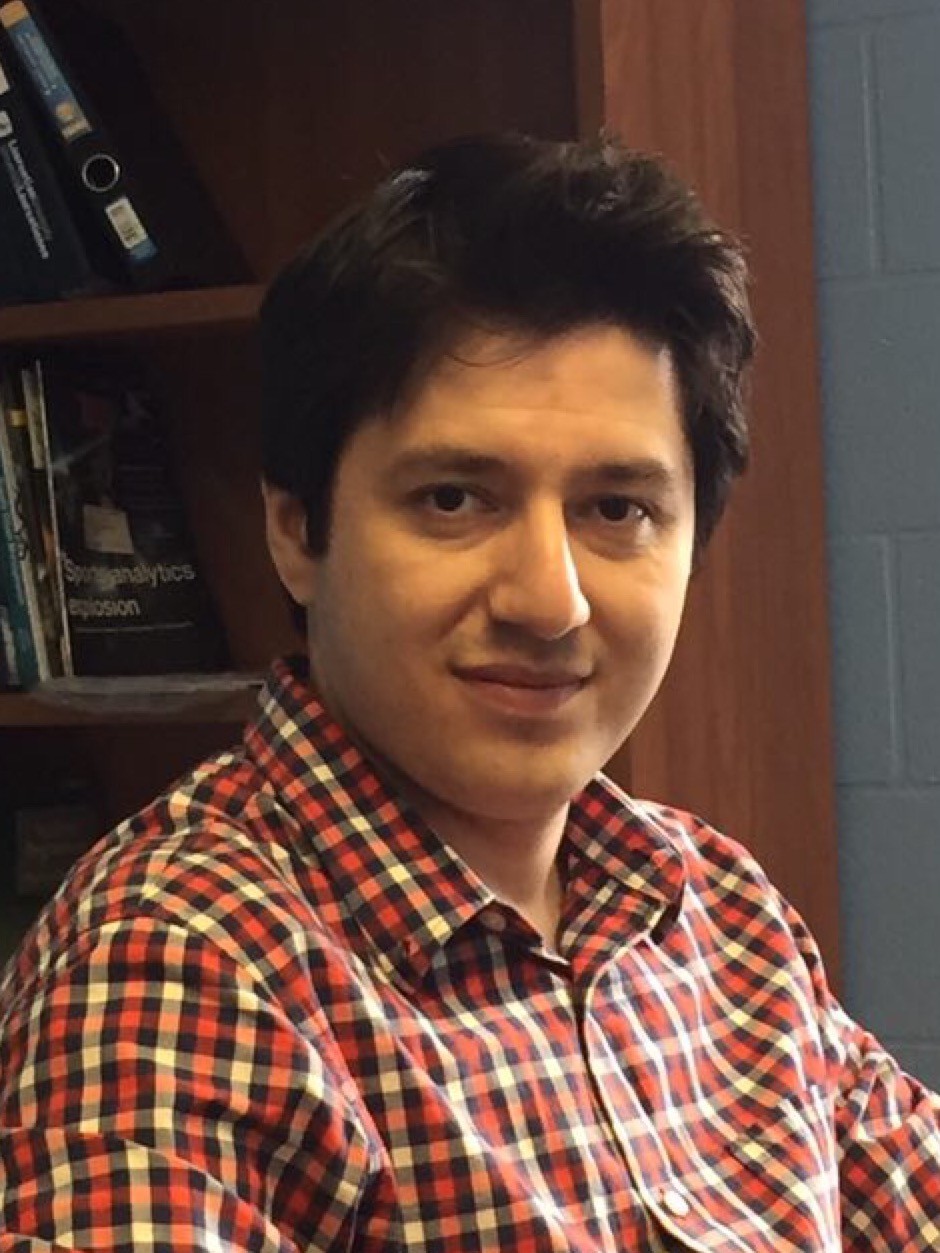
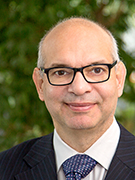
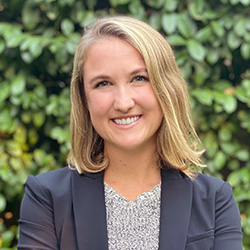
Dr. G M Wali Ullah is a finance academic at Flinders University's College of Business, Government and Law, with over 10 years of teaching experience in Australia and Bangladesh. His research spans Corporate Finance, Behavioral Finance, FinTech, Supply Chain Management, and Climate Finance. Ph.D. in Corporate Finance (University of Adelaide) MSc in International Finance (University of Westminster) BBA in Finance (East West University, Bangladesh) His work on managerial ability, supply chain power, and FinTech has been published in top ABDC-ranked journals like Energy Economics and British Accounting Review . Recent studies focus on climate finance, social capital in FinTech lending, and geopolitical impacts on crypto markets. Notable awards include the 2025 CBGL Teaching Innovation Award, Mace Bearer for Adelaide University's 2022 graduating class, and full scholarships for doctoral and postgraduate studies.
Caglar Kaya is a post-doctoral researcher at the Center for Corporate Governance within Copenhagen Business School . Holding a Ph.D. in Financial Economics from Lund University, his academic journey includes visiting scholar roles at the University of Illinois at Urbana-Champaign and graduate studies at Istanbul Bilgi University, University of Bologna, and Lund University. His research bridges corporate governance, corporate finance, and banking, with a focus on enterprise foundations and capital structure dynamics. Lund University: Ph.D. in Financial Economics (dissertation: Corporate Growth and Corporate Credit Risk) University of Illinois at Urbana-Champaign: Visiting Scholar (Finance Department) Istanbul Bilgi University: Master’s in International Finance (Banking & Accounting specialization) University of Bologna: Master’s in International Management Lund University: Master’s in Finance His research investigates governance and financial decision-making in unique ownership structures, particularly enterprise foundations (foundation-owned firms). Key projects compare these to publicly and family-owned firms, analyzing board governance, stakeholder relationships, and credit risk. Additional work explores internal capital markets in Swedish corporate groups, collateral’s role in financing, and relationship banking in cooperative banks. His publications reflect expertise in corporate growth dynamics (2019) and creditor governance (2024), with ongoing studies on foundation ownership implications. At Lund University, Caglar taught graduate courses including Financial Valuation & Risk Management, Fixed Income & Derivatives, and Mathematics in Finance. His industry background in audit and banking (five years at multinational firms) informs his empirical research approach. Current projects include analyzing enterprise foundations’ impact on corporate survival and financing strategies, as well as cooperative banks’ role in relationship banking.
Professor Daniel M. Kammen is a leading academic at the University of California, Berkeley , where he holds appointments across the Energy and Resources Group , the Goldman School of Public Policy , and the Department of Nuclear Engineering . As founding director of the Renewable and Appropriate Energy Laboratory (RAEL) and co-Director of the Berkeley Institute of the Environment , he bridges technical innovation with policy analysis to address global energy challenges. His research focuses on climate change mitigation, renewable energy systems, energy poverty, and the intersection of health and environmental policy. He has pioneered methods for assessing carbon offset quality, particularly in cookstove projects, and advocates for data-driven energy planning across sectors. Recent publications reveal Kammen's expertise in solar PV economics, urban energy potential, and the IPCC's role in climate action. His work spans techno-economic modeling, policy design, and equity analysis in energy transitions across high-income and low-income contexts. Nobel Peace Prize (2007) as IPCC coordinating lead author Director, Transportation Sustainability Research Center Co-Director, Berkeley Institute of the Environment Founding Director, Renewable and Appropriate Energy Lab Contributor to global energy poverty frameworks Advisor on US-China climate cooperation In media, Kammen has hosted the Discovery Channel's Ecopolis and appeared on 60 Minutes and Nova . His lab, RAEL, emphasizes 'use-inspired basic research' through collaborations with policymakers, industry, and community groups to accelerate the clean energy transition.
Tiago Gomes da Silva Tavares is an Assistant Professor in the Department of Economics at ITAM (Instituto Tecnológico Autónomo de México), with a concurrent affiliation at the University of Minho (Portugal). His research spans sovereign default , firm dynamics , international macroeconomics , and financial crises , with recent focus on Covid-19 economics and labor market distortions during debt defaults. Ph.D., Economics, University of Rochester, 2015 M.A., Economics, University of Rochester, 2011 M.A., Economics, Universidade Católica Portuguesa, 2009 B.S., Summa Cum Laude, Economics, Universidade Católica Portuguesa, 2007 His research interests include sovereign default mechanisms, firm investment behavior under credit constraints, pandemic data reporting effects, and fiscal policy in emerging economies. Key keywords are international reserves, working capital costs, managerial competition, and informality. Articles show trends in sovereign debt modeling , consumption volatility in small open economies, and skill premium dynamics linked to managerial practices. Major scientific awards include: University of Rochester Graduate Fellowship and Tuition Scholarship (2012-2014) Fulbright Scholarship (2009-2011) Honors Tuition Scholarship (Universidade Católica Portuguesa, 2003-2008)
Prof. Dr. Yarema Okhrin serves as Full Professor at the Department of Statistics and Data Science within the Faculty of Economics at the University of Augsburg. He leads the Chair of Statistics and Data Science, which is part of the Business Analytics & Operations and Finance, Accounting, Controlling & Taxation clusters. His research group includes Dr. Sebastian Heiden, Dr. Rui Ren, and several research assistants working on advanced statistical methods and their applications in business and economics. Professor Okhrin's research spans mathematical and statistical models for data-driven problems in business and economics, with particular expertise in statistics, data science, and machine learning. His work focuses on developing methodologies for time series analysis, portfolio optimization, risk management, and statistical process control. Recent research has expanded into high-dimensional statistics, image analysis, and network monitoring applications. Analysis of his recent publications (2023-2025) reveals a strong trend toward interdisciplinary applications of statistical methods, particularly in finance and process monitoring. His work demonstrates increasing integration of machine learning techniques with traditional statistical approaches, especially in portfolio optimization and risk assessment. A notable pattern is the development of specialized statistical methods for high-dimensional data analysis across multiple domains. Professor Okhrin supervises bachelor's and master's theses at the Department of Statistics, with research topics including data mining, time series modeling, forecasting methods, regression analysis, and statistical data analysis. His department offers thesis opportunities in specialized areas such as asymmetric dependencies in financial markets, forecasting, investor sentiment analysis, medical statistics, volatility modeling, multivariate distributions, sustainable investing, and portfolio optimization. The Chair of Statistics maintains active research collaborations and offers academic consulting on statistical issues and data analysis. The department hosts regular research seminars to facilitate exchange of ongoing research projects and maintains connections with industry partners for practical applications of statistical methods.
Kerstin Lopatta is a Professor at the University of Hamburg , Faculty of Business, Economics and Social Sciences, Department of Socioeconomics. Her research focuses on Accounting, Auditing, and Sustainability , particularly in the context of Corporate Social Responsibility (CSR), financial performance, and gender diversity. Current team member with Prof. Dr. Alexander Bassen Active in Journal of Sustainable Finance & Investment and other high-impact journals Collaborates on topics like managerial style, labor representation, and microfinance Her recent work investigates ESG index construction, gender dynamics in financial reporting, and the interplay between sustainability performance and equity costs . Publications include analyses of institutional dual holdings, CEO narcissism, and language patterns in corruption. No specific scientific awards are listed in the provided texts. She advises on corporate governance and has contributed to theoretical frameworks in financial accounting . The team operates within the Professorships Accounting, Auditing and Sustainability at the university, with no explicit mention of lab affiliations but extensive cross-country collaboration.
Dr. Amirmohsen Golmohammadi is an Assistant Professor in the Department of Operations Management at the Faculty of Business and Information Technology, Ontario Tech University. He joined Ontario Tech University after serving as an Associate Professor at Laurentian University. His academic expertise spans sustainable supply chain management, game theory, and stochastic optimization. Dr. Golmohammadi's educational background includes: PhD in Industrial Engineering, McMaster University, 2015 Dr. Golmohammadi's research focuses on sustainable supply chain management, examining how regulators can design effective environmental and social policies and how businesses can adapt to these regulations. He investigates collaborative approaches where companies work with supply chain partners, NGOs, and even competitors to enhance social and environmental responsibility. His methodological toolkit includes game theory, stochastic optimization, and machine learning to address complex sustainability challenges in supply chains. Analysis of Dr. Golmohammadi's recent publications reveals a strong emphasis on sustainability in supply chain management. His work spans social responsibility in supplier relationships, environmental regulation design, reliability improvement in assembly systems, and performance evaluation of financial institutions. The research demonstrates sophisticated applications of game theory and stochastic optimization to address real-world supply chain challenges, with particular attention to uncertainty, risk management, and sustainability considerations across various industries. Dr. Golmohammadi has taught several key courses in the business curriculum: Operations Management Purchasing and Sourcing Management Simulation for Business Operations Project Management With over three years of professional experience in the Information Technology and Oil and Gas industries prior to his academic career, Dr. Golmohammadi brings practical industry insights to his teaching and research. His work bridges theoretical operations research with practical business applications, particularly in the growing field of sustainable operations.
Prof. Dr. Matthias Scherer is a Professor of Risk and Insurance at the TUM School of Computation, Information and Technology since 2019, with a prior appointment as Professor of Mathematical Finance (2010–2019). He is actively involved in bridging academic research and industry practice through memberships in the board of the Deutsche Gesellschaft für Versicherungs- und Finanzmathematik , leadership of the graduate school ISAM , and editorial roles for scientific journals. University of Ulm: Diplom in Business Mathematics (2005) Syracuse University (USA): Master of Science in Mathematics (2004) University of Ulm: Doctorate in Structural Credit-Risk Models (2007) Research Interests span actuarial science , mathematical finance , and stochastic modeling , with a focus on: Valuation of complex financial/insurance products Dependency structures and copula modeling Credit portfolio analysis Quantitative risk management Cyber risk and parametric insurance Stochastic gradient algorithms and simulation Scientific Awards include multiple Golden Circle Teaching Awards (2010, 2012, 2017), the Gauss Award (2011), and the ISAM Supervisory Award (2018). He leads the RiskFactory lab and collaborates with industry partners like Allianz , Munich Re , and Celonis through the TUM CAIR Labs initiative.
Stephan Heblich is a Professor in the Department of Economics at the University of Toronto and cross-appointed to the Munk School of Global Affairs and Public Policy. His research focuses on spatial disparities in the distribution of economic and cultural amenities, their impact on house prices, innovation, entrepreneurship, and regional voting behavior, with a strong emphasis on historical developments explaining modern phenomena. Key research areas: Economic Geography, Urban Economics, Political Economy, Economic History, and Public Policy Editorial board member of leading journals: Journal of Urban Economics , Regional Science and Urban Economics , Journal of Economic Geography His work often uses historical events to establish causality, such as analyzing the long-term effects of 19th-century pollution on urban inequality ( East Side Story ) or migration patterns post-WWII. Recent studies include the economic consequences of shale gas exploration ( Market Tremors ), the impact of rail disinvestment ( The Beeching Axe ), and the role of cultural amenities in economic growth ( Music in the Air ). Media outlets like The Economist , Vox EU , and Freakonomics Radio have featured his research. He has collaborated extensively with scholars like Alex Trew, Yanos Zylberberg, Christian Dippel, and Stephen Redding. His methodological contributions include causal mediation analysis tools for instrumental variables regressions ( ivmediate ). While no explicit scientific awards are mentioned, his editorial roles and media presence indicate significant academic influence.
Ridoan Karim is a Senior Lecturer at the Department of Business Law & Taxation, School of Business, Monash University Malaysia. His work bridges Business Law, International Trade Law, Environmental Law, Energy Law, and Technology Policy , with a focus on energy justice, AI ethics, blockchain applications, and legal frameworks for emerging technologies . Primary Research Areas: Energy Justice, AI Ethics, Blockchain Legal Issues, Privacy Law, and Sustainable Development Geographic Focus: Malaysia, Bangladesh, and broader Southeast Asian contexts Recent Research Trends His publications from 2018-2025 show consistent exploration of: Legal implications of AI integration in energy, healthcare, and manufacturing Blockchain technology for energy systems, health coverage, and financial transparency Energy justice frameworks across Southeast Asia and emerging economies Privacy law development in smart cities and digital environments Comparative legal studies between common law and Islamic/Shari'ah frameworks Scientific Awards No specific awards mentioned in available texts.
Karyl B. Leggio is Professor of Finance at Loyola University Maryland’s Sellinger School of Business, where she researches retirement decumulation, credit-risk analytics, and sustainable-finance applications. A Certified Risk Manager and Fulbright Specialist (2020), she has published extensively on the viability of traditional withdrawal rules, the predictive power of CDS models versus credit ratings, and the use of Monte-Carlo simulation in public-sector sustainability planning. Education: Ph.D. Finance, University of Kansas MBA, East Tennessee State University B.S. Business, Virginia Tech Research focus: Her recent work challenges the long-standing 4 % withdrawal guideline for retirees, proposes quarterly decumulation strategies to mitigate sequence-of-returns risk, and compares Bloomberg CDS-implied models to traditional credit ratings. Other streams examine herding during the 2010 Flash Crash, efficiency of bank branches via DEA, and pedagogical innovations such as flipped ethics courses and MOOC adoption. Scientific recognition: Fulbright Specialist Appointee, 2020 STAR Research Award, 2019 Sellinger Scholars Leadership Speaker, 2015 Multiple “Who’s Who” listings 2002-2010 Professional engagement: Continuous member of the Financial Management Association, American Finance Association, Midwest, Southern and Eastern Finance Associations since the mid-1990s; Certified in Risk Management since 2006. While specific doctoral advisees are not enumerated, her case supervision and teaching awards indicate active student mentorship.
Alan L. Kolata serves as the Bernard E. and Ellen C. Sunny Distinguished Service Professor in the Department of Anthropology at the University of Chicago, with additional affiliations through the Committee on Southern Asian Studies and the Committee on Environment, Geography and Urbanization. His academic foundation includes a PhD from Harvard University (1978), establishing his expertise in archaeological and anthropological methodologies. Dr. Kolata's research spans archaeology and ethnohistory, preindustrial urbanism, agricultural systems, and human-environment interactions, with regional focus on the Andes, Mesoamerica, and Southeast Asia. His recent work emphasizes agroecological systems, the human dimension of global change, and urban social ecology, particularly through the Cambodia Project which investigates socio-ecological transformations in the Lower Mekong Basin. His interdisciplinary approach integrates environmental science, anthropology, and development studies to analyze ancient civilizations and contemporary migration patterns. His publication record reveals consistent focus on Andean civilizations (especially Tiwanaku and Inca) and Southeast Asian environmental dynamics, with increasing emphasis on climate change impacts and rural-urban migration since 2010. Recent works demonstrate sophisticated integration of hydrological modeling, paleoenvironmental data, and ethnographic fieldwork. His primary scientific recognition includes the Bernard E. and Ellen C. Sunny Distinguished Service Professorship. Bernard E. and Ellen C. Sunny Distinguished Service Professorship Dr. Kolata has secured significant funding from the Neubauer Collegium, Center for International Social Science, Social Science Research Center at the University of Chicago, and National Science Foundation. His research group employs mixed-method approaches including household surveys, socio-economic censuses, and distributed ethnography to study environmental transformation, migration, and urbanization, particularly examining how large-scale infrastructure projects reshape human-environment relationships. He directs the Cambodia Project Research team, which investigates lived experiences of rural-to-urban migrants, analyzing economic, environmental, and social drivers of migration while documenting changing connections to place and community in the context of dam construction and economic transformation.
Hinrich Julius is Professor of Civil Law and Legal Dialogue with Emerging Countries at the University of Hamburg's Faculty of Law since March 2010, coordinating the EU-funded "China-EU School of Law" project. Previously, he held full professorships at Hochschule Wismar (1997-2000) and Hochschule für Angewandte Wissenschaften Hamburg (2000-2004), and served as head of GTZ's legal cooperation office in Beijing (2004-2009). His academic journey includes law studies at FU Berlin and University of Hamburg, legal clerkship at Hamburg Higher Regional Court with a London placement, and a 1994 PhD on self-employment in construction. Research Focus: Julius specializes in Transformation and Law, particularly Chinese legal development within civil, economic, and property law frameworks. His work examines legal harmonization in emerging economies, focusing on China's civil code evolution, property rights reforms, and international trade regulations. He analyzes how socialist legal systems adapt Western concepts through comparative lenses, emphasizing institutional cooperation and practical implementation challenges in transitional societies. Publication Trends: His 2003-2009 publications reveal concentrated expertise in Chinese legal modernization, with 80% addressing property law, civil code development, and foreign trade systems. Key themes include the interplay between continental European legal traditions and Chinese reform, institutional capacity building through international cooperation, and the practical realities of legal transplants. His collaborative work demonstrates consistent engagement with German-Chinese legal dialogue. Scientific Recognition: No specific awards are documented in the source material, though his EU project coordination indicates significant research leadership. Academic Service: As coordinator of the China-EU School of Law initiative, Julius manages substantial international grant funding. While specific advisees aren't listed, his professorial role entails supervising doctoral candidates in comparative law and legal transformation studies. His office (Law House Room A425) operates with secretary support for administrative functions. Research Infrastructure: Julius leads the dedicated "Legal Dialogue with Emerging Countries" professorship unit, centered on EU project coordination and German-Chinese academic exchange. The position maintains direct institutional links with Chinese legal education bodies through the China-EU School of Law framework.
Dr. Hüseyin Doluca is a Researcher at the University of Augsburg's Faculty of Business and Economics, Department of Business Administration, where he works at the Chair of Innovation Management and International Sustainable Business under Prof. Dr. Marcus Wagner. Holding a postdoctoral position since 2014, he previously served at the University of Würzburg's Chair of Entrepreneurship and Management from 2010 to 2014, establishing himself in German academic business research. Education: Bachelor's in Business Administration (statistics, marketing, information systems focus) from University of Marburg M.Sc. in Management from University of Texas at Dallas (2001) Master’s in Business Research from Goethe University Frankfurt PhD in Quantitative Economics from Ludwig Maximilian University of Munich Research stay at Erasmus University Rotterdam's Department of Applied Economics His research integrates entrepreneurship, sustainability, and innovation with methodological rigor, combining formal modeling and empirical approaches including laboratory experiments. Key investigations examine sustainable entrepreneurship motivations, environmental innovation in family firms, and CSR-financial performance linkages, consistently emphasizing practical applications for bridging academic theory and business practice. Analysis of his 2019-2025 publications reveals expanding interdisciplinary scope—from core sustainability and family business research into banking risk regulation and sovereign ratings—while maintaining focus on practical implications. Recent work on 'Convertible/Bail-Inable Dividend Bonds' demonstrates innovative financial regulation approaches, complementing ongoing studies of green entrepreneurial intentions and environmental CSR mechanisms. Grants and Knowledge Transfer: Principal Investigator for BMBF-funded WIR (Wissenstransfer Region Augsburg) project fostering academia-business collaboration Third-party funding for knowledge and technology transfer initiatives across regional industries Doluca actively mentors student founders through university entrepreneurship programs while leading the WIR initiative's practical implementation. This platform connects academic research with regional business needs through workshops, joint projects, and innovation labs, directly supporting sustainable business model development in Bavaria's industrial ecosystem.
Alex Steiny Wellsjo is an active Assistant Professor of Economics and Strategy at the Rady School of Management, University of California San Diego. With a PhD in Economics from UC Berkeley and postdoctoral training at the Haas School of Business, Wellsjo combines economic theory with psychological insights to study individual behavior. Education : PhD in Economics (UC Berkeley), Postdoctoral Training (Haas School of Business) Research Focus : Applied microeconomics with emphasis on behavioral economics, health economics, and household finance. Key themes include: Habit formation and automaticity in organizational settings Productivity optimization through behavioral interventions Inflation's impact on housing market decisions Data-driven fintech innovations and their economic consequences Recent Publications demonstrate interdisciplinary trends in behavioral economics, with applications spanning healthcare compliance, financial decision-making, and productivity management. His work employs audit studies, longitudinal data, and real-effort experiments. Collaborations include researchers from multiple institutions in economics, psychology, and business fields. Wellsjo maintains active research in: Behavioral interventions for organizational performance Self-regulation across life-course stages Technological impacts on financial services