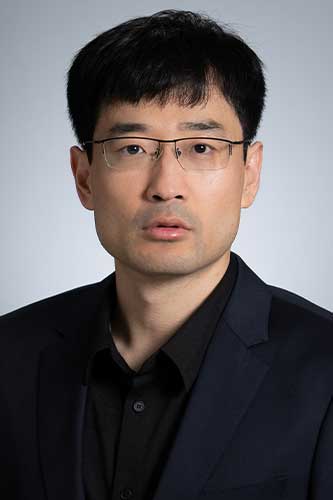
Yuanchang Xie serves as Professor in Civil and Environmental Engineering at UMass Lowell's Francis College of Engineering, where he leads research in the Center for Smart Cyber-Physical Systems. His work integrates computational methods with transportation infrastructure analysis, focusing on safety-critical applications through federal partnerships. Dr. Xie earned his Ph.D. in Civil Engineering from Texas A&M University (2007), preceded by M.S. and B.S. degrees in Transportation Engineering from Southeast University, China (2003, 2000). His academic foundation supports interdisciplinary research bridging civil engineering and cyber-physical systems. Research centers on traffic safety, intelligent transportation systems, and logistics optimization. He pioneers AI-driven approaches for crash prediction, connected vehicle operations, and infrastructure monitoring, emphasizing real-world implementation through partnerships with USDOT and state agencies. Current work explores multimodal data fusion for safety analytics in mixed-autonomy environments. Recent publications (2024-2025) reveal accelerating focus on deep learning applications: crosswalk detection via drone imagery, trajectory prediction in mixed traffic, and real-time work zone safety monitoring. This evolution demonstrates strategic alignment with emerging transportation technologies while maintaining core safety objectives. No scientific awards were explicitly documented in source materials. Dr. Xie has secured continuous funding as Principal Investigator through NSF, USDOT, DOE, and USDA programs. Key projects include Connected Vehicles: Toward the Understanding of "Firm Science" (NSF), Center of Multi-Scale Sensing Technologies (USDOT), and nuclear evacuation modeling for rural communities (USDA). His grants consistently address infrastructure resilience through cyber-physical integration. He directs research activities within UMass Lowell's Center for Smart Cyber-Physical Systems, which develops sensor networks and computational models for transportation infrastructure monitoring. The center's work on drone-based inspection systems and emergency response logistics demonstrates practical applications of his theoretical frameworks.