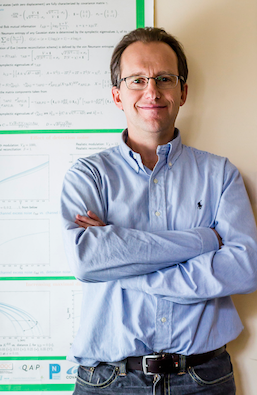
Andrej Bogdanov is a Professor at the University of Ottawa in the School of Electrical Engineering and Computer Science . He earned his B.S. and M.Eng. from MIT and Ph.D. from UC Berkeley . Before joining Ottawa, he held positions at the Chinese University of Hong Kong , ITCS (Tsinghua) , DIMACS (Rutgers) , and the Institute for Advanced Study . He has served as a Visiting Professor at the Tokyo Institute of Technology (2013) and the Simons Institute (2017, 2021). Research Interests : Computational complexity, cryptography foundations, pseudorandomness, one-way functions, property testing, quantum algorithms, and sublinear-time algorithms. Teaching : Courses on Discrete Mathematics, Great Algorithms, Computational Complexity, and Cryptography at University of Ottawa, Chinese University of Hong Kong, and Rutgers University. Publications : 15+ recent works in TCC , CRYPTO , ICALP , RANDOM , and journals like Journal of Cryptology and Theory of Computing . Service : Program co-chair for SAC 2026 , and committee member for major conferences including CRYPTO , TCC , Eurocrypt , and FOCS . Advising : 12 current and former Ph.D./M.Phil. students, with postdoctoral advisees at institutions like IIT Palakkad and Academia Sinica . His work bridges theoretical computer science with applications in cryptography, quantum computing, and network security.
Claudia Klüppelberg is a Professor and Chair of Mathematical Statistics at the Center for Mathematical Sciences, Technische Universität München (TUM). Her academic journey includes positions at ETH Zurich, University of Mainz, and TUM since 1997. She holds a Carl von Linde Senior Fellowship at TUM-IAS, focusing on Risk Analysis and Stochastic Modeling. Her research bridges applied probability, statistics, and their applications in finance and insurance, emphasizing extreme value theory, risk processes, and stochastic networks. She has received prestigious awards such as the New Frontiers in Risk Management Award (2007) and Cross of Merit (2001). Her work addresses real-world challenges in financial risk management, including systemic risk in networks and operational risk modeling. Her recent publications explore causal analysis of extreme risks in networks, max-linear models, and Bayesian networks for extreme events. She contributes to academic leadership as an editorial board member and advisor, promoting interdisciplinary stochastic sciences.
Michael Zurel is a NSERC Postdoctoral Fellow in the Department of Mathematics at Simon Fraser University, working under Dr. Nadish de Silva, Canada Research Chair in the Mathematics of Quantum Computation. His research focuses on foundational aspects of quantum computation, quantum information, and nonclassical physics. Key interests include quantum contextuality, negativity in quasiprobability representations, and classical simulation algorithms for quantum systems. He holds a PhD, MSc, and BSc in Physics and Mathematics from the University of British Columbia (2024, 2020, 2019), all supervised by Dr. Robert Raussendorf. His doctoral work explored classical descriptions of quantum computations via hidden variable models and quasiprobability representations. His master’s thesis addressed hidden variable models and classical simulation algorithms for quantum computation with magic states on qubits. Research interests emphasize bridging quantum foundations with computational efficiency, particularly how nonclassical features like contextuality enable quantum advantage. Collaborators include prominent figures such as Robert Raussendorf, Juani Bermejo-Vega, and Cihan Okay. His scientific achievements include the NSERC Postdoctoral Fellowship. Advising and grants are not explicitly detailed, but his work is supported by foundational research grants. He collaborates actively within quantum information theory and computational physics communities.
Professor Michelle Y Simmons AO is a Laureate Fellow and Director of the Centre of Excellence for Quantum Computation and Communication Technology at UNSW Sydney. She founded Silicon Quantum Computing (SQC), Australia's first vertically integrated quantum computing company, and pioneered atomic electronics by creating devices in silicon with atomic precision. Research focuses on quantum computing, spin qubits, and atomic-scale engineering Key achievements: first quantum gates with donor atoms, 3D atomic chip architecture Recent publications highlight advancements in silicon qubit fabrication, quantum coherence, multi-qubit control, and noise mitigation. These works emphasize scalable architectures and practical quantum computing solutions. Scientific awards include: 2023 Prime Minister’s Prize for Science 2023 Swiss Erna Hamburger Prize 2022 AmCham Alliance Award 2021 Bakerian Medal 2018 Australian of the Year 2017 L’Oréal-UNESCO Laureate Her leadership in quantum research has secured major industry partnerships (CBA, Telstra, Commonwealth Bank) and driven the development of silicon-based quantum technologies. Current work involves optimizing spin qubit performance and exploring applications of quantum computing in materials science and information processing.
Pierre ALQUIER is a Professor at ESSEC Business School (Singapore) since 2023, specializing in statistical learning and machine learning. Previously, he held professorships at ENSAE Paris (2014–2019) and the University of Dublin (2012–2014). He earned his PhD in Mathematical Statistics from Pierre and Marie Curie University in 2006, with a focus on advanced statistical methodologies. His research centers on Bayesian methods, PAC-Bayes bounds, high-dimensional data analysis, and robust estimation, with applications in quantum computing and time series. He has authored over 60 peer-reviewed articles, including influential works on kernel mean embeddings and meta-learning. Alquier has received the 2019 Best Paper Award at the Asian Conference on Machine Learning. He actively contributes to academic leadership, serving as an associate editor for leading journals like the Journal of Machine Learning Research and organizing international workshops. His educational contributions include co-supervising multiple doctoral theses on topics like robust Bayesian inference and non-negative matrix factorization. Education: PhD in Mathematical Statistics (2006), Pierre and Marie Curie University MSc in Probability Theory and Statistics (2003), Pierre and Marie Curie University Diploma in Statistician-Economist (2003), ENSAE Research Focus: Machine learning theory, PAC-Bayes bounds, Bayesian computation, high-dimensional statistics, quantum tomography, and time series forecasting. Grants & Activities: Member of key academic societies (IMS, SFdS), reviewer for top conferences (NeurIPS, ICML), and organizer of workshops on approximate Bayesian inference and high-dimensional data analysis. His recent work emphasizes robust regression, meta-learning, and the theoretical foundations of deep learning, often addressing challenges in dependent data and model misspecification. He has developed R packages like regMMD for robust statistical estimation.
Corrado Loglisci is an Assistant Professor at the Department of Computer Science, University of Bari Aldo Moro, Italy. His research focuses on Temporal Data Mining , Machine Learning , and Quantum Computing , with applications in bioinformatics, medical informatics, and cybersecurity. He earned his Ph.D. in Computer Science with a thesis on temporal projection in longitudinal data. Research Highlights : Temporal Learning, Textual Data Mining, Quantum-Classical Hybrid Systems Collaborations : IRSTEA Research Institute (France), Aristotle University of Thessaloniki (Greece) His publications address dynamic network analysis , emotion detection in social media , and quantum-enhanced classification . He contributes to program committees and journal editorial work, including a special issue on Mining Complex Patterns in the Journal of Intelligent Information Systems . Notable contributions include the jKarma framework for change detection and studies on concept drift robustness in intrusion detection systems. His work spans European/National research projects, leveraging machine learning for tasks like mobile crowd sensing trustworthiness prediction (2020) and investor behavior analysis (2023-2025).
Bojko Bakalov is a Professor in the Department of Mathematics at North Carolina State University (NC State), serving as Director of Graduate Programs in Mathematics and Applied Mathematics. He also holds the role of Associate Director of the NC State Quantum Initiative. His research focuses on mathematical physics, quantum computing, representation theory, signal processing, and integrable systems. Bakalov earned his PhD in Mathematics from the Massachusetts Institute of Technology (MIT) in 2000. He has made significant contributions to quantum information processing, including work on barren plateaus in quantum circuits and geometric quantum machine learning. He leads a $10M DOE-backed quantum computing research project and is involved in organizing the Quantum Information Processing conference series. His research is supported by grants such as the NSF-funded Quantum Information Science initiative. Education: PhD in Mathematics, MIT (2000) His research interests span quantum computing algorithms, representation theory of vertex algebras, and applications of algebraic methods to integrable systems. Notable achievements include the development of quantum coherent state transforms and the classification of dynamical Lie algebras in spin systems. Bakalov is actively involved in advancing quantum technologies through interdisciplinary collaborations. His publications explore topics such as logarithmic vertex algebras, Poisson pseudoalgebras, and quantum signal processing. He is affiliated with the Algebra and Combinatorics Research Group and the Topology, Geometry, and Mathematical Physics Research Group at NC State. Grants and Leadership: Leads DOE quantum computing projects and directs graduate programs, shaping the next generation of mathematicians and quantum scientists. Labs/Teams: Part of the NC State Quantum Initiative, fostering collaborative research in quantum technologies.
Roman Frigg is Professor of Philosophy at the London School of Economics and Political Science (LSE) , affiliated with the Department of Philosophy, Logic and Scientific Method . He serves as Director of the Centre for Philosophy of Natural and Social Science (CPNSS) and Co-Director of the Centre for the Analysis of the Time Series (CATS) . Holding a PhD from the University of London and MScs in theoretical physics and philosophy from the University of Basel, his research spans philosophy of science , statistical mechanics , and climate modeling . Education : PhD (University of London), MSc (University of Basel: Theoretical Physics, Philosophy) His work addresses foundational questions in statistical mechanics and thermodynamics , including equilibrium theory, entropy interpretation, and relations between Boltzmannian and Gibbsian frameworks. Recent publications focus on probabilistic forecasts in chaotic climate models , culminating in the co-authored book The Fundamentals of Thermodynamics (Springer, 2025). Articles explore topics like the Ergodic Hierarchy , GRW quantum theory , and robustness analysis in climate science. Roman has made significant contributions to reconciling deterministic dynamics with objective probability via Humean interpretations. His collaborations with Charlotte Werndl, Carl Hoefer, and David Lavis have produced key insights into typicality , chaos-randomness relations , and non-equilibrium thermodynamics . Scientific Awards : Friedrich Wilhelm Bessel Research Award (Alexander von Humboldt Foundation) Roman supervises PhD students on topics ranging from scientific representation to quantum mechanics and climate policy uncertainty . His website provides access to his publications and teaching materials.
Dr. Masoud Ghalaii is a Lecturer in Quantum Information at the Department of Computing and Mathematics, Manchester Metropolitan University (UK). He holds a PhD in Electrical Engineering (Quantum Communications) from the University of Leeds (2019), and has conducted postdoctoral research at the University of York and the University of Leeds, focusing on quantum technologies. His academic career includes visiting research at Institut Polytechnique de Paris-Telecom ParisTech (2015). Education: PhD, University of Leeds (2019) MSc, Sharif University of Technology (2014) BSc, Isfahan University of Technology (2011) Research Interests: Dr. Ghalaii’s work centers on quantum information science and quantum optics, with applications to quantum communication networks, quantum key distribution (QKD), and quantum repeaters. He has organized workshops (e.g., White Rose Quantum Information Science and Technologies Workshop 2024) and contributed to editorial roles (e.g., Special Issue on Quantum Communication Networks for Entropy Journal). His research emphasizes secure quantum communication protocols, hybrid quantum-classical systems, and turbulence-resistant quantum networks. Publications: His recent articles explore topics like CV-MDI-QKD, satellite-based QKD, and quantum communication in turbulent environments. These contributions highlight advancements in secure quantum communication frameworks and their practical implementation across diverse networks. Affiliations & Roles: He serves as a reviewer for international journals/conferences in quantum information and optics. His expertise bridges theoretical developments with applied quantum technologies, positioning him as a key figure in advancing quantum communication infrastructure.
Nicolas Cerf is a Full Professor at the Ecole Polytechnique de Bruxelles, Université Libre de Bruxelles (ULB), where he heads the Centre for Quantum Information and Communication (QuIC). He has been a faculty member at ULB since 1998, initially as an associate professor and promoted to full professor in 2009. Cerf maintains visiting appointments at Caltech, MIT, and the University of Arizona, demonstrating his international standing in the quantum information community. His educational background includes a M.Eng. in Electronics and Telecommunication (1987), M.Sc. in Physics (1988), and Ph.D. in Physics (1993), all from ULB. After his PhD, he was awarded a Marie Curie fellowship and worked at the University of Paris XI, followed by research faculty positions at Caltech before returning to ULB. Nicolas Cerf's research focuses on quantum information science, with significant contributions including the discovery of the role of negative (conditional) entropies in quantum information theory, development of continuous-variable quantum cloning and cryptographic protocols, invention of the adiabatic quantum search algorithm, and establishing the fundamental quantum limit on information transmission via Gaussian bosonic channels. His work spans quantum information theory, quantum cryptography, quantum computation, quantum optics, and quantum foundations. His recent publications (2023-2025) demonstrate continued innovation in quantum information processing, particularly in boson sampling validation, Wigner entropy theory, majorization applications, and quantum channel capacities. These works show a consistent focus on both theoretical foundations and practical applications of quantum information principles. Marie Curie Excellence Award (2006) Caltech President's Fund award (1997) Alcatel-Bell scientific prize (1999) Prize of the Wernaers fund awarded by the Belgian National Fund for Scientific Research (FNRS) (2000) Elected member of the Royal Academies for Science and the Arts of Belgium (2009) COVAQIAL project nominee for 2007 Descartes Prize Nicolas Cerf has supervised numerous PhD students including Sofyan Iblisdir, Jérémie Roland, Gilles Van Assche, and many others. He has hosted many postdocs and senior scientists. His research has been supported by numerous European projects across multiple Framework Programs, including EQUIP, CHIC, RESQ, SECOQC, COVAQIAL, QAP, COMPAS, HIPERCOM, QALGO, QUCHIP, ShoQC, and AppQInfo. As head of QuIC, Cerf leads a research team exploring cutting-edge topics in quantum information. The group maintains strong international collaborations and has been instrumental in establishing Belgium as a significant player in quantum information research. The team's work bridges theoretical developments with potential applications in quantum communication, quantum computing, and quantum cryptography.
Dr. Jacob Taylor is an Adjunct Professor at the University of Maryland and a Fellow at the Joint Quantum Institute (JQI) and the National Institute of Standards and Technology (NIST). His research focuses on quantum information science, dark matter detection, and the development of quantum sensors. Taylor leads the Taylor Research Group, which explores mechanical quantum sensing, quantum computing applications, and gravitational interactions. He has advised numerous graduate students, including Prabin Adhikari, Andrew Glaudell, and Haitan Xu, and collaborates with postdoctoral researchers such as Vanita Srinivasa and Minh Tran. His work spans theoretical and experimental domains, with notable contributions to dark matter detection methodologies, including proposals for ultraheavy dark matter searches using mechanical pendulums and optomechanical sensors. Taylor has also pioneered quantum computing automation techniques, leveraging machine learning to optimize quantum dot systems. His research has been recognized with prestigious awards, including the 2020 Department of Commerce Gold Medal for expanding U.S. leadership in quantum information science. In recent years, Taylor's team has published extensively on topics like backaction-evading receivers, cavity-mediated spin qubit entanglement, and pressure sensing via atomic collisions. These studies highlight his interdisciplinary approach, blending quantum mechanics, engineering, and computational methods. His laboratory work emphasizes both fundamental physics and practical applications, such as improving cryogenic systems for dark matter experiments like DarkSide-20k. Awards: Department of Commerce Gold Medal Award (2020) Grants and Funding: Supported by NIST and DOE projects in quantum sensing and dark matter detection Lab Affiliations: Taylor Research Group (JQI), QuICS (Quantum Information and Computer Science)
Alexander R.H. Smith, Ph.D., is an Assistant Professor of Physics at Saint Anselm College and holds an adjunct appointment at Dartmouth College. His research employs information-theoretic methods to investigate quantum theory and gravitational physics, focusing on quantum time dilation, relational quantum mechanics, and quantum field theory in curved spacetimes. Education Ph.D. in Theoretical Physics, University of Waterloo, Canada (2017) Ph.D. in Theoretical Physics, Macquarie University, Australia (2017) M.Sc. in Theoretical Physics, University of Toronto, Canada (2012) B.Sc. in Physics, University of Waterloo, Canada (2011) Academic Appointments Assistant Professor of Physics, Saint Anselm College (2020–present) Adjunct Assistant Professor, Dartmouth College (2020–present) Junior Fellow, Society of Fellows, Dartmouth College (2017–2020) Postdoctoral Fellow, National Science and Engineering Research Council of Canada (2017–2019) Research Interests Smith's research adopts John Wheeler's 'radically conservative' approach, pushing quantum theory and general relativity to their extremes. Key areas include: Quantum Time Dilation : Exploring quantum corrections to relativistic time dilation using superposed clocks. Relational Quantum Physics : Developing frameworks for quantum reference frames to eliminate classical dependencies. Quantum Field Theory in Curved Spacetime : Studying operational probes like Unruh-DeWitt detectors to analyze spacetime effects. Satellite-Based Tests : Leveraging quantum technologies for experimental tests of general relativity. Publication Trends Recent articles (2019–2021) concentrate on quantum time dilation, relational dynamics, and entanglement in curved spacetimes, with experimental implications for fundamental physics. Earlier work (2016–2018) established foundations in quantum reference frames and relativistic quantum information. Awards and Fellowships Junior Fellow, Society of Fellows, Dartmouth College (2017–2020) Postdoctoral Fellowship, NSERC Canada (2017–2019) Smith teaches undergraduate physics courses including Calculus-Based Physics, Classical Mechanics, and Quantum Mechanics.
Dr. Roberta Zambrini is a CSIC Senior Scientist and Deputy Director at the Institute of Interdisciplinary Physics and Complex Systems (IFISC), a joint institute between the Spanish National Research Council (CSIC) and the University of the Balearic Islands (UIB). She holds a prominent position in quantum physics research with significant contributions to complex quantum systems. Her research spans Complex and Open Quantum Systems , Quantum Networks , Quantum Synchronization , and more recently Quantum Machine Learning . Dr. Zambrini has pioneered work in quantum reservoir computing and quantum associative memories, bridging theoretical quantum physics with practical information processing applications. Dr. Zambrini has led numerous significant research projects including QuaResC (Quantum machine learning using reservoir computing), QUAREC, and QuProCS (an EU Horizon 2020 project). Her publication record shows consistent high-impact contributions in quantum information science, with recent work focusing on quantum machine learning implementations and theoretical frameworks. Her scientific recognition includes: Guarantor of the 'Unit of Excellence Maria de Maeztu' Award (2018-2022) Coordinator of CSIC's White Paper on Digital and Complex Information Divisional Associate Editor of Physical Review Letters since 2020 As an educator, she teaches in the Master in Physics of Complex Systems program, specializing in quantum aspects of complex systems. She actively mentors doctoral students in the Physics doctoral program and has organized numerous international workshops on quantum complex systems, demonstrating strong leadership in her field.
Prof. Kurt Busch is a Professor of Theoretical Optics & Photonics at Humboldt University of Berlin and Group Leader at the Max-Born-Institute, with prior appointments at Karlsruhe Institute of Technology (2005-2011) and University of Central Florida (2004-2005). His research focuses on light-matter interactions in complex photonic systems, spanning quantum technologies to nanoscale optical phenomena. His educational background includes: Diplom in Physics, Universität Karlsruhe (TH), 1993 PhD in Physics, Universität Karlsruhe (TH) and Iowa State University, 1996 Postdoctoral Research, University of Toronto (Prof. Sajeev John), 1997-2000 Busch's research encompasses quantum photonics, nano-photonics, computational optics, photonic crystals, plasmonics, random media, fluctuation-induced phenomena, and Group-IV photonics. His work combines theoretical modeling with computational approaches to investigate light propagation in disordered and nanostructured materials, with applications in quantum information processing and advanced optical devices. Key methodologies include time-domain simulations and quantum electrodynamics frameworks for non-equilibrium systems. Analysis of his 15 most recent publications (2021-2025) reveals dominant trends in quantum optics (40% of articles), non-Hermitian photonics (25%), and computational nanophotonics (35%). Significant subfield intersections include topological protection in quantum states, Casimir-Polder force engineering, and nonclassical light manipulation via waveguide architectures, reflecting his group's focus on bridging fundamental quantum phenomena with photonic device applications. His scientific awards include: Editor-in-Chief, Journal of the Optical Society of America B (2019) Fellow of the Optical Society of America (2012) Carl-Zeiss Research Award (2006) Teaching Award, KIT Department of Physics (2009) Emmy-Noether Fellow, DFG (2000) While current student advising details are not specified in available materials, his Emmy-Noether fellowship (2000-2003) established his independent research group. Current grant activities likely support his Max-Born-Institute collaborations on photonic nanostructures and quantum friction phenomena, though specific projects aren't detailed in the source text. Busch leads the 'Photonic Nanostructures' research group within Humboldt University's Theoretical Optics & Photonics Department, maintaining strong ties to the Max-Born-Institute for collaborative experimental-theoretical work. His team specializes in computational modeling of quantum optical effects in plasmonic systems and topological photonic structures, utilizing high-performance computing resources for electromagnetic simulations and quantum dynamics calculations.
Bo-Han Wu serves as an Assistant Professor in the Department of Electrical and Computer Engineering at the University of Arizona's College of Engineering. His academic journey spans electrophysics, physics, and quantum information science, with postdoctoral experience at MIT's Research Laboratory of Electronics. Educational background: B.S. in Electrophysics, National Chiao Tung University, 2011 M.S. in Physics, National Tsing Hua University, 2014 Ph.D. in Physics, University of Arizona, 2022 Dr. Wu's research pioneers the integration of quantum systems and machine learning through a co-design methodology. He developed the Quantum Neuromorphic Sensor Network (QNSN) that leverages quantum entanglement to achieve superior signal processing efficiency and noise reduction. His work spans continuous-variable quantum photonics on silicon nitride platforms, quantum error correction for CV systems, quantum radar with pulse-compression techniques, and high-speed quantum key distribution using single-photon sources. Current focus areas include entangled neuromorphic networks, physics-informed neural networks, variational quantum circuits, and on-chip optical squeezers for scalable quantum technologies in computing, communication, and sensing. Scientific awards: No awards mentioned in source text Details regarding graduate student advising and research grants were not provided in the source material. Dr. Wu's experimental-theoretical approach bridges quantum optics theory with practical implementation, positioning his work at the forefront of quantum technology translation. At the University of Arizona, Dr. Wu leads research efforts in quantum machine learning and integrated quantum photonics. His laboratory focuses on developing experimental platforms that merge quantum information science with neural network architectures, particularly advancing silicon nitride-based photonic circuits for generating high-dimensional cluster states and implementing quantum-enhanced sensing solutions.