معرفی
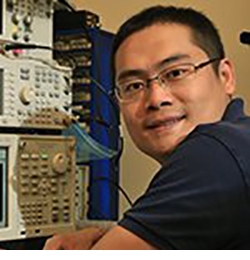
Bo-Han Wu serves as an Assistant Professor in the Department of Electrical and Computer Engineering at the University of Arizona's College of Engineering. His academic journey spans electrophysics, physics, and quantum information science, with postdoctoral experience at MIT's Research Laboratory of Electronics.
Educational background:
- B.S. in Electrophysics, National Chiao Tung University, 2011
- M.S. in Physics, National Tsing Hua University, 2014
- Ph.D. in Physics, University of Arizona, 2022
Dr. Wu's research pioneers the integration of quantum systems and machine learning through a co-design methodology. He developed the Quantum Neuromorphic Sensor Network (QNSN) that leverages quantum entanglement to achieve superior signal processing efficiency and noise reduction. His work spans continuous-variable quantum photonics on silicon nitride platforms, quantum error correction for CV systems, quantum radar with pulse-compression techniques, and high-speed quantum key distribution using single-photon sources. Current focus areas include entangled neuromorphic networks, physics-informed neural networks, variational quantum circuits, and on-chip optical squeezers for scalable quantum technologies in computing, communication, and sensing.
Scientific awards:
- No awards mentioned in source text
Details regarding graduate student advising and research grants were not provided in the source material. Dr. Wu's experimental-theoretical approach bridges quantum optics theory with practical implementation, positioning his work at the forefront of quantum technology translation.
At the University of Arizona, Dr. Wu leads research efforts in quantum machine learning and integrated quantum photonics. His laboratory focuses on developing experimental platforms that merge quantum information science with neural network architectures, particularly advancing silicon nitride-based photonic circuits for generating high-dimensional cluster states and implementing quantum-enhanced sensing solutions.