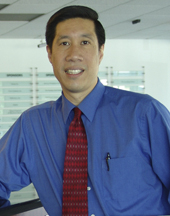
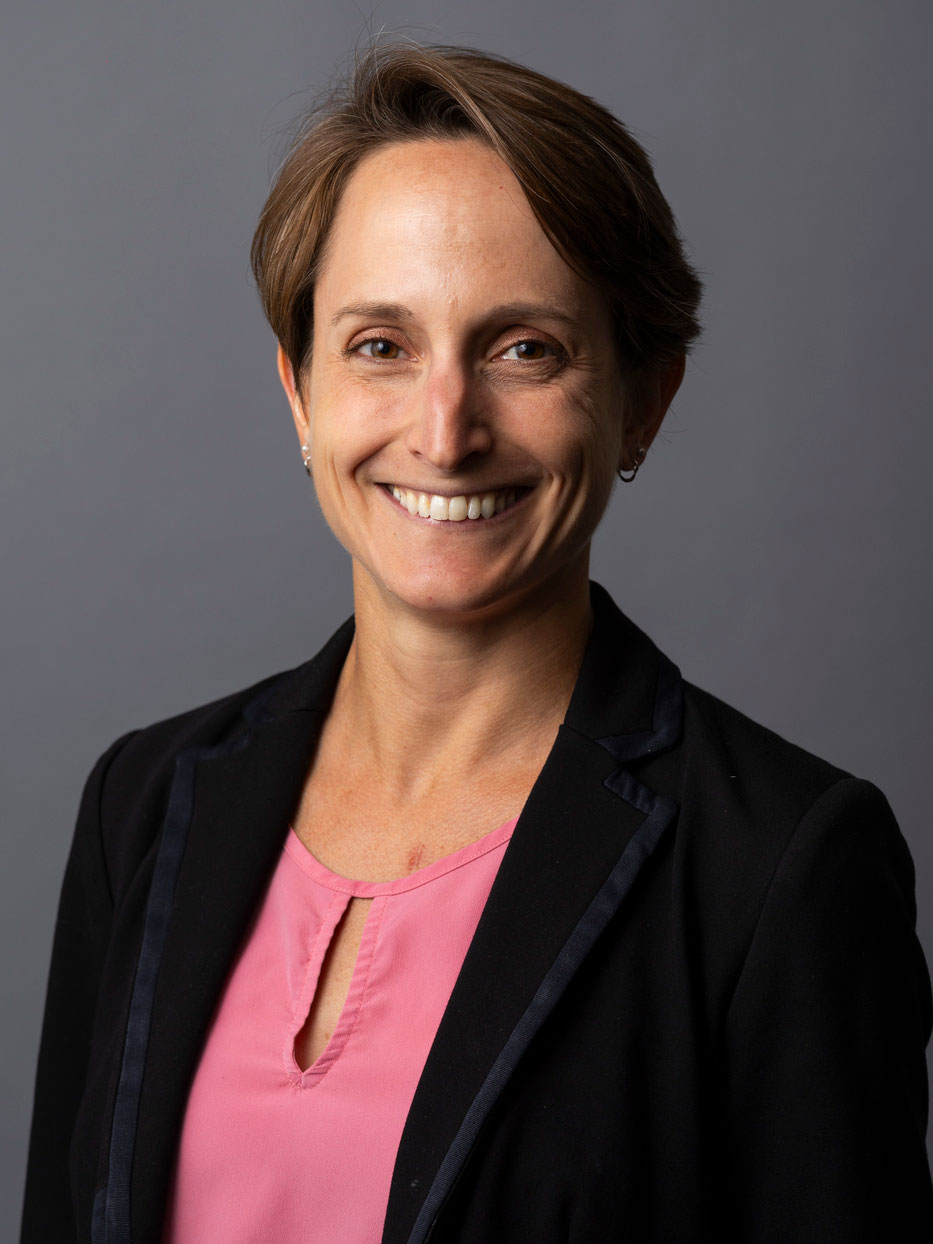
Wynne Chin is a Professor of Decision & Information Sciences at the C.T. Bauer College of Business, University of Houston. He holds a Ph.D. from the University of Michigan, MBA from the University of Michigan, and degrees from Northwestern University and UC Berkeley. His research focuses on IT adoption, structural equation modeling (SEM), and predictive analytics. He developed the PLS-Graph software, widely used in PLS-based SEM, and has contributed to cross-cultural analysis of IT sourcing and workplace assessment. Education: Ph.D. (Computers & Information Systems, U. Michigan), M.S. (Chemical Engineering, Northwestern), MBA (U. Michigan), B.S. (Biophysics, UC Berkeley). Research interests include IT decision-making, end-user satisfaction, group process measures, and methodological innovations in SEM. He has been recognized globally, ranking 3rd in first-authored articles in MISQ/ISR. Awards include the AIS Fellow, Esther Farfel Award, and AIS Technology Legacy Award. His work bridges IS and statistics, influencing both academic and applied fields. His articles emphasize technology acceptance models, causal modeling, and PLS techniques. Grants and advising contributions are significant but not explicitly detailed here. He has held visiting roles at institutions like the Australian School of Business and is a leader in the PLS research community.
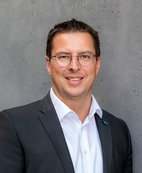
Michael Reichhardt Hansen is an Associate Professor at the Department of Applied Mathematics and Computer Science (DTU Compute) at the Technical University of Denmark. He holds a MSc in Engineering (1982) and a PhD in Computer Science (1987) from DTU. He has held postdoctoral and visiting roles, including a fellowship at IBM Research Center (1984–1985) and a guest professorship at Oldenburg University (1992–1993). His research focuses on formal methods, embedded systems, and real-time systems, emphasizing mathematically grounded software development. He has authored/co-authored three books and over 70 scientific articles. Research interests include model-based program construction, temporal logic, functional programming, and ontology alignment. He has led projects on ontology matching frameworks (e.g., MDMapper) and formal methods for real-time systems. Hansen has supervised PhD students in areas like data integration and genetic circuit synthesis. He has contributed to international conferences and serves as a reviewer/examiner for academic programs. His work bridges theoretical foundations with industrial applications, particularly in embedded systems and data management. He has collaborated internationally, with projects addressing ESG reporting standards and regulatory compliance through automated data traceability.
Bertrand Meyer is a renowned academic and software engineering expert affiliated with Constructor University in Switzerland. He previously held positions at ETH Zurich (2001-2016), the University of Toulouse (2015-2016), and Monash University. His research focuses on object-oriented programming, software engineering, formal methods, and programming languages. He is best known for developing the Eiffel programming language and pioneering the 'Design by Contract' paradigm. Meyer earned his PhD from the University of Nancy, France. His contributions include seminal textbooks like *Object-Oriented Software Construction* (1988, 1997), *Touch of Class* (2009), and *Agile!* (2014). He has received the ACM Software System Award (2006) for his work on Eiffel. His research emphasizes rigorous software design principles, formal verification, and practical software engineering practices. Key innovations include: Design by Contract methodology Advancements in object-oriented design patterns Contributions to component-based development Work on software testing and validation techniques Meyer has authored over 374 publications spanning journals, conferences, and books. His work bridges theoretical foundations and practical software development methodologies.
Prof. Dr.-Ing. Jürgen Melzner is a Professor at the Faculty of Civil and Environmental Engineering at Bauhaus-Universität Weimar. His research focuses on construction operations, occupational health and safety, and BIM integration. He leads projects in lean construction management, noise pollution modeling, and safety planning using BIM. His work emphasizes digital transformation in construction processes and legal aspects of building permits. Education includes a Dr.-Ing. (Doctor of Engineering) with extensive career contributions to construction safety and process optimization. His teaching and research involve BIM applications, IoT integration, and interdisciplinary methods in construction education. Research interests span BIM-based safety systems, predictive noise simulation, ontology networks for construction data, and lean principles in project management. Recent articles address stakeholder management in permits, machine learning for site monitoring, and metaverse applications in urban planning. Notable advising includes guidance of master's students like Mahshid Birkholz and Nasim Babazadeh. His work bridges academic research with practical implementation through projects like BIMwissT and DROHNIS. Labs/teams: Active in the Chair for Construction Management and BIM, focusing on digital tools and safety innovation.
Louay N. Mohammad is a Professor and Irma-Louise Rush Stewart Professor at the Department of Civil and Environmental Engineering , Louisiana State University (LSU) , and serves as Transportation Group Coordinator. He directs the Sustainable and Resilient Pavement Materials and Technologies Center and the Engineering Materials Characterization and Research Facility at LSU’s Louisiana Transportation Research Center. Education: B.S. Civil Engineering, LSU (1980) M.S. Civil Engineering, LSU (1982) Ph.D. Civil Engineering, LSU (1989) Research Interests: His work focuses on highway construction materials , pavement engineering , accelerated pavement testing , advanced materials characterization and modeling , and infrastructure sustainability . Key areas include asphalt mixture design, intelligent compaction, moisture susceptibility, and recycling of materials like crumb rubber and plastics for pavement applications. Article Trends: His 2025 publications emphasize asphalt mixture durability, moisture resistance, and sustainability, with studies on polymer/epoxy modified binders, SCB test protocols, and environmental impact integration. Recent works also explore self-healing materials and high-recycled-content mixes.
Associate Professor Thayaparan Gajendran serves as Head of the School of Architecture and Built Environment at the University of Newcastle. With expertise in construction management and disaster risk reduction, he applies a sociological lens to study organizational cultures, ICT integration, and innovation in project-based industries. His work bridges construction and disaster management, emphasizing evidence-based solutions for improved community resilience. Education: PhD (University of Newcastle), MSc in Facilities Management (National University of Singapore), Postgraduate Diploma in Management (University of Sri Jayewardenepura), BSc in Quantity Surveying (University of Moratuwa, Sri Lanka) Gajendran’s research focuses on cultural analysis in permanent and temporary organisations , ICT adoption , innovation behavior , and project governance within construction and disaster contexts. He has designed university programs like the Master of Disaster Preparedness and Reconstruction and led curriculum reforms integrating Building Information Modelling (BIM). Recent publications highlight topics such as power dynamics in megaprojects, behavioral economics in green construction adoption, and climate resilience in informal settlements. His scientific awards include multiple citations for teaching excellence and research supervision, alongside 2023 Excellence Awards in Equity/Diversity, Leadership, and Industry Engagement. Teaching: Courses in Building Economics, Disaster Management, and Research Methods Administrative Roles: Research Director, Program Convenor for Disaster Management, Acting Head of Discipline
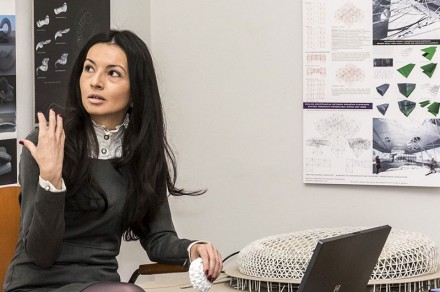
Jelena Milošević is an Assistant Professor at the Department of Architectural Technologies, University of Belgrade - Faculty of Architecture. She serves as Vice-Dean for Teaching and Student Affairs and specializes in structural systems, spatial structures, morphology, and optimization of structures. Her research combines computational design, digital fabrication, and sustainable construction methods. Education: Graduated in Architecture, University of Belgrade (2006) Enrolled in doctoral studies (2009) Her research focuses on generative design approaches for architectural structures, performance-based optimization, and applications of 3D printing in construction. She investigates biomimetic pattern applications in structural design and develops parametric workflows for complex geometries. Recent work explores circular economy potentials in architectural production through recycled materials and additive manufacturing. Publications demonstrate a strong focus on digital fabrication technologies in architectural education and practice. Recent articles examine hybrid pedagogical approaches integrating 3D printing technologies into design studios, material efficiency in additive-manufactured structural systems, and sustainable applications of recycled materials in digital fabrication. She has participated in research projects including 'Development and application of scientific methods in design and construction of highly economical structural systems using new technologies' funded by the Ministry of Education, Science and Technological Development of Serbia.
Dr Himashi Peiris is a Research Fellow in the Department of Data Science & AI at Monash University's Faculty of Information Technology in Australia. She holds a PhD in Biomedical Engineering from Monash University (2024) and a Bachelor's in Information Technology from the University of Moratuwa, Sri Lanka. Her work focuses on semi-supervised learning, medical image analysis, and AI-driven healthcare solutions. She has over three years of industry experience in software engineering. Research interests include developing machine learning algorithms for medical imaging challenges, particularly in scenarios with limited labeled data. Her innovations span neural networks, transformer architectures, and uncertainty-guided segmentation techniques applied to MRI, CT scans, and biomedical datasets. Her publications in Nature Machine Intelligence and MICCAI conference highlight contributions to semi-supervised segmentation and AI-driven diagnostic tools. Notable collaborations include the development of PINGU for perivascular space identification and adversarial networks for construction waste recognition. Awards include the 2023 Victorian Biomedical Imaging Capability Early Career Award and 2023 IEEE ACS Student Writing Award. Her work has been featured in media outlets and Mendeley platforms, emphasizing AI's role in medical decision-making.
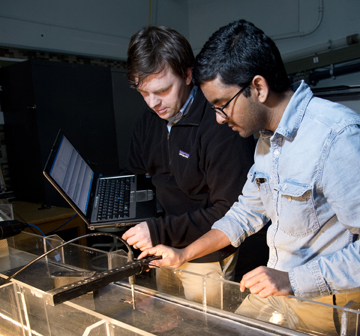
Cary D. Troy is a Professor of Civil Engineering at Purdue University's Lyles School of Civil and Construction Engineering. He specializes in environmental fluid mechanics, with a focus on hydrodynamic processes in lakes and coastal systems, particularly Lake Michigan. His research integrates field experiments, numerical modeling (e.g., SUNTANS), and analytical methods to study circulation, thermal structure, and mixing in aquatic environments. Education: Ph.D. (2003), M.S. (1997), and B.S. (1995) in Civil Engineering from Stanford University, University of Illinois Urbana-Champaign, and Purdue University, respectively. Research interests include benthic boundary layer processes, river plume characterization, and the impacts of invasive species (e.g., quagga mussels) on water quality. His pedagogical work emphasizes active learning in engineering education, including flipped classrooms and writing-to-learn strategies. He has mentored over a dozen graduate students and received multiple teaching awards, including the Purdue University Bravo Award (2015) and Exceptional Early Career Teaching Award (2014). Awards include the Roy E. & Myrna G. Wansik Teaching Leadership Award (2016) and the American Society of Civil Engineers ExCEED Teaching Fellow designation (2009). His lab, the Burke Hydraulics and Hydrology Lab, focuses on advancing understanding of coastal and limnological systems through interdisciplinary approaches.
Paolo Salvatore is a Full Professor of Geometry at the Department of Mathematics, University of Rome Tor Vergata. His research focuses on algebraic topology, particularly operad theory, configuration spaces, and homotopy theory. He has contributed to foundational work on operadic structures, including studies on the Gravity and Hypercommutative operads, En-algebras, and the Fulton-MacPherson operad. Salvatore has also explored non-formality in characteristic two and geometric realizations of topological spaces. His teaching responsibilities include courses in linear algebra, geometry, and topology for engineering and mathematics students. He has developed extensive lecture materials and online resources for courses such as Linear Algebra and Geometry (Engineering Sciences) and Complementi di Topologia Algebrica . Examinations are conducted via written and oral evaluations with digital platforms. Salvatore has collaborated extensively with researchers like T. Rossi, M. Ching, and J. Giansiracusa on topics ranging from Koszul duality to moduli spaces. His work bridges algebraic topology with geometric and categorical methods, influencing both theoretical and applied mathematical domains.
Neziha Yılmaz is a Researcher affiliated with the Civil Engineering Department at Istanbul Technical University's Civil Engineering Faculty. Her work focuses on integrating Building Information Modeling (BIM), Mixed Reality technologies, Machine Learning, and Artificial Intelligence into construction management and facility operations. Education: PhD in Structural Engineering (2020), Istanbul Technical University Master's in Building Management (2017), Istanbul Technical University Bachelor's in Civil Engineering (2012), Istanbul Technical University Research interests span Virtual Reality, Augmented Reality, Digital Twin applications, and data-driven decision-making in construction. She has explored topics like RFI analysis optimization, occupant feedback systems in BIM, and cross-cultural office leasing criteria using AHP methodology. Her articles emphasize practical applications of emerging technologies in construction asset management, building design, and usability evaluations of mixed reality solutions. No scientific awards or grants are explicitly listed in available records. She currently advises no formal graduate students. Professional Experience includes roles as a BIM Engineer at Gülermak Nurol Makyol Metro Construction Partnership (2019–2020) alongside academic duties since 2020.
Nancy Larson Varney serves as an Associate Teaching Professor in the Department of Civil and Environmental Engineering at Northeastern University, a position she assumed in August 2023. Her academic career focuses on advancing structural engineering education and sustainable infrastructure practices. Education: PhD in Structural Engineering, The University of Texas at Austin, 2013 MS in Structural Engineering, The University of Texas at Austin, 2010 BS in Civil Engineering, Lehigh University, 2008 Research Interests: Dr. Varney's research centers on structural engineering with specialized expertise in concrete structures, structural safety mechanisms, and sustainable resource engineering. She investigates critical infrastructure vulnerabilities through civil infrastructure security frameworks while pioneering sustainable construction methodologies. Her experimental work on inverted-T beams and mass timber systems directly addresses durability challenges in modern infrastructure, including alkali-silica reaction and delayed ettringite formation in prestressed concrete elements. Publication Trends: Her scholarly output (2012-2018) demonstrates consistent focus on structural performance validation through experimental and analytical approaches. Key research trajectories include concrete-steel composite systems, innovative timber construction techniques, and durability assessment of critical structural components. Publications in ACI Structural Journal and PCI Journal reflect her industry-relevant contributions to design standards and safety protocols, with increasing emphasis on sustainable materials integration. Professional Affiliations: Active membership in the American Concrete Institute, American Institute of Steel Construction, and American Society of Civil Engineers Structural Engineering Institute enables cross-sector collaboration on code development and structural safety initiatives. Professional Recognition: Licensed as a Professional Engineer in Massachusetts and New Hampshire and Structural Engineer in Hawaii, Dr. Varney maintains active industry engagement through technical committees. No specific scientific awards or student advisees were documented in available materials, and grant funding details remain unspecified.
Professor Gareth Peters is the Janet & Ian Duncan Endowed Chair of Actuarial Science and holds the Chair in Statistics for Risk and Insurance at the Department of Statistics & Applied Probability, University of California Santa Barbara (UCSB). His research focuses on statistical solutions for risk and insurance, with emphasis on actuarial science, financial engineering, environmental data analysis, and cybersecurity risk. He has received notable recognition including the 2024 IFoA Peter-Clark Prize, the oldest actuarial award established in 1891. His academic contributions span advanced statistical modeling techniques for financial markets, climate-related risk analysis, and healthcare analytics. Notable projects include developing methodologies for green bond valuation, cyber insurance frameworks, and machine learning applications in audiology and speech disorders. He has pioneered software tools such as CovRegpy for covariance regression and DivFolio for portfolio divestment analysis. Educations: Advanced degrees in statistics and actuarial science (specific details not provided) Professional Memberships: Fellow of multiple academic societies including the Royal Statistical Society and Institute of Mathematics and its Applications Research interests include: Statistical causality in financial and environmental time series Mortality modeling incorporating long-memory processes Quantifying climate change impacts on energy consumption Machine learning for cybersecurity risk mitigation His recent work emphasizes interdisciplinary applications of statistics in climate finance, sustainable investing, and precision agriculture. Over 2020-2025, his publications explore topics ranging from municipal green bonds to vocal analysis for Parkinson’s diagnostics. Awards: 2024 IFoA Peter-Clark Prize Elected Member of ISI (International Statistical Institute) IEEE Senior Member Labs/Initiatives: Develops open-source software packages for statistical analysis (e.g., AdvEMDpy, PyKronecker) and contributes to regulatory frameworks via tools like AuditChain for blockchain-based trading audits.
Dr Benjamin Cerfontaine is an Associate Professor in Geotechnical Engineering at the University of Southampton. His research focuses on geotechnical solutions for offshore renewable energy infrastructure, particularly floating and bottom-fixed offshore wind turbines. He specializes in numerical and physical modeling techniques such as finite elements, DEM, and centrifuge testing, aiming to uncover fundamental mechanisms governing foundation behavior. Education: PhD in Geotechnical Engineering from the University of Liège (2014), followed by postdoctoral research at the University of Dundee (2017–2020). Research Interests: Offshore renewable energy systems, constitutive modeling of geomaterials, and innovative anchoring solutions. Projects: Leads the ROBOCONE and TAILWIND projects, focusing on robotic ground characterization and sustainable anchor designs. Key achievements include the Geotechnical Research Medal (2023) and the Bright Spark Lecture Award (2023). He supervises three PhD students and actively collaborates with industry partners on offshore energy infrastructure. Dr. Cerfontaine is part of the Infrastructure Group and the Southampton Marine and Maritime Institute, contributing to interdisciplinary research on ocean energy and coastal communities.
Elsa Devienne is an Assistant Professor at Northumbria University's Faculty of Arts, Design and Social Sciences, where she has been teaching since 2019. Previously, she taught at Princeton University, Université Paris Nanterre, Science Po Paris and the École des Hautes Etudes en Sciences Sociales. Her scholarly expertise focuses on environmental history, urban history, and the history of the body within the context of 20th-century United States, with particular attention to how everyday environments shape human experience and social relations. Education: PhD in History, École des hautes études en sciences sociales MA in History, École normale supérieure de Lyon Devienne's research is unified by her interest in understanding the mundane aspects of everyday life and how seemingly natural environments are socially and materially constructed. Her work demonstrates how spaces like beaches, urban areas, and public spaces have been transformed through historical processes that often reflect broader social inequalities. She approaches environmental history through the lens of environmental justice, consistently examining how environmental changes have benefited certain communities while disadvantaging others, particularly vulnerable populations. Her scholarship bridges historical analysis with contemporary environmental concerns, making historical perspectives directly relevant to current ecological challenges and policy discussions. Her publications reveal a consistent focus on environmental and urban transformations, particularly in coastal settings. Across her work, she explores how human interventions have reshaped natural environments, how these spaces have been regulated and contested, and how they have served as sites for the construction of social identities and cultural practices. Her research spans multiple disciplines, connecting environmental history with urban studies, cultural history, and body studies to provide comprehensive analyses of human-environment relationships throughout the 20th century. Scientific Awards: Willi Paul Adams Award (2021) Doyce B. Nunis, Jr. Award (2019) Finalist of the Prix de la Recherche SAES/AFEA (2021) The Arthur Miller Centre First Book Prize (June 2025) Devienne has secured significant research funding from prestigious organizations including the Fulbright Program, Princeton-Mellon Initiative, British Association of American Studies, FACE Foundation, Historical Society of Southern California, Ahmanson Foundation, and British Academy/Leverhulme Small Grant scheme. She actively contributes to academic discourse through editorial work, including co-editing special issues on 'Beaches: Contested Territories' and 'Places and Cultures of Capitalism.' She serves on the executive committee of the British Association of American Studies, co-leading their sustainability initiative Green BAAS, and represents France in the European Society of Environmental History. Her current research projects include 'The War on Plastics: A History of the Anti-Plastics Movement in the US and the UK' (2025-2026), examining how environmental activism has shaped mainstream discourse on plastics, and a study on pedestrianism and air pollution in cities from the perspective of parents and children. At Northumbria University, Devienne teaches American studies and history modules including 'From Sea to Shining Sea: US History from 1776 to 2008,' 'Affluence & Anxiety: US history 1920-1960,' and 'Red, White and Green: The American Environment through Time,' where she has pioneered efforts to integrate environmental perspectives into historical education. She regularly engages with public audiences through media appearances on radio, podcasts, and television, and has contributed to publications like Time Magazine and The Wall Street Journal, demonstrating her commitment to making historical scholarship accessible and relevant to contemporary environmental challenges.