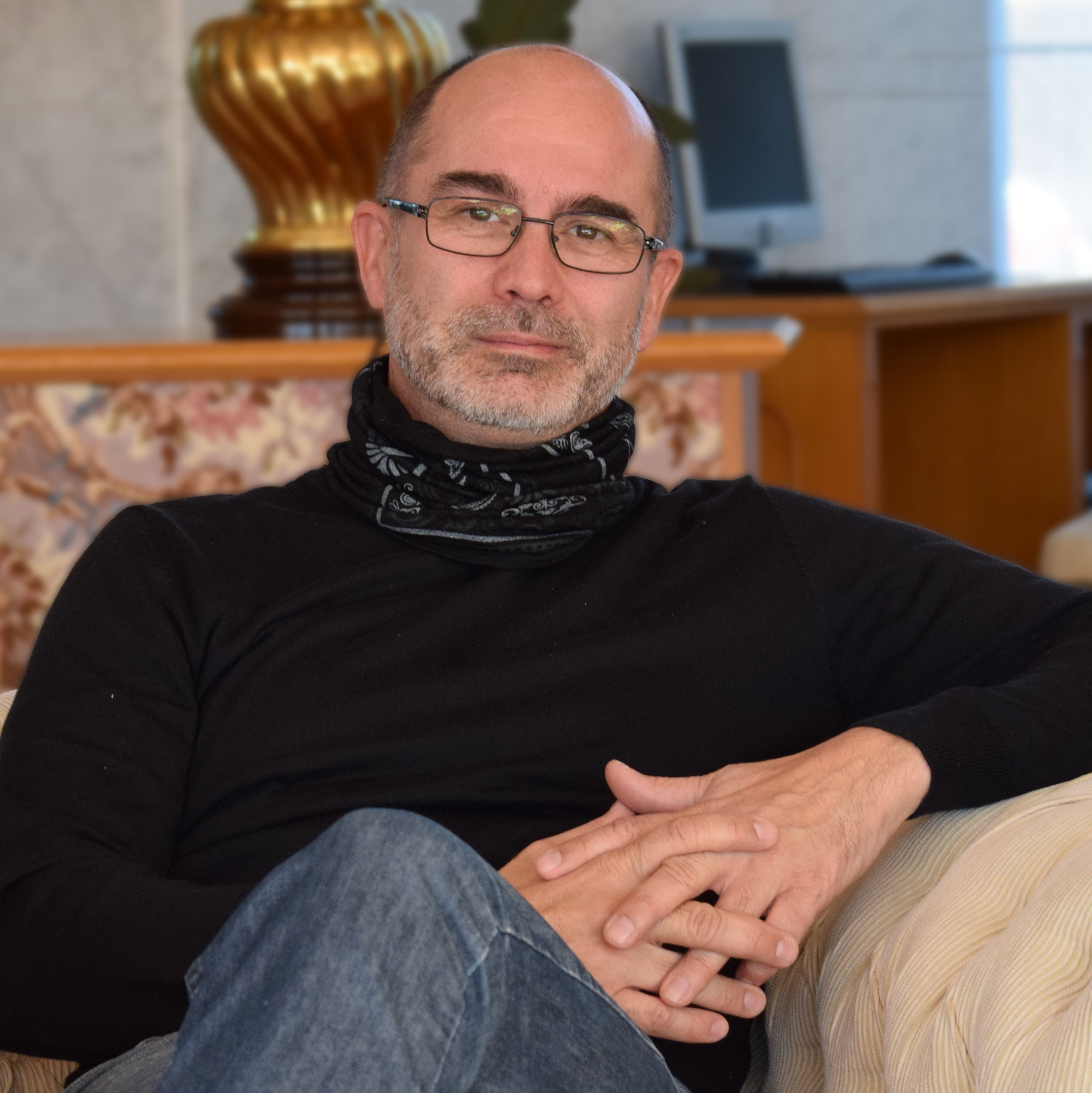
Mahdi Fazeli is an Associate Professor at the School of Information Technology, Halmstad University, Sweden, specializing in hardware security and trust, energy-efficient computing, and embedded and cyber-physical systems. His academic journey began with a Ph.D. in Computer Engineering from Sharif University of Technology, Iran, in 2011. His career progression includes positions as Associate Professor at Bogazici University (2019-2021) and Iran University of Science and Technology (2016-2019), and Assistant Professor at the same institution (2011-2016). His research interests focus on hardware security and trust, reliable VLSI circuits and systems, energy-efficient computing, and dependable embedded systems. His work bridges the gap between theoretical security concepts and practical implementations in real-world systems, particularly in IoT and embedded environments. He has established himself as a leading researcher in Physical Unclonable Functions (PUFs), hardware trojans detection, and energy-efficient security solutions for resource-constrained devices. His publication record shows a clear progression and deepening expertise in hardware security, with recent work focusing on cutting-edge applications in edge computing, vehicular networks, and IoT security. His 2023-2025 publications demonstrate significant contributions to magnetic memory-based security primitives, anomaly detection systems, and energy-efficient security mechanisms. Throughout his career, Fazeli has led multiple research initiatives including the Dependable Systems and Architecture Lab (DSA) and the Networked and Embedded Systems Lab at Iran University of Science and Technology. His leadership extends to heading the Hardware Group and serving as Vice Chair for Educational Affairs, demonstrating his commitment to both research excellence and academic administration.
Pedro Roque is a Postdoctoral Researcher at KTH Royal Institute of Technology in Stockholm, affiliated with the Wallenberg AI, Autonomous Systems and Software Program (WASP) and associated with the Division of Decision and Control Systems (DCS). He obtained his Ph.D. in 2024 from the same division under the supervision of Prof. Dimos Dimarogonas, Prof. Mikael Johansson, and Prof. Jana Tumova. His research focuses on practically applicable theoretical results in robotics and control, with emphasis on space and aerial systems. Dr. Roque is particularly interested in developing algorithms that directly contribute to system performance and enhanced capabilities. He currently leads the setup of a Space Robotics Laboratory at KTH, associated with the Space Center and the WASP NEST DISCOWER project. He is an advocate for open-source software and hardware, contributing to NASA Astrobee and PX4 projects, with his research tested on the International Space Station and indoor flight arenas. Dr. Roque's work demonstrates a clear progression from theoretical foundations to practical implementation in space environments. His recent publications show an increasing focus on multi-agent coordination in microgravity, with significant contributions to model predictive control for space robotics applications. The research spans from fundamental control theory to complete system implementation, reflecting his commitment to bridging theory and practice. ICRA 2022 Outstanding Coordination Award for work on decentralized model predictive control for collaborative UAV bar transportation Dr. Roque actively mentors Master's students in Space Robotics, Control, and Vision, with supervision details available on his personal website. He has collaborated extensively with NASA Astrobee and PX4 projects, and his DISCOWER project involves collaboration with 3 Ph.D. students, 2 Master's students, 6 Professors, and one Post-doc. He also completed a 4-month internship at JPL within the Maritime and Multi-Agent Systems group. He leads the Space Robotics Laboratory at KTH, associated with the Space Center and the WASP NEST DISCOWER project, which has already demonstrated capabilities to Digital Futures, SAAB AB, SAAB Inc., and Purdue scholars. The laboratory focuses on weightless robotics, collaborative robotics (Space Cobot), and exploration robotics (MoonHopper), with practical testing on the International Space Station.
Gerardo Schneider is a Full Professor in Computer Science at the University of Gothenburg, Sweden, and holds a joint appointment at Chalmers University of Technology. He serves as Head of the Data Science and Artificial Intelligence (DSAI) Division and has previously led the Formal Methods Division and acted as Director of Graduate Studies. University of Gothenburg: 2009–present Chalmers University of Technology: 2009–present Uppsala University: 2002–2003 University of Oslo: 2005–2009 His research focuses on formal methods for software engineering, including contract specification and analysis , privacy policy formalization , model checking , and runtime verification . He works on verification of real-time systems, embedded systems (e.g., smart Java cards), and blockchain-based smart contracts. Key projects include: X-LEGAL (2020–2023): Smart Legal Contracts (Swedish Research Council) PolUser (2016–2019): User-Controlled Privacy Policies (Swedish Research Council) ARVI (2014–2018): Runtime Verification Beyond Monitoring (ICT COST Action) ReMU (2013–2017): Reliable Multilingual Digital Communication (Swedish Research Council) He has supervised numerous PhD and Master’s students in formal methods, blockchain security, and privacy compliance. His tools include SPeeDI (Polygonal Hybrid Systems Verification), CLAN (Contract Normative Conflict Detection), and AnaCon (Controlled Natural Language Analysis).
Wilhelm Skoglund is an Associate Professor and Senior Lecturer in the Department of Economics, Geography, Law and Tourism at Mid Sweden University, based in Östersund. He serves as the contact person for the international master's program in Sustainable Food City Design and is affiliated with the ETOUR research center, focusing on tourism and regional development through cultural and creative industries. His research centers on sustainable food systems, rural development through cultural and creative industries, and gastronomy tourism. He investigates how local food systems drive entrepreneurship, the role of craft breweries in place development, and the integration of UNESCO Creative Cities Network in sustainable regional strategies. His work emphasizes practical applications for Northern Swedish contexts while addressing global sustainability challenges. Analysis of his recent publications reveals strong interdisciplinary trends at the tourism-food-sustainability nexus, with consistent focus on Northern Swedish case studies. His work examines local food industry dynamics, public procurement for environmental sustainability, and cultural dimensions of gastronomy in rural development, often highlighting community-driven approaches and networked governance models. Skoglund leads collaborative research projects including 'Enhancing Entrepreneurship in Rural Areas through Local Food Systems' and KKN initiatives on cultural industries. These projects involve multi-institutional partnerships focused on practical regional development applications, particularly in Östersund and Sundsvall. As an active member of the ETOUR research center, he contributes to academic discourse on tourism-driven regional development while mentoring through the Sustainable Food City Design master's program, bridging theoretical research with tangible community impact.
Fredrik Sandin is a Professor in the Department of Computer Science, Electrical and Space Engineering at Luleå University of Technology, where he leads the Machine Learning research group with approximately thirty members. His work focuses on neuromorphic technologies and the intersection of machine learning with computational physics to solve challenging real-world interaction problems. He coordinates the 'Teknisk fysik och elektroteknik' program at LTU and has been instrumental in establishing neuromorphic research activities at the university. Luleå University of Technology, Department of Computer Science, Electrical and Space Engineering Member of WASP (Wallenberg AI, Autonomous Systems and Software Program) and ELLIS (European Laboratory for Learning and Intelligent Systems) Coordinator of Neuromorphic Innovation Platform Sweden with KTH, Lund University, Uppsala University, FOI, ABB, Ericsson, and SAAB Fredrik earned his PhD in Physics from Luleå University of Technology in 2007, with thesis work focusing on dense states of matter in neutron stars. His academic journey began with an MSc diploma work in ATLAS at CERN in 2001, followed by postdoctoral research in computational physics at IFPA in Belgium (2008-2009) and brain-like computing at EISLAB with Prof. Jerker Delsing (2010-2011). Professor Sandin's research interests center around neuromorphic technologies, particularly neuromorphic computing and spiking neural networks. He investigates sensor/detector and intelligent systems co-design where constraints like energy, power, latency, and dynamic range challenge conventional digital approaches. His work spans mixed-signal neuromorphic circuits, algorithms, and systems, as well as machine learning projects involving industrial data and collaboration. He has been a key figure in establishing neuromorphic research at LTU, supported by The Kempe Foundations, particularly through the 2014 Gunnar Öquist Fellowship. His recent publications demonstrate a strong interdisciplinary focus spanning quantum phase transitions, particle physics detector optimization, renewable energy materials, and the integration of large language models into control systems. This diverse portfolio reflects his approach connecting machine learning with fundamental physics and practical engineering applications, particularly in neuromorphic computing and intelligent systems design, with emphasis on solving real-world problems through co-design of hardware and algorithms. Gunnar Öquist Fellowship Award and 3 MSEK grant from The Kempe Foundations ISSP award for an Original Work in Theoretical Physics (signed by Prof. 't Hooft and Prof. Zichichi) New-Talents award for original work in theoretical physics at the International School of Subnuclear Physics in Erice Professor Sandin has supervised numerous PhD students working on topics ranging from neuromorphic TinyML to materials for neuromorphic computing, privacy-preserving machine learning at the edge, and intelligent fault diagnosis. He has secured substantial research funding from various sources including Vinnova, ÅForsk, Kempe Foundations, WASP-WISE, and EU programs like ECSEL JU Arrowhead Tools and ITEA3 AutoDC. His current major projects include the Neuromorphic Innovation Platform Sweden and several initiatives focused on neuromorphic condition monitoring and computing, with total funding exceeding 30 MSEK in the past five years. He leads the Machine Learning group at LTU, which collaborates extensively with industry partners including ABB, Ericsson, SAAB, SKF, and RISE. The group is active in developing neuromorphic technologies for wireless sensor networks, condition monitoring systems, and next-generation intelligent systems that address energy, power, and latency constraints that challenge conventional digital approaches.
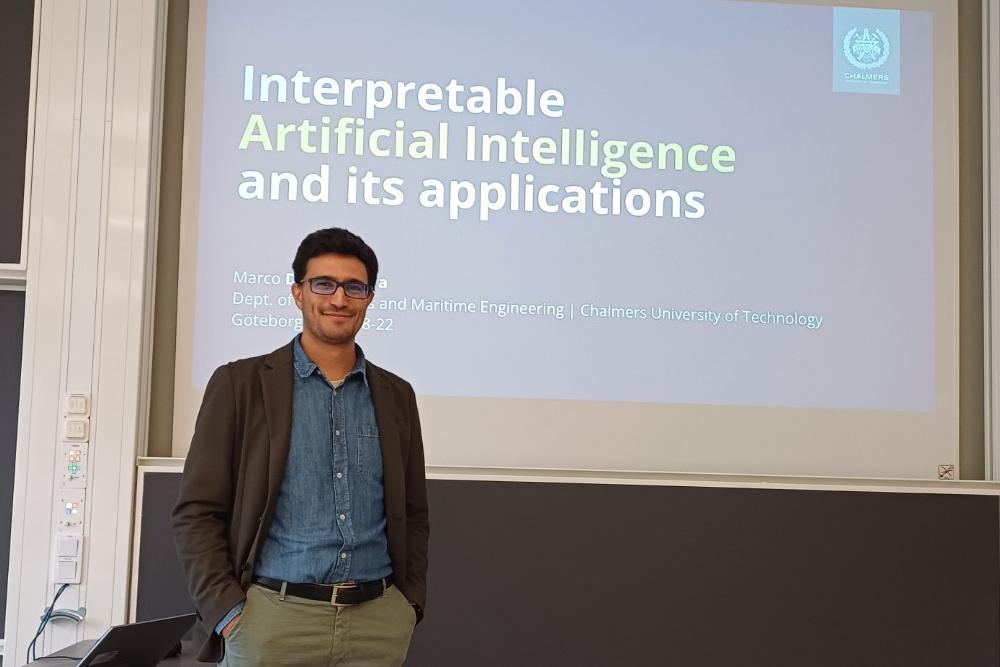
Marco L. Della Vedova is a Senior Lecturer in Applied Artificial Intelligence at Chalmers University of Technology, Sweden. He works in the Vehicle Engineering and Autonomous Systems division within the Department of Mechanics and Maritime Sciences, as part of Prof. Mattias Wahde's research group. Since 2025, he has served as Director of the Data Science and AI master's programme (MPDSC) at Chalmers, where he teaches courses including Introduction to Artificial Intelligence and Digitalization in Sports. Dr. Della Vedova earned his academic foundation at the University of Pavia, Italy, where he completed his BSc (2006), MSc (2009), and PhD (2013) in Computer Engineering. His doctoral research focused on "Real-Time Physical Systems and Electric Load Scheduling" under Prof. Tullio Facchinetti. During his PhD studies, he spent a year at U.C. Berkeley hosted by Prof. Francesco Borrelli at the Model Based Predictive and Distributed Control Lab. His research spans multiple AI domains with a strong emphasis on interpretability. Dr. Della Vedova develops interpretable methods for conversational AI, naturalness evaluation of forests using canopy height models, and geospatial applications. His work bridges theoretical AI with practical societal benefits, particularly in environmental monitoring, transportation systems, and orienteering. He has previously contributed to cloud computing, hate speech detection, and cyber-physical energy systems, demonstrating his interdisciplinary approach to AI research. Dr. Della Vedova's publication record reveals a consistent trajectory of impactful research across multiple domains of artificial intelligence. His recent work shows a strong focus on interpretability in AI systems, with significant contributions to natural language processing, geospatial analysis, and causal inference. The research demonstrates both theoretical depth and practical applications, particularly in environmental monitoring and social media analysis. His methodology often combines traditional machine learning approaches with novel interpretability techniques, creating bridges between complex AI systems and human understanding. Dr. Della Vedova has received several prestigious recognitions for his work: Best PhD thesis award from the Order of the Engineers of Bergamo (2013) Italian champion of Il Cervellone (2012) Top Italian performer in IEEEXtreme 6.0 programming competition (148th overall globally, 2012) Premio Arturo Schena award from Fondazione Credito Valtellinese (2010) With over 50 students supervised through bachelor's and master's theses, Dr. Della Vedova has established himself as a dedicated mentor in the AI community. His current PhD students include Minerva Suvanto working on interpretable NLP and Vivien Lacorre developing AI for railway infrastructure inspection. His supervision spans diverse topics from forest naturalness evaluation to hate speech detection and transportation optimization. Beyond formal supervision, he actively contributes to educational initiatives including serving as Director of Chalmers' Data Science and AI master's program and developing innovative teaching methods that connect theoretical concepts with real-world applications. Dr. Della Vedova is deeply embedded in both academic and professional communities. He leads the Applied Artificial Intelligence research group at Chalmers while maintaining strong connections with European research networks through projects like the ERASMUS+ EUrienteering initiative. His interdisciplinary approach is reflected in collaborations across computer science, environmental science, and social sciences. Notably, he applies his AI expertise to orienteering both as a researcher developing localization methods and as a licensed Event Advisor for the International Orienteering Federation, demonstrating how his professional and personal interests converge in innovative ways.
Nacira Agram is an Associate Professor at Kungliga Tekniska Högskolan (KTH), specializing in stochastic analysis, mean-field processes, and mathematical finance. She contributes to education through roles as Examiner and Teacher in advanced financial mathematics courses. Research Focus: Her work centers on stochastic differential equations with applications to financial markets, energy systems, and population modeling. Key areas include conditional McKean–Vlasov jump diffusions, singular control of stochastic Volterra equations, and deep learning applications in stochastic modeling. Publications: Recent research explores mean-field control, optimal stopping, and SPDEs with space interactions, emphasizing advanced mathematical techniques for financial and ecological systems. Teaching: Currently involved in courses like Financial Derivatives and Martingales and Stochastic Integrals , where she serves as course responsible and examiner.
Carl Lebeck is an academic at Stockholm University's Department of Law. He primarily teaches Constitutional Law (Statsrätt) in the Swedish law degree program and supervises/examines master's theses in public law, focusing on constitutional/administrative law and administrative procedural law. He occasionally delivers lectures at other universities and for practicing lawyers, including engagements with the Swedish Bar Association and various public authorities like the Competition Authority and Public Health Agency. His research centers on constitutional law, administrative law, EU law, and European human rights law. Publications analyze tensions between national constitutional law and supranational legal frameworks (EU/EEA), examining how these interactions affect power allocation, fundamental rights protection, and national constitutional effectiveness. Carl Lebeck's work reveals a functional dependency between national and supranational legal systems that creates a 'constitutional deficit' in national law when supranational norms limit constitutional constraints. His 2024 article and 2019 doctoral dissertation highlight procedural limitations being more common than substantive ones, with national courts rarely refusing supranational law application despite constitutional concerns.
Pär Åhlström is a Professor at the Department of Entrepreneurship, Innovation and Technology at the Stockholm School of Economics (SSE), and serves as Vice President of Degree Programs. He holds the prestigious Torsten and Ragnar Söderberg Chair in Business Administration. His research focuses on lean manufacturing, agile processes, sustainability in operations, and innovation management. He is affiliated with the Mistra Center for Sustainable Markets. Åhlström’s work bridges theory and practice, emphasizing dynamic capabilities, quality management, and the integration of IT with lean principles. His research spans longitudinal studies in manufacturing and services, exploring topics like organizational slack in R&D, modular product design, and healthcare process optimization. He has published extensively across academic journals and presented at international conferences. His awards include the Torsten and Ragnar Söderberg Chair, reflecting his scholarly contributions. His articles highlight trends in sustainable business performance, lean service adoption, and the evolving role of technology in operations. He actively engages in educational leadership, shaping curricula and overseeing degree programs at SSE.
Hugo Hedlund serves as an Associate Professor in the Department of Informatics at Umeå University, Sweden, with his office located in the MIT building (Campustorget 5, room MIT.E.424) in Umeå. His active research and teaching focus on digital innovation within institutionally complex public sector environments, maintaining direct contact through email and phone. His research centers on digital transformation mechanisms through institutional logics perspectives, examining generative change processes and structural flexibility in public sector innovation. Key interests include how digital logic transposition reshapes welfare services and organizational structures, with strong theoretical grounding in institutional complexity and practical applications in government digitalization. Analysis of his 2019-2023 publications reveals consistent focus on public sector digital innovation through institutional theory lenses, utilizing methodologies like document co-citation analysis and case studies. Recurring themes include co-creation frameworks, logic transposition dynamics, and the interplay between digital innovation and institutional constraints. Hedlund contributes to the Swedish Center for Digital Innovation research group and previously led the "Co-creative welfare through digitalization" project (2017-2021). He teaches bachelor-level courses in the Behavioural Sciences and IT Environments program and Systems Analyst program at Umeå University, emphasizing holistic pedagogical approaches integrating cognitive, emotional, and physical dimensions of academic teaching.
Evangelia Petridou serves as Associate Professor in the Department of Humanities and Social Sciences at Mid Sweden University, where she is core faculty at the Risk and Crisis Research Centre (RCR). Her academic work bridges political science and practical crisis management, with emphasis on European policy processes and Swedish governance structures. Her research focuses on policy entrepreneurship dynamics during crises, particularly examining how actors navigate institutional constraints in emergency contexts. Key areas include reactive policy entrepreneurship, risk communication across EU nations, and the operationalization of national policy styles during pandemics. She integrates theoretical frameworks like Kingdon's Multiple Streams with empirical analyses of Swedish municipal responses to disasters. Recent publications (2022-2025) reveal three dominant trends: conceptual expansion of policy entrepreneurship to street-level bureaucrats, methodological innovation through immersive simulations in crisis training, and comparative analyses of European pandemic responses. Her work consistently addresses the tension between centralized policy directives and local implementation challenges, especially in decentralized systems like Sweden. Dr. Petridou leads multiple externally funded projects including FUTURESILIENCE, LEGITIPREP, and RISE (Resilience in Sweden: Governance, Social Networks and Learning). She directs the RCR Lab at Mid Sweden University, which pioneers experimental design in crisis management education through virtual/physical immersion classrooms. Her collaborative network spans 15+ European institutions with frequent co-authorship on cross-national policy studies.
Magnus Klofsten is a Professor at Linköping University , leading the Project, Innovations and Entrepreneurship (PIE) division within the Department of Management and Engineering (IEI) . With over 30 years of experience in innovation and entrepreneurship, he has played a pivotal role in establishing Linköping as a hub for technology-based firm development. Founding Director of the Centre for Innovation and Entrepreneurship (CIE) Research Leader at Helix Centre of Excellence Former Research Leader of AgoraLink Centre for researcher mobility Board member of SMIL (Foundation for technology-based firms) His research focuses on early-stage technology ventures , science park dynamics , and university-industry relations . Recent work emphasizes circular economy ecosystems and rural development . He has secured substantial funding from the European Commission , Swedish Research Council , and Lundberg Foundation . Key publication trends show a progression from technology commercialization to circular economy ecosystems , with 6 of 15 recent articles focusing on sustainability aspects. His work spans entrepreneurial university strategies , innovation support systems , and regional development frameworks. As an educator, he developed the "Entrepreneurship and New-Firm Start-Up" course in 1993 and leads the PhD course "Entrepreneurship in Theory and Practice" since 2006. He has contributed to over 500 firm start-ups through programs like LEAD and has built extensive international collaborations across 44 countries.
Petter Falkman is an Associate Professor in Systems and Control Engineering at Chalmers University of Technology, where he leads research in the Automation research group. With 68 publications spanning over two decades, his work bridges theoretical control systems with practical industrial applications, particularly in manufacturing and robotics. His research has been supported by major funding bodies including VINNOVA and European Commission projects. Falkman's research primarily focuses on intelligent automation systems, with key contributions in sequence planning, virtual commissioning, and human-robot interaction. His work integrates formal methods with practical industrial applications, developing frameworks like the Sequence Planner for control of intelligent automation systems. His recent publications demonstrate a strong emphasis on data-driven approaches, digital twin technologies, and the application of virtual reality for industrial applications. The research shows a clear trajectory toward increasingly sophisticated integration of human factors with automation systems, particularly through eye tracking and movement prediction technologies. Falkman has led or participated in 10 major research projects from 2011-2025, including CLOUDS (2022-2025) on circular solutions for sustainable production systems, UNICORN (2017-2021) on robotic refuse handling, and several VINNOVA-funded projects on virtual preparation and industrial automation. His collaborative network includes researchers across Chalmers and industry partners like Volvo Group, demonstrating strong industry-academia connections. Falkman has established himself as a key contributor to the development of frameworks for intelligent automation, with particular expertise in translating theoretical control concepts into practical industrial applications. His work on the Sequence Planner framework represents a significant contribution to the field, enabling more efficient preparation and commissioning of automation systems.
Martin Nordin is an Associate Professor in the Department of Economics at Lund University's School of Economics and Management and serves as a Policy Officer at the AgriFood Economics Centre. His academic work focuses on labor market economics with additional expertise in health economics, agricultural economics, and environmental economics. Dr. Nordin's research at AgriFood has evaluated the effects of the Common Agricultural Policy and analyzed labor market issues within agriculture. His current research focuses on income differences between rural and urban areas and changes in incomes for ethnically segregated areas. His work contributes to several UN Sustainable Development Goals related to poverty reduction, environmental protection, and prosperity. His research spans multiple disciplines with a strong focus on labor market economics (62%), profit analysis (49%), higher education (48%), returns to education (42%), employment (39%), and mental health economics (39%). This diverse research portfolio demonstrates his ability to bridge economic theory with practical policy applications across multiple sectors. Dr. Nordin has been involved in significant research projects including 'Socioeconomic Segregation – The Impact of Neighborhoods, Schools and Policy Across the Life Course' funded by the Swedish Research Council (2023-2030), 'Constraints on the expansion of organic farming in Sweden' funded by FORMAS (2018-2022), and evaluation of Sweden's rural development program (2007-2013). His collaborative research network extends across Sweden and internationally, with recent external collaborations spanning multiple countries. This network supports his interdisciplinary approach to economic research that connects academic theory with real-world policy applications.
Panagiota Nasiopoulou serves as a Lecturer in pedagogy at Södertörn University, specializing in preschool education research and teacher training. Her work investigates structural determinants of preschool quality, including group organization, teacher competence, and curriculum implementation within the Swedish educational context. She earned her PhD in Child and Youth Studies from the University of Gothenburg in 2020, with doctoral research examining preschool teachers' decision-making regarding group division and curriculum content under varying structural conditions. Dr. Nasiopoulou's research program centers on preschool quality assessment through structural lenses, with particular emphasis on quantitative analysis and mixed-methods approaches. Her investigations consistently explore how factors like group size, teacher education levels, and organizational frameworks influence pedagogical practices and child outcomes. She maintains a strong focus on practical applications for improving preschool environments through evidence-based insights. Analysis of her publication record reveals sustained investigation into ECERS-3 quality assessment applications, teacher professional profiles, and curriculum implementation challenges in Swedish preschools. Her work demonstrates methodological diversity through quantitative analyses, observational studies, and policy critiques, consistently linking structural conditions to educational quality outcomes. Her teaching portfolio spans preschool teacher education courses covering historical perspectives on educational ideals, interculturality, educational documentation, and quality development processes. She also contributes to doctoral education through methods instruction in Educational Science Studies, emphasizing rigorous research design applicable to early childhood contexts. While specific laboratory affiliations or research teams aren't documented in available materials, her collaborative publications with researchers like Sheridan, Williams, and Mellgren indicate active participation in interdisciplinary early childhood research networks focused on Swedish preschool systems.