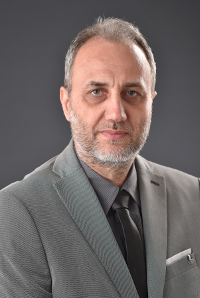
Dalibor Radovanović is a researcher at Singidunum University , affiliated with the Faculty of Business Informatics . His work spans cybersecurity, blockchain technologies, and their applications in business and IoT systems. Education: Doctoral Dissertation (2016, Singidunum University) Master's & Basic Studies (Faculty of Business Informatics) Secondary Education: ETŠ Nikola Tesla Research Interests include: Security frameworks for IoT and blockchain integration Smart card and wireless network vulnerabilities E-governance and corporate IT audit methodologies Machine learning applications in cybersecurity Environmental performance optimization in agribusiness Publication Trends reveal a focus on blockchain (2022), cybersecurity (2009-2022), and IT governance (2010-2017). His work bridges theoretical analysis with practical implementations in Serbia's digital economy. Collaborations with scholars like Marko Šarac and Saša Adamović highlight interdisciplinary approaches to securing financial systems, educational institutions, and industrial IoT applications.
Svetlana Stanišić is an Associate Professor at Singidunum University's Faculty of Informatics and Computer Science, Department of Applied Artificial Intelligence. She holds a dental degree from the University of Belgrade's Dental Faculty (1998-2004) and a PhD in Physical Chemistry from the University of Belgrade's Faculty of Physical Chemistry (2007-2011). Her interdisciplinary research bridges environmental science, artificial intelligence, and public health. Her research interests focus on environmental science, air pollution modeling, and artificial intelligence applications . She investigates the atmospheric fate of pollutants using advanced machine learning techniques, with particular emphasis on polycyclic aromatic hydrocarbons (PAHs), volatile organic compounds (VOCs), and particulate matter. Her work combines environmental chemistry, computational modeling, and public health impact assessment to address urban air quality challenges. Analysis of her recent publications reveals a clear trend toward explainable AI applications in environmental science . She has pioneered the use of SHAP (SHapley Additive exPlanations), XGBoost, and metaheuristic optimization for pollutant fate prediction and source apportionment. Her research spans indoor and outdoor environments, with particular attention to health implications of air pollution exposure in urban settings like Belgrade. Dr. Stanišić leads significant research projects including "crAIRsis" (2024-2026) , which characterizes crisis-caused air pollution alternations using AI frameworks, and "ATLAS" , focusing on artificial intelligence theoretical foundations for spatio-temporal modeling. She has also authored influential books including "Ako je hrana Vaš porok" (2024) and "Ishrana i zdravlje" (2018). Her research group focuses on environmental informatics , developing computational tools to understand pollutant behavior in complex urban environments. The team combines atmospheric chemistry measurements with advanced machine learning techniques to create predictive models with practical applications for urban air quality management and public health protection.
Nebojša Bačanin Džakula is an academic affiliated with Singidunum University's Faculty of Mathematics, specializing in Computer Science. He earned his PhD in 2015 with a thesis on improving swarm intelligence metaheuristics for global optimization. His research focuses on AI-driven solutions for cybersecurity, energy forecasting, and optimization algorithms. He has authored/co-authored books on cloud computing and web programming. His work bridges metaheuristics with machine learning, addressing challenges in IoT security, renewable energy prediction, and healthcare diagnostics. He actively contributes to conferences like Sinteza and IEEE events, emphasizing practical applications of AI and optimization in real-world scenarios. Education: Completed doctoral studies at the Faculty of Mathematics (2009–2015). Extensive industry certifications include Microsoft, CompTIA, and Oracle credentials, enhancing his technical expertise. Research Interests: Develops hybrid models combining metaheuristics (e.g., PSO, GA) with deep learning for tasks like intrusion detection, price forecasting, and medical diagnostics. Specializes in optimizing neural networks and feature selection using advanced algorithms. His work often addresses societal challenges in sustainability, cybersecurity, and healthcare. Recent Publications: Focus on AI-driven solutions for IoT security, renewable energy prediction, and medical diagnostics (e.g., Parkinson’s detection via LSTM networks). His articles appear in prestigious journals like Engineering Applications of Artificial Intelligence and Applied Soft Computing.
Aleksandar Mihajlovic is a researcher and Art Director at Singidunum University, Serbia. With a doctoral degree in Contemporary Business Decision-Making (2022), a master's in Business Economics (2014), and a bachelor's in Computer Graphics and Design (2008), he combines academic rigor with creative leadership in the university's marketing strategy. Doctoral studies: Contemporary Business Decision-Making, Singidunum University (2022) Master studies: Business Economics, Singidunum University (2008–2014) Undergraduate: Computer Graphics and Design, Faculty of Informatics and Management (2005–2008) High school: Robotics and Flexible Production Systems Technician, Polytechnic Academy (1995–1999) His research spans visual communication , digital marketing , and artificial intelligence applications in creative industries. Key contributions include Co-authoring 11 academic papers (2015–2025) on topics like Instagram ad effectiveness, techno-feudalism, and responsive logo design. Developing the scientific research portal 'Singipedia' and international magazine 'SingiLogos'. Participating in 7 global projects including Erasmus+ and TEMPUS initiatives. His scientific awards include the JISA Discobolos Special Award (2010), IT Globus Award (2010), and Grafima Fair Special Award (2025). He serves on the organizing committee for conferences like Sinteza and Sitcon , and has judged marketing competitions while volunteering for NGOs like the City Organization of the Deaf of Belgrade.
Marina Milovanović is a Professor at the University of Singidunum, Faculty of Informatics and Computing, Department of Mathematics. She holds dual doctoral degrees from the Faculty of Science, University of Kragujevac (Department of Mathematics, 2014) and Faculty of Entrepreneurial Business, Union University (2008), along with Master's and Bachelor's degrees from the Faculty of Mathematics, University of Belgrade (2000-2005 and 1995-2000 respectively). Faculty of Science, University of Kragujevac, Department of Mathematics (PhD, 2014) Faculty of Entrepreneurial Business, Union University (PhD, 2008) Faculty of Mathematics, University of Belgrade (Master's, 2000-2005) Faculty of Mathematics, University of Belgrade (Bachelor's, 1995-2000) Svetozar Marković High School, science and mathematics major (1991-1995) Professor Milovanović specializes in Mathematics Education and Educational Technology, with particular expertise in interactive multimedia applications for teaching mathematics. Her research consistently bridges theoretical mathematics with practical educational technology solutions, evolving from traditional multimedia approaches to incorporating cutting-edge AI and machine learning techniques. She has authored multiple books including 'Interactive multimedia in mathematics teaching' (2015) and collections of solved mathematics problems for entrance exams. Her recent publication record through 2025 demonstrates active engagement in interdisciplinary research, particularly at the intersection of educational technology, artificial intelligence, and practical applications in fields ranging from software engineering to medical diagnostics. Her work shows a clear trajectory from foundational educational technology research toward more sophisticated AI-enhanced learning systems. Professor Milovanović has made significant contributions to semantic web applications in education, particularly through Moodle LMS enhancements, and has explored SCADA applications in industrial contexts. Her collaborative research spans multiple countries and institutions, reflecting an international scholarly network. She has extensive experience developing computer tools for engineering education and has published on diverse topics including petroleum industry processes, environmental management, and financial mathematics. Her work demonstrates consistent application of computational approaches to solve domain-specific problems across multiple disciplines.
Miloš Racković serves as a full Professor in the Department of Mathematics and Informatics at the University of Novi Sad, Serbia. He maintains active academic engagement through the Laboratory for the development of information systems, with his office located in the Information technologies and systems office (DMI&DF) on the second floor, room 49. Contact is available via telephone (485)-2868 or email rackovic@dmi.uns.ac.rs, and his personal website (http://www.is.pmf.uns.ac.rs/rackovicm/) provides additional resources. His research spans foundational and applied computer science, with seminal contributions in fuzzy database systems including PFSQL query language development and prioritized fuzzy logic for relational databases and XML. He has pioneered deep learning methodologies through innovative classification techniques using negative and missing features in convolutional neural networks. Additional expertise includes high-performance computing implementations of Lattice Boltzmann methods using OpenCL, robotics (symbolic modeling and trajectory planning), and blockchain applications for Industry 4.0 production processes. His sports analytics work applies neural networks to basketball player and referee movement analysis. Analysis of his 2012-2025 publications reveals a strategic evolution toward interdisciplinary applications, particularly in industrial transformation (blockchain-enabled traceability) and sports analytics. His work consistently bridges theoretical computer science with practical implementations, demonstrating increasing focus on real-world problem solving while maintaining strong foundations in database theory and computational methods. Professor Racković leads the Laboratory for the development of information systems, which focuses on advancing information system methodologies through formal modeling extensions (including Petri net innovations) and practical implementations for uncertainty management. The laboratory's work spans from foundational research in fuzzy logic systems to applied projects in high-performance computing and blockchain integration, fostering innovation in information technology development.
Aleksandar Jevremović is a Full Professor at the Faculty of Informatics and Computing, Singidunum University (Belgrade, Serbia), and holds multiple academic and professional roles. He is the Serbian representative at the UNESCO IFIP Technical Committee on Human-Computer Interaction since 2018. He has served as Vice-Dean of his faculty (2015–2018) and held visiting professorships at institutions like Ss. Cyril and Methodius University (North Macedonia) and Tallinn University (Estonia). His research focuses on cybersecurity, IoT, AI, and e-learning innovation. Education and Affiliations: External Researcher at the Mathematical Institute of the Serbian Academy of Sciences and Arts Visiting Scholar at Cyprus Interaction Lab (Cyprus University of Technology) Alumni/Postdoc Researcher at Tallinn University's HCI Group Member of IEEE and the Informatics Association of Serbia Research Interests: Jevremović’s work spans cybersecurity (e.g., intrusion detection, secure IoT protocols), human-computer interaction (HCI), AI-driven education tools, and neurotechnological applications like EEG-based assessment systems. He emphasizes practical solutions for digital safety, such as children’s online protection and cryptographic key generation from biometric data. Grants and Projects: Member of the External Advisory Committee for the EU-funded ONTOCHAIN project (2022–2023) Mentor for training schools like AAPELE Training School and NET4Age-Friendly initiatives Trainer in IoT, cybersecurity, and health promotion programs across Europe Labs and Teams: He collaborates with interdisciplinary teams on projects like CASPER (Children Agents for Secure and Privacy Enhanced Reaction) and led the development of WIDE, a collaborative web development education platform.
Prof. Dr. Saša Adamović is a faculty member at Singidunum University in Belgrade, Serbia, affiliated with the Faculty of Informatics and Computer Science . His academic career spans over 15 years with a focus on Cryptography, Biometrics, and IoT Security . Born October 15, 1985, in Drvar, Bosnia and Herzegovina PhD in Advanced Security Systems (2013), Master’s in Contemporary Information Technologies (2008), and Bachelor’s in Business Informatics (all from Singidunum University) His research interests include: Biometric Cryptography Blockchain for IoT Security Catalan Number Applications in Cryptography Machine Learning in Security Systems Virtualization and Energy Efficiency Steganography and Forensics Recent publications highlight trends in: IoT Healthcare Security (2022) Biometric Authentication (2021) Combinatorial Cryptography (2021) Machine Learning for Diabetes Prediction (2021) Distance Learning Security (2023) He served as one of five Serbian representatives in the Open World program (USA) for expert exchange in technology development.
Славица Кордић is an Associate Professor at the Department of Applied Computer Science, Faculty of Technical Sciences, University of Novi Sad. She has been employed at the institution since 1998 and holds the academic rank of ванредни професор. Her teaching responsibilities include multiple courses in undergraduate and master's programs related to computer science and informatics. She received her B.Sc. in Electrical Engineering (1998), M.Sc. in Technical Sciences (2006), and Ph.D. in Technical Sciences (2013), all from the Faculty of Technical Sciences, University of Novi Sad. Her research and professional focus lies in applied computer science and informatics, with contributions to the field through academic teaching and scholarly activities. She has been actively involved in the academic community at the Faculty of Technical Sciences, where she continues her role as a faculty member.
Tamara Papić is an Assistant Professor at Singidunum University in Belgrade, specializing in Innovation Management and Entrepreneurship. She holds a Ph.D. in Sensor Technologies from Jožef Stefan International Postgraduate School (Slovenia) and a Master's in Quality Management from Fakultet organizacionih nauka. Her research focuses on sensor technologies, dyslexia detection through eye-tracking, and the application of AI in education and marketing. Key academic contributions include developing sensor-based systems for analyzing reading patterns in children with dyslexia, leveraging machine learning models like VGG16 and autoencoders. She co-founded BabyFM, a startup creating smart thermoregulation devices for infants using sensors and mobile apps. Her work has been supported by grants from Innovation Forum Cambridge, Star Tech, and Serbia’s Innovation Fund. Professionally, she produced RTV Serbia’s entrepreneurial series 'My Hero' and 'Golden Idea,' and organized national startup competitions. She chairs strategic conferences like Smart City SEE and Belgrade Strategic Dialogue, promoting innovation ecosystems. Her cross-disciplinary projects bridge engineering, education, and business strategy.
Olga Ristić is an Associate Professor at the Department of Information Technologies, Faculty of Technical Sciences Čačak, University of Kragujevac, Serbia. Her office is located at Svetog Save 65, Čačak (Office No. 237), and she can be contacted via phone (+381 32 302-714) or email. She holds a Diploma in Technics and Informatics (1997), a Master's in Technical Sciences (2006), and a PhD in Information Technologies and Systems (2016), all from the University of Kragujevac. Her research focuses on: Software testing methodologies and quality assurance Modeling and simulation of complex systems Optimization algorithms for industrial applications Educational technology and IT pedagogy Mobile applications and information systems reliability Her recent publications emphasize interdisciplinary approaches, with strong trends in machine learning applications for cybersecurity, optimization in Industry 4.0 systems, educational technology innovations, and sustainable energy management. She frequently employs simulation techniques and algorithm development across diverse domains. She has led or contributed to eight Ministry of Science-funded projects: Curriculum development for IT education programs Software quality assurance frameworks Industrial system reliability modeling Food supply chain optimization Deregulated energy distribution systems At the Faculty of Technical Sciences, she coordinates courses across all academic levels, including Data Structures, Software Testing, Mobile Applications, and Quality of Software. She also conducts professional development seminars on database design and ISTQB certification.
Marina Marjanovic is a faculty member at Singidunum University in Belgrade, Serbia, affiliated with the Faculty of Informatics and Computing. She maintains an active research profile with numerous publications spanning machine learning, computer vision, and signal processing applications. Her work demonstrates strong interdisciplinary connections between theoretical AI development and practical implementations in healthcare, security, and digital government services. Dr. Marjanovic earned her Doctoral degree in Signals and Systems from Universidad Politecnica de Madrid in 2007, following a Master's degree in the same field from the same institution in 2005. Her foundational education includes basic studies in Telecommunications at the Faculty of Electrical Engineering in Belgrade, and secondary education at the third Belgrade high school with a focus on natural sciences. This strong technical background has enabled her transition from traditional signal processing to contemporary AI research. Her research interests center around machine learning and computer vision, with significant contributions to emotion recognition, sign language processing, and explainable AI. She has demonstrated particular expertise in developing robust AI models that address real-world challenges such as demographic bias in age estimation systems, vulnerability to adversarial attacks in deep learning models, and accurate medical diagnostics through imaging analysis. Her recent work shows increasing focus on healthcare applications, security implications of AI systems, and making AI more transparent and interpretable. Analysis of her publication trajectory reveals a clear evolution from signal processing foundations toward contemporary AI applications. Her recent work (2022-2024) shows strong emphasis on healthcare AI, security applications, and explainability, often combining traditional machine learning approaches with novel optimization techniques. She frequently collaborates with international researchers across multiple institutions, demonstrating the global reach of her work. Dr. Marjanovic has established herself as a productive researcher with consistent publication output across reputable journals and conferences including IEEE transactions, Springer publications, and specialized AI conferences. Her collaborative approach is evident through her extensive co-authorship network spanning multiple Serbian and international institutions. She actively contributes to the academic community through conference organization (including Sinteza conferences) and participation in research projects at Singidunum University's research institutes. Her work bridges theoretical advancements with practical implementations across multiple domains, demonstrating versatility and impact across the AI research landscape.
Marko Šarac is a Professor at Singidunum University in the Faculty of Informatics and Computer Science . He holds a Master's degree in Contemporary Information Technologies (2008) and a PhD in Advanced Protection Systems (2013) from the same institution. His research spans Cybersecurity, Artificial Intelligence, Blockchain, Internet of Things (IoT), Machine Learning, and Data Privacy . Education: Master: Contemporary Information Technologies, Singidunum University, 2008 PhD: Advanced Protection Systems, Singidunum University, 2013 Research Focus: SSL Traffic Security, Virtual Datacenters, Biometric Cryptography, and IoT Healthcare Systems Developed frameworks for Explainable AI in Metaverse Security , Blockchain-based IoT Security Gateways , and Machine Learning for Medical Diagnostics Notable Publications: 2025: CNN-enhanced attack detection for IoT-based Metaverse 2024: Modified Firefly Algorithm for medical dataset classification 2023: Space weather prediction using metaheuristics Projects: Co-author on 9+ books including Internet Marketing (2020) and Computer Network Security (2014) Contributed to 50+ peer-reviewed journals and conference papers on cybersecurity and AI Grants & Collaborations: Active in IEEE , ZINC , and Sinteza conference series Collaborated with researchers across Europe and Asia on IoT, Blockchain, and Cloud Security Contact: msarac@singidunum.ac.rs
Miloš Mravik is an academic affiliated with Singidunum University's Faculty of Informatics and Computing, specializing in research involving artificial intelligence, cybersecurity, and data science. He holds a doctoral degree in 'Advanced Protection Systems' from Singidunum University (2020–2023), preceded by a Master’s in 'Contemporary Information Technologies' (2018–2019) and a Bachelor’s in 'Informatics and Computing' (2014–2018). His work emphasizes applying machine learning techniques to real-world challenges like healthcare diagnostics, cybersecurity frameworks, and pandemic-era education systems. Research Interests: AI-driven cybersecurity solutions for IoT and blockchain Machine learning applications in health informatics Optimization of predictive algorithms using metaheuristics E-learning strategies during crises Recent articles focus on explainable AI for metaverse security, sentiment analysis using BERT models, and blockchain node detection via XGBoost. His work bridges theoretical computer science with practical applications in emergency education and pandemic response. No scientific awards listed. Advised no formally registered students. Active in conference organizing and software prototyping, as seen in projects like a scheduling web application and network management systems.
Petar Biševac is a Lecturer at the Faculty of Informatics and Computing within Singidunum University , Belgrade. His academic work focuses on applied artificial intelligence and machine learning. Education : Not explicitly detailed in available texts. Research Interests : Spanning Artificial Intelligence , Neural Networks , Image Processing , and Metaheuristic Optimization , his research emphasizes hybrid AI systems for biomedical signal processing, cryptocurrency forecasting, and image analysis. Publications : Recent works include anomaly detection in ECG/EEG signals, vehicle damage recognition, and Ethereum price forecasting using LSTM and metaheuristic algorithms. Collaborations : Frequently works with researchers like Nebojsa Bacanin, Milan Zivkovic, and Predrag Spalević. Contact : Email pbisevac@singidunum.ac.rs