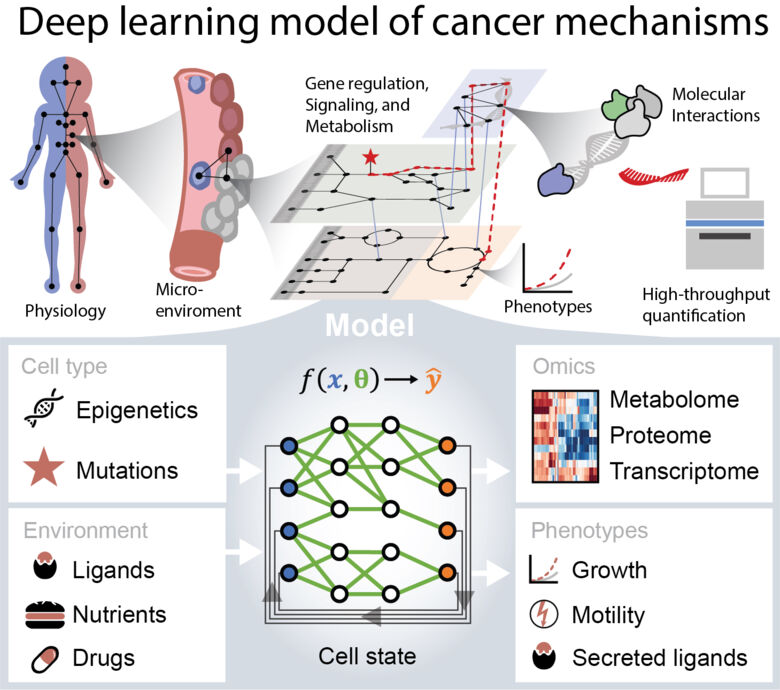
Avlant Nilsson is an Assistant Professor at the Department of Cell and Molecular Biology, Karolinska Institutet. His research focuses on applying interactome-based deep learning to unravel cancer mechanisms, particularly in pancreatic cancer stroma interactions and drug target discovery. Education: PhD in Biology and Biological Engineering (Chalmers, 2019), M.S. Engineering Physics (Chalmers, 2014), B.S. Biological Engineering (Chalmers, 2012) The group develops constrained deep learning models aligned with physical biomolecular interactions, integrating transcriptomics, metabolomics, and proteomics data to study metabolism, signal transduction, and gene regulation networks in cancer. Key research themes include: Precision cancer medicine Drug resistance mechanisms Tumor microenvironment modeling Computer-aided drug design Metabolic network simulations Scientific awards include: DDLS Fellow (Knut and Alice Wallenberg Foundation, 2024-2029) Junior Investigator Award (Swedish Cancer Society, 2024-2026) Deep learning grants from Swedish Cancer Society and Vetenskapsrådet Current lab members: Avlant Nilsson (Group Leader) Olof Nordenstorm (PhD Student) Xinhe Xing (PhD Student) Xuechun Xu (Postdoctoral Researcher)
H. Vincent Poor is the Michael Henry Strater University Professor in the Department of Electrical Engineering at Princeton University’s School of Engineering and Applied Science. He holds a Ph.D. in Electrical Engineering and Computer Science from Princeton (1977), and has maintained a long-standing and influential career in academia and research. His work spans multiple domains including wireless networks, information theory, machine learning, and smart grid systems. Ph.D., Electrical Engineering & Computer Science, Princeton University, 1977 M.A., Electrical Engineering, Princeton University, 1976 M.S., Electrical Engineering, Auburn University, 1974 B.E.E., with Highest Honor, Auburn University, 1972 His research interests are centered on the theoretical and practical challenges in modern communication and energy systems. He investigates information-theoretic foundations of wireless networks, including spectrum sharing, semantic communications, and AI-driven network design. His work explores low-latency, high-reliability communications , physical-layer security, and joint communication-sensing systems. In energy, he focuses on smart grid resilience , integration of renewable energy, privacy in energy data, and game-theoretic models for peer-to-peer energy trading. He also collaborates on epidemic modeling and control using network science and machine learning. The recent publications reflect a strong trend toward integrating machine learning with networked systems —whether in wireless communications, power grids, or public health. His work increasingly leverages graph neural networks , diffusion models , and data-driven optimization to solve complex, real-world problems involving uncertainty, delay, and security. The interdisciplinary nature of his research is evident in the breadth of journals, from IEEE Transactions to PNAS. His numerous scientific awards highlight his global impact: Elected Member of the U.S. National Academy of Sciences and National Academy of Engineering Foreign Member of the Royal Society (UK), Chinese Academy of Sciences, and Royal Society of Canada IEEE Alexander Graham Bell Medal, IEEE Marconi Prize Paper Award (twice), IEEE James H. Mulligan Education Medal Multiple honorary doctorates from institutions including Imperial College, University of Waterloo, and Tsinghua University John Fritz Medal, considered the highest honor in engineering Prof. Poor has advised numerous Ph.D. students who have gone on to prominent academic and industrial positions. His research is supported by extensive collaborations and likely major grants from NSF, DOE, and other agencies, though specific grants are not listed. He has held visiting positions at UC Berkeley, Caltech, and Imperial College, reflecting his international stature. He leads a dynamic research group working on the intersection of information theory, AI, and critical infrastructure. His research group is actively engaged in projects involving AI-enabled wireless networks , secure and resilient smart grids , and data-driven epidemic control . The team combines theoretical rigor with practical implementation, often publishing in top IEEE and interdisciplinary journals. They maintain a strong presence on arXiv, indicating ongoing, high-volume research output.
Sven Johansson is a Senior Lecturer at the Department of Technology and Aesthetics , Blekinge Institute of Technology, Faculty of Engineering. His work spans interdisciplinary domains, with a focus on signal processing, IoT applications, and educational technology. Current affiliation: Blekinge Institute of Technology Academic role: Senior Lecturer Research Interests Johansson's research primarily intersects Computer Science , Signal Processing , and Health Informatics . Key areas include: Wavelet Transform and Neural Network integration for noise cancellation in medical diagnostics IoT-based solutions for agricultural and industrial applications Innovations in remote laboratory education and flipped classroom methodologies Industry 4.0 implementations for safety and health preservation systems His publications demonstrate a consistent focus on applying computational techniques to real-world challenges in healthcare and automation. Scientific Contributions Johansson has contributed to advancements in: Adaptive denoising algorithms for phonocardiography Smart sensor networks in agricultural supply chains Remote diagnostics education frameworks Control algorithm validation in distributed systems
Staffan Svärd is a Professor at the Department of Cell and Molecular Biology, Uppsala University, specializing in Microbiology and Immunology. His research focuses on the molecular mechanisms of parasitic protozoa, particularly Giardia intestinalis and related diplomonads. Investigates host-pathogen interactions at cellular and molecular levels Develops genomic and proteomic tools for studying parasite biology Explores drug resistance mechanisms in intestinal parasites His work bridges evolutionary biology and clinical parasitology, with significant contributions to understanding anaerobic eukaryotic cell biology and parasite virulence factors.
Jacob Orrje is a Researcher at Uppsala University's Department of History of Science and Ideas , with dual affiliations at the Center for History of Science at the Royal Swedish Academy of Sciences . His work bridges early modern knowledge systems and computational methodologies. Education: PhD in History of Science and Ideas (Uppsala University, 2015) Research focuses on digital history and early modern knowledge geographies , particularly through two major projects: "Merchants of Enlightenment" (funded by the Swedish Research Council) investigating commercial networks in 18th-century scholarly communication, and "Mapping Geographies of Early Modern Mining Knowledge" utilizing HTR for transcribing historical mining travelogues. His methodological approach combines handwritten text recognition and deep mapping to analyze non-academic knowledge production in contexts like commerce and state governance. Publications emphasize the material infrastructure of intellectual exchange, from merchant-led book shipments to computational analysis of historical sources. Professional trajectory includes postdoctoral research (2016–19) at Stockholm University's Department for Culture and Aesthetics, and teaching/research roles at Uppsala University (2015–16). Current work explores how digital methods reshape historical research paradigms, particularly in Sweden's 18th-century knowledge economy.
Michael M. Zavlanos is the Yoh Family Professor in the Department of Mechanical Engineering and Materials Science at Duke University’s Pratt School of Engineering. He holds secondary appointments in the Departments of Electrical and Computer Engineering and Computer Science. Additionally, he serves as Director of the Healthcare Systems Optimization program with Duke AI Health and is an Amazon Scholar with Amazon Robotics. National Technical University of Athens (NTUA): Diploma in Mechanical Engineering (2002) University of Pennsylvania: M.S.E. and Ph.D. in Electrical and Systems Engineering (2005, 2008) His research spans Control Theory , Optimization , Machine Learning , and AI , with applications in Robotics , Cyber-Physical Systems , and Healthcare/Medicine . Recent work focuses on systems-level approaches combining mathematical optimization and AI to address healthcare challenges like surgery scheduling and resource utilization, reducing patient wait times, and enhancing operational efficiency. His recent publications highlight trends in Distributionally Robust Optimization , Transfer Learning for Robotics , and Graph Neural Networks integrated with Path Signatures . These works emphasize algorithmic resilience to outliers, adaptation to visual observation changes, and modeling time-series data on graphs. Office of Naval Research Young Investigator Program (YIP) Award National Science Foundation Faculty Early Career Development (CAREER) Award At Duke AI Health, Dr. Zavlanos leads initiatives to optimize healthcare workflows by leveraging predictive models, algorithmic technologies, and collaborations across engineering, surgery, and anesthesiology. His role bridges Duke’s Pratt School of Engineering with its School of Medicine to translate methodological innovations into clinical impact.
Christina Grandien is a Senior Lecturer and Head of Department at Mid Sweden University's Department of Communication, Quality Management and Information Systems (KKI) in Sundsvall. Her research focuses on strategic communication in political and organizational contexts, with active involvement in sustainability and climate communication initiatives. Grandien's work centers on political communication, organizational communication, and public relations, examining digital political labor, influencer politics, and parasociality in election campaigning. Her research projects—including 'The role of coworkers in sustainability goals implementation' and 'Strategic climate communication'—bridge theoretical frameworks with practical sustainability challenges, emphasizing organizational dynamics and communication value creation. Analysis of her 2017-2025 publications reveals consistent exploration of digital media's impact on political authenticity and institutional change. Key contributions include communication maturity indices, occupational branding in public relations, and longitudinal studies of election campaigning, predominantly using qualitative and discursive methodologies to analyze practitioner experiences and sectoral comparisons.
Raja-Khurram Shahzad serves as a Lecturer in Computer Science at Mid Sweden University's Department of Communication, Quality Management and Information Systems (KKI), located in Östersund. Holding a PhD in Engineering, he maintains active research engagement in cybersecurity and educational technology domains. His research focuses on two primary thrusts: (1) Cybersecurity applications , particularly Android malware detection through advanced feature fusion and artificial data generation techniques; and (2) Educational technology innovation , where he develops formative assessment management systems leveraging AI for personalized student feedback. His work bridges theoretical computer science with practical implementations in mobile security and adaptive learning environments. Analysis of his publication trajectory reveals a strategic pivot from cybersecurity fundamentals (2018) toward educational technology applications (2023), demonstrating interdisciplinary adaptability while maintaining core expertise in machine learning systems. Both publications exhibit strong technical rigor with immediate real-world applicability in their respective domains. Scientific Awards No awards or fellowships documented in available materials Dr. Shahzad actively supervises graduate research in cybersecurity and educational technology, though specific student names aren't publicly cataloged. His grant portfolio appears focused on technology-enhanced learning initiatives and mobile security frameworks, with recent work supported through Mid Sweden University's internal research channels. Current projects indicate exploration of AI-driven assessment personalization and next-generation malware detection architectures. He operates within Mid Sweden University's Computer Science research ecosystem, contributing to departmental expertise in applied machine learning systems. His collaborative work with researchers like Erik Ström and Peter Mozelius demonstrates strong interdisciplinary networking within the Scandinavian academic community.
Julian Jose Duque Pedraza is a doctoral student and affiliated researcher at Lund University, Faculty of Medicine, Department of Molecular Enzymology and Infect@LU, respectively. His work focuses on microbiology, molecular biology, and structural biology, particularly in the context of bacterial defense systems. Research interests include Toxin-antitoxin systems Phage defense mechanisms Protein interactions Gene regulation His 2023 PNAS article investigates the structural basis of hyperpromiscuity in combinatorial networks of type II toxin-antitoxin systems and related phage defense systems, with keywords spanning molecular biology, microbiology, and bioinformatics. Additional collaborations and network activity are implied through publications with international teams. Julian is affiliated with the Infect@LU research group and contributes to the broader goals of molecular enzymology. No scientific awards are explicitly mentioned in the scraped data. He has no listed advisees or grants.
Vasili Hauryliuk is a Professor and Senior Lecturer at the Department of Molecular Enzymology , Lund University , Sweden. He serves as a Principal Investigator for projects under the Swedish Research Council and Göran Gustafssons Stiftelse, while also participating in cross-institutional collaborations like eSSENCE and NanoLund . His work intersects with the Infect@LU network and the LTH Profile Area: Nanoscience and Semiconductor Technology . Research Focus Bacterial Defense Against Phages Ribosome Function in Antibiotic Resistance Protein Quality Control Stress Sensing and Signaling His research employs microbiology , biochemistry , next-generation sequencing , and cryo-EM to explore molecular mechanisms. Recent publications highlight trends in structural biology , antibiotic resistance , and CRISPR-Cas systems . 2024: Göran Gustafsson Prize in Molecular Biology 2019: Swedish Fernström Prize 2018: Science Award of the Estonian Republic 2014: Ragnar Söderberg Fellow in Medicine As a Principal Investigator (PI), Hauryliuk leads projects such as A double tap: ribosomal protection through rRNA methylation and antibiotic displacement (Swedish Research Council, 2024–2028) and Decoding bacterial toxin-antitoxin systems (Knut and Alice Wallenberg Foundation, 2021–2026). His lab fosters interdisciplinary collaborations across Europe.
Faramarz Nilfouroushan is a Senior Lecturer in Land Surveying at the University of Gävle, Sweden. His research focuses on tectonic geodesy, ground motion measurements, and geospatial information sciences using satellite geodetic data such as GNSS and InSAR. He actively contributes to advancements in geodetic infrastructure through collaborations with institutions like Lantmäteriet. Research Interests: His work integrates geodetic techniques with geological and hydrological data to analyze crustal deformation, subsidence in mining areas, landslide monitoring, and salt dome modeling. He explores the impact of precise gravity field modeling on aerial photogrammetry and sensor integration. Article Trends: Recent publications emphasize landslide deformation monitoring via EGMS and SBAS-InSAR, GNSS/IMU integration challenges, and subsidence analysis in Sweden and Iran using Sentinel-1 data. Themes include geodetic infrastructure development, environmental monitoring, and tectonic modeling. Projects & Collaborations: He leads contributions to the InSAR-Sweden Project, maintains Sweden’s ETRS89 realization, and evaluates nationwide InSAR services. His teams implement geodetic SAR for height system unification and sea level research in the Baltic Sea.
Najmeh Abiri is a Senior Lecturer at Halmstad University's School of Information Technology. Her research focuses on machine learning, deep learning, and Bayesian inference with applications in image/text processing and life sciences. Research Interests She specializes in: Deep Generative Modeling (GenAI) Probabilistic machine learning Quantum mechanics applications Epidemiological forecasting Publications Her recent work spans tick classification challenges in citizen science (2025), time series imputation (2025), disease risk mapping (2024), and quantum mechanics modeling (2020). Key themes include data quality control, robust probabilistic methods, and ecological informatics applications. Affiliations School of Information Technology Halmstad University
Urban Bilstrup is a Senior Lecturer at the School of Information Technology, Halmstad University. His professional role focuses on advancing wireless communication technologies and computational intelligence applications. Research Interests: Dr. Bilstrup's work spans wireless network optimization, cognitive radio systems, and predictive modeling using computational intelligence. His research includes solar activity forecasting, cyber conflict analysis, and military communication protocols. Publications: His scholarly output demonstrates expertise in ad hoc networks, dynamic spectrum allocation, and neuro-fuzzy systems for space weather prediction, with a publication history from 2000-2020.
Ola Flygt is a Lecturer in Computer Science at Linnaeus University in Växjö, Sweden, affiliated with the Department of Computer Science and Media Technology within the Faculty of Technology. His academic specialization focuses on networking and cybersecurity disciplines. With expertise spanning Computer Security, Computer Networks, Internet Security, Mobile and Wireless Security, and Digital Forensics, Dr. Flygt contributes to both theoretical frameworks and practical security implementations in contemporary computing environments. As Program Director for the Bachelor's Program in Computer Science, he oversees curriculum development and program administration for undergraduate computer science education at Linnaeus University. Cyber-Physical Systems (CPS) Health Data Sweden (HDS)
Andreas Kotsios is a Senior Lecturer at the Department of Law, Uppsala University. He focuses on intersections between law, data protection, and emerging technologies, with a particular emphasis on EU law frameworks. Affiliation: Uppsala University, Department of Law Email: andreas.kotsios@jur.uu.se Research Interests: Andreas's research spans data protection law, privacy in emerging technologies, consumer law, and engineering ethics. His work addresses GDPR compliance, fairness in consumer data practices, and legal challenges in social network research. Publication Trends: From 2015 to 2025, his publications cover GDPR impacts on data sharing, privacy in augmented reality, and the role of law in engineering ethics education. Key themes include regulatory compliance, EU legal frameworks, and interdisciplinary approaches to data governance.