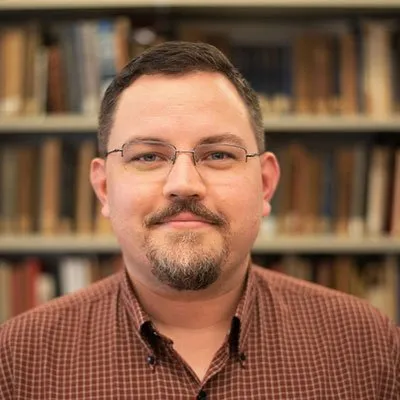
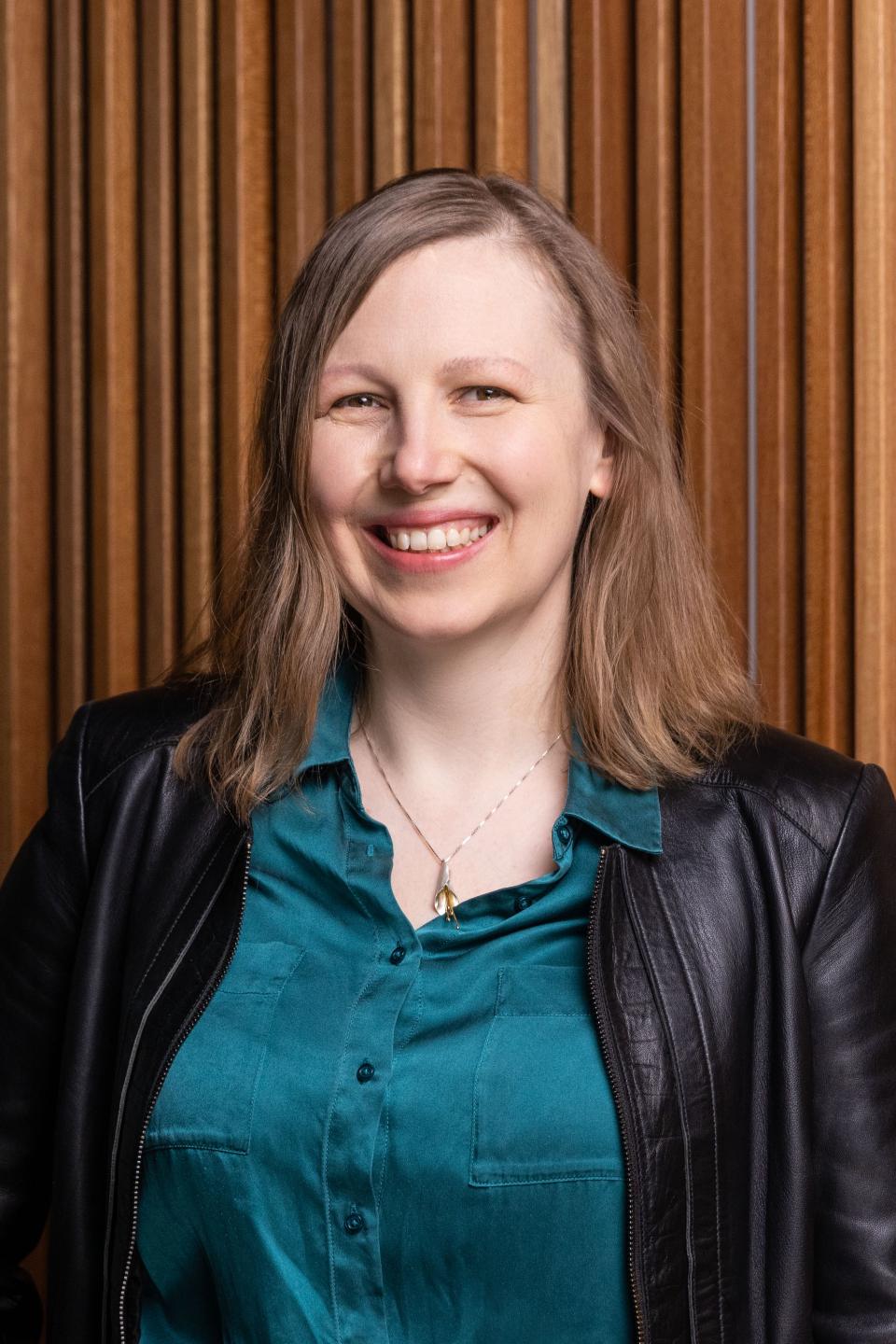
Rikker Dockum (he/him) is a Visiting Assistant Professor in the Linguistics Department at Swarthmore College. His research spans historical linguistics, phonetics, sociolinguistics, computational linguistics, and gender studies, with a focus on Kra-Dai languages, tonal systems, and ethical issues in language technology. Academic Rank: Visiting Assistant Professor University: Swarthmore College Research Focus: Historical linguistics, phonetics, sociolinguistics, computational linguistics, gender studies Contact: rdockum1@swarthmore.edu His recent work explores phonological generalizations from limited data, gender bias in language models and teaching, computational modeling of tone, and decolonizing historical linguistics. Articles highlight functional load dynamics, dialectal variation in Zhongjiang Chinese, and methodological advancements in language documentation. Key trends in his publications include interdisciplinary approaches to phonology, critical examination of sociolinguistic biases, and the application of computational tools to endangered languages. Notable collaborations involve studies of Tai-Khamti sound systems and syntactic borrowing between Khmer and Thai.
Simo Hosio is an Academy Research Fellow (2022-2027) and Professor of Computer Science and Engineering at University of Oulu's Center for Ubiquitous Computing, where he leads the Crowd Computing Research Group. He also maintains a visiting position at University of Tokyo, Japan. Having graduated as the first Finnish scholar under Microsoft Research Cambridge's Ph.D. scholarship program, he has published over 150 peer-reviewed scientific articles spanning two decades of research. Hosio's research spans three primary domains: crowdsourcing methodologies, human-computer interaction, and digital health applications. His work pioneers novel approaches to online labor markets, investigates the suitability of crowdsourcing for diverse applications, and explores HCI aspects of digital health solutions for chronic conditions. His research group, founded in 2020, has secured nearly two million USD in funding, demonstrating significant research impact and recognition. Analysis of Hosio's recent publications reveals a strong trend toward interdisciplinary research at the intersection of crowdsourcing, healthcare technology, and emerging AI systems. His work increasingly focuses on practical applications of crowd computing in health contexts, with growing attention to mental health, women's health, and workplace well-being solutions. The integration of AI and machine learning techniques with traditional HCI approaches represents another significant trajectory in his recent scholarship. Distinguished Paper Award (2024) Best Paper Honourable Mention Award (2022) PMCJ Best Research Paper (awarded in 2024) Best Paper Award (2022) Best Full Paper Award (2015) Honorable Mention Award (2014) Best Paper Presentation award (2010) As an educator, Hosio has taught Human-Computer Interaction (2019-2025) to over 260 students in 2024, Social Computing (2018-2021) to approximately 60 students annually, and Applied Computing (2015-2018) to around 50 students each year. His research group's nearly two million USD in secured funding demonstrates significant grant acquisition success, supporting innovative work at the intersection of crowd computing, health technology, and human-centered AI systems. The Crowd Computing Research Group, founded by Hosio in 2020, represents a significant research infrastructure focused on advancing methodologies for crowd-powered systems. The group's work spans from fundamental research on crowd labor markets to applied projects in healthcare, workplace well-being, and social computing, demonstrating a strong commitment to both theoretical advancement and practical impact.
Anna Wilbik is a Professor in Data Fusion and Intelligent Interaction at the Department of Advanced Computing Sciences, Faculty of Science and Engineering, Maastricht University (The Netherlands). Her research bridges data understanding and human-machine synergy in complex systems, focusing on multi-criteria decision making, explainable AI, and data fusion techniques. PhD in Computer Science (with honors), Systems Research Institute, Polish Academy of Science (2010) Postdoctoral Fellow, University of Missouri (2011) Stanford University TOP500 Innovators Program Alumnus Research Pillars: Intelligent human-machine interaction for joint decision making Data fusion methods for heterogeneous data integration Contextualized multi-criteria decision frameworks Fuzzy logic and linguistic summaries for explainability Federated learning systems Article Trends: Recent work focuses on intuitionistic fuzzy sets for knowledge-intensive processes, federated learning with uncertainty handling, and linguistic summarization techniques for interpretable AI. She actively explores explainability , collaborative business models , and driver behavior analysis through attention-based models. Professional Leadership: Vice-chair of IEEE Fuzzy Systems Technical Committee Organizer of IEEE World Congress on Computational Intelligence (2024)
Professor Matei Candea is a social anthropologist at the University of Cambridge , affiliated with the Department of Social Anthropology and King's College . His research explores ethics, epistemology, materiality, and political subjectivity , with regional focus on Europe and the Mediterranean . He leads the ERC-funded Risking Speech project , analyzing debates over freedom of speech in Europe, and has conducted fieldwork on Corsica, human-animal relations, and anthropological comparison. Current research on European free speech debates Methodological interest in comparative anthropology Teaching roles in undergraduate and postgraduate programs Matei's recent publications cluster around free speech and comparative reasoning , including works on metapragmatic struggles , liberal speech frameworks , and ethical imaginaries . His scholarship bridges political anthropology and philosophical inquiry , with theoretical engagements on Bourdieu, Michel Serres, and the ethics of description. The Risking Speech project's findings inform his analysis of speech regulation and political subjectivity in contemporary Europe.
Prof. Tomaso Fontanini is a researcher at the Department of Engineering and Architecture, University of Parma. His academic contributions span multiple disciplines, including computer science, artificial intelligence, and computer vision. 2025/2026: Deep Learning and Generative Models (Master's in Computer Engineering) 2024/2025: Processing Systems (Bachelor's in Prevention Techniques) 2023/2024: Processing Systems (Bachelor's in Prevention Techniques) 2022/2023: Processing Systems (Bachelor's in Prevention Techniques) Research Focus: His work primarily explores generative models, image synthesis, and style transfer with a strong emphasis on semantic control and attention mechanisms. Recent research has advanced state space models for efficient style transfer (Mamba-ST), semantic image synthesis via class-adaptive cross-attention, and diffusion model acceleration through U-shape architectures. Scientific Contributions: Publications include breakthroughs in controllable face synthesis, mask-based generative modeling, and video anomaly detection. His work bridges theoretical advancements in neural architectures with practical applications in remote sensing and educational technology. 2025: FLAV (audio-video generation), Swin2-MoSE (remote sensing) 2024: MARS (text-based person search), MCGM (mask conditioning) 2023: FrankenMask (face part editing), Student attendance systems
Dr. Fan Zhang serves as Associate Professor in Engineering (Engineering and Design) at the School of Engineering and Informatics, University of Sussex, where he leads research in control systems and sustainable energy technologies. His work bridges theoretical control engineering with practical renewable energy applications, particularly in hydrogen storage and conversion systems. His academic foundation includes: PhD in Control Systems from the University of Sheffield MSc in Control Systems from the University of Sheffield PgCLT (Distinction) from the University of South Wales BEng in Automation from Tianjin University of Technology and Education Research centers on control systems for renewable energy integration, with emphasis on hydrogen storage, wind/solar-hydrogen systems, and automation. His work demonstrates strong interdisciplinary connections between power electronics, energy conversion, and sustainable transportation solutions, particularly through advanced control strategies for complex energy systems. Publication analysis reveals consistent focus on hydrogen energy systems (70% of recent work), with growing emphasis on aviation applications and tidal energy integration. His research trajectory shows evolution from foundational photovoltaic control (2013-2015) toward multi-source renewable systems (2021-2025), reflecting industry shifts toward hydrogen economy solutions. Academic recognition includes: Senior Fellow of the Higher Education Academy He supervises research projects including tidal lagoon power and hydrogen energy storage optimization, with teaching responsibilities spanning Robotics and Electrical Engineering programs delivered in China. His curriculum development for Automation & Mechatronics and Systems Analysis modules demonstrates practical application of his research expertise. Current research activities involve supervisory control systems for renewable hydrogen infrastructure, with emerging work in neurolinguistics-based control interfaces indicating expanding interdisciplinary reach.
Isabel Espinosa Zaragoza is an Assistant Professor in the Department of English Philology at the University of Alicante, Faculty of Philosophy and Letters I. She holds a PhD in Linguistic Studies (cum laude, 2022) and is renowned for her work in lexicology and English for Specific Purposes, particularly the language of color. PhD in Linguistic Studies (cum laude, University of Alicante, 2022) Master’s in English and Spanish for Specific Purposes (University of Alicante, 2016, extraordinary award) B.A. in English Philology (University of Alicante, 2014, extraordinary award) Her research focuses on lexical creativity, color terminology, and natural language processing applications for accessibility. She contributes to projects like CLEARTEXT (CENID) and leads in text simplification for cognitive disabilities. Published in journals: Procesamiento del lenguaje natural , Feminismo/s , Color Culture and Science Journal Book chapters with Cambridge Scholars Publishing and Universidad de Alicante She participated in 15 conferences (PICS 2022, BICLCE 2024) and contributed to 8 public research projects (2019-2025), including EU-funded initiatives. Teaching spans 10 years across 12 courses in English for International Relations, Cultural Management, and Computational Linguistics.
Dr. Anand Mishra is an Assistant Professor and Student Advisor at the Department of Cultural and Religious History within Heidelberg University's South Asian Institute. He joined the university in 2009 and specializes in ancient Indian knowledge systems, particularly Sanskrit grammar and ritual studies. His research includes formal modeling of Pāṇinian grammar and investigations into medieval Hindu traditions. Education : Mathematics from IIT Kanpur, Computational Linguistics & Classical Indology from Heidelberg University His publications explore interdisciplinary connections between Sanskrit studies, computer science, and comparative religious analysis. Key works include "Modeling the Pāṇinian System of Sanskrit Grammar" (2019) and contributions to the "Ritual Dynamics" research program. His research interests intersect with Heidelberg University's Flagship Initiative Transforming Cultural Heritage. He teaches courses on Indian philosophy, Sanskrit grammar, and digital editing of Indic texts. Current projects engage with transcultural knowledge dynamics and historical epistemology in South Asian contexts.
Li Nguyen is an Assistant Professor of Linguistics and Multilingual Studies at Nanyang Technological University (NTU), Singapore . Their work bridges linguistics with computational approaches, focusing on language variation, contact phenomena, and multilingual NLP. Education: PhD in Linguistics (University of Cambridge), Master’s in General and Applied Linguistics (Australian National University) Research interests include: Language variation and change in multilingual/diasporic communities Computational sociolinguistics and NLP for low-resource varieties Syntax-pragmatic interface in bicultural contexts Code-switching and heritage language documentation Recent publications highlight collaborations on Vietnamese-English and other code-switched language pairs, with a focus on NLP applications and corpus-based analysis. Their work has gained recognition through grants like the NTU Start-up Grant and Cambridge Language Sciences funding . Scientific awards: Cambridge International Scholarship, Philological Society Fieldwork Grant Li Nguyen actively collaborates on projects involving sociolinguistically informed NLP and community-driven language documentation. They have contributed to the development of the CanVEC corpus for Vietnamese-English speech research.
Kevin Hong is a Professor and Miami Herbert Centennial Endowed Chair at the University of Miami's Miami Herbert Business School , where he also serves as Associate Dean for Research. His work focuses on information systems and digital platform design. Current roles: Professor, Centennial Endowed Chair, Associate Dean for Research Email: yxh1034@miami.edu ORCiD: 0000-0002-0577-7877 Research Interests: Kevin Hong's work explores digital privacy, user engagement, and behavioral economics across online platforms. His studies examine: Temporal cues in online learning environments Privacy-enhancing designs in dating applications AI implementation in customer service Content generation incentives in knowledge platforms Labor dynamics in gig economy marketplaces Publication Trends: Recent studies demonstrate expertise in field experimentation, behavioral analytics, and platform economics. Key methodologies include: Randomized controlled trials Difference-in-differences modeling Large-scale observational studies
Dr. Almut Sophia Koepke is a junior research group leader and TUM Junior Fellow at the Technical University of Munich (TUM) and University of Tübingen. She leads the multi-modal learning research group focusing on video understanding through sound, vision, and text integration. University: Technical University of Munich School: TUM School of Computation, Information and Technology Department: Informatics 9 Academic Rank: Researcher Her research spans multi-modal learning, audio-visual foundation models, and cross-modal attention mechanisms. Key themes include: Advancing zero-shot learning through language-guided audio-visual models Developing explainable AI systems via attention pattern translation in VQA Exploring temporal understanding in video-adverb retrieval Building robust multi-modal representations for self-driving applications Recent publications analyze foundation model capabilities in audio-visual tasks (ICCV 2025), temporal reasoning (ACMMM 2024), and cross-modal attention frameworks (ECCV 2022). She co-organizes CVPR workshops on foundation model evaluations and serves as area chair/reviewer for major conferences.
Dr. Uma Pradhan is an Associate Professor at UCL's Institute of Education (IOE), Faculty of Education and Society, and serves as Deputy Programme Leader for BA Education, Culture, and Society. She also holds the position of Inclusion Co-Lead for the Department of Education, Practice and Society (EPS). At UCL, she is actively involved with the Centre for Education and International Development (CEID) and the Centre for the Study of South Asia and the Indian Ocean World. Prior to her current position, Dr. Pradhan was a Lecturer and Leverhulme Early Career Fellow at the University of Oxford from 2018 to 2022, and then a Lecturer at University College London from 2022 to 2024 before her promotion to Associate Professor in 2024. Dr. Pradhan's research spans multiple interconnected fields including Anthropology, Development Studies, Applied Linguistics, Humanitarian Disasters, Conflict and Peacebuilding, and Educational Technology. Her work particularly focuses on South Asian educational contexts, with extensive research on Nepal's educational landscape. She examines how educational policies intersect with social structures, linguistic diversity, and political transformations, with special attention to marginalized communities and post-disaster educational reconstruction. Her research demonstrates a consistent commitment to addressing educational inequality and exploring how education can serve as a vehicle for social justice. Dr. Pradhan's scholarly output reveals a strong focus on the intersections between language, technology, and education in South Asia. Her recent publications examine how artificial intelligence is being used for indigenous language preservation, the impact of the pandemic on educational systems across South Asia, and the bureaucratic mechanisms that can inadvertently reproduce social inequality through scholarship programs. Her work consistently connects theoretical frameworks with practical implications for educational policy and practice. Leverhulme Early Career Fellow Fellow of Higher Education Academy (FHEA) As an academic leader, Dr. Pradhan supervises research degrees and engages in collaborative projects and consultancy work. Her research aligns with several United Nations Sustainable Development Goals, particularly Quality Education (SDG 4), Reduced Inequalities (SDG 10), Peace, Justice and Strong Institutions (SDG 16), and Partnerships for the Goals (SDG 17). Her position at the intersection of multiple research centers at UCL enables her to foster interdisciplinary collaborations that address complex educational challenges in global contexts.
Farhad Javanmardi is a Researcher at Aalto University within the Department of Information and Communications Engineering. His work focuses on applying advanced computational methods to speech and biomedical signal analysis. Research Interests: Speech processing, voice disorders, machine learning, deep learning, biomedical signal processing, computational linguistics, and health informatics. His recent research trends emphasize the use of transformer-based models and wav2vec2 for robust detection of heart failure and voice pathologies in telephony environments. He investigates database-independent approaches, severity classification, and data augmentation techniques to improve model generalizability. Publications appear in journals like Speech Communication and Computer Speech and Language , as well as conferences including ICASSP and INTERSPEECH .
Kyle Rawlins is a Professor in the Department of Cognitive Science at Johns Hopkins University (JHU), where he heads the Semantics Lab located in Krieger Hall 105. His research focuses on semantics, pragmatics, syntax, and their intersections, often collaborating with labs like the Van Durme Lab in Computer Science. The Semantics Lab facilitates weekly meetings for discussing research, structured as seminars or traditional lab sessions, and co-organizes projects such as the Decomp Project and MegaAttitude Project . Current lab members include PhD students Karl Mulligan and Natalia Talmina. Notable collaborators: Ilaria Frana (University of Enna), Barbara Landau (JHU), Ben Van Durme (JHU CS), and Aaron Steven White (Rochester). His research spans topics like: Questions Under Discussion (QUD) frameworks Evidentiality and bias in language Multimodal semantic parsing Decompositional semantics Pragmatic particles in Italian Recent publications analyze polar questions, neural network representations, and discourse particles. The lab maintains a mailing list for event announcements, emphasizing collaborative research in semantics and computational linguistics.
Andreas Niekler is a research associate and lecturer in Computational Humanities at the Institute of Computer Science, Leipzig University, Faculty of Mathematics and Computer Science. He develops computational methods for semantic language analysis and applies them to computational social science and humanities research, with focus on machine learning and data management methodologies. His research interests span Natural Language Processing , Computational Social Science , Digital Humanities , Text Mining , Machine Learning , and Conversational AI . Niekler specializes in developing algorithms including Bayesian Models, Topic Models, Deep Learning, and Support Vector Machines for text analysis applications. He is actively involved in the development of the interactive Leipzig Corpus Miner platform and researches how semantic representations can be applied to literary studies and scientometrics. Niekler's recent publications demonstrate expertise across computational linguistics, social science methodology, and practical applications of text mining. His work shows strong interdisciplinary connections between computer science, linguistics, and social sciences, with particular emphasis on developing robust methodologies for automated content analysis. As an educator, Niekler has extensive teaching experience in computational methods for humanities and social sciences, offering courses on text mining, computational linguistics, and programming in R and Python. He serves as a scientific staff member in the Computational Humanities research group led by Prof. Dr. Manuel Burghardt and represents scientific staff in the Faculty Council of Mathematics and Computer Science at Leipzig University.