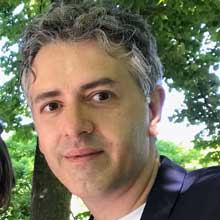
Gianni Loboscoمشاهده پروفایل
استادیار
Gianni Lobosco serves as a Fixed-term tenure-track Assistant Professor at the Interuniversity Department of Regional and Urban Studies and Planning (DIST) at Politecnico di Torino. He also holds affiliations with the University of Ferrara, where he previously worked as a Researcher with a fixed-term contract (2021-2023) and conducted teaching activities (2020-2021). His academic roles include membership in the Planning and Design Board and serving as Course Lecturer for Landscape Architecture programs, including the Master of Science in Landscape Architecture: Design and Management and Designing for Risk Mitigation courses. Lobosco's research spans multiple dimensions of landscape studies with particular emphasis on coastal, rural, and urban landscapes. His work integrates theoretical frameworks with practical applications in landscape design, environmental planning, and climate action. His research interests demonstrate a strong commitment to sustainability, as evidenced by alignment with UN Sustainable Development Goals 11 (Sustainable cities), 13 (Climate action), and 15 (Life on land). Analysis of his recent publications reveals a distinctive research trajectory that bridges traditional landscape architecture with emerging technological approaches. His work shows increasing integration of GIS, spatial analysis, and big data methodologies with landscape planning. A notable trend is his exploration of unconventional landscapes, including underground and extraterrestrial environments, demonstrating innovative applications of landscape architecture principles beyond traditional terrestrial contexts. Lobosco actively contributes to doctoral education as a member of the Doctoral College for Architecture and Urban Planning at the University of Ferrara (2024/2025 academic year). His teaching focuses on landscape architecture modules, particularly those addressing risk mitigation design and urban climate considerations. His scholarly output demonstrates significant engagement with both theoretical landscape discourse and practical design applications. Recent works explore soil transformation as design praxis, adaptive valorization of rural waterfront areas, and the integration of environmental assessment procedures with ecosystem services frameworks. His research increasingly incorporates cross-disciplinary approaches, connecting landscape architecture with geology, space exploration, and environmental science.