Professor Hongbo Zhang is a leading academic at Åbo Akademi University , affiliated with the Faculty of Natural Sciences and Engineering and the InFLAMES (Innovation Ecosystem based on the Immune System) flagship program. With over 227 publications and 21 active/completed projects since 2006, his research spans Functional Materials , Drug Delivery , and Clinical Translation . Research Interests: His work focuses on Engineering nanostructures for blood-brain barrier penetration Microfluidics-enabled biomedical devices Antimicrobial resistance solutions Cellulose-based sustainable materials Mitochondrial delivery systems Theranostic hydrogels Scientific Awards: Fellow of the Royal Society of Chemistry (2024) MDPI Pharmaceutics Young Investigator (2020) Chinese Orthopedic Association 1st Prize (2019) Best Oral Drug Formulation (Control Release Society, 2014) 10 Leading Chinese Talents in Europe (2023) Collaborative Network: Actively hosts international researchers and contributes to EU/Nordic-funded projects like NAP4DIVE and Printed Intelligence Infrastructure . His recent publications demonstrate expertise in nanomedicine, biocomposites, and lignin valorization.
Luigi Aldieri is a Full Professor in the Department of Economic and Statistical Sciences (DISES) at the University of Salerno , Italy. His research spans applied econometrics, innovation economics, environmental sustainability, and knowledge spillovers. He holds a PhD from the Solvay Brussels School of Economics and Management at Université Libre de Bruxelles. Research Interests: His work focuses on the economic impact of innovation, particularly green and environmental technologies, knowledge diffusion, R&D spillovers, energy efficiency, and their effects on employment, productivity, and well-being. He investigates how innovation interacts with migration, education, and institutional quality across regions and countries. Recent Research Trends: His recent publications (2023–2025) emphasize the digital economy, regulatory quality, circular economy, migration-innovation nexus, food security under SDGs, and energy resilience. He employs advanced econometric models such as panel data, spatial analysis, and stochastic frontier analysis, often using international datasets from OECD, EU, and global firms. Scientific Editorial Roles: Associate Editor, Journal of Environmental Management (Environmental Policy, Economics, Social Science section) Associate Editor, Environment, Development and Sustainability Associate Editor, Energy Engineering Editorial Board Member, Sustainability , Energies , Clean Technologies , International Journal of Knowledge-Based Development , and others Guest Editor for special issues in MDPI Energies and Sustainability on climate change, green growth, and total environment Advising and Grants: While no direct PhD advisees are listed, Aldieri leads a robust research network, frequently collaborating with scholars from Russia, Finland, Belgium, and Italy. He is affiliated with the International Centre for Innovation, Technology and Education Studies (iCite) at ULB. His work is supported by extensive co-authorship networks and institutional research projects focused on innovation, sustainability, and economic development. Laboratories and Research Groups: He is part of the research ecosystem at the University of Salerno’s DISES department and collaborates with international research groups. His work is associated with empirical research in innovation economics and environmental policy, often leveraging large datasets and cross-country comparisons.
Romdhane Rekaya serves as a Professor in the Department of Animal and Dairy Science within the College of Agricultural & Environmental Sciences at the University of Georgia. He also holds courtesy faculty positions in the Department of Statistics and is an associate faculty member with the Institute of Bioinformatics at UGA. His research program focuses on developing statistical and computational tools for analyzing large genetic and genomic datasets with applications in livestock, poultry, and human health. Dr. Rekaya's educational background includes: Agriculture Engineer from the High Institute of Agriculture, Tunisia Master of Science from the International Center for Advanced Studies in Mediterranean Agriculture of Zaragoza, Spain Ph.D. from the Polytechnic University of Madrid, Spain Dr. Rekaya's research interests span quantitative genetics, genomics, biostatistics, and bioinformatics. His work centers on developing statistical and computational methodologies for analyzing big genetic and genomic data sets with practical applications in livestock, poultry, and human health. His research has been particularly focused on addressing critical challenges in animal agriculture including horn fly resistance in beef cattle, water utilization efficiency in poultry, and greenhouse gas emissions in dairy production. His methodological approaches often integrate machine learning, Bayesian statistics, and genomic technologies to solve complex biological problems. Dr. Rekaya's publication record demonstrates a consistent focus on statistical methodology development for genetic analysis, with recent work increasingly emphasizing practical applications of genomic technologies in animal agriculture. His research spans both theoretical statistical development and practical implementation in livestock improvement programs, with particular emphasis on innovative approaches to traditional breeding challenges. Among his professional recognitions: Student Career Success Influencer Award 2024 Mini-Sabbatical Award Student Career Success Influencer Award 2022 Carnegie fellowship Carnegie African Diaspora Fellow Faculty with significant positive impact of at least one graduate student Gamma Sigma Delta outstanding Research Achievements Award Dr. Rekaya has successfully mentored numerous graduate students including PhD candidates Amanda Warner, Mahsa Zare, Koushik Das, and Evan Hartono, along with undergraduate researchers. His research has been consistently supported by major funding agencies including USDA NIFA, USDA ARS, Georgia Agricultural Commodity Commission for Beef, National Academy of Sciences, and industry partners including Tyson Foods and Cobb-Vantress. Current projects include developing genetic solutions to the horn fly problem in beef cattle, improving water utilization efficiency in poultry, and examining associations between greenhouse gas emissions and feed efficiency in dairy cattle. Dr. Rekaya leads an active research laboratory that collaborates with multiple departments and institutions. His lab focuses on applying advanced statistical and computational methods to solve pressing problems in animal agriculture, with particular emphasis on integrating genomic information into practical breeding programs. The lab maintains strong industry connections and international collaborations, particularly with researchers in Africa through the African Animal Breeding Network.
Klaus Abberger is a Researcher at the KOF Business Tendency Surveys unit of the KOF Swiss Economic Institute , affiliated with ETH Zurich . His work focuses on business cycle analysis , composite economic indicators , and policy uncertainty impacts on investment and inflation expectations. He has developed methodologies for partial least squares modeling and real-time economic simulations , including the Global Economic Barometers for tracking worldwide output growth. His research frequently incorporates economic tendency survey data from multiple countries, with applications in Swiss business cycles and data-scarce regions like Abu Dhabi. Collaborations with scholars such as Jan-Egbert Sturm and Michael Graff highlight his expertise in composite indicator design and economic forecasting during crises like the Covid-19 pandemic and energy shortages . Abberger's publications span journals including Review of World Economics and European Economic Review , alongside contributions to KOF Studies and KOF Analysen . His work addresses policy uncertainty effects , inflation expectation pass-through , and compositional data analysis in economic contexts.
Sara Magliacane is an Assistant Professor at the University of Amsterdam , affiliated with the Amsterdam Machine Learning Lab (AMLab) and the Informatics Institute . She also holds a Research Scientist position at the MIT-IBM Watson AI Lab and has been an ELLIS Scholar since 2022. Education PhD in Artificial Intelligence (2017), VU Amsterdam MSc in Computer Engineering (2011), Politecnico di Milano BSc in Computer Engineering (2008), Università degli Studi di Trieste Research Focus : At the intersection of Causality and Machine Learning , her work addresses Causal Representation Learning from high-dimensional data (images, sequences) Causal Discovery in latent confounder scenarios Causality-inspired Reinforcement Learning for robustness and adaptability Neurosymbolic AI for theoretical guarantees Publication Trends : Her recent work explores Factored adaptation in non-stationary environments (NeurIPS 2022) Temporal causal identifiability (ICML 2022) Binary interaction-based causal discovery (UAI 2023) Safe exploration in visual RL (HSCC 2021) Structure learning lower bounds (NeurIPS 2020) Scientific Recognition : ELLIS Scholar (2022–present) Spotlight presentations at ICML 2022 and ICLR 2022 Advising & Collaborations : Currently supervising 6 PhD students at the University of Amsterdam and AUMC, with 12 alumni advisees. Collaborates with researchers at MIT-IBM Watson AI Lab, Simons Institute, and TUM.
David Blakesley is Professor of Rhetorics, Communication, and Information Design and Campbell Chair in Technical Communication at Clemson University's College of Arts and Humanities, Department of Interdisciplinary Studies. He currently serves as President of the Faculty Senate for 2023-2024. His academic career spans over three decades with significant contributions to rhetorical theory, digital publishing, and technical communication. Blakesley earned his PhD in Rhetoric, Linguistics, and Literature from the University of Southern California (1990), an MA in English from San Diego State University (1986), and a BA in English from the same institution (1983). His research spans multiple interconnected fields including rhetorical theory, history of rhetoric, digital and visual rhetorics, print and digital publishing, film theory and production, technical communication, and digital humanities. He has focused particularly on Kenneth Burke's rhetorical theory and its applications across various media. His scholarly work demonstrates a consistent trajectory from traditional rhetorical theory toward digital applications and publishing innovations. Over the past decade, his research has increasingly focused on the intersection of digital technologies with rhetorical practices, particularly examining how digital platforms transform scholarly communication and publishing. His 2022 TUGboat article on production versus distribution in publishing exemplifies his ongoing interest in how technological shifts impact academic and professional communication. Fellow, Rhetoric Society of America George Yoos Distinguished Service Award (RSA) Charles Moran Award for Distinguished Contributions to the Field of Computers and Composition Blakesley has secured significant funding including the $11 million Clemson-Adobe Partnership for Campus-Wide Creative Cloud implementation. He serves as Editor of KB Journal, Co-Editor of WAC Journal, and General Editor of The Writing Instructor. His editorial work has been instrumental in shaping scholarly communication in rhetoric and composition studies, particularly through his leadership in digital publishing initiatives.
Dr. Epameinondas Katsikas is a Senior Lecturer in Accounting at Kent Business School, University of Kent, with a focus on management accounting, institutional change, and public sector accounting. He holds a BSc in Accounting from Strayer University, an MBA from Leicester University, and a PhD in Accounting from Durham University Business School. Research interests include management accounting change, performance measurement, and accounting innovations in public sector organizations Teaching spans management accounting, financial accounting, and financial statement analysis Supervision topics cover CSR, public sector accounting, and management control systems His work has been published in international peer-reviewed journals and presented at conferences. Key research trends include institutional dynamics in financial systems, CSR impacts, and ESG policy analysis.
Katia Furlotti is a Full Professor at the Department of Economics and Business Sciences, University of Parma, with a career spanning over 15 years in academia. Her research focuses on Corporate Social Responsibility (CSR), Business Ethics, Corporate Governance, Stakeholder Engagement, and the History of Accounting, particularly in Italian contexts. She has led numerous empirical studies on CSR disclosure practices, gender diversity in governance, and ethical code development for SMEs and non-profits. Education: PhD in 'Determination and Communication of Value in Companies' (2010), Master's in Business Administration (2006), and Degree in Business Economics (2003) from University of Parma. Her research explores CSR disclosure mechanisms, ethical governance structures, and historical accounting practices in institutions like Parma's Teatro Regio and Consorzio del Prosciutto di Parma. Recent studies analyze mandatory gender quotas, CSR vs. business ethics, and board evaluation processes. Key scientific awards include the 2006/2007 ASCAI Award and the Mirella Valentini Scholarship for her Master's thesis. She has served as Vice Direttore of her department and as Quality Assurance Officer for undergraduate programs.
Arnaud Bertsch is a Lecturer at the École Polytechnique Fédérale de Lausanne (EPFL) within the School of Engineering (STI) and the Department of Microengineering (IEM). He is affiliated with the Microsystems Laboratory 1 (LMIS1) and has been actively involved in teaching advanced microfabrication techniques and MEMS sensor/actuator practicals. His research spans microfluidics, nanofluidics, biomedical devices, and 3D microfabrication, with a focus on neural probes, drug delivery systems, and cell manipulation technologies. Microfluidic hydrodynamic and dielectrophoretic systems Nanovolcano microelectrode arrays for electrophysiology Thermal control of ionic transport in nanochannels 3D lipid microrobots for drug delivery MEMS-based intraocular pressure sensors Arnaud Bertsch has supervised PhD students including Torres Vila Pol, Zhang Tao, and past advisees like Clémentine Lipp, Nicolas Maïno, and Joan Teixidor. His work bridges fundamental research in nanofluidics with applied biomedical solutions, contributing to fields such as neuroscience, cancer therapy, and implantable medical devices. The articles listed demonstrate expertise in microsystem design, electrochemical sensing, and biofabrication technologies.
Joel M. Cohen is a Professor of Mathematics at the University of Maryland, College Park. He specializes in Algebraic Topology , Harmonic Analysis , and Functional Analysis , with a focus on Operator Theory and Differential Equations on Trees . His work bridges abstract mathematical theory with applications in Mathematical Physics and Geometric Analysis . His recent publications include studies on Carleson measures, harmonic structures on trees, and the Radon transform. He has received the 2006 Lester R. Ford award for his article in the American Mathematical Monthly. Key Collaborators: Flavia Colonna, David Singman, Massimo Picardello Courses Taught: Math 136 (Calculus for Life Sciences), Math 734 (Algebraic Topology) Cohen has served in various academic roles, including Former Member of the University Senate and Founding Member of the Coalition on Intercollegiate Athletics . His research has been published in journals such as Ann. Inst. Fourier Grenoble, American Journal of Mathematics, and Advances in Applied Mathematics.
Mark Batty is a Professor in the School of Computing at the University of Kent, specializing in formal methods for concurrent systems. His work bridges hardware-software interfaces, focusing on memory models for C/C++, OpenCL, and architectures including x86, ARM, POWER, and GPUs. As a member of the Programming Languages and Systems Research Group, he develops mathematical specifications and verification tools for real-world concurrency challenges. His research centers on empirical testing of hardware/compiler behavior, formal modeling of system components, and verification of fine-grained concurrent algorithms. Key contributions address relaxed memory semantics, transactional memory, and compositional reasoning for concurrent data structures. His work combines theoretical rigor with practical tool development to ensure correctness in complex concurrent environments. Analysis of his 2015-2025 publications reveals consistent focus on memory consistency models, formal verification of weak memory concurrency, and compiler optimizations. Dominant themes include C/C++11 standards, GPU concurrency semantics, and mechanized verification techniques. His research demonstrates strong industry relevance through collaborations with hardware vendors and contributions to language standards. Mark Batty has received significant recognition: John C. Reynolds Doctoral Dissertation Award (2015) from ACM SIGPLAN CPHC and BCS Distinguished Dissertation Award (2015) Lloyds Register Foundation and Royal Academy of Engineering Research Fellowship (2016) He actively leads major research initiatives and mentors next-generation researchers: Current Funding: EPSRC Standard Grant 'Verifiably Correct transactional memory' (2018), VeTTS Grant 'Specification and verification of C++ data structure libraries' (2018), EPSRC First Grant 'Compositional, dependency-aware C++ concurrency' (2018) PhD Recruitment: Actively seeking candidates for UKRI-funded studentship in Verified Trustworthy Software Systems Batty drives community engagement through Kent Concurrency Workshop (2016) and South of England Programming Language Seminars, fostering national collaboration in programming languages research. His leadership in organizing Royal Society discussions underscores his influence in trustworthy systems verification.
Christie Toth is an Associate Professor in the Department of Writing & Rhetoric Studies at the University of Utah . Her research focuses on two-year college composition studies, transfer student writing experiences, writing assessment and placement, settler colonial studies, and tribal college writing instruction. Education: PhD in Education from the University of Michigan (2014) MA in English from Portland State University (2008) BA in Anthropology from Bowdoin College (2004) Research Interests center on equity in writing assessment, transfer student literacy sponsorship, and the intersection of settler colonial studies with writing pedagogy. She advocates for transformative practices in community college-university partnerships and guided pathways reforms. Recent Publications explore writing placement equity, transfer student experiences, and the role of two-year colleges in shaping writing studies. Her work emphasizes social justice frameworks and systemic reform. Scientific Awards include the Robert A. Goldberg Endowed Prize in the Humanities (2024), Best Book Award from the Council of Writing Program Administrators (2022), and multiple teaching and leadership accolades from the University of Utah and national organizations. Grants supported initiatives like the Transfer Student Success Fellowship and Martha Bradley Evans Teaching Fellowship, focusing on writing studies and pedagogical innovation.
Seung Eock Kim is a Professor in the Department of Civil and Environmental Engineering at Sejong University, Korea, where he has served since 1997. Previously, he held executive leadership as Senior Vice President (2015-2018) and brings industry experience from Daewoo Engineering. His academic credentials include a Ph.D. from Purdue University (1996), M.S. from KAIST (1990), and B.S. from Yonsei University (1983). Kim leads research in structural systems optimization with emphases on: Nonlinear inelastic analysis of steel/composite structures AI-driven structural design methodologies LRFD (Load and Resistance Factor Design) frameworks Advanced computational mechanics for infrastructure His recent publications (2024-2025) demonstrate strong focus on machine learning applications for structural health monitoring, nano-scale material characterization of steels, and sensor-based corrosion detection. This represents a strategic expansion into intelligent infrastructure systems beyond traditional mechanics. Awards and honors: National Research Laboratory designation (Ministry of Science, 2000) Elected Full Member of Korean Academy of Science and Technology (2011) He directs the Steel Structure Laboratory , where he developed the specialized nonlinear analysis software 3D-PAAP. His research has generated 132 SCIE-indexed publications with 1,599+ citations, including the influential CRC Press book LRFD Steel Design Using Advanced Analysis (1997).
Woojin Han is an Assistant Professor in the Departments of Orthopedics and Cell, Developmental & Regenerative Biology at the Icahn School of Medicine at Mount Sinai. His research program focuses on the mechanobiology of skeletal muscle stem and progenitor cells, with applications in disease modeling and the development of advanced therapeutics for muscle injuries and degenerative diseases. Dr. Han earned his BS in Biomedical Engineering from the University of Rochester and his MS and PhD in Bioengineering from the University of Pennsylvania. He completed his postdoctoral training at the Georgia Institute of Technology, where he received awards from the American Federation for Aging Research (AFAR) and the NIH. Dr. Han's research integrates biomaterials, bioengineering, and in vivo genetic approaches to investigate cell-matrix interactions and mechanobiological signaling, aiming to uncover the mechanisms driving muscle regeneration and pathology. His work is supported by the National Institutes of Health (NIH) and the Department of Defense (DoD). Analysis of Dr. Han's recent publications reveals a strong focus on muscle regeneration mechanisms, particularly examining the role of extracellular matrix proteins, mechanical confinement, and signaling pathways in muscle stem cell behavior. His research spans from fundamental mechanobiology to translational applications using biomaterials for tissue regeneration. 2025 NEBEC Emerging Investigator Award 2024 Mount Sinai Faculty Council Award for Junior Faculty 2023 Popular Science's The Brilliant 10 2022 Stephen I. Katz Early Stage Investigator Grant Awardee American Federation for Aging Research (AFAR) award NIH award Dr. Han's research is supported by significant funding from the National Institutes of Health (NIH) and the Department of Defense (DoD). His work bridges basic science and clinical applications, with particular emphasis on developing advanced therapeutics for muscle injuries and degenerative diseases. Through his lab, he mentors junior researchers in the fields of biomechanics, bioengineering, and regenerative medicine. Dr. Han leads the Han Lab, which focuses on skeletal muscle regeneration research. The lab employs a multidisciplinary approach combining biomaterials engineering, molecular biology, and advanced imaging techniques to develop novel strategies for enhancing muscle repair and preventing pathological changes following injury.
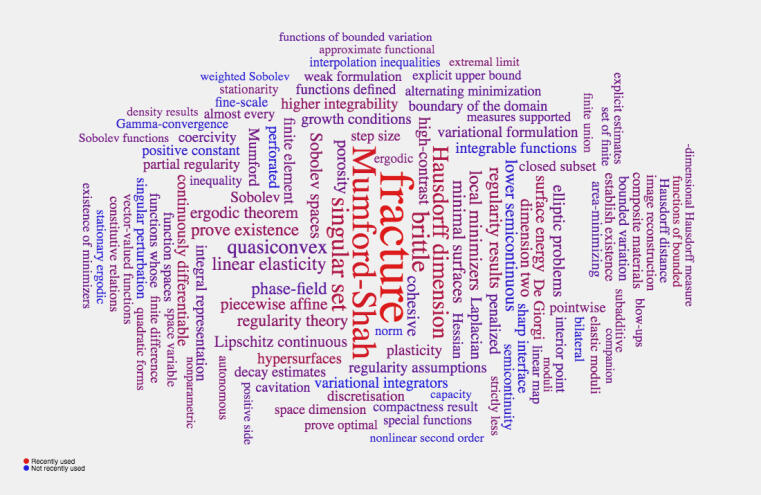
Professor Caterina Ida Zeppieri is a distinguished mathematician at the Westfälische Wilhelms-University Münster (University of Münster) in Germany, where she leads the Research Group 'Analysis and Modelling' within the Institute for Analysis and Numerics. She has maintained a continuous academic presence since at least the Winter semester 2012/13 through to upcoming semesters in 2025/26, consistently teaching advanced mathematics courses and supervising research activities. Her research focuses on fundamental aspects of mathematical analysis with significant applications to materials science. She specializes in Calculus of Variations, Elliptic PDEs, Gamma-convergence, Homogenization theory, Free-discontinuity problems, Nonlinear elasticity, and Plasticity. Her work bridges theoretical mathematics with practical applications in understanding material behavior, particularly fracture mechanics and composite materials. Professor Zeppieri's publication record demonstrates a consistent and impactful research trajectory from 2007 through forthcoming publications in 2025. Her recent work shows a strong emphasis on stochastic homogenization techniques applied to free-discontinuity problems and singularly-perturbed functionals, revealing sophisticated mathematical approaches to modeling complex material behaviors across multiple scales. She regularly collaborates with leading researchers including Filippo Cagnetti, Gianni Dal Maso, and Lucia Scardia, contributing to significant advances in the mathematical understanding of material science phenomena. Her research has been published in top-tier mathematics journals including Calculus of Variations and Partial Differential Equations, Archive for Rational Mechanics and Analysis, and SIAM Journal on Mathematical Analysis. Within the department, Professor Zeppieri plays an active role in teaching advanced courses such as Partial Differential Equations, Calculus of Variations, and Advanced Topics in the Calculus of Variation, while participating in the department's Advanced Seminar in Applied Mathematics and Colloquium on Applied Mathematics.