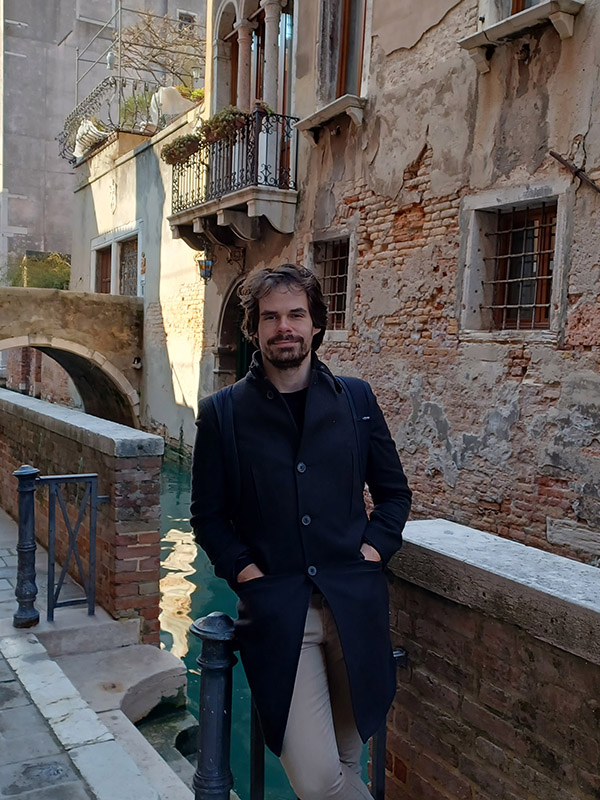
Christine Sabine Sheppardمشاهده پروفایل
پژوهشگر ارشد
Christine Sabine Sheppard is a Privatdozent (Priv.-Doz.) and Senior Research Associate in the Landscape Ecology and Vegetation Science group at the Institute of Landscape and Plant Ecology, University of Hohenheim, Germany. She specializes in plant ecology with a research focus on biological invasions and biotic interactions. Starting September 2025, she will assume a position as Full Professor of Botany and Vegetation Ecology at BOKU University in Vienna, Austria. Her work combines multi-species experiments and macroecological analyses to understand eco-evolutionary dynamics of plant invasions. Dr. Sheppard completed her Habilitation and venia legendi in Plant Ecology at the University of Hohenheim in April 2022 with a thesis on 'Eco-evolutionary dynamics of plant invasions in novel biotic and abiotic contexts.' Prior to this, she earned her PhD in Biological Sciences from The University of Auckland, New Zealand in 2014 with a thesis on 'Potential distribution and invasiveness of recently naturalised alien plants under climate change,' for which she received The University of Auckland International Doctoral Scholarship. She also holds a Master of Science ETH in Environmental Sciences from the Swiss Federal Institute of Technology Zurich, with a major in Ecology and Evolution. Her research focuses on understanding biotic interactions between alien plants and native communities, including plants, pollinators, herbivores, and soil organisms, as well as among multiple invaders. She investigates the long-term dynamics of plant invasions and tests potential synergistic effects of plant invasions with various factors of global change such as climate change. Her work takes a functional trait approach to obtain generalizations on eco-evolutionary dynamics of alien and native plants. She leads several research projects including 'From novel to native: long-term dynamics of biotic interactions (Nov-Nat)', 'Performance of and interactions among multiple co-occurring plant invaders', and 'Temporal dynamics of plant invasions: the role of residence time mediated by abiotic and biotic dissimilarity.' Analysis of her recent publications reveals a strong emphasis on understanding how residence time affects invasion dynamics, competitive hierarchies among alien species, and the role of biotic resistance in determining invasion success. Her work spans experimental ecology, field studies, and macroecological analyses, with particular attention to how global change factors interact with invasion processes. She frequently employs multi-species experimental approaches to generate generalizable insights about invasion mechanisms. University of Auckland International Doctoral Scholarship Eliteprogramme for Postdocs Baden-Württemberg Stiftung Dr. Sheppard has been actively involved in multiple research projects funded by various organizations including the German Research Foundation (DFG) and the Baden-Württemberg Stiftung. Her laboratory work includes large-scale mesocosm experiments at the Heidfeldhof experimental field site in Stuttgart, involving 1250 mesocosms for long-term dynamics of plant invasions and 1400 pots for alien-alien interactions experiments. She collaborates extensively with researchers across Europe and New Zealand, contributing to large collaborative efforts such as the TRY plant trait database project. Her research team focuses on understanding the complex interactions between multiple invasive plant species and native communities under changing environmental conditions. The team combines experimental approaches with macroecological analyses to generate insights applicable to invasion management and conservation planning in the context of global change.