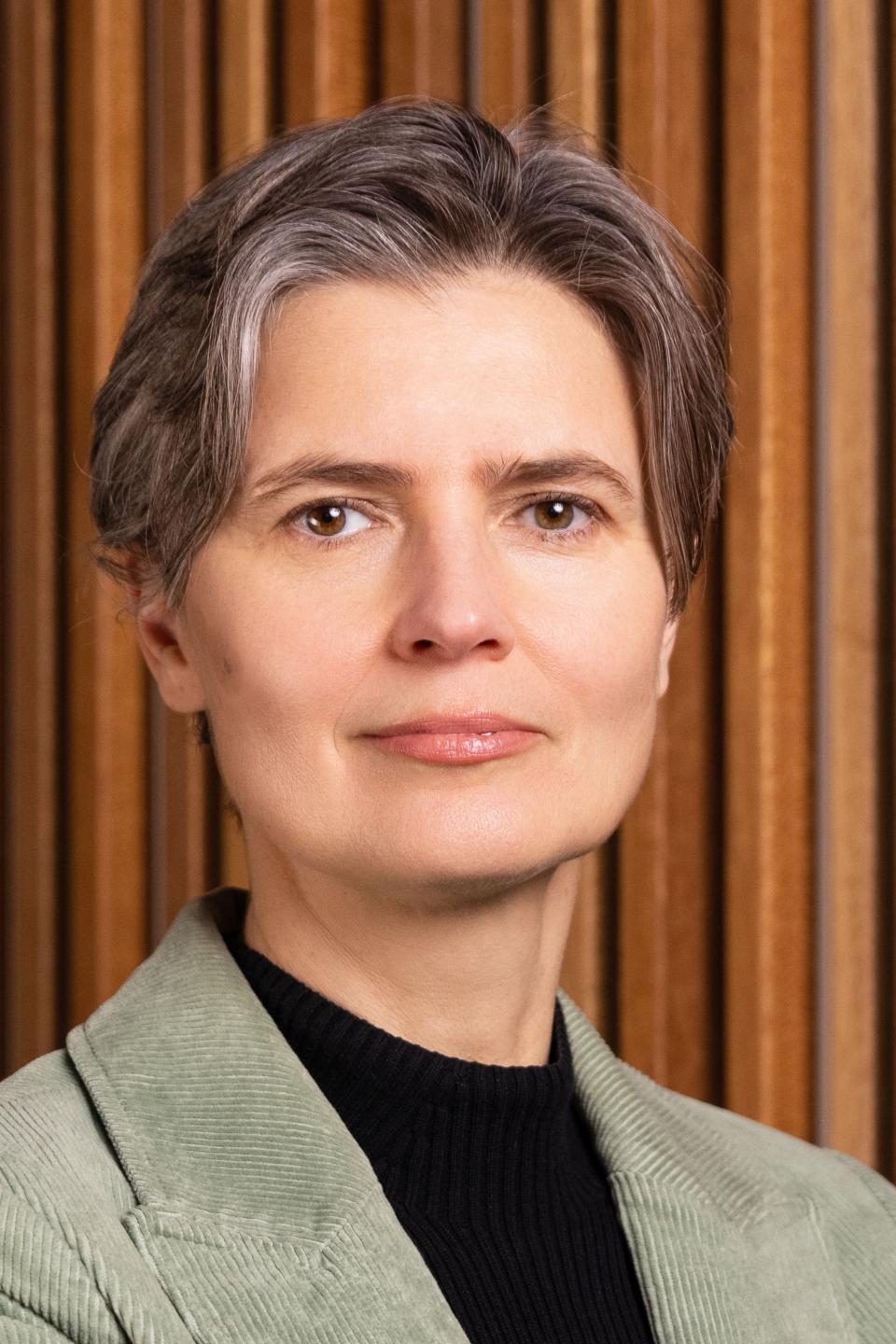
Prof. Emiel Krahmer is a Professor at the Department of Communication and Cognition, Tilburg School of Humanities and Digital Sciences (TSHD), Tilburg University. His research focuses on healthcare communication, digital health technologies, and patient-centered approaches. He explores barriers/facilitators in return-to-work strategies for trauma patients, personalized predictions in rehabilitation, and the role of serious games in health behavior change. His work also addresses ethical challenges in self-monitoring platforms for mental health, emphasizing epistemic justice and algorithmic fairness. Collaborations with medical professionals and interdisciplinary teams highlight his contributions to digital health innovation. Key projects include studies on trauma patient perspectives, implementation of patient-reported outcome measures (PROMs), and game-based interventions. His research bridges communication science and clinical practice, aiming to enhance patient engagement and equitable healthcare delivery through technology.
Helga Gardarsdottir is a Professor in Pharmacoepidemiology at Utrecht University (Netherlands), serving as Scientific Director of the Center for Pharmacoepidemiology. She also holds an adjunct professorship at the University of Iceland and serves as a Seconded National Expert at the European Medicines Agency (EMA). Her work focuses on real-world data for regulatory decision-making, drug safety, and clinical guideline implementation. She leads international projects like IMI Trials@Home and EMA IMPACT, addressing decentralized clinical trials, risk minimization, and pharmacovigilance impact. Her roles include co-chairing the ENCePP steering group and editing Pharmacoepidemiology & Drug Safety . Beyond research, she chairs the Faculty of Science’s EDI committee, promoting inclusive academic practices. Education: Pharmacist training in Sweden; Pharmacoepidemiology specialization in the Netherlands. Research Interests: Innovations in real-world evidence generation, regulatory science, drug safety surveillance, and clinical trial modernization. Key areas include RWE’s role in HTA/regulatory decisions, unintended impacts of drug policies, and digital health integration. Publications: Recent work emphasizes methodological advancements in decentralized trials, pharmacovigilance outcomes (e.g., fluoroquinolone prescribing shifts), and harmonized approaches to external control trials. Her studies bridge regulatory practices with clinical practice guideline adherence. Achievements: Overseeing multi-country initiatives like the IMI Trials@Home consortium (decentralized trials framework) and EMA IMPACT (guideline-RMM integration). Recognized for leadership in ENCePP’s methodological standards and ISPE’s Real-World Evidence Task Force. Grants & Teams: Principal investigator on EMA-funded projects and IMI grants. Leads Utrecht’s Applied Data Science initiative and collaborates with the EU PEV Research Network. Active in training next-generation researchers through teaching and mentoring. Labs/Teams: Utrecht Center for Pharmaceutical Policy & Regulation; Trials@Home consortium; ENCePP working groups.
Prof. Dr. J. Ellers is a Full Professor at the Faculty of Science, Vrije Universiteit Amsterdam , and a member of the Amsterdam Institute for Life and Environment . His research focuses on understanding how an individual’s phenotype is shaped by interactions between genes, genome, and environment , employing molecular, physiological, and experimental tools within an evolutionary framework. Ellers contributes to the Netherlands Society of Evolutionary Biology (NLSEB) as a co-founder and serves as Vice-Chair of the Dutch Biology Council , advocating for biology research and education in the Netherlands. Research Interests: Ellers explores the intersection of evolutionary biology, ecology, and environmental science , with key themes in phenotypic plasticity, urbanization effects on species, trait-based ecology, and adaptive signaling . His work spans soil fauna dynamics, invasive species impacts, and metabolic adaptations , emphasizing interdisciplinary approaches to link mechanisms with ecological and evolutionary outcomes. Recent Publications highlight trends in urban ecology, climate change impacts, and trait evolution . Notable studies examine how noise and light pollution alter animal communication , high-sugar diets affect microbiomes , and robot morphologies reflect biological systems . His research also addresses data interoperability through initiatives like ShareTrait and global soil arthropod assessments . Scientific Contributions: Ellers advocates for open-access publishing and interdisciplinary climate change experiments. His leadership in the Dutch Biology Council and co-founding of NLSEB reflect sustained commitment to scientific policy and community engagement. Supervised 23 PhD theses and teaching courses like Ecosystem Services and Scientific Advocacy underscore his mentorship and educational impact.
Maarten de Rijke is a Professor at the University of Amsterdam's Informatics Institute, leading the Information Retrieval Lab (IRLab). He specializes in information retrieval, machine learning, and recommendation systems, focusing on neural ranking models, fairness, and conversational search. His work bridges theory and practice, addressing challenges in reproducibility, robustness, and ethical AI. He supervises numerous PhD students and postdocs, including recent defenses by Barrie Kersbergen, Antonis Krasakis, and Vera Provatorova. His lab collaborates internationally, organizing events like SIGIR workshops and the Search Engines Amsterdam (SEA) meetup. Key awards include the Best Reproducibility Paper Award (2025) and Best Paper at WSDM 2021. Research interests span generative retrieval, adversarial robustness, and fairness in ranking. Notable projects include the FULTR dataset, FairDiverse toolkit, and studies on empathetic conversational systems. He actively promotes open science through reproducible methodologies and community-driven benchmarks.
Adriana Iamnitchi is a Full Professor and Key Domain Chair for Computational Science at Maastricht University's Faculty of Science and Engineering, affiliated with the Department of Advanced Computing Sciences. Her research focuses on computational social science, social media dynamics, and misinformation detection. Her primary research interests include: Analysis of coordinated information campaigns across social platforms Development of LLM-based synthetic data generation for social media research Polarization quantification in multi-community networks Policy compliance frameworks for digital regulation (e.g., EU's Digital Services Act) Ethical AI applications for content moderation and transparency Her recent publications (2023-2025) demonstrate strong focus on: Cross-platform disinformation detection using multimodal embeddings Generative AI for synthetic social media datasets Quantitative analysis of toxicity monetization in creator economies Regulatory compliance automation for content transparency
Dr. Jun Hu is an Associate Professor in Design Research on Social Computing at the Department of Industrial Design, Eindhoven University of Technology (TU/e). He serves as the Scientific Director for the Engineering Doctorate program in Designing Human-System Interaction and is the chair of the working group "Aesthetics and empowerment" of IFIP TC14. Additionally, he holds positions as a Distinguished Adjunct Professor at Jiangnan University and a Guest Professor at Zhejiang University. Dr. Hu earned his Ph.D. degree in Interaction Design and an Engineering Doctorate degree in User-system Interaction, both from TU/e. He also holds a B.Sc degree in Mathematics and an M.Eng degree in Computer Science. He is a System Analyst and a Senior Programmer with qualifications from the Ministry of Human Resources and Social Security, and the Ministry of Industry and Information Technology of China. His research focuses on the intersection of Human-Computer Interaction, Social Computing, and Design Research, with particular interests in data physicalization, empowering systems, and health informatics. Dr. Hu's work explores how technology can be designed to support human needs in social contexts, with applications in health, stress management, and physical activity motivation. His approach often combines aesthetic considerations with functional design to create systems that empower users. Analysis of Dr. Hu's recent publications reveals a strong focus on data physicalization, social aspects of personal informatics, and health applications of interactive systems. His work spans from theoretical frameworks for understanding user interaction with physicalized data to practical applications in stress management for children and motivation for physical activity. There's a clear trend toward integrating AI capabilities into human-centered design approaches while maintaining a focus on user empowerment. Senior Member of ACM Distinguished Adjunct Professor at Jiangnan University Guest Professor at Zhejiang University Editor-in-chief for EAI Endorsed Transactions on Pervasive Health and Technology Associate editor for Behaviour & Information Technology and Entertainment Computing Editor for the International Journal of Arts and Technology Dr. Hu has supervised numerous students through the Engineering Doctorate program and has been involved in various research grants, particularly in the areas of health technology and human-system interaction. He has served in leadership roles including head of the Designed Intelligence group at ID TU/e from 2015-2017 and currently chairs the working group "Aesthetics and empowerment" of IFIP TC14. He coordinates the TU/e DESIS Lab in the DESIS Network and serves on multiple editorial boards. Dr. Hu is actively involved with the Design Of Empowering Systems research group and the EAISI Health initiative at TU/e. His work often involves interdisciplinary collaboration across computer science, design, and healthcare domains, focusing on creating systems that empower users through thoughtful integration of technology into everyday contexts. He also serves as Chairman of the Foundation for Design Promotion in Europe and China and is a board member of the International Chinese Association of Computer Human Interaction (ICACHI).
Raymond H. Cuijpers is an Associate Professor at Eindhoven University of Technology in the Human Technology Interaction group. His research focuses on Cognitive Robotics , Human-Robot Interaction , and Artificial Intelligence for cognitive agents, with applications in healthcare robotics and aging population support. PhD in Physics of Man from Utrecht University (2000) Postdoctoral research at Erasmus MC Rotterdam and Radboud University Nijmegen Key research areas include: Developing socially intelligent robots with proper social cue interpretation Hybrid AI approaches for real-world complexity handling Visual-haptic perception integration in human motor control Service robots for COPD patient assistance (KSERA project) Rescue robotics and tele-operation applications Recent research output (2025) includes studies on: Personalization in human-robot communication Optimal lighting for elderly visual perception Human-robot bonding mechanisms Interactive sensorized platforms for homecare (GUARDIAN) Audiovisual temporal integration in virtual environments He coordinates large-scale European projects like GUARDIAN and previously KSERA, contributes to sustainable development goals through healthcare robotics, and serves on editorial boards of leading journals including International Journal of Social Robotics . His work spans both technical robotics development and human-centric interaction studies.
Dr. Franziska Pannach is an Assistant Professor at the Faculty of Arts of the Rijksuniversiteit Groningen (Netherlands), affiliated with the Centre for Language and Cognition (CLCG) . She specializes in Computational Linguistics , Digital Humanities , and Semantic Web Technology , focusing on modeling narratives and mythological texts using NLP and ontologies. Her work emphasizes Open Science and cross-cultural comparisons of folktales and myths. Education : Dr. rer. nat. (PhD) in Applied Computer Science (Digital Humanities/Computational Linguistics), University of Göttingen, Germany (2024) MSc in Applied Computer Science (Digital Humanities), University of Göttingen (2019) BSc in Applied Computer Science (Computational Neuroscience), University of Göttingen (2013) Research Interests include computational approaches to mythological and folkloristic analysis, shallow ontologies for narrative comparison, and semantic web applications in cross-cultural studies. She leads the GOLEM (Graph Ontologies for Literary Evolution Models) project and contributed to the STRATA (Stratification Analyses for Mythic Narrative Materials) project. Teaching : Semantic Web Technology (MSc), Database-driven Web Technology (BSc), Digital Humanities: Tools and Methods (MSc), Analysing Data (MSc) Supervision : PhD students Pritha Majumdar (RUG) and Kristina Schneider (RUG/University of Mainz) Publications focus on narrative ontologies, mythological event annotation, and NLP for under-resourced languages. Her recent work includes the GOLEM Triple Store and shallow ontologies for myth comparison. Networks & Memberships : Member, Digital Humanities Association of Southern Africa (DHASA) since 2019 Co-founder and editor of the Journal of Digital Humanities Association of Southern Africa (JDHASA) Collaborations with institutions in Germany, South Africa, and Denmark
Dr. Muirne Paap is an Associate Professor with Ius Promovendi at the Faculty of Behavioural and Social Sciences, University of Groningen. She specializes in psychometrics, with expertise in test theory, item response theory, and computerized adaptive testing. Her research focuses on enhancing clinical decision-making through advanced measurement methodologies. Education: PhD in Psychiatry from the University of Oslo (2011), MSc in Clinical Psychology and Psychometrics from the University of Groningen (2006, cum laude). Research Interests: Development of reliable clinical assessment tools Computerized adaptive testing (CAT) applications in healthcare Measurement of personality disorders and quality of life Notable Projects: SEALS Project (2024–2028): Methodology for progressive tests in education PersoniCAT Project (2019–2022): Adaptive diagnostic interviews for personality pathology Awards: FRIPRO Young Research Talents Grant (2018) Member of the Young Academy Groningen (2021) Teaching: Test theory, item response theory, and applied statistics at undergraduate and master's levels. Collaborations: Extensive international partnerships, including with Oslo University Hospital, Harvard Medical School, and the Netherlands Cancer Institute.
Dr. Judith Verstegen is an Assistant Professor in the Department of Human Geography and Spatial Planning at Utrecht University's Faculty of Geosciences. Her research focuses on geosimulation modeling and spatial optimization, with applications in urban planning, environmental vulnerability assessment, and policy analysis. She leads projects such as HEADS 4 Health (2023-2024), which integrates agent-based models into urban digital twins, and coordinates the GeoSIM research group. Her work emphasizes interdisciplinary collaboration, including projects analyzing linguistic diversity in South America and environmental threats to Amazonian indigenous lands. She is the Program Chair of the MSc Geographical Information Management and Applications (GIMA) program and serves as Editor-in-Chief of the Journal of Spatial Information Science. Notable contributions include methodologies for spatial optimization under uncertainty and agent-based modeling of pedestrian behavior in urban environments. Key research areas include applied data science, complex systems analysis, and the PtS - Transforming Cities initiative. She has advised PhD students on topics ranging from fire prevention optimization to indigenous land vulnerability. Her lab at the University of Münster previously focused on spatial modeling frameworks, and she collaborates internationally with institutions like Leiden University and the PBL Netherlands Environmental Assessment Agency. Recent projects highlight innovation in computational methods, such as Python-based open-source tools for land-use modeling (IMAGE-land) and immersive video experiments for behavioral studies. Her work bridges theoretical modeling with practical policy applications, addressing challenges in sustainable urban development and environmental conservation.
Dr. Almila Akdag is an Assistant Professor in Human-Centered Computing at Utrecht University's Faculty of Science, Department of Information and Computing Sciences. As a Digital Humanities scholar with expertise spanning new media analysis, bibliometrics, and information visualization, she combines qualitative and quantitative methods to study humanities and social data. Research Focus Her interdisciplinary research bridges: Digital Humanities : Computational analysis of cultural artifacts including paintings, poetry, and oral histories Human-Centered AI : Developing empathetic and accessible AI systems Trauma Informatics : Analyzing breathing patterns in oral histories of trauma survivors Cultural Analytics : Studying art communities and online creative platforms Following the 2023 Turkey/Syria earthquake, she is creating an oral history archive to document collective memory of the disaster, with particular focus on Turkish, Kurdish and Syrian diaspora experiences. Awards and Recognition NWO VENI laureate for 'deviantArt: Mapping the Alternative Art World' project Co-initiator of Mellon Grant: 'Tools for Analysis and Visualization of Large Image/Video Collections for Humanities' Leadership and Service Workgroup leader of 'Visual Media and Interactivity' for DARIAH-EU Founding member of International Society for Knowledge Organization (ISKO LC Low Countries Chapter)
Dirk Thierens is an Associate Professor in the Department of Computer Science at Utrecht University's Faculty of Science, specializing in Intelligent Systems within AI & Data Science. His academic career spans over 25 years, with continuous publications from 1996 through 2025, demonstrating sustained research activity and leadership in his field. He maintains an active research program with numerous collaborations, most notably with Peter A.N. Bosman, indicating a long-standing productive research partnership. Thierens' research focuses on evolutionary computation, particularly model-based evolutionary algorithms, genetic algorithms, and optimization techniques. His work has evolved from foundational genetic algorithm research in the late 1990s and early 2000s to more specialized model-based approaches in recent years, including significant contributions to Gene-pool Optimal Mixing Evolutionary Algorithms (GOMEA). His expertise spans single-objective and multi-objective optimization, permutation problems, mixed-integer problems, and real-valued optimization. In recent years, his research has expanded into applications in machine learning, particularly semi-supervised learning and neural network optimization. His publication record shows a consistent output of high-quality research, with numerous papers in top conferences like GECCO and journals in evolutionary computation. His most recent work (2023-2025) demonstrates continued innovation in synthetic data generation, neural network combination techniques, and parameterless evolutionary algorithms. The breadth of his work spans theoretical algorithm development, benchmarking methodologies, and practical applications in healthcare and other domains. While no specific scientific awards are mentioned in the available information, his extensive publication record, tutorial contributions at major conferences, and sustained research productivity over multiple decades indicate recognition within the evolutionary computation community. His tutorial work at GECCO conferences suggests he is considered an authority on model-based evolutionary algorithms. Thierens maintains an active research laboratory focused on evolutionary algorithms and their applications, with recent work exploring the intersection of evolutionary computation and deep learning. His research continues to advance both theoretical understanding and practical applications of optimization techniques in complex problem domains.
Prof. dr. Mirella M.N. Minkman serves as the Vilans Chair in Innovation of Organization and Governance of Integrated Care at Tilburg University's TIAS School for Business and Society. Concurrently, she is CEO of Vilans (National Knowledge Organization for care and support), bridging science, practice, policy, and education through national innovation programs. Her leadership extends to Chair of the National Governance Innovation Advisory Committee (BoZ), Chair of the NVTZ Scientific Advisory Board, Supervisory Board roles at RIBW Brabant and Rivierenland Hospital, and membership in the VGN Committee of Experts. Minkman's research pioneers person-oriented integrated care governance within multi-organizational networks, focusing on leadership, accountability systems, and strategic innovation. She examines how governance modes enable collaborative care models while addressing implementation barriers in healthcare transformation. Her work emphasizes change management frameworks for large-scale system integration, with particular attention to supervision mechanisms and value-based accountability structures across care continua. Analysis of her 15 recent publications (2021-2023) reveals consistent exploration of integrated care governance across Dutch and international contexts. Key thematic clusters include leadership in nursing home care, decision-making dilemmas in service networks, and emerging AI applications in long-term care. Methodologically, her work spans systematic reviews, policy analyses, and implementation studies, predominantly published in the International Journal of Integrated Care and specialized healthcare management outlets. Through Vilans, Minkman directs national knowledge platforms and large-scale implementation programs that connect academic research with practical healthcare innovation. Her international engagement includes board membership with the International Foundation for Integrated Care, editorial roles for the International Journal for Integrated Care, advisory positions with WHO's Integrating the Health and Care Workforce group, and participation in the UK Center for Evidence IMPACT's Critical Friends Group.
Elly Konijn is a Full Professor in Media Psychology at the Department of Communication Science, Vrije Universiteit Amsterdam, and holds the Fenna Diemer-Lindeboom Endowed Chair. She is the founder of the Media Psychology Amsterdam program and leads research at the Network Institute and the Communication Choices, Content and Consequences (CCCC) initiative. Education: PhD in Media Psychology, Vrije Universiteit Amsterdam (1994) Her research focuses on three primary domains: Relating to media figures, virtual humans, and social robots through the PEFiC and i-PEFiC models of emotional bonding Emotions and media-based reality perceptions (e.g., moral standards shaped by media use) Media effects on adolescents (e.g., cyberbullying, violent video games, thin-body ideal, self-presentation) Her 15 most recent publications explore: 2024: Active-passive dynamics in adolescent photo sharing and mental health (Telematics and Informatics) 2024: Narrative complexity engagement frameworks 2024: Cognitive style-political affiliation interactions in media storytelling 2024: Human-robot convention formation models 2023: Figurative language effects in right-wing anti-immigration rhetoric Scientific honors include: KNAW/NWO Eurekaprijs (2015) Prix Grand Écran: Pariscience (2015) Computable Award (2021) Protocerebrum Prize (2017) Network Institute Competitive Funding (2025) She supervises PhD theses and leads projects like ROBOT-BOND (ERC Advanced Grant, 2025-2029), focusing on optimizing human-robot bonding in education and healthcare.
National Research Institute for Mathematics and Computer ScienceNetherlands
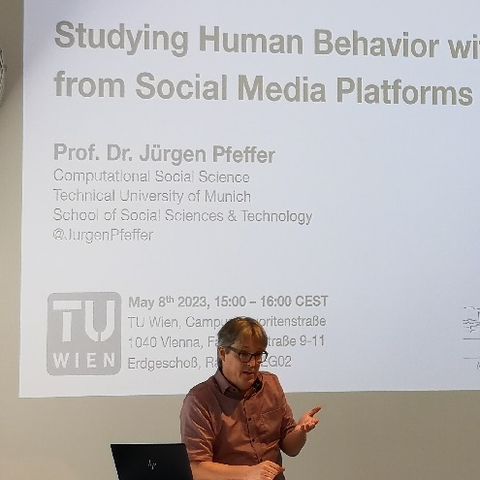
Jürgen Pfeffer is a Professor of Computational Social Science & Big Data at the Technical University of Munich's School of Social Sciences and Technology, with an additional appointment as Adjunct Professor at Carnegie Mellon University's Institute for Software Research. His interdisciplinary work bridges computer science and social science with a focus on analyzing large-scale socio-technical systems. His research expertise spans computational social science, network analysis, and big data methodologies. Pfeffer's work examines methodological, algorithmic, and theoretical challenges in analyzing dynamic social systems, with current projects focusing on modeling and detecting negative dynamics from social media, particularly online firestorms and hate speech against politically active women. His research combines network science approaches with computational methods to understand complex social phenomena. Pfeffer's publication record demonstrates significant contributions to the field since his 2010 doctorate, with high-impact papers in journals like Science and EPJ Data Science. His work on social media analysis, particularly the influential 2014 Science paper 'Social Media for Large Studies of Behavior' co-authored with Derek Ruths, has shaped methodological approaches in the field. His research shows consistent evolution from foundational network analysis to contemporary applications in political discourse, hate speech detection, and multi-layer network analysis. Hennig, M., Brandes, U., Pfeffer, J., & Mergel, I. (2012). Studying Social Networks. A Guide to Empirical Research Ruths, D., & Pfeffer, J. (2014). Social Media for Large Studies of Behavior Pfeffer, J., Morstatter, F., & Mayer, K. (2018). Tampering with Twitter's Sample API As an advisor and collaborator, Pfeffer has worked extensively with researchers including Raji Ghawi, Mirco Schönfeld, Momin Malik, and Kathleen Carley. His work demonstrates strong connections between theoretical network science and practical applications in social media analysis. His current research continues to address pressing issues in online discourse, with recent work focusing on hate speech classification, lexical change in negative word-of-mouth, and polarization dynamics in social media environments. Pfeffer leads the Pfeffer Lab, which focuses on developing methodological approaches for analyzing complex social systems through computational methods. His work has implications for understanding political legitimacy, social influence, and community dynamics in both online and offline contexts.