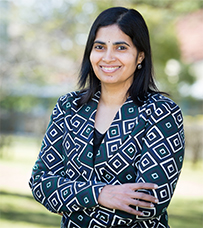
Professor Sujana Adapa is a Professor and Head of the UNE Business School at the University of New England. She specializes in Management (Strategy & Marketing) and teaches courses such as Strategic Marketing and Consumer Behaviour. Her research focuses on SMEs, corporate social responsibility (CSR), technology adoption, and gender diversity. She holds a BSc (Ag), MSc (Ag), MBA (India), and PhD (UNE). **Education**: BSc (Agriculture) MSc (Agriculture) MBA (India) PhD (University of New England) **Research Interests**: Consumer studies, gender research, technology adoption, regional entrepreneurship, SMEs, sustainability, and CSR. Current projects include studies on women’s career progression in accounting firms and CSR practices in SMEs across Australia, Malaysia, and India. **Awards**: 2016 ANZAM Educator of the Year 2016 Australian Awards for University Teaching Citation 2016 HEA Senior Fellowship (UK) Multiple LearnX Awards (2015–2016) **Grants and Roles**: Grants totaling over $1M in areas like workplace safety, innovation ecosystems, and inclusive workplaces. Deputy Head of School (2019), Course Coordinator (2017–2019), and equity committee roles. Editorial roles for journals like Small Enterprise Research . **Teaching and Leadership**: Awards include the 2017 UNE Teaching Excellence Award for multimedia-enhanced teaching. She supervises HDR students in marketing, consumer behavior, and SME innovation.
Stacy Holman Jones is a Professor of Theatre and Performance in the School of Languages, Literatures, Cultures and Linguistics at Monash University. With over 23 years of academic experience, she has developed an international reputation for leadership in performance studies, particularly in feminist and queer theory, new materialist research, and critical arts-based methodologies. Her educational background includes a PhD in Communication/Performance Studies from the University of Texas at Austin (2001), an MA in Communication from California State University Sacramento (1996), and a BA in Humanities (1988). Professor Jones's research focuses on performance as socially, culturally, and politically resistive and transformative activity. She is a recognized leader in critical autoethnography and has published over 100 articles, book chapters, and editorials, as well as authored, co-authored, and edited 14 books including the influential Handbook of Autoethnography (2013, 2021) and Queering Autoethnography (2018). Her work spans cultural critique, social inclusion, education, resilience building, designing for social impact, and enhancing health and wellbeing among minoritarian communities. Analysis of her recent publications reveals a strong trajectory toward creative ecological approaches to mental health, collaborative autoethnographic methods, and innovative design for social impact. Her research increasingly integrates performance studies with mental health applications, particularly in educational settings, while maintaining strong connections to queer theory, new materialisms, and critical autoethnography. International Congress of Qualitative Inquiry's Special Career Award National Communication Association's Distinguished Service Award in Performance Studies Janice Hocker Rushing Early Career Research Award Organization for the Study of Communication, Language, and Gender Feminist Teacher/Mentor Award Over the Rainbow Recommended Book List for Queering Autoethnography (2019) International Congress of Qualitative Inquiry Qualitative Book Award, Honourable Mention (2020) Multiple Good Design Awards for 'The Tomorrow Party' (2024) Professor Jones has been part of 3 successful ARC applications totaling $1,353,604, including as Lead CI for DP200102876 Staging Australian Women's Lives (2020-2023). She is currently accepting PhD students with supervision interests in theatre and performance studies, social change and social justice, and health and wellbeing research. She serves as the founding editor of Departures in Critical Qualitative Research and has been actively involved in professional organizations including serving as President of the International Congress of Qualitative Inquiry (2015-2018). Her current research activities include multiple collaborative projects such as 'Playing Transitions - Settling and Belonging in School together' (2024-2027), 'Learning Creates: Tomorrow Party' (2024), and 'Canopy: Creative partnerships for policy advocacy in Climate and Health' (2024), demonstrating her commitment to interdisciplinary, impact-focused research that bridges theory and creative practice.
Jessica Ringrose is a Professor of Sociology of Gender and Education at the UCL Institute of Education (IOE), part of University College London's Faculty of Education and Society. She co-directs the UCL Centre for Sociology of Education and Equity and leads the global Phematerialism.org network, focusing on feminist posthumanism and new materialism in education. Her research centers on gender equity, digital media's impact on youth, and technologically facilitated sexual violence. Notable projects include the Mayor of London’s 'Women We See' initiative, which addressed advertising diversity, and studies on cyberflashing influencing the UK Online Safety Bill. She has also explored youth experiences of online harassment during the pandemic. Ringrose holds a PhD from York University (Canada) and has advised UK governmental bodies, educational institutions, and NGOs on gender and digital safety. Her awards include the 2020 AERA Gender Equity Award. She advocates for inclusive education policies, digital literacy, and feminist methodologies to combat gender-based violence. Education: PhD in Sociology from York University, Canada Key Projects: Online Safety Bill advocacy (cyberflashing criminalization) 'Women We See' advertising diversity campaign AHRC-funded 'Postdigital Intimacies' research network Public Engagement: Regular media contributions to BBC, The New York Times, and The Guardian. Her work bridges academia and activism, emphasizing intersectional approaches to gender, sexuality, and digital justice.
Dr Jeff Chamberlain is a Senior Lecturer at Deakin Business School, Faculty of Business and Law, Deakin University, where he also serves as Deputy Director of the MBA program. With over two decades of industry experience at the Australian Taxation Office (ATO), he transitioned into academia, bringing a pragmatic, industry-informed approach to teaching and research. His work centers on the 'triple helix' model linking strategy, business processes, and technology. Doctor of Philosophy, Deakin University Master of Electronic Commerce, Deakin University Graduate Diploma of Electronic Commerce, Deakin University Graduate Certificate of Electronic Commerce, Deakin University Graduate Certificate of Higher Education, Deakin University Bachelor of Business, Deakin University CPA (Certified Practising Accountant), CPA Australia His research focuses on business process management, digital transformation in SMEs, enterprise systems (especially ERP), and organizational learning. He explores how SMEs strategize for technological change and the role of awareness and learning in enterprise transformation. Recent work includes a study on a Global Advisory Program (GAP) for innovative SMEs. The recent articles reflect a strong trajectory in e-government, digital services, and cross-cultural project management, with a pivot toward educational innovation and flexible learning models. His work bridges public sector digital transformation and academic pedagogy, emphasizing practical application. Vice Chancellor's Award for Teaching Excellence, 2017 Fellow, CPA Australia (FCPA), 2016 Fellow, Institute of Managers and Leaders (FIML), 2016 Dean's Lecturing Legend Award, 2012 Australia Day Achievement Award, 2002 Jeff has supervised numerous student capstone projects, led industry-university partnerships, and secured internal grants such as the BPM Deakin project. He has been involved in executive education with DeakinCo, delivering transformation leadership programs to Tata Aerospace. He also serves on the board of Eastern Innovation Business Centre, supporting sustainable startups. He leads the 'BPMDeakin' virtual community and has developed innovative teaching models like 'Start Anytime' and 'Cloud First'. His teaching units include MBA705 Enterprise Optimisation and Transformation, emphasizing real-world applicability and digital agility.
Michelle MacLeod is a Professor of Gaelic and Head of the School of Language, Literature, Music and Visual Culture at the University of Aberdeen, where she has been a faculty member since 2004 and was promoted to Personal Chair in 2019. She is currently Dean for Impact and Engagement and leads research and teaching in Scottish Gaelic language, literature, and identity. Education: M.A. (Hons), PhD (University of Aberdeen) Her research centers on modern Gaelic literature, Gaelic drama, language planning, and the sociolinguistics of minority languages. She is deeply engaged in questions of Gaelic identity, adult language acquisition, and community language policy. Her work bridges academic scholarship and public policy, particularly through her role on Bord na Gaidhlig. The most recent publications show a strong focus on Gaelic cultural expression, language policy critique, and sociolinguistic analysis of new speakers and family language use. Her work increasingly integrates interdisciplinary methods, including digital pedagogy and motivational psychology in language learning. Scientific awards include: Donald Meek Prize for best non-fiction Gaelic book (2021) AHRC Future of Languages Research Fellow (2022) Students' Union & University of Aberdeen Prize for Most Inspirational Lecturer (2024) She supervises PhD students in Gaelic studies and linguistics and collaborates with institutions like Sabhal Mòr Ostaig and Comunn na Gàidhlig. Her leadership extends to national language planning and knowledge exchange, reflecting her commitment to the revitalization of Gaelic as a living community language. Michelle MacLeod is a key figure in the Gaelic academic community, leading both institutional and scholarly efforts to sustain and develop Scotland’s indigenous language through research, teaching, and policy engagement.
Edmond Y. Chang is an Associate Professor in the Department of English at Ohio University’s College of Arts and Sciences. He earned his Ph.D. in English from the University of Washington and holds advanced degrees from the University of Maryland. His academic work spans technoculture, race, gender, sexuality, and digital media, with a focus on video games, queer game studies, and 20/21C American literature. His research interests include: Queer and feminist approaches to game studies Race and representation in digital and analog games Speculative literature and ethnic futurisms Posthuman narratives and digital culture Critical pedagogy and the digital humanities Chang’s recent scholarship explores themes of identity, inclusion, and resistance in games and literature. His publications, such as “Gaming While Asian” and “Queergaming,” analyze how games reflect and shape cultural norms around race, gender, and sexuality. He is also co-editing special issues on game studies and has authored a forthcoming practical guide on close playing. His work frequently bridges creative practice and academic critique, exemplified by his original games Tellings and Archaea . His notable awards include: University Professor Award (2024) Emerging Presidential Research Scholar Award (2025–26) Chang is actively involved in academic service as Assistant Editor for Analog Game Studies and Contributing Editor for Gamers with Glasses . He mentors students through graduate seminars and creative projects and is currently on sabbatical while continuing to publish and present at major conferences. He leads innovative teaching initiatives, including courses on virtual worlds, queer literature, and game-based learning. He is affiliated with research and creative labs focused on game design and digital storytelling, fostering collaborative and interdisciplinary work in media and culture.
Sari Fröjd is a **Lecturer** at **Tampere University**, affiliated with the **Faculty of Social Sciences** and the **Health Sciences** department. Her research focuses on adolescent mental health, bullying, sexual harassment, transgender identity, and the impact of social media on youth. She has published extensively on topics such as mental health interventions, suicide risk in transgender adolescents, and socioeconomic influences on adolescent behavior. Her work emphasizes the intersection of clinical and public health approaches, with studies on programs like the Icehearts and Gutsy Go initiatives. She has contributed to understanding the mental health trends of Finnish adolescents, including changes in cannabis use, delinquency, and bullying over time. Key research interests include: Bullying and its mental health consequences Social media's role in adolescent well-being Gender identity and mental health outcomes Adolescent substance use epidemiology Her publications (85+ since 2003) reflect collaborations with institutions like Pirkanmaan Sairaanhoitopiiri and involve large-scale population surveys. No notable awards are mentioned, but her work informs national health policies and clinical practices.
Aneta Podkalicka is a Senior Lecturer in Communications and Media Studies at the School of Media, Film and Journalism (MFJ), Monash University, Melbourne. She is actively engaged in research, teaching, and supervision, with a strong focus on media's role in social innovation, environmental sustainability, and everyday life. Her work bridges academic research with real-world applications across non-profit, government, and commercial sectors. Her research interests include: Media and everyday life Environmental communication Media for social innovation Digital and automated technologies and work futures Thrift, secondhand, and circular economies Media analytics and research training Aneta’s recent publications reflect a consistent trajectory in examining how media shapes sustainable practices, digital economies, and social inclusion. Her work spans cultural studies, sociology of consumption, and media policy, often employing qualitative and interdisciplinary methods. She has contributed to journals such as International Journal of Cultural Studies , Media International Australia , and Convergence , as well as book publications with Intellect and Palgrave. She is currently a Chief Investigator on the international project 'Workers in transition through automation, digitalisation and robotisation of work' (2020–2025), and previously led a project on virtual housing policy modeling. She has served as guest editor for Media International Australia and Linkoping University Electronic Press, demonstrating her active role in academic publishing. Aneta supervises postgraduate students in media, communication, sociology of consumption, and design. She is part of the 'Media and Environment' research group at MFJ and contributes to advancing the UN Sustainable Development Goals, particularly those related to sustainable consumption and environmental sustainability.
Katherine Pence is an Associate Professor in the Department of History at the Weissman School of Arts and Sciences, Baruch College, City University of New York (CUNY). She has been actively teaching courses including Global History Since 1500 and Capstone: Search History through Spring 2025. Her educational background includes: Ph.D. in History, University of Michigan M.A. in History, University of Michigan B.A. in History, Pomona College Professor Pence specializes in Cold War history with a particular focus on German history, consumer culture, gender studies, and transnational relations between Germany and Africa during the decolonization period. Her research explores how consumer politics, gender dynamics, and Cold War competition shaped everyday life in divided Germany, as well as examining German-African relations during the Cold War era. She has made significant contributions to understanding the intersections of consumption, citizenship, and Cold War politics in both East and West Germany, with particular attention to gendered experiences. Her book Gender and Consumer Politics in Cold War Germany (Cambridge University Press, 2019) represents a major contribution to the field. Her recent scholarly output reveals a growing emphasis on German-African relations during the Cold War, particularly examining how West Germany engaged with decolonizing Africa through trade exhibitions, development aid, and cultural diplomacy. While her earlier work focused primarily on consumer culture and gender in divided Germany, her research has expanded to explore transnational connections and the global dimensions of Cold War competition. Her publications span historical methodology, gender studies, and transnational history, with consistent attention to how ordinary people navigated political systems through everyday practices. Faculty Service Award for the Weissman School of Arts and Sciences (2015) Presidential Excellence Award for Distinguished Teaching (2008) Feliks Gross Endowment Award for Outstanding Research (2007) Eugene M. Lang Junior Faculty Research Program Award (2006) Whiting Research Award for Excellence in Teaching (2005) Weissman School of Arts and Sciences Dean's Award for Special Service to Students (2004) Professor Pence has received multiple PSC-CUNY research grants for her projects on 'The East and West German Scramble for Africa,' totaling over $25,000 in funding between 2008-2017. She has served as a dissertation committee member for graduate students at Harvard University, NYU, and the University of Illinois. Her service to the academic community includes organizing numerous conferences, particularly the International Conference of Undergraduate Research (ICUR), and she has held various leadership positions within Baruch College and CUNY, including Faculty Liaison for ICUR and member of the Weissman School of Arts and Sciences Diversity Equity and Inclusion (DEI) Alliance. Professor Pence is actively involved in campus initiatives related to undergraduate research, diversity and inclusion, and international education. She has organized multiple faculty workshops on research in undergraduate classrooms and has been instrumental in developing Baruch's Women's Studies program. Her current research projects continue her exploration of German-African relations during the Cold War era, with particular attention to local initiatives, gender dynamics, and transnational connections.
Maree Higgins is a Senior Lecturer at the University of New South Wales (UNSW) , affiliated with the Faculty of Arts and Social Sciences and the School of Social Work . She serves as the Social Work Honours Program Convenor and is an Associate of the Australian Institute of Human Rights , with links to the Forced Migration Research Network , Kaldor Centre , and Gendered Violence Research Network . Education : Doctor of Philosophy (Social Work), Australian Catholic University (ACU National) Bachelor of Social Work (Hons First Class), UNSW Research Interests : Maree’s work centers on social justice , human rights , and contextualized lived experience , with a focus on refugee and migrant populations , disability studies , aged care , criminal justice reform , and participatory research methods . Her recent publications emphasize lived experience-led knowledge , co-design practices , and trauma-informed approaches . Grants : She has secured funding for projects like Missing Girls: from childhood runaway to criminalised woman (2022–2025; $204,307) and Ethics and community-based participatory research in refugee studies (2019; $5,000). Supervision : Maree supervises PhD candidates in areas such as intellectual disability and support needs , intimate partner violence , and border policy impacts on asylum seekers . Her completions include honors and master’s theses on autonomy in eating disorder treatment , technology-facilitated abuse , and Aboriginal women in maternity care . Professional Engagement : She collaborates with organizations including STARTTS , Foundation House , Black Dog Institute , and Prince of Wales Hospital , while actively participating in Australian Heads of Schools of Social Work , National Field Educational Network , and African Studies Association of Australasia and the Pacific .
Marcus Nohlberg is an Associate Professor in the Department of Information Technology at the University of Skövde, Sweden. His primary academic affiliation is with the School of Informatics where he serves as a course coordinator for multiple bachelor-level courses in information security. He maintains an active research profile with numerous publications in cybersecurity, particularly focusing on human aspects of security. His research interests center on cybersecurity training methods, social engineering, usable security, and information security management. Nohlberg has developed the Context-Based Micro-Training (CBMT) framework, which has become a significant contribution to security awareness training. His work frequently examines how cognitive factors impact security behaviors and how training can be designed to be more effective and accessible. His publication trends show a consistent focus on human-centered security approaches, with recent work expanding into automotive cybersecurity, digital inclusion for seniors, and relationship security aspects. His research demonstrates a strong interdisciplinary approach, bridging computer science with psychology, education, and organizational behavior. Nohlberg has received recognition through numerous publications in reputable journals and conferences including Information and Computer Security, Computers & Security, and various IFIP WG 11.12 symposiums. His work often appears in Human Aspects of Information Security and Assurance conferences. He has led several research projects including "Development of Decision Support for Users in Risky Online Situations" (2020-2022) and "Information Security Training with Context-Based Microtraining" (2019-2020), demonstrating his commitment to translating research into practical security solutions. His work frequently involves collaboration with Swedish municipalities, auto workshops, and other organizations to address real-world security challenges. Nohlberg maintains active engagement with the public through media appearances and popular science presentations at the University of Skövde, discussing topics like AI risks and opportunities, digital security in relationships, and BankID accessibility issues.
Nicolás de Roux is an Associate Professor in the Department of Economics at Universidad de los Andes in Bogotá, Colombia. He holds a PhD in Economics from Columbia University and an MA from Universidad de los Andes. His academic work focuses on applied microeconomics with a specialization in development economics, particularly examining firm behavior, financial inclusion, agricultural economics, and labor markets in developing countries. He actively contributes to the academic community as a co-organizer of the biweekly Virtual Development Seminar (VDEV/CEPR/BREAD). De Roux's research interests center on understanding economic development challenges in the Global South, with particular emphasis on how weather shocks affect agricultural productivity, labor market power in developing economies, and the impacts of trade disruptions on firm performance. His interdisciplinary approach combines rigorous econometric methods with theoretical insights to address pressing development issues. His work demonstrates how microeconomic analysis can inform policy decisions that improve economic outcomes for vulnerable populations in developing countries. His publications span multiple high-impact journals including the Journal of Labor Economics, The Review of Financial Studies, and Journal of Public Economics. De Roux's research demonstrates consistent focus on labor markets, agricultural productivity, and financial inclusion, with recent work examining how weather risk affects small farms, the extent of employer power in developing country labor markets, and how firms adapt to trade partner collapse. His research methodology typically combines detailed administrative data with innovative econometric approaches to establish causal relationships. Featured Economist Interview, International Economic Association (IEA), July 2025 De Roux has mentored numerous students through his teaching at Universidad de los Andes, where he teaches courses including Introduction to Mediation, Econometrics 1, and Haciendo Economía 1. His research collaborations extend across multiple institutions, working with economists from around the world including Giacomo De Giorgi, Garance Genicot, Gianmarco León-Ciliotta, and Eric Verhoogen. His work on academic tracking revealed the counterintuitive finding that students perform better when they're at the top of a lower-ability group rather than at the bottom of a higher-ability group, challenging conventional wisdom about educational tracking. His research team includes collaborators working on projects examining internet access and banking competition in rural credit markets, as well as quality upgrading in the Colombian coffee sector. De Roux maintains an active presence in policy discussions through media outlets like VoxDev, World Bank blogs, and Colombian publications including Foco Económico and La República.
Mor Naaman is a Professor at Cornell University specializing in Human-Computer Interaction, Social Media Analysis, and AI-Mediated Communication. With a prolific publication record spanning over two decades, his research focuses on how people interact with social computing systems, particularly examining trust, information exposure, and community dynamics in online environments. His research interests span several interconnected domains: Human-Computer Interaction with emphasis on social media platforms, AI-Mediated Communication examining how AI systems influence human communication patterns, Misinformation Detection and analysis of information ecosystems, Location-Based Social Networks and community awareness systems, and Trust in Online Systems. His work often bridges technical and social aspects of computing, with publications appearing in top venues like CHI, CSCW, and ICWSM. Analysis of his recent publications (2022-2025) reveals a strong focus on the emerging challenges of AI in social contexts, particularly examining AI-generated content, trustworthiness evaluations of AI systems, and the social implications of generative AI. His research shows consistent interest in understanding community dynamics across platforms like Reddit, Facebook, and Twitter, with recent work examining hyperlocal communities, news consumption patterns, and cross-cultural aspects of AI-mediated communication. Mor Naaman has mentored numerous students and collaborators, including Xiao Ma, Yiqing Hua, and Marianne Aubin Le Quéré, who frequently appear as co-authors on his publications. His work demonstrates strong interdisciplinary connections between computer science, social science, and communication studies. His research methodology typically combines large-scale data analysis of social media platforms with user studies and system design, contributing both theoretical insights and practical applications for designing more effective social computing systems. Recent projects have examined AI writing assistants, community governance of AI content, and the cultural implications of AI-mediated communication.
Susan Scott is an Associate Professor in the Information Systems and Innovation Group at the Department of Management of The London School of Economics and Political Science. Her research focuses on the intersection of digital innovation and organizational change, particularly examining how information systems reshape work practices and risk management in financial services, travel, and publishing sectors. Education : PhD in Management Studies (University of Cambridge, 1993-1998), MSc in Analysis, Design and Management of Information Systems (LSE, 1991-1992), BA in History and Politics (SOAS, 1987-1990) Research Interests Digital Innovation Work Practices and Organizational Structuring Organizational Technologies Strategy, Structures, and Information Infrastructures Managing Change Materiality and Practice Research Her recent publications analyze the materiality of digital systems through case studies in book publishing and travel , while historical studies trace the evolution of financial infrastructure like SWIFT . She explores how metadata, software standards, and social media reshape organizational accountability and risk practices. Scientific Awards ICIS Best Paper in Field Award (2007) Nordic Exchange Scholarship (2000-2001) ESRC PhD Scholarship (1993-1996) Best Paper Nominations (Academy of Management, ECIS, ICIS) Selected for European Research Paper of the Year (2014, 2015) Grants and Professional Roles Recipient of grants from SWIFT , British Academy , and HEFCE . She has served on editorial boards of Information and Organization and Organization Science , and co-chaired conferences like IFIP 8.2 and ICIS .
Jon Crowcroft is the Marconi Professor of Communications Systems in the Department of Computer Science and Technology at the University of Cambridge, and serves as the Chair of the Programme Committee at the Alan Turing Institute. He is also a Fellow of Wolfson College, Cambridge, and a visiting professor at the Department of Computing at Imperial College London. With a career spanning over three decades in computer networking research, Professor Crowcroft has made seminal contributions to the development of the Internet and continues to be highly active in cutting-edge research areas. His educational background includes: BA in Physics from Trinity College, University of Cambridge (1979) MSc in Computing from University College London (1981) PhD from University College London (1993) Professor Crowcroft's research spans multiple domains in computer networking and distributed systems. He has worked in Internet support for multimedia communications for over 30 years, with three main focus areas: scalable multicast routing, practical approaches to traffic management, and the design of deployable end-to-end protocols. His current research focuses on opportunistic communications, social networks, and techniques to scale infrastructure-free mobile systems. He is particularly known for his 'build and learn' paradigm for research and has recently been exploring decentralized digital identification systems, smart cities, and edge computing. His work often bridges theoretical foundations with practical implementations, emphasizing privacy-preserving approaches and sustainable network architectures. Professor Crowcroft has received numerous prestigious awards recognizing his contributions to the field, including: Election as Fellow of the Royal Society (2013) ACM SIGCOMM Award (2009) ACM Fellow (2002) Fellow of the Royal Academy of Engineering IEEE Fellow (2004) Chartered Fellow of the British Computer Society Throughout his career, Professor Crowcroft has advised numerous PhD students, including Mark Handley and Pan Hui, who have themselves become influential researchers in the networking community. He has authored several influential books that have been adopted internationally in academic courses, such as 'TCP/IP & Linux Protocol Implementation,' 'Internetworking Multimedia,' and 'Open Distributed Systems.' His research has been supported by various grants and collaborations with both academic institutions and industry partners, contributing to successful startup projects and influencing Internet standards. Professor Crowcroft is actively involved in several research initiatives, including serving on the Scientific Council of IMDEA Networks Institute since 2007 and the advisory board of the Max Planck Institute for Software Systems. He is also a director of the Matrix Foundation, which develops open network protocols. His current research group focuses on privacy-preserving analytics, decentralized systems, and the future of Internet architecture.