Liz Ryan is a Senior Lecturer in Nursing at the University of Southern Queensland's School of Nursing and Midwifery, with over 25 years of experience in nursing and 12 years in academia. Her career spans roles as a lecturer, clinical coordinator, program director, and deputy associate head (previous). She is affiliated with the Centre for Health Research and the Higher Education Research and Development Society of Australia (HERDSA). BNurs, MNurs, PhD from the University of New England Her research focuses on patient safety, intentional rounding, student experience, workforce dynamics, rural nursing, and acute care. She employs mixed methods, qualitative, and quantitative research methodologies. Recent publications analyze early career nurses' experiences, intentional rounding practices, rural career aspirations, and psychological resilience in nursing students. She teaches courses NUR1103, NUR1120, NUR8550, NUR8075, and NUR3379, emphasizing holistic nursing education and clinical competency.
Dr. Darren Elliott-Smith serves as Senior Lecturer in Film & Gender Studies within the Communications, Media and Culture department at the University of Stirling's Faculty of Arts and Humanities. He currently teaches across all levels in film, television and gender studies, and holds the position of Programme Director for the MLitt/MSc (Applied) in Gender Studies. His research focuses primarily on representations of queerness, gender, sexuality and psychoanalysis in horror film and television. This work extends to curation theory in film and visual art programming, cult and experimental film studies, adaptation studies, and queer theory. His scholarly output includes a monograph, numerous journal articles, and significant contributions to edited collections across multiple academic presses. Elliott-Smith's research output demonstrates a consistent focus on queer perspectives within horror media, with particular attention to marginalized identities and alternative cinematic narratives. His work bridges theoretical analysis with practical applications through videographic film projects and video essays. Tutor of the Year 2018 (University of Hertfordshire) Professionally, he maintains active roles as Fellow of the Higher Education Academy and Founding Member of BAFTSS Horror Studies Special Interest Group. His industry experience includes previous work as Film Curator and Programmer for the BFI, Mainline Pictures, The Odyssey Cinema, and as Film Manager for the Film Education Consortium for Hertfordshire (2007-2010). He is also recognized online as the Queer Horror Doctor through his digital presence. His academic journey includes a BA (Hons) in Communication Studies from the University of Sunderland, an MA in the History of Film and Visual Media from Birkbeck College, University of London, and a PhD in 'New Queer Horror in Film and Television' completed at Royal Holloway, University of London in 2013 under the supervision of Prof. Mandy Merck.
Dr. Ken Ferens is an Assistant Professor in the Department of Electrical and Computer Engineering at the Price Faculty of Engineering, University of Manitoba. He serves as the Computer Engineering Champion in the Centre for Engineering Professional Practice and Engineering Education and directs the Applied Cognitive Intelligence (ACI) Research Group. Dr. Ferens is a senior member of the Institute of Electrical & Electronics Engineers (IEEE), Chair of the EduManCom Chapter of the IEEE, Vice-Chair of the Computer and Computational Intelligence Chapter of the IEEE, and Chair of the Industry, Teaching Assistants, and Student Forums for Engineering Curriculum Review and Improvement. Ph.D. (Computer Engineering), University of Manitoba, 1996 M.Sc. (Computer Engineering), University of Manitoba, 1991 B.Sc. (Electrical Engineering), University of Manitoba, 1989 Dr. Ferens has over 33 years of research experience in computational intelligence, focusing on cognitive machine learning, artificial intelligence, cognitive computational intelligence, chaos theory applications, agent-based models, and various optimization algorithms including simulated annealing, genetic algorithms, artificial neural networks, and particle swarm optimization. His research applies these techniques to develop software and hardware intrusion detection systems for cybersecurity applications. He teaches graduate-level courses on Computer Network Security and Applied Computational Intelligence, providing students with theoretical background and hands-on experience in state-of-the-art security methods. Analysis of Dr. Ferens' recent publications reveals a strong focus on applying cognitive and chaotic computational techniques to cybersecurity challenges, particularly malware detection and network intrusion detection. His work increasingly integrates complexity theory, fractal analysis, and hybrid optimization approaches to enhance security systems' effectiveness. There's a clear progression toward more sophisticated machine learning architectures applied to increasingly complex security scenarios, with growing emphasis on real-world IoT and network security applications. Best Paper Award at IEEE International Conference on Cognitive Informatics and Cognitive Computing (ICCI*CC 2022) Best Paper Award at IEEE International Conference on Cognitive Informatics and Cognitive Computing (ICCI*CC 2015) Best Journal Paper Award for 2013 (Journal of ICT Research and Applications) Best Poster Award at 12th International Conference on e-Health Networking, Application & Services (2010) Best Paper Award at IASTED International Conference on Computer, Electronics, Control, and Communication (1991) Dr. Ferens collaborates with national and international industry partners including the Department of Advanced Information Management, Content Technology Canadian Tire Corporation (CTC), and Magellan Aerospace. His research group has received funding supporting the Cyber-security Research Program, developing practical applications of computational intelligence for security systems. He has supervised numerous graduate students in the Electrical and Computer Engineering department, focusing on research at the intersection of machine learning and cybersecurity. Dr. Ferens leads the Applied Cognitive Intelligence (ACI) Research Group within the Department of Electrical and Computer Engineering, which focuses on applying cognitive, chaotic, and computationally intelligent algorithms to build intrusion detection systems. The group collaborates with industry partners to develop practical security solutions while providing students with hands-on research experience in cutting-edge security technologies. Their work spans both theoretical algorithm development and practical hardware implementation for real-world security applications.
Kash Barker serves as the John A. Myers Professor and David L. Boren Professor at the University of Oklahoma in the Department of Industrial & Systems Engineering within the College of Engineering. As Graduate Liaison, he leads research on network resilience, supply chains, and systems engineering for societal good, with applications spanning infrastructure, supply chains, and community systems. His lab has produced 11 Ph.D. graduates (10 in academia) and 31 M.S. graduates. Research Domains: Resilient networks and interdependent systems Risk and decision analytics Supply chain survivability Pandemic economic impact modeling Climate migration optimization Cyber-Physical-Social Systems Article Trends emphasize disinformation defense , network restoration optimization , and multi-layer resilience modeling across infrastructure, supply chains, and community systems. His work combines game theory , machine learning , and decision analysis frameworks. Scientific Awards & Roles: Fellow, Institute of Industrial and Systems Engineers Senior Member, IEEE Fellow, Fulbright Finland Foundation (2023) Associate Editor roles in IISE Transactions and Naval Research Logistics Editorial Board Member for Risk Analysis and Scientific Reports Faculty Advisor, OU INFORMS student chapter Educational Background: Ph.D., Systems Engineering, University of Virginia M.S., Industrial Engineering, University of Oklahoma B.S., Industrial Engineering, University of Oklahoma
Dr. Kathryn Howell is an Assistant Professor in the Department of Psychology at the University of Wisconsin–Madison. Her research focuses on the health and well-being of children and families, particularly in the context of trauma and adversity. She leads an active research program examining resilience and psychopathology in families exposed to traumatic events such as intimate partner violence or bereavement. Her research interests include: Effects of family adversity on mental health Resilience and risk factors in children and parents Development and evaluation of strengths-based interventions Trauma-informed care for families Dr. Howell is actively involved in graduate training and welcomes applications from students interested in clinical psychology with a focus on trauma and resilience. She emphasizes a holistic review of applicants, valuing research experience, academic potential, and motivation to work with children and families. She maintains an open but structured communication policy, encouraging email inquiries about her research but refraining from pre-application meetings to ensure fairness in the admissions process. Her scientific contributions are reflected in her publications, accessible via her Google Scholar profile. Though specific awards and grants are not listed, her research program indicates active engagement in funded scholarship. Dr. Howell advises graduate students in clinical psychology and is building a research lab focused on trauma and family resilience. Her lab is currently developing its website, and she collaborates with students on independent research projects and publications.
Thomas Barrie is a Professor of Architecture at North Carolina State University's College of Design, serving as Director of the Affordable Housing and Sustainable Communities Initiative and Coordinator of the Master of Advanced Architectural Studies program. An internationally recognized scholar in religious architecture and spirituality in the built environment, he is a Fellow of the American Institute of Architects (AIA) and has received numerous accolades including the 2024 NCSU Alexander Quarles Holladay Medal for Excellence. His educational background includes: Master of Philosophy in Architectural History and Theory, University of Manchester Master of Architecture, Virginia Polytechnic Institute and State University B.A. in English, University of North Carolina at Greensboro Professor Barrie's research explores the symbolism, cultural significance, and ritual functions of architecture across religious traditions, while examining housing through the ontological roles of home. His work bridges architectural theory and practice, emphasizing architecture's social mission and spiritual dimensions. Key publications include four books addressing sacred space, world religions, and domestic environments, establishing foundational frameworks for understanding architecture's role in human experience. His scholarly output reveals consistent exploration of architecture as a mediator between sacred and secular realms, with recent works focusing on comparative religious architecture and cultural contexts of home. This trajectory demonstrates deep commitment to understanding how built environments shape communal identity and individual well-being across diverse cultural settings. His distinguished career has been recognized with numerous honors: NCSU Alexander Quarles Holladay Medal for Excellence (2024) ACSA Distinguished Professor Award (2019) AIA Fellowship (2020) Three NC State Outstanding Extension Service Awards (2019, 2015, 2014) Induction into the Academy of Faculty Engaged in Extension (2015) Two AIA Honor Awards for design excellence As director of the Affordable Housing and Sustainable Communities Initiative, Professor Barrie has mentored hundreds of students through community-based design studios addressing housing challenges in the Triangle region. His leadership has fostered interdisciplinary collaboration across architecture, planning, and social sciences, resulting in award-winning student projects and tangible community impact through the Architecture, Culture and Spirituality Forum which he co-founded. Professor Barrie leads the Affordable Housing and Sustainable Communities Initiative and co-founded the international Architecture, Culture and Spirituality Forum, creating platforms for scholarly dialogue and practical application that bridge academic research with community engagement in housing and spiritual dimensions of the built environment.
Professor Ioannis Katakis is a Faculty Member at the University of Nicosia, where he is affiliated with the School of Sciences and Engineering and the Department of Computer Science. He has held various academic positions across multiple institutions including Aristotle University of Thessaloniki, University of Cyprus, Cyprus University of Technology, Open University of Cyprus, Hellenic Open University, Athens University of Economics and Business, and National and Kapodistrian University of Athens. His educational background includes a PhD in Machine Learning for Automated Text Classification (2005-2009), a Master's in Information Systems (2005-2007), and a Bachelor's in Computer Science (2000-2004), all from Aristotle University of Thessaloniki. Professor Katakis specializes in several cutting-edge areas of computer science and data analysis. His primary research interests include Mining Social, Web and Urban Data , Sentiment Analysis and Opinion Mining , Data Streams , and Multi-label Learning . His work bridges theoretical machine learning approaches with practical applications in social media analysis, healthcare informatics, privacy protection, and smart city technologies. He has published extensively in top venues including CIKM, ECML/PKDD, IEEE TKDE, and ECAI. His recent publications demonstrate a clear trend toward applying machine learning techniques to real-world problems with societal impact. He has focused on areas such as GDPR compliance in smart devices, sentiment analysis in crowd-sourced content, healthcare applications including drug reaction classification and brain disease monitoring, and privacy protection in wearable technologies. His work often involves multi-modal data analysis and addresses challenges in data streams and multi-label classification. Professor Katakis has made significant contributions to his field, with his research cited over 4,200 times. He serves as an Editor for the journal Information Systems and has edited four special issues in journals such as DAMI and InfSys. He regularly contributes to the academic community by serving on program committees for major conferences including ECML/PKDD, WSDM, DEBS, and IJCAI, and by reviewing for prestigious journals like TPAMI, DMKD, TKDE, TKDD, JMLR, TWEB, and ML. He has been actively involved in European research projects, notably serving as Quality Assurance Coordinator and Senior Researcher for projects such as VAVEL (www.vavel-project.eu) and INSIGHT (www.insight-ict.eu). His grant activities demonstrate a strong focus on collaborative, interdisciplinary research with practical applications in urban data management, social media analysis, and healthcare informatics. He has organized three workshops at major conferences (ICML, ECML/PKDD, EDBT/ICDT) and has extensive experience translating research into practical applications through his involvement in European projects.
Elizabeth J. Marsh is a Professor of Psychology and Neuroscience at Duke University and a Faculty Network Member of the Duke Institute for Brain Sciences . Her work bridges cognitive psychology, neuroscience, and education, with a focus on memory accuracy, misinformation, and aging. Education: Ph.D., Stanford University (1999) B.A., Drew University (1994) Research Interests: Marsh investigates how memory can be both accurate and erroneous, exploring questions like why people misremember facts, how fiction influences memory, and how aging affects decision-making and belief formation. Her work intersects with social psychology , developmental psychology , and educational psychology . Scientific Awards: Langford Lecture Award (2010) Grants & Funding: Aging and Finding Information: Using Google vs. Relying on Other People (2015–2025) Effects of Aging on Episodic Memory-Dependent Decision Making (2018–2025) When are pictures worth a thousand words? Debunking misinformation with images (2022–2023) Advancing Artificial Intelligence for the Naval Domain (2018–2023) Leveraging Older Adults' Social Goals to Improve Memory and Strategy Use (2018–2020) Exploring the potential of essay testing for improving memory and learning (2013–2019) Courses Taught: PSY 990: Special Readings in Psychology PSY 765S: Psychology and Neuroscience Grant Writing PSY 755: Research Practicum PSY 724S: Survey of Current Topics in Psychology and Neuroscience II PSY 723S: Survey of Current Topics in Psychology and Neuroscience I PSY 102: Cognitive Psychology: Introduction and Survey NEUROSCI 755: Interdisciplinary Program in Cognitive Neuroscience (IPCN) Independent Research Rotation
Dr. Hye-Young Jung is an Associate Professor at Weill Cornell Medical College's Department of Population Health Sciences. Her research focuses on clinical workforce organization in nursing homes, telehealth implementation, and care quality for elderly residents, particularly during the COVID-19 pandemic. Education: Ph.D. (Brown University, 2013), B.A. (University of California, Santa Cruz, 2006) Her work examines SNFist physicians' impact on resident outcomes, telehealth utilization trends, and policy responses to pandemic challenges in long-term care facilities. Current projects include analyzing REIT investments in nursing homes and advanced provider care models for dementia patients. She founded Weill Cornell's Master of Science program in Health Policy and Economics and continues to teach Introduction to US Healthcare Policy and Delivery .
Katarina Domijan is an Associate Professor in Statistics at the Department of Mathematics and Statistics, Maynooth University, Ireland. She holds a PhD in Statistics from Trinity College Dublin (2008) and has been affiliated with Maynooth University since 2008, transitioning from Lecturer/Assistant Professor to her current role in 2024. Her academic career includes editorial roles as Associate Editor for The R Journal (2021–present) and the Journal of Computational and Graphical Statistics (2015–2024). Research Interests focus on Bayesian methods for high-dimensional data, particularly in classification problems. She specializes in feature selection and model visualization, with applications spanning agricultural data analysis (e.g., hyperspectral imaging for lactose prediction), medical diagnostics (e.g., sepsis and cancer detection), and space physics (e.g., Saturn Kilometric Radiation classification). Her work bridges theoretical statistics with real-world challenges, including socio-economic studies and forensic science. Key Research Areas Bayesian statistical inference Machine learning for large feature spaces Statistical computing and model interpretability Data visualization and chemometrics Scientific Contributions include leading projects like VistaMilk Phase II (2024–2030, €152,300) and Measuring Carbon Sequestration (2024–2028, €174,788.90). Her 15 most recent publications highlight advancements in ensemble modeling, spatial statistics, and medical diagnostics. Scientific Awards Associate Editor, The R Journal (2021–present) Associate Editor, Journal of Computational and Graphical Statistics (2015–2024) Student Supervision includes PhD and MSc graduates such as Dr. Bruna Wundervald (2024) and Dr. Mark O’Connell (2017). She also collaborates with researchers across disciplines, including Dr. Nadim Akasheh in food hypersensitivity studies.
Rich Etchberger is a Professor in the Department of Wildland Resources at Utah State University's S.J. & Jessie E. Quinney College of Natural Resources, Uintah Basin campus. He founded the wildlife science program in 1995 and pioneered hands-on education in Utah's energy development corridor, earning the 2015 Carnegie U.S. Professor of the Year award for Utah. His educational background includes a Bachelor's in Ecology from Unity College (Maine), and Master's/Doctorate in Wildlife Ecology from the University of Arizona. Teaching methodology integrates classroom theory with fieldwork through partnerships with the Bureau of Land Management and U.S. Forest Service, exemplified by black-footed ferret reintroduction projects in Pariette Wetlands. Etchberger revolutionized accessibility through eLearning, creating USU's first general education online course (USU 1350 Integrated Life Science) in 2002. His flipped classroom model and multimedia-rich instruction consistently rank among USU's highest student evaluations across all delivery formats. His scientific awards include: 2015 Carnegie Professor of the Year for Utah 2014 Undergraduate Research Mentor of the Year (College of Natural Resources) 2011 Professor of the Year (USU-Uintah Basin) Securing 65 grants totaling $2.4M, Etchberger mentored 300+ undergraduates in paid internships, resulting in peer-reviewed publications and 26 professional conference presentations. His program achieves 100% alumni career/grad school placement, with graduates dominating Bureau of Land Management roles in the Uintah Basin. He maintains critical partnerships with natural resource agencies through an 18-year internship agreement, directly linking student training to Basin environmental management and economic development. His community-focused approach ensures scientific training addresses local energy development challenges while preserving ecological health.
Dr. Patrick Shane Crawford serves as Assistant Professor in the Department of Civil, Construction and Environmental Engineering at the University of Alabama's College of Engineering. Affiliated with the Center for Sustainable Infrastructure and Alabama Water Institute, his research focuses on enhancing community resilience to tornadoes, floods, and hurricanes through interdisciplinary engineering approaches integrating social science and policy perspectives. His educational background includes: B.S. in Civil Engineering (2012, University of Alabama) M.S. in Civil Engineering (2014, University of Alabama) Ph.D. in Civil Engineering (2018, University of Alabama) Dr. Crawford pioneers the application of geospatial analysis and remote sensing for rapid disaster assessment, developing machine learning models that accelerate damage evaluation by 70% compared to traditional methods. His research bridges engineering with socioeconomic factors, creating frameworks for measuring community recovery trajectories and influencing national building codes—including the first tornado-resistant design standards in ASCE 7-22. Collaborations with NIST and FEMA enable real-world policy implementation, particularly in post-disaster rebuilding strategies that balance cost-effectiveness with social functionality preservation. Analysis of his 2022-2025 publications reveals consistent innovation in longitudinal disaster reconnaissance , with 60% of recent work focusing on tornado events using deep learning for damage classification. Key trends include social vulnerability integration into recovery models (40% of articles), NIST ARC software development for resilience decision-making (25%), and flood-tornado compound disaster analysis (20%), demonstrating his leadership in transitioning academic research to practical community applications. Active in federal partnerships, Dr. Crawford's 2025 feature Confident but Exposed: How Prepared Are U.S. Homeowners for Extreme Weather? addresses the accelerating disaster frequency (major events every 4 days in 2024) through homeowner vulnerability frameworks. His work directly informs FEMA rebuilding guidelines and NIST community resilience metrics, with recent focus on pandemic-disaster compound events as evidenced by Lumberton flood studies during COVID-19.
Dr. Eunice Eunhee Jang is a Professor in the Department of Applied Psychology and Human Development at the Ontario Institute for Studies in Education (OISE), University of Toronto. Her research focuses on synergistic learner modeling, dynamic assessment systems, and the intersection of language testing with educational measurement. PhD with specializations in language testing, educational measurement, and program evaluation Develops interactive digital assessment interfaces for struggling readers Author of "Focus on Assessment" (2014) and co-author of OECD Reviews on Evaluation and Assessment in Education Research Interests Dr. Jang's work explores prismatic assessment analytics to understand learner potential and predict learning pathways. She integrates natural language processing and machine learning to create diagnostic feedback systems that support cognitive, metacognitive, and affective growth in technology-rich classrooms. Scientific Awards Jacqueline Ross TOEFL Dissertation Award Caroline Clapham IELTS Master’s Award Tatsuoka Measurement Award Professional Contributions She has served on major advisory boards including EQAO provincial assessments and TOEFL Committees of Examiners. Currently, she is an elected board member for the International Language Testing Association and contributes to the Broader Measures of Success Advisory Committee for People for Education.
David Sbarra serves as Professor and EOS Foundation Endowed Chair in Health Psychology at the University of Arizona's Department of Psychology, where he directs the Laboratory for Social Connectedness & Health (LSCH). His research examines the biopsychosocial mechanisms linking social relationships to health outcomes, with particular focus on how divorce, marital separation, and loneliness function as risk pathways for poor health. Dr. Sbarra's academic credentials include: B.S. in Psychology from Cornell University (1996) Clinical Internship at University of Wisconsin Department of Psychiatry Ph.D. in Clinical Psychology from University of Virginia (2004) His research program centers on social relationships and health, stress physiology, and genetically-informed methodologies including twin studies, polygenic risk scores, and Mendelian Randomization. The Laboratory for Social Connectedness & Health investigates how high-quality relationships promote health resilience while relationship disruptions create vulnerability, emphasizing causal inference through advanced quantitative methods and open science practices. Recent publications reveal a pronounced shift toward establishing causal relationships in the social connection-health field, with heavy utilization of genetically-informed designs and multi-method approaches. His 2024-2025 work demonstrates particular innovation in applying Mendelian Randomization to loneliness-depression pathways, examining cardiovascular impacts of marital separation, and developing novel measures for couple therapy processes. Dr. Sbarra holds the prestigious EOS Foundation Endowed Chair in Health Psychology, recognizing his significant contributions to understanding social determinants of health. His co-authored work in the American Psychologist has helped establish social connection as a critical public health priority. While specific advising details aren't documented in available sources, his laboratory direction and course instruction (including PSY 383 Health Psychology and clinical practica) indicate active mentorship of graduate students. His research program likely operates through multiple federally funded grants supporting genetically-informed longitudinal studies. The Laboratory for Social Connectedness & Health employs diverse methodologies including daily diary assessments, physiological monitoring, fMRI, and genetically-informed designs to examine how social connection operates as a fundamental health determinant across the lifespan. Current projects focus on causal mechanisms linking relationship quality to biological aging, intervention development for attachment security, and public health applications of social connection research.
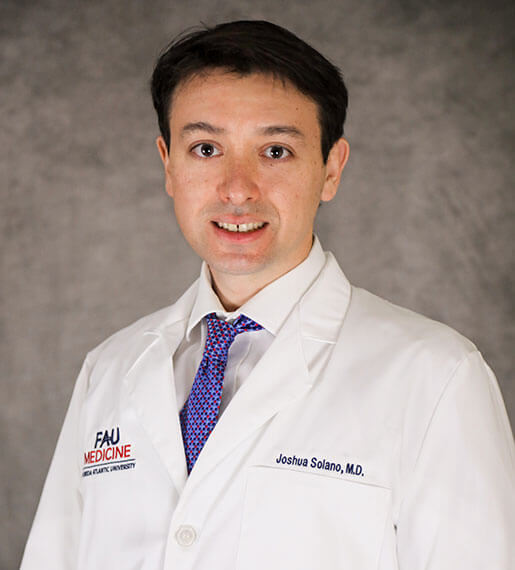
Joshua J. Solano, M.D., FAAEM is an Associate Professor of Emergency Medicine and Clerkship Director for the Emergency Medicine Residency program at the Florida Atlantic University Charles E. Schmidt College of Medicine. As Clerkship Director, he works alongside residents to promote best practices for emergency department patient care. Dr. Solano is board certified in emergency medicine and maintains active membership in the American College of Emergency Physicians and the American Academy of Emergency Medicine. Dr. Solano's educational background includes a BS in Biology and BA in History from Duke University, followed by his MD from the University of Florida. He completed his emergency medicine residency at Beth Israel Deaconess Medical Center in Boston and served on faculty at Harvard Medical School as an instructor and assistant program director before joining FAU. In his final year in Boston, he completed the Rabkin Medical Education Fellowship. Dr. Solano's research focuses on geriatric emergency medicine, particularly head trauma management in elderly patients, anticoagulation risks, and emergency department quality assurance. His recent publications demonstrate a strong emphasis on developing clinical decision rules for geriatric head trauma and understanding medication interactions in older emergency patients. He has also contributed significantly to medical education literature, developing innovative residency training curricula. His scholarly work shows a clear progression toward establishing evidence-based guidelines for geriatric emergency care, with numerous publications on intracranial hemorrhage risk assessment, anticoagulation management, and fall prevention strategies. Dr. Solano's research bridges clinical practice with educational innovation, making significant contributions to both patient care protocols and emergency medicine training. 2017: Attending Role Model Award, Beth Israel Deaconess Medical Center 2016-2017: Rabkin Medical Education Fellowship 2011: Alpha Omega Alpha Medical Honor Society 2011: Chapman Humanism Society 2010: Equal Access Clinic Service Award 2010: Lawrence M. Goodman Award for Medical Student Research 2010: Community Service Award As Clerkship Director, Dr. Solano oversees medical student education in emergency medicine and has implemented electronic evaluation systems that have increased the quality and quantity of student assessments. His clinical work includes staff positions at Bethesda East Hospital and Delray Medical Center. Dr. Solano's research program demonstrates strong institutional support through multiple publications and ongoing investigations into geriatric emergency care protocols.