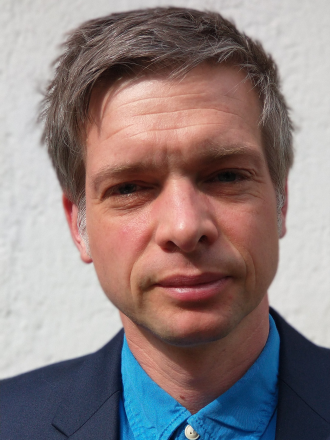
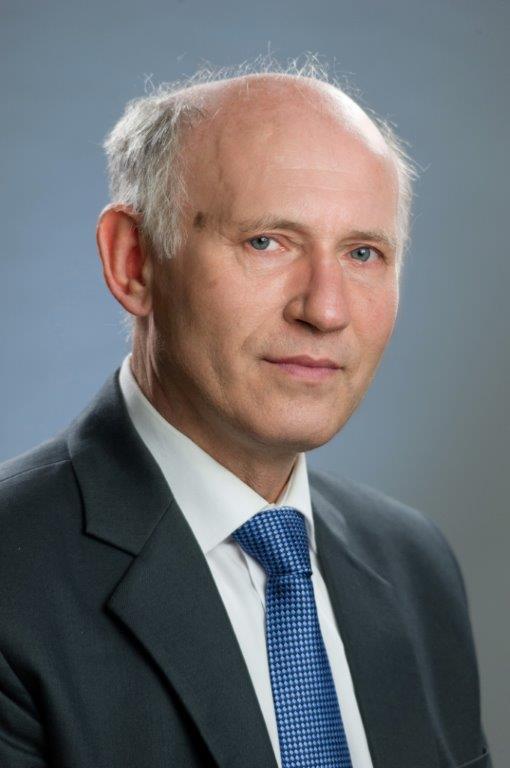
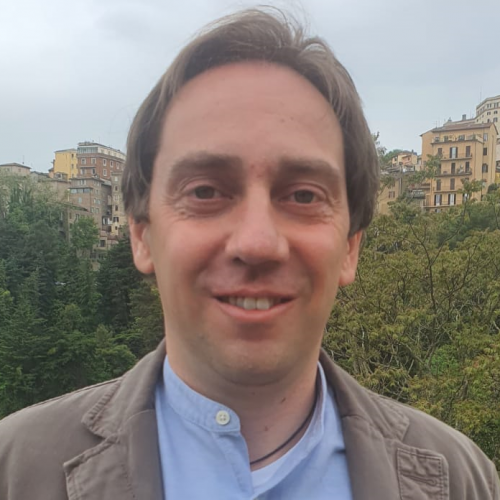
Galen Dorpalen-Barry is an Assistant Professor at Texas A&M University. Her research focuses on geometric and algebraic combinatorics, particularly hyperplane arrangements, oriented matroids, polytopes, posets, and related fields. Education: PhD in Mathematics (University of Minnesota, 2021) Masters in Mathematics (University of Minnesota, 2018) Bachelor of Arts in Mathematics (Bard College, 2015) Her recent research explores the topology of hyperplane arrangement complements, cohomology of graphical configuration spaces, and combinatorial interpretations of the ab-index. She collaborates with researchers including Nick Proudfoot, Christian Stump, and Vic Reiner. Galen has organized multiple seminars and conferences, including the Algebra and Combinatorics Seminar at Texas A&M and special sessions at SIAM and AMS meetings. She has presented at numerous international workshops and seminars on topics like positive geometries, Shi arrangements, and the Varchenko-Gel'fand ring. Contact: dorpalen-barry@tamu.edu | Website | GitHub
Gabriel Alejandro Valiente Feruglio is a Professor at the Universitat Politècnica de Catalunya (UPC), affiliated with the Barcelona School of Informatics (FIB) and the Department of Computer Science. He is a member of the ALBCOM research group, focusing on Algorithms, Bioinformatics, Complexity, and Formal Methods. His work integrates theoretical computer science with applications in computational biology, including phylogenetic analysis, graph algorithms, and metagenomics. Valiente’s research emphasizes the development of algorithms for biological networks, phylogenetic tree and network comparison, and efficient graph representation. He has contributed to tools like TANGO for taxonomic assignment in metagenomics and AligNet for protein-protein interaction network alignment. His publications span over 140 works in journals like BMC Bioinformatics, IEEE-ACM Transactions on Computational Biology, and Bioinformatics. He leads and collaborates in competitive research projects funded by institutions like the Catalan government, focusing on bioinformatics, computational biology, and algorithmic methods. His research also extends to LaTeX typesetting for scientific documents and the structural analysis of scientific collaborations in graph transformations.
Andrea Celli is an Assistant Professor in the Department of Computing Sciences at Bocconi University. He is affiliated with the ELLIS Society and the Bocconi Institute for Data Science and Analytics. Previously, he was a postdoctoral researcher at Meta (formerly Facebook Research) in London. He holds a Ph.D. in Computer Science from Politecnico di Milano and conducted research at Carnegie Mellon University's Electronic Marketplaces Lab. His research focuses on intersections of computer science, machine learning, and economics, particularly in strategic interactions and online learning environments. Notable achievements include a NeurIPS 2020 Best Paper Award and the 2017 Lesmo Prize for his MSc thesis. His research is supported by grants including an ERC Starting Grant (2024) for the PLA-STEER project and an MUR-PRIN grant (2022). He teaches courses such as Deep Learning and Reinforcement Learning, Machine Learning, and Optimization at the Ph.D. level. His work spans topics like equilibrium finding, online learning under constraints, and mechanism design. Key publications include contributions to ICLR, NeurIPS, EC, and other top venues. Celli advises Master’s students including Annalisa Barbara, Emanuele Coccia, Davide Drago, and Antonio Preiti. He collaborates with postdocs like Riccardo Poiani and Martino Bernasconi. He actively organizes academic events, such as the EC 2025 workshop on Online Learning and Economics. His research emphasizes theoretical foundations while addressing practical challenges in algorithmic game theory and data-driven decision-making.
Gruia Calinescu is an Associate Professor of Computer Science at Illinois Institute of Technology (IIT), affiliated with the College of Computing's Computer Science Department. He joined IIT in 2000 and has held visiting positions at the University of Bonn and the University of Wisconsin-Milwaukee. His research focuses on approximation algorithms, combinatorial optimization, and theoretical computer science, with contributions to graph theory, network design, and algorithmic problems in wireless networks. Education includes a PhD from Georgia Tech's Algorithms, Combinatorics, and Optimization program (1998) under Howard Karloff. He also holds a diploma from the University of Bucharest in scheduling theory. Key research interests include algorithms for Steiner trees, network connectivity, scheduling, and power optimization. He has published extensively on topics like minimum power covering, relay placement, and LP rounding techniques. His work often bridges theoretical foundations with practical applications in wireless networks and distributed systems. Recent work includes advancements in combination algorithms for Steiner tree variants (2022), energy-aware scheduling (2016), and improved approximation algorithms for relay placement (2014). He is also involved in teaching, such as CS 530 - Theory of Computation.
Prof. Dr. Peter Sanders is a full professor in Theoretical Computer Science at the Karlsruhe Institute of Technology (KIT), leading the Algorithm Engineering group. His academic career includes a doctoral degree from Karlsruhe University and research stints at institutions like the Max Planck Institute for Informatics. He specializes in algorithm theory and engineering, focusing on parallel computing, large-scale data processing, and graph partitioning. His research bridges theoretical foundations with practical implementations, emphasizing real-world applications in optimization, route planning, and distributed systems. Education: Ph.D. in Computer Science, Karlsruhe University (1996) Bachelor/Master studies at Karlsruhe University (1988-1996) Research Interests: Algorithm design and analysis Parallel and distributed algorithms Graph algorithms and partitioning Algorithm engineering for big data High-performance computing Publications: Over 250 papers, emphasizing parallel algorithms, distributed systems, and graph theory. Recent work includes scalable SAT solving, hypergraph partitioning, and distributed string sorting. His contributions have advanced practical applications in route planning, load balancing, and large dataset processing. Awards: Recipient of the prestigious Leibniz Prize (DFG) and Baden-Württemberg State Research Prize. He coordinated the DFG Priority Program on Algorithm Engineering and is an active reviewer for major funding bodies. Consulting: Engages with companies like SAP and Google, focusing on optimization, route planning, and database algorithms. Leads projects on algorithm scalability and real-world problem-solving. Labs/Teams: Heads the Algorithm Engineering group at KIT, fostering collaborations in distributed computing and algorithmic research.
Sven Schewe is a Professor in the Department of Computer Science at the University of Liverpool, affiliated with the School of Electrical Engineering, Electronics and Computer Science. He leads the AI Section and is a founding member and former leader of the Verification Group. He also has secondary affiliations with the Algorithms, Complexity Theory and Optimisation Group and the Institute for Risk and Uncertainty. Research Interests: His research centers on automata theory and game theory, particularly their applications in the verification and synthesis of reactive and safety-critical systems. He investigates infinite-duration games, automata over infinite words and trees, and develops algorithms and tools for automated verification, synthesis, and learning of optimal control strategies. His work extends to reinforcement learning with formal guarantees, cyber-physical systems, and AI safety. Recent Research Trends: His recent publications demonstrate a strong integration of formal methods with machine learning, particularly in adversarial training, neural network robustness, and model-free reinforcement learning under omega-regular objectives. He also applies formal reasoning to interdisciplinary domains such as chemical space exploration and materials science. Scientific Awards: Finalist for the ERCIM Cor Baayen Award 2010 Dr. Eduard Martin Preis 2009 GI Dissertation Award 2008 Advising and Grants: He actively supervises numerous PhD students and postdoctoral researchers. He is Principal Investigator (PI) or Co-Investigator (CI) on multiple major grants, including EPSRC Programme Grants, Royal Society Fellowships, and Horizon Europe projects. His funded research spans topics such as game theory, verification, synthesis, reinforcement learning, and risk analysis. He has hosted visiting researchers and collaborated internationally with institutions in Germany, France, India, Taiwan, and the US. Labs and Teams: He co-founded and led the Verification Group and previously led the AI Section at the University of Liverpool. These groups focus on formal methods, automata, games, and their applications in AI and safety-critical systems.
Ali Shokoufandeh is Interim Dean and Distinguished University Professor at the College of Computing & Informatics (CCI), Drexel University, where he leads academic transformation initiatives in technology studies. He has held key leadership roles including Senior Associate Dean for Academic Affairs and Operations, Associate Dean of Research, and Associate Department Head for Graduate Studies in CCI. His academic background includes a Ph.D. and M.S. in Computer Science from Rutgers University, where he also earned a Diploma Certificate in Cognitive Science, and a B.Sc. in Computer Science from the University of Tehran. He has held visiting positions at the University of Pennsylvania and The Wistar Institute. Dr. Shokoufandeh's research focuses on Artificial Intelligence, Machine Learning, Robotics, and Theoretical Computer Science , with specific interests in algorithms, graph theory, combinatorial optimization, and computer vision. His work is supported by grants from the National Science Foundation, National Institutes of Health, DARPA, U.S. Army, U.S. Air Force Research Laboratory, Environmental Protection Agency, and other agencies. He serves as Reviewing Editor for the Journal of Pattern Recognition and is on the editorial boards of Pattern Recognition Letters and IET Computer Vision, reflecting his significant contributions to the field. Scientific Awards & Honors: Distinguished University Professor, Drexel University (2025) Fellow, European Centre for Living Technology, University of Venice Dr. Shokoufandeh has advised graduate students and led research teams through his roles in graduate studies and research leadership. He has secured substantial external funding and continues to advance interdisciplinary research in computing and informatics. He is affiliated with research centers including the European Centre for Living Technology and has contributed to academic service through editorial and administrative leadership. His work bridges theoretical foundations with applications in vision and intelligent systems.
Professor Arunabha Sen is a faculty member at Arizona State University (ASU), affiliated with the School of Computing and Augmented Intelligence and the College of Health Solutions as a Health Solutions Ambassador. He joined ASU in 1987 and holds a Ph.D. in Computer Science from the University of South Carolina (1987). His research focuses on resource optimization in telecommunication networks, VLSI circuits, hardware-software co-design, and network security. Key areas include algorithm design, combinatorial optimization, and network processor systems. His work spans wireless, optical, and sensor networks, with contributions to video transmission over mobile ad-hoc networks and interference-aware channel assignment. Notable projects include robust network design against WMD attacks and tools for resilient communication networks. He has served on multiple technical committees for conferences like IEEE and IFIP, and contributed to academic initiatives such as capstone courses on network processors. Grants include NSF, DOD-DTRA, and Motorola Labs funding, emphasizing interdisciplinary research in network science and communications. Teaching responsibilities include courses on algorithms, game theory, and network design. His service roles include Associate Editor for IEEE Transactions on Mobile Computing and leadership in graduate program committees. Research outputs include over 30 peer-reviewed publications, with recent work in algorithmic network design and social computing data mining.
Prof. Henning Bruhn-Fujimoto is a faculty member at the Institute for Optimization and Operations Research at Ulm University. His research focuses on graph theory, combinatorial optimization, and discrete mathematics , with notable contributions to Erdős-Pósa properties, cycle packing, and algorithmic graph theory. He teaches courses in mathematical foundations of machine learning and combinatorics. Academic Background: - Habilitationsschrift : Graphs and their Circuits (2009) - PhD Thesis: Infinite circuits in locally finite graphs (2005) - Diploma Thesis: Generating the cycle space by induced non-separating cycles (2001) Research Interests: - Structural graph theory and algorithm design - Optimization in discrete systems - Applications of combinatorial mathematics Thesis Supervision: He regularly oversees bachelor's and master's theses in optimization, graph theory, and related fields. Notable past thesis topics include elevator system optimization, Erdős-Posa properties in graphs, and container ship unloading algorithms. Labs/Teams: His work is centered within the Institute's optimization group, collaborating with researchers on projects involving graph algorithms and combinatorial optimization.
Bart Bogaerts is an Associate Professor in the Department of Computer Science at KU Leuven's Faculty of Engineering Science. He is affiliated with the Declarative Languages and Artificial Intelligence (DTAI) research unit and is a member of Leuven.AI - KU Leuven Institute for Artificial Intelligence. Bogaerts serves on the Council of the Faculty of Engineering Science as senior academic staff and participates in the Programme Committee for Artificial Intelligence curriculum development. His research focuses on foundational aspects of logic programming and knowledge representation, with particular expertise in approximation fixpoint theory, higher-order logic programming, and non-monotonic reasoning. Bogaerts investigates the theoretical underpinnings of stable model semantics, justification frameworks, and executable query languages. His work bridges theoretical computer science with practical applications in artificial intelligence and knowledge-based systems. Bogaerts' publication record demonstrates consistent contributions to top venues in logic programming and artificial intelligence. His recent work shows increasing focus on category-theoretic approaches to approximation theory, distributed web traversal specifications, and certified model expansion techniques. The publications reveal a strong emphasis on formal methods with applications spanning from theoretical mathematics to practical AI systems. As a promotor for multiple significant research projects, Bogaerts leads investigations into certified answer set programming (CertifASP), first-order model expansion (CertiFOX), proof generation for combinatorial optimization, distributed configuration problems, and knowledge integration paradigms. These projects, funded through 2028-2029, demonstrate his leadership in advancing the theoretical foundations of AI and logic programming. Bogaerts is actively involved in teaching courses on knowledge representation and reasoning, contributing to the development of next-generation AI researchers. His work within the DTAI research unit positions him at the forefront of declarative AI approaches in Belgium's leading research university.
Professor Martin Bača is affiliated with the Department of Applied Mathematics and Informatics at the Faculty of Mechanical Engineering , Technical University in Košice , Slovakia. His academic role involves advanced research and teaching in graph theory and discrete mathematics. Research Interests: Specializing in graph labelings including vertex irregular total labelings, magic and antimagic labelings, edge-magic labelings, face-magic labelings of type (a,b,c), and harmonious labelings. Key areas: irregularity strengths , modular labelings , doubly resolving sets , and antimagic graphs . Focus on applications in network topology , chemical graph theory , and combinatorial optimization . Recent Article Trends: His 2024-2023 works explore modular irregularity strengths for dense graphs, corona products, and flower graphs, alongside antimagic labelings for digraphs, fullerenes, and generalized prisms. Notable themes include graph evaluation techniques , edge-antimagic total labelings , and vertex-antimagic labelings .
Dr. Agata Gitlin-Domagalska serves as an Adjunct Professor at the Faculty of Chemistry, University of Gdańsk, where she leads research in the Department of Molecular Biochemistry and Laboratory of Bioorganic Chemistry. Her work bridges peptide chemistry and bioorganic drug design, focusing on innovative synthetic strategies and therapeutic applications. Academic Affiliation: Faculty of Chemistry, University of Gdańsk Department: Department of Molecular Biochemistry Laboratory: Laboratory of Bioorganic Chemistry Specializing in peptide synthesis and prodrug development , Dr. Gitlin-Domagalska investigates strategies to enhance oral bioavailability of charged peptides through lipophilic charge masking and non-covalent inhibition of serine proteases like matriptase and furin . Her research extends to antimicrobial peptide conjugates with dual therapeutic functions and Zika virus suppression via protease inhibition. Recent publications highlight her expertise in peptide splicing mechanisms , solid-phase synthesis optimization , and nanoparticle-based delivery . She has developed cyclic RGD prodrugs for targeted intestinal permeability and bicyclic furin inhibitors using combinatorial chemistry approaches. Her work contributes to antibiotic conjugates with leukemia-selective antifungal activity , neuroprotective humanin analogs , and vasopressin derivatives with expanded therapeutic potential. Current trends emphasize matriptase-selective inhibitors and earthworm-derived antimicrobial nanoparticles . Dr. Gitlin-Domagalska employs model membrane biosensing for drug-membrane interaction studies and has pioneered high-shear mixing techniques to improve amide bond formation efficiency in peptide synthesis processes.
Valentino Santucci is an Associate Professor of Computer Engineering at the University for Foreigners of Perugia, Italy, affiliated with the Department of International Human and Social Sciences (SUSI). Since 2021, he has served as the Rector's Delegate for Technological Innovation and Information Flows, highlighting his leadership in digital transformation within the institution. His research spans key areas in Artificial Intelligence, particularly Evolutionary Computation, Natural Language Processing, Machine Learning applications in e-learning and sustainability, and digital technologies in education. He employs algebraic techniques to analyze combinatorial search spaces and evolutionary algorithm dynamics, contributing to both theoretical and applied advancements. The most recent publications reflect a strong trend in combinatorial optimization using algebraic frameworks, hybrid evolutionary-swarm algorithms, and applications in text complexity classification and educational technology. His work bridges computer science with humanities and sustainability, reflecting a multidisciplinary approach. PhD in Computer Science and Mathematics, University of Perugia (2012) He teaches courses in Artificial Intelligence, Computer Science for Humanities, Cybersecurity, and Sustainability across various degree programs. His editorial roles include contributing to WoS/Scopus-indexed journals, and he has taught at the University of Perugia and Hong Kong Baptist University. Dr. Santucci actively mentors through teaching and research supervision. While specific student names are not listed, his involvement in academic projects and publications suggests advisory roles. He has no explicitly mentioned grants, but his research output and leadership position indicate active project engagement. He is involved in institutional innovation through his role in technological advancement and has contributed to projects integrating soft skills and learning technologies. His work emphasizes practical applications of AI in education and sustainability, positioning him at the intersection of technical innovation and societal impact.
Morten Brun is an Associate Professor at the Department of Mathematics, University of Bergen. His research spans computational topology, persistent homology, and applications in biology and data science. Email: morten.brun@uib.no Research Interests: He specializes in topological data analysis, focusing on sparse nerves, relative persistent homology, and computational geometry. His work applies topological methods to biological problems, including drug resistance modeling in tuberculosis and immune profiling in multiple sclerosis. Recent Publications: His 2025 work includes hypercubic modeling of tuberculosis drug resistance and high-dimensional immune profiling post-stem cell transplantation. Earlier articles explore computational topology techniques (2017-2024) and interdisciplinary applications in toxicology and systems biology.
Ashkan Yousefpour is a Computer Scientist with a PhD from the University of Texas at Dallas , where he contributed to the FLOW project. He served as a Lecturer and research assistant at UT Dallas, while also working as a Visiting Researcher at UC Berkeley . His research spans Fog/Edge Computing , Federated Learning , Reinforcement Learning , and Distributed Systems . Current Role: AI Scientist at Meta Academic Affiliation: Department of Computer Science, University of Texas at Dallas Research Interests include: Minimizing IoT service delay through fog offloading Developing failure-resilient distributed neural networks (ResiliNet) Advancing privacy-preserving machine learning (Opacus, Papaya) Optimizing traffic flow with autonomous vehicles via reinforcement learning Advising : Supervised multiple graduate students including Ashish Patil , Harshavardhan Nalajala , and Brian Nguyen . Collaborated with researchers like Professor Alexandre Bayen (UC Berkeley) and Professor Cathy Wu (MIT) on traffic control frameworks such as Flow .