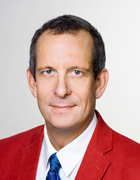
Professor Leon Bach is an Adjunct Professor in the Faculty of Medicine at Monash University and Deputy Director of the Department of Endocrinology and Diabetes at Alfred Hospital. His research focuses on glycated proteins' role in diabetic complications and insulin-like growth factor (IGF-1) regulation in diseases like cancer and diabetes. He has led/co-investigated 19+ projects since 2004, including studies on diabetes complications, hypertension management, and surgical infection prevention. Key collaborations involve organizations like NHMRC and JDRF. Recent publications (2021-2025) address automated insulin delivery systems, diabetes management questionnaires, and cardiac effects of IGF-1. His work contributes to UN SDGs for health and well-being (Goal 3).
Anna Wieczorek is a Full Professor at Eindhoven University of Technology (TU/e), affiliated with the Department of Industrial Engineering and Innovation Sciences. She serves as the TU/e Sustainability Ambassador and leads major projects like the €10.4M Interreg NWE SmartCORE initiative and the NWO-funded ORAKLE project. Her research focuses on sustainability transitions, socio-technical systems, renewable energy, and community-driven innovation in energy and mobility, with a regional focus on Europe and the Global South. Education background includes a PhD in Innovation Sciences from Utrecht University and extensive work at the Vrije Universiteit Amsterdam’s Institute for Environmental Studies. She co-founded the Sustainability Transitions Research Network (STRN) and established its Global South and Brazilian chapters. Notable awards include the EU Citizens Award for Sustainable Energy Innovation (2020) and multiple teaching excellence awards. Key research areas include community energy systems, virtual power plants, blockchain applications in energy, and governance of low-carbon transitions. She supervises PhD students in sustainability and innovation, and her work bridges academic research with practical implementation through projects like the cVPP, which empowers communities to drive energy transitions. Active in editorial roles (e.g., Urban Transformations journal) and international collaborations, her work emphasizes actionable research for societal impact. Recent projects emphasize scaling community energy initiatives, digitalization’s role in energy justice, and regional governance capacities for sustainable transitions. She also explores mobility systems innovation, including cycling-as-a-service and shared automated mobility.
Malte Rothhämel is an Assistant Professor in Vehicle System Technology at KTH Royal Institute of Technology since 2020. He holds a Master of Engineering (Diplom-Ingenieur) from TU Dresden and a PhD from KTH, with industrial research at Scania and Volkswagen Global Research. His roles at KTH include teaching and examining courses such as Vehicle Dynamics, Vehicle Engineering, and related project courses. He leads research in vehicle dynamics, automated systems, and human factors in transportation. Education: Technical University Dresden (Diplom-Ingenieur), Industrial PhD at Scania/KTH. Professional experience includes 3.5 years at Scania developing active steering systems and time as a guest researcher at Volkswagen. Research focuses on vehicle dynamics of heavy trucks, automated driving, teleoperation systems, and child safety in cycle carriers. He collaborates with groups like the Vehicle Dynamics Group and ECO² Vehicle Design, contributing to projects like TRENoP (novel transport solutions). Over 60 patents related to steering systems, safety, and autonomous vehicle technologies. No explicit awards listed, but his work spans academic and industrial innovation.
Mikael Nybacka is an Associate Professor at the Department of Engineering Mechanics at KTH Royal Institute of Technology, specializing in Vehicle Dynamics. He leads the Research Concept Vehicles initiative within the Integrated Transport Research Lab (ITRL) and advises the KTH Formula Student team. His roles include Programme Director for the Master's Programme in Vehicle Engineering (2020–present) and Director of the TRENoP strategic research area (2022–2024). Education: PhD in Engineering (2009) from Luleå University of Technology, focusing on automotive winter testing technologies. Research Interests: Vehicle validation, autonomous vehicle systems, fault-tolerant control, urban vehicle concepts, and driver-vehicle interaction. Current projects include PREDICT (zero-emission vehicle validation), REDO2 (remote driving), and iCOMSA (vehicle dynamics evaluation). Publications Highlight: Recent work explores remote driving systems, autonomous path planning, and sensor-based vehicle control, emphasizing safety and efficiency in next-generation vehicles. Grants and Funding: Active in strategic initiatives like EIT Urban Mobility and SAFER Vehicle Safety Centre. Supervised over 10 PhD students, including graduates at Scania and Volvo Cars. Labs/Teams: Leads ITRL's research vehicles program and collaborates with industry partners in automotive innovation.
Lars Drugge is a Professor at the Royal Institute of Technology (KTH) in the Department of Automotive Engineering and Technical Acoustics. His research focuses on smart, safe, and sustainable transportation solutions, including electrification, automation, and active vehicle systems. He explores crosswind stability, tire-wheel interactions, and driver-vehicle interfaces through experimental and simulation-based methods. Drugge leads courses such as Vehicle Dynamics and collaborates on advanced driving simulators to improve motion algorithms and reduce motion sickness in autonomous vehicles. His work integrates interdisciplinary approaches to optimize vehicle characteristics for energy efficiency and safety. Research highlights include developing Kalman filters for real-time crosswind load identification, investigating heat-insulated wheelhouses' impact on truck tires, and optimizing autonomous vehicle trajectories to mitigate motion sickness. Drugge's contributions span vehicle dynamics modeling, sensory feedback systems, and environmental sustainability in transportation. Education: Not explicitly detailed in text, inferred through academic role. Grants/Awards: None explicitly mentioned. Labs/Teams: Active in KTH's vehicle dynamics and simulator research groups.
Prof. B. van Arem is a Professor in the Department of Transport, Mobility and Logistics at Delft University of Technology. He has held an external position since 2003 in the Thematic Collaboration Smart Public Transport Lab. His research focuses on automated vehicles, traffic control systems, and sustainable urban mobility. He has contributed to over 475 publications and leads projects like CriticalMaaS and STAD, addressing mobility-as-a-service and automated driving impacts. Key research areas include intelligent transportation systems, urban transportation planning, and safety in automated driving. His work integrates machine learning and simulation frameworks to address challenges in traffic management and electrification of public transport. Received the Greenshields Prize 2012 and Best Student Paper Runner-up Award (IEEE ITSC 2023). Active in media engagements, discussing topics like zero-emission zones and future urban planning. Supervised 31 students and contributed to 10 datasets, including code for automated driving and lane detection systems. Prof. van Arem collaborates internationally and participates in initiatives like XCARRCITY, focusing on mobility hubs and automated mobility solutions.
Arkady Zgonnikov is a researcher in Mechanical Engineering at Delft University of Technology, specializing in Human-Robot Interaction with a focus on autonomous vehicles and human-machine systems. His work addresses critical issues in automated vehicle control, safety, and user perception through interdisciplinary approaches combining machine learning, cognitive modeling, and empirical studies. Research focuses on modeling driver behavior during automated driving scenarios, evaluating safety mechanisms, and understanding human factors in vehicle automation. Notable contributions include studies on Tesla users' experiences with partially automated systems and frameworks for meaningful human control in autonomous systems. Zgonnikov collaborates extensively with academic and industry partners, contributing to datasets on driver modeling and traffic interactions. His work has been featured in media discussions about AI in mobility and regulatory challenges for automated vehicles. He supervises academic projects and has co-created multiple datasets available via 4TU.ResearchData, including machine learning implementations and interaction modeling frameworks.
M. Saeednia is a Researcher at Delft University of Technology's Department of Transport, Mobility and Logistics within the Civil Engineering & Geosciences School. His work focuses on optimizing freight transport, multimodal systems, and railway logistics. He holds a Dr.ir. (Dutch engineering doctorate) and actively contributes to transportation engineering research. Research interests include pod scheduling, carrier movement optimization, physical internet-based logistics, and automated railway systems. His recent publications address challenges in multimodal freight networks, intermodal connectivity, and robust logistics design. He collaborates extensively with institutions like TU Delft and international researchers on projects involving heuristic frameworks and railway automation. No scientific awards explicitly mentioned. Advising and grants details unavailable in provided texts. His work contributes to labs focused on sustainable transport systems and multimodal infrastructure integration.
Prof. Wolfgang Wiechert is a Universitätsprofessor at Forschungszentrum Jülich GmbH, leading the Computational Systems Biotechnology group within the Institute of Bio- and Geosciences (IBG-1). His research focuses on integrating computational methods with experimental biotechnology to optimize bioprocesses, particularly in metabolic engineering and systems biology. Key areas include metabolic flux analysis, high-throughput screening, and Bayesian statistical methods for process optimization. Research interests span Bioprocess design and scale-up (e.g., itaconate production, fungal cultivation) Automated microbioreactor systems and robotic workflows Development of computational tools for metabolic modeling (e.g., hopsy, pyFOOMB) Application of machine learning in bioprocess analytics Recent publications emphasize Bayesian approaches for flux inference, strain characterization automation, and integration of omics data with process analytics. Collaborations span industries and academic partners, driving innovations in sustainable biomanufacturing and enzyme production systems.
Nebojsa Mitrovic is a full Professor at the Faculty of Electronics, University of Niš, Serbia, where he is affiliated with the Department of Electrical Power Engineering. He has been a faculty member since earning his PhD in 1998 and was promoted to full professor in 2004. His research focuses on electric motor drives, power electronics, and control systems for industrial applications. His research interests span Electrical Power Engineering , Power Electronics , and Electric Motor Drives , with a strong emphasis on sensorless control of induction motors , direct torque control , and adjustable speed drives . His work integrates advanced control algorithms with practical power electronics to improve efficiency and reliability in industrial motor systems. The recent articles highlight a consistent research trajectory in motor drive control, particularly focusing on eliminating mechanical sensors, improving dynamic response, and enhancing power quality. Key themes include speed estimation , voltage and slip compensation , and real-time control implementation in PWM-based drives. His publications appear in IEEE journals and regional technical periodicals, reflecting both international engagement and regional impact. Total of 72 published papers Two university textbooks authored Participation in 6 scientific research projects Project leader for Ministry of Serbia-funded project on crane drive automation Industry collaboration on commissioning of electrical systems in industrial plants Nebojsa Mitrovic has contributed significantly to applied research in power engineering, particularly through projects funded by the Ministry of the Republic of Serbia and collaborations with industrial partners. His work bridges theoretical control strategies with real-world implementation in motor drive systems. He is affiliated with the Department of Electrical Power Engineering at the Faculty of Electronics in Niš, where he conducts research and teaching in power electronics and drive systems. His laboratory work likely supports student projects and industrial prototypes in motor control and power conversion.
Prof. Martin Buss is a full professor and chair of Control Engineering at the Technical University of Munich (TUM), affiliated with the TUM School of Computation, Information and Technology. He holds a doctorate from the University of Tokyo (1994) and habilitation from TUM (2000). Since 2003, he has led the Chair of Control Systems at TU Berlin before joining TUM. His research focuses on control theory, mechatronics, robotics, and medical technology, with notable contributions to hybrid systems, telepresence, and human-robot interaction. He coordinates TUM's Excellence Cluster CoTeSys and collaborative research centers on telepresence. Awards include the IEEE Fellow (2014) and Federal Cross of Merit (2011). Education: Studied electrical engineering at TU Darmstadt, PhD at University of Tokyo, and habilitation at TUM. His work spans over 200 publications in journals like IEEE Transactions and International Journal of Robotics. Key projects include IURO (social HRI), autonomous navigation, and safe reinforcement learning. He advises on grants for robotics and automation, with labs focusing on control systems and medical applications. Research highlights: Development of adaptive controllers for nonlinear systems, energy-efficient balancing in humanoid robots, and distributed MPC for traffic systems. His work integrates cognitive science with technical systems, emphasizing real-world applications in healthcare and autonomous vehicles.
Prof. Mohammad Ali Nasseri is a Professor of Surgical Robotics at the Technical University of Munich (TUM) and Founding Director of the Medical Autonomy and Precision Surgery (MAPS) research group within the TUM School of Medicine and Health. He holds an adjunct professorship in the Department of Medical Engineering at the University of Alberta. His research focuses on surgical robotics, surgical intelligence, and medical AI, with key contributions in surgical mechatronics, medical imaging, and visualization. Nasseri leads the MAPS group, which develops advanced technologies for precision surgery and robotic systems. Notable achievements include coordinating the ForNeRo project (~EUR 2M) and receiving awards such as the Best Medical Robotics Paper Award (ICRA 2024 finalist), Best Short Paper (Medical Visualization VCBM 2019), and the Robot Dalen Innovation Award (2015). His work on robot-assisted microsurgery and real-time surgical monitoring systems has advanced medical robotics safety and precision. Education: Ph.D. in Engineering (details not specified). Affiliations: TUM School of Medicine and Health, MAPS Research Group, University of Alberta (adjunct). Research emphasizes interdisciplinary innovations at the intersection of robotics, AI, and healthcare, with a focus on translating technical advancements into clinical applications. Recent projects include Envibroscope for environmental motion monitoring and Colibri5 for vitreoretinal surgery tracking. Grants & Projects: Bavarian Research Foundation (ForNeRo), TUM excellence programs. Nasseri’s labs and teams collaborate internationally on surgical autonomy, precision surgery tools, and medical AI integration. His work bridges fundamental engineering research with clinical practice in minimally invasive procedures.
Yunli Shao, Ph.D., is an Assistant Professor at the University of Georgia's School of Electrical & Computer Engineering, Department of Electrical and Computer Engineering. His research focuses on applied control systems, e-mobility, and connected/automated vehicles, emphasizing energy efficiency, traffic optimization, and AI integration in IoT. He is affiliated with the Boyd Research and Education Center and actively publishes in areas such as vehicle dynamics, smart infrastructure, and digital twin technologies. Shao's work explores real-time traffic prediction, cyber-physical systems integration, and eco-driving strategies for electric vehicles. His recent studies include frameworks for digital twin cities, edge computing for urban traffic management, and cooperative control strategies for connected vehicles. He has collaborated on hardware-in-the-loop testbeds and living labs to evaluate autonomous systems' efficacy and sustainability. His research demonstrates a blend of theoretical advancements (e.g., pseudospectral optimization, algebraic approaches) and practical applications, including real-sim interfaces for cross-domain simulation and AI-driven traffic signal control. While no specific awards are listed, his prolific publication record reflects a strong academic profile in transportation engineering and control systems.
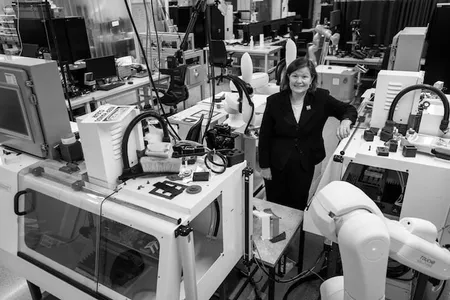
Dr. Dawn Tilbury is a Professor and inaugural Department Chair of the Robotics Department at the University of Michigan, Ann Arbor. She holds courtesy appointments in Mechanical Engineering and Electrical Engineering and Computer Science (EECS). Her research focuses on control systems, including distributed control, manufacturing systems, human-robot interaction, and robotics reliability. She leads the Tilbury Lab, collaborating on projects such as smart manufacturing, dynamic systems modeling, and cyber-physical systems. Education: Bachelor of Science in Electrical Engineering, University of Minnesota Master of Science and Ph.D. in EECS, University of California, Berkeley Research Interests: Control theory applications, distributed systems, logic control for manufacturing, human-robot teaming, and digital twin integration. She co-leads initiatives like the Reconfigurable Manufacturing Systems Engineering Research Center (ERC/RMS) and has been Deputy Director of the Automotive Research Center (ARC). Articles Overview: Recent work spans human-autonomy collaboration, digital twin applications, supply chain optimization, and automated driving systems. Key themes include adaptivity, safety, and resilience in complex systems. Awards and Service: Served as NSF Assistant Director for Engineering (2017–2021). Active in professional organizations like the American Automatic Control Council (AACC) and IFAC. Co-organized workshops on logic control and robotics. Labs & Teams: Directs the Tilbury Research Group (TilLab), focusing on control theory and robotics. Collaborates with Prof. Kira Barton on smart manufacturing and Prof. Lionel Robert on human-robot teaming.
Paulo Rogério Barreiros D'Almeida Pereira is an Assistant Professor at the Department of Electrical and Computer Engineering at Instituto Superior Técnico, Universidade de Lisboa. He holds a PhD in Electrical and Computer Engineering from the same institution (2003), following a MSc (1994) and BSc (1991) in the same field. His academic roles include teaching courses such as 'Arquitectura e Gestão de Redes' and 'Programação'. Institution: Universidade de Lisboa (IST) Department: Departamento de Engenharia Electrotécnica e de Computadores His research focuses on computer networks, including vehicular networks, delay-tolerant networks (DTN), IoT, and cyber-physical systems. He leads projects at INESC INOV-Lab, emphasizing practical applications in smart grids and vehicular communication. Key research interests include: Routing protocols for DTN and vehicular environments Network security and privacy preservation Quality of Service (QoS) optimization Edge computing and monitoring systems Recent work highlights: Development of location-based and congestion-aware routing schemes Privacy-enhanced protocols for vehicular networks Co-simulation frameworks for smart grid protection systems Awarded the ITST 2011 Best Paper Award for contributions to vehicular DTN fragmentation mechanisms. Active contributor to EuroNF and IEEE initiatives, with over 50 publications in peer-reviewed venues. Lab affiliations: INESC INOV-Lab (Researcher), with interdisciplinary collaborations in telecommunications and cyber-physical systems.