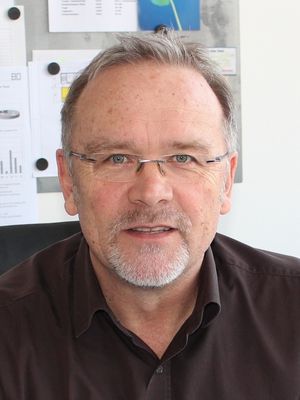
Prof. Dr.-Ing. Bernd Nolting is a faculty member at the Bochum University of Applied Sciences , where he has served since 1996 as Professor of Urban Water Management. He was Dean of the Department of Civil and Environmental Engineering from 1999–2005. His career spans international projects in Germany (Düsseldorf, Regensburg, etc.), India, Palestine, China, Russia, Romania, and Bulgaria. Education: Dipl.-Ing. in Civil Engineering (specializing in Urban Water Management, Hydrology, Hydraulic Engineering) from Technical University of Hanover Doctorate: Ruhr University Bochum His research focuses on wastewater drainage systems , sewer network calculations , rainwater infiltration , and water-sensitive urban planning . He specializes in addressing urban flash floods , rehabilitation of water supply networks , and hydraulic optimization of drainage systems . Publications from 1988–2009 reveal expertise in membrane bioreactors , nutrient removal (nitrogen, phosphorus), stormwater management , and cost-effective wastewater solutions . Key themes include biological and chemical treatment interactions , filtration systems , and sustainable urban infrastructure .
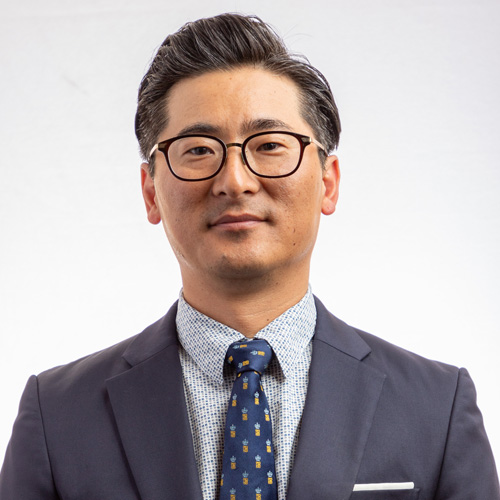
Sangmin Shin is an Assistant Professor in the Department of Civil Engineering at the Southern Illinois University College of Engineering. His research focuses on integrated water resources management, critical interdependent infrastructure modeling, water cyber-physical-social systems, artificial intelligence applications, urban water sustainability and resilience, socio-environmental hydrology, multi-objective optimization, and systems analysis. PhD: Civil and Environmental Engineering, University of Utah (2016-2020) MS: Civil and Environmental Engineering, Korea Advanced Institute of Science and Technology (KAIST) (2008) BS: Civil Engineering, Pusan National University (2006) Shin leads the SciWater Lab, which investigates smart and connected infrastructure for water systems under uncertainty. Key strategies include: increasing infrastructure variety, building cyber-physical-social networks, and integrating feedback interactions between critical systems. The lab aims to transform water infrastructure through interdisciplinary approaches involving communities, engineers, and policymakers. His research portfolio demonstrates trends in: climate change adaptation (14% of publications), infrastructure resilience (22%), AI applications (18%), socio-hydrology (12%), and systems thinking (16%). Notable methodologies include system dynamics modeling, modern portfolio theory, and cyber-physical attack simulations. Postdoc Travel Assistance Award (University of Utah, 2019) Best Paper Presentation Award (Korean Society of Disaster & Security, 2015) Contact: Engineering B, Room 34, 1230 Lincoln Drive, Carbondale, IL 62918, USA | Phone: 618-453-3325 | Email: sangmin.shin@siu.edu
Michael Hyland is an Associate Professor in the Department of Civil and Environmental Engineering at the Samueli School of Engineering, University of California, Irvine. His research focuses on the modeling, analysis, and optimization of smart urban transportation systems, with particular emphasis on shared autonomous vehicles, microtransit integration with fixed-route transit, and sustainable mobility solutions. He employs methodologies from operations research (optimization, Markov decision processes), statistical modeling (discrete choice, regression), and economic analysis to address challenges in urban mobility. Education: Ph.D., Civil and Environmental Engineering (Transportation), Northwestern University, 2018 M.Eng., Civil and Environmental Engineering (Transportation), Cornell University, 2013 B.S. Civil and Environmental Engineering, Cornell University, Magna Cum Laude, 2013 His recent research explores emerging mobility paradigms through topics such as dynamic fleet management, vehicle miles traveled (VMT) impacts, equity in job accessibility, electricity demand implications of e-bikes, and human-machine collaborative planning frameworks. The work often combines large-scale simulation with interpretable modeling techniques. Hyland leads the Hyland Lab , which develops computational tools for evaluating integrated transportation systems. The lab's work spans theoretical modeling (e.g., state-space representations, decomposition heuristics) and applied policy analysis (e.g., assessing Senate Bill 1 infrastructure projects, AV-era parking reforms, and micromobility deployment strategies).
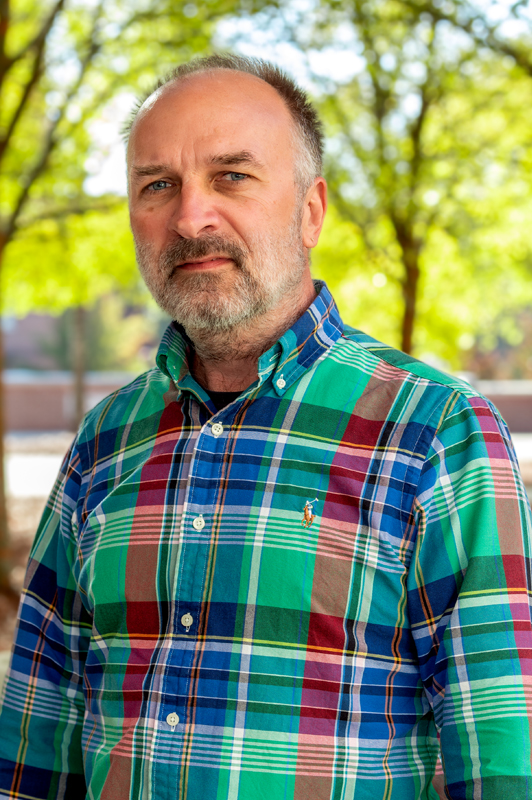
Wenlong Jin is a Professor in the Department of Civil and Environmental Engineering at the Samueli School of Engineering, University of California, Irvine. His research focuses on intelligent transportation systems , traffic flow theory , and transportation network analysis , with applications to evacuation control, eco-driving algorithms, and connected/autonomous vehicle systems. Ph.D., Applied Mathematics, University of California, Davis (2003) M.S., Applied Mathematics, University of California, Davis (2000) B.S., Automatic Control, University of Science and Technology of China (1998) Recent research trends include: Developing generalized bathtub models for network trip flows and evacuation control Advancing car-following models with safety guarantees for autonomous vehicles Optimizing dynamic pricing schemes for high-occupancy toll lanes Investigating capacity drop phenomena at traffic bottlenecks Creating eco-driving algorithms using vehicle-to-infrastructure communication He actively contributes to transportation network resilience and cybersecurity in intelligent transportation systems .
Associate Professor Zhidong Li is a prominent researcher at the Data Science Institute within the Faculty of Engineering and Information Technology at University of Technology Sydney (UTS), Australia. With over a decade of experience in data science and machine learning, he leads impactful research bridging theoretical advancements with practical applications across multiple critical infrastructure domains. Dr. Li earned his PhD from the University of New South Wales, Sydney, Australia, and previously served as a senior engineer at Data61, CSIRO (Commonwealth Scientific and Industrial Research Organisation), Australia's federal government agency for scientific research. His research spans machine learning, data mining, pattern recognition, image processing, and human-computer interaction with applications in water, gas, traffic, urbanization, visitor economy, agriculture, environment, finance, property market, railway, law, electric and health sectors. His work particularly focuses on developing interpretable AI models, temporal point processes, and practical applications for smart infrastructure management. His extensive publication record reveals strong thematic consistency in applying advanced machine learning techniques to infrastructure management problems, with particular emphasis on water systems. His research demonstrates progression from fundamental algorithm development toward increasingly sophisticated applications with real-world impact, especially in temporal modeling, graph neural networks, and fairness in AI systems. Scientific Awards 2022 R&D Excellence Award NSW Water Award 2021 UTS Medal for Research Impact for the Vice-Chancellor's Awards for Research Excellence 2018 Australian Museum Eureka Prize for Excellence in Data Science 2019 Victorian iAwards - Industrial & Primary Industries Merit for 'Predictive Analytics for Water Pipe Maintenance' Multiple AWA research innovation awards (NSW, National, QLD) Dr. Li actively supervises Masters and PhD students and leads numerous funded research projects across diverse sectors. His collaborative approach is evident through partnerships with water utilities, transport agencies, and various CRC projects focusing on Food Agility, Digital Finance, and Smartcrete. His work on the world's first independently-audited ethical talent AI in partnership with Reejig demonstrates his commitment to translating research into real-world solutions that address societal challenges while maintaining ethical standards.
Dr. Saidi Siuhi serves as an Associate Professor of Civil Engineering at South Carolina State University, where he teaches undergraduate and graduate courses while conducting research and providing institutional service across departmental and university levels. His academic credentials include: Ph.D. in Civil Engineering from the University of Nevada, Las Vegas (2009) M.Sc. in Civil Engineering from Florida State University (2006) B.Sc. in Civil Engineering from the University of Dar-es-Salaam (2003) Specializing in transportation engineering, Dr. Siuhi's research focuses on traffic safety, transportation planning, and microscopic traffic simulation. His work addresses critical transportation challenges including distracted driving/walking behaviors, traffic management during special events (notably the 2017 solar eclipse), and the application of advanced computational methods to transportation networks. He integrates emerging technologies like virtual reality, machine learning, and deep learning to develop innovative safety solutions for complex transportation systems. Analysis of his recent publications (2021-2025) reveals a strong trajectory toward computational transportation safety, with increasing emphasis on AI-driven solutions for pedestrian safety, driver behavior analysis, and infrastructure monitoring. His work consistently bridges theoretical transportation models with practical safety applications, particularly in distracted behavior analysis and event-based traffic management. Dr. Siuhi actively mentors students through senior design projects (CE 459/460) and graduate coursework, though specific advisee names aren't documented. His service contributions span departmental, college, and university committees, supporting academic operations and strategic initiatives within the engineering program.
Danijel Skočaj is Full Professor at the University of Ljubljana, Faculty of Computer and Information Science , and serves as Head of the Visual Cognitive Systems Laboratory . He is an internationally recognized researcher in computer vision, machine learning, and cognitive robotics , with a strong focus on deep-learning solutions for real-world visual perception tasks and their ethical implications. Education: While specific degrees are not listed in the text, Professor Skočaj’s 2002 “Best PhD paper award” confirms he holds a PhD in the relevant field. Research Interests: His work spans Computer Vision & Pattern Recognition Deep Learning & Neural Networks Cognitive Robotics & Autonomous Navigation Visual Anomaly & Surface-Defect Detection AI Ethics & Societal Impact of AI These interests manifest in both theoretical advances and practical systems deployed in industry and public infrastructure. Publication Trends: Recent papers (2020-2024) emphasize deep-learning architectures for defect detection, robotic grasping, autonomous navigation, traffic-sign recognition, and 3-D anomaly detection , demonstrating a clear trajectory toward robust, real-time, and data-efficient visual intelligence. Awards & Honors: Prometheus of Science Award 2021 (Slovenian Science Foundation) Golden Plaque, University of Ljubljana 2020 ARRS National Award for Exceptional Scientific Achievement 2011 & 2022 Multiple Best-Paper awards at ERK conferences (2013, 2017, 2019) Top-downloaded paper recognition, Journal of Intelligent Manufacturing 2020 Grants & Projects: He currently leads or co-leads five major 2025-2028 national and EU projects (RTFM, SMASH, COMET, RoDEO, MUXAD) totaling several million Euros, focusing on advanced computer vision, machine learning for science & humanities, autonomous systems, and explainable AI. Past leadership includes EU FP7 CogX, GOSTOP, ViLLarD, and many ARRS programmes. Laboratory & Team: The Visual Cognitive Systems Laboratory hosts a dynamic group of doctoral and master’s students working on cutting-edge perception systems. The lab’s open-source low-cost robotic platform and datasets are widely adopted for education and research.
Rod Turochy is the James Madison Hunnicutt Professor in Traffic Engineering and Associate Director for Outreach at the Auburn University Transportation Research Institute (AUTRI). He holds a Ph.D. from the University of Virginia and degrees from Virginia Tech. His work focuses on traffic engineering, highway safety, and pedestrian infrastructure, with a strong emphasis on community-based solutions. Education: Ph.D., Civil Engineering, University of Virginia M.S., Civil Engineering, Virginia Tech B.S., Civil Engineering, Virginia Tech Research interests include improving transportation safety through innovative roadway design, bicycle/pedestrian facility planning, and advancing engineering education. He co-led a $1.3M grant to enhance pedestrian safety in Alabama’s Black Belt region and contributed to studies on wrong-way driving prevention. He plays a key role in Auburn’s Transportation Research Institute, organizing major conferences like the Alabama Transportation Conference and collaborating with municipalities (e.g., Selma) on traffic safety initiatives. His outreach efforts bridge academic research with real-world transportation challenges.
F. Albert Liu serves as an Associate Professor at McGill University, specializing in Geotechnical Engineering within civil infrastructure resilience. His research develops intelligent solutions through fundamental analysis of failure mechanisms in natural and human-induced hazards. His academic credentials include: Ph.D. from Georgia Institute of Technology M.Sc. in Computational Science & Engineering from Georgia Institute of Technology M.Sc. from Georgia Institute of Technology M.Eng. from University of Bristol Dr. Liu's expertise centers on Geotechnical Engineering with emphasis on hazard failure analysis, employing computational methods to enhance structural resilience against earthquakes, landslides, and construction-related risks. His work bridges theoretical geomechanics with practical civil engineering applications for disaster mitigation. No information was provided regarding scientific awards, student advising, research grants, or laboratory facilities in the source material.
Shaghayegh Abtahi (Shay) serves as an Assistant Professor in the Department of Civil and Environmental Engineering within the Faculty of Engineering at the University of Alberta. She is the sole female faculty member in the Structures group, actively promoting diversity while driving innovation in infrastructure resilience research and engineering education. Her academic credentials include a Ph.D. in Structural Engineering from the University of Alberta (2022), an M.Sc. in Structural Engineering from Sharif University of Technology (2016), and a B.Sc. in Civil Engineering from Sharif University of Technology (2014). Professional experience encompasses postdoctoral research at UAlberta and structural engineering practice in Iran. Dr. Abtahi's research pioneers next-generation infrastructure systems through cutting-edge integration of computational mechanics, AI, and risk analysis. Her work addresses critical climate adaptation challenges by developing: ML-powered physics-based modeling frameworks Digital twin systems for post-disaster infrastructure assessment Uncertainty-quantified performance evaluation methodologies AI-assisted infrastructure inventory and condition monitoring tools Resilience-focused design protocols for hazard-exposed structures She teaches core courses including Structural Analysis I (CIV E 372) and Advanced Topics in Civil Engineering (CIV E 789), emphasizing practical applications of computational modeling and performance-based design principles. Dr. Abtahi maintains an inclusive research group actively recruiting graduate students with expertise in computational mechanics, risk analysis, and AI applications. She particularly encourages applications from underrepresented minorities in engineering, valuing diverse perspectives in solving complex infrastructure challenges.
Mayank Jaiswal serves as an Assistant Professor of Management in the School of Business & Management at the State University of New York at Brockport, specializing in strategic management and entrepreneurship education. Education: PhD in Strategic Management with focus on Entrepreneurship from Georgia Institute of Technology, Scheller College of Business MBA from University of Chicago, Booth School of Business BE (Civil) from Delhi College of Engineering Research Focus: His scholarly work investigates the intersection of innovation and business strategy, with particular emphasis on diversity dynamics in entrepreneurial ecosystems, mechanisms of innovation diffusion across industries, and measurable business impacts of technological adoption. Current projects explore socioeconomics of entrepreneurship through empirical analysis of startup ecosystems. Teaching Portfolio: Dr. Jaiswal teaches foundational courses including Socioeconomics of Entrepreneurship (BUS 263), Innovation Management (BUS 363), Startup and Small Business (BUS 463), and capstone Strategic Management (BUS 475), integrating his research on innovation diffusion into classroom applications. Scientific Awards: Academic Contributions: While specific grants and advisees aren't documented in the source material, his curriculum development reflects active engagement with entrepreneurship pedagogy and strategic management frameworks. Ongoing research continues to examine innovation adoption patterns in diverse business contexts. Research Infrastructure: No dedicated laboratories or research teams are referenced in the available documentation.
Dr. Kenneth Sullivan is a Professor at Arizona State University (ASU), affiliated with the School of Sustainable Engineering and the Built Environment and the Del E. Webb School of Construction. He specializes in organizational transformation, procurement, risk management, and facility management. Sullivan holds degrees from the University of Wisconsin-Madison: a B.S., M.S. in Civil and Environmental Engineering, an MBA in Real Estate and Urban Economics, and a Ph.D. in Civil and Environmental Engineering. He has authored over 200 publications, co-authored the book Managing the Profitable Construction Business , and won multiple best paper awards. His research has generated $12 million in funding and impacted over 140 organizations on projects worth $10 billion. Sullivan has led projects in outsourcing, software procurement, financial management, and construction delivery. He created ASU's Facility Asset and Project Management master's program, new procurement courses, and served as Graduate Program Chair for seven years. His awards include the 2013 IFMA Educator of the Year and four Ira A. Fulton School of Engineering Teaching Awards (2008, 2009, 2012, 2015), along with Fulton Exemplar status (2014-2016 and 2018-2020). Grants and collaborations include strategic engagements with Georgia-Pacific ($610k), Google ($330k), and the University of California ($360k). His work focuses on best-value procurement, performance measurement, and expertise-driven project delivery. Sullivan’s research emphasizes minimizing risks and optimizing outcomes in construction and facility management through advanced methodologies and organizational transformation.
Dr. Bo Xia is a Professor at the School of Architecture & Built Environment, Queensland University of Technology (QUT). His expertise spans construction management, sustainable development, and age-friendly built environments. He holds editorial roles at journals like the International Journal of Construction Management and ASCE Journal of Management in Engineering. His research focuses on retirement village sustainability, project delivery systems, and megaproject governance, supported by grants from ARC and RICS. Education includes a PhD from Hong Kong Polytechnic University and roles as Adjunct Professor at Hefei University of Technology. He has supervised over 10 doctoral students, with notable works on retirement village dynamics and green building practices. Awards include Best Paper Awards at CRIOCM 2018 and 2013, and recognition for postgraduate supervision excellence. Current projects include 'Building a Better Built Environment for Older Australians' (ARC DP230101313) and resilience frameworks for disaster risk reduction in SE Queensland. His work bridges theoretical research with practical applications in urban sustainability and infrastructure policy. Key research themes are: Age-friendly communities & retirement village design Sustainable construction practices Project delivery innovation (design-build, PPP) Social license for infrastructure projects Megaproject social responsibility Publications highlight spatial analyses of retirement communities, public perception studies, and Bayesian network modeling. Collaborations span 12 universities across Australia, China, and the U.S., reflecting his global research impact.
Dr. Colin Caprani is an Associate Professor and Head of Structural Engineering at Monash University's Department of Civil and Environmental Engineering. His research focuses on bridge traffic loading, structural reliability, vibration serviceability, and Intelligent Transportation Systems. He holds qualifications including a PhD, BSc(Eng), and DipEng, and is a Chartered Professional Engineer (CPEng) and Chartered Structural Engineer (CEng). He has contributed to editorial roles for journals like Advances in Structural Engineering and Computers & Concrete , and led community initiatives such as mini-symposiums on bridge loading and maintenance. His professional affiliations include the Institution of Structural Engineers and the International Association for Bridge and Structural Engineers. Recent projects include the ARC Research Hub for Nanoscience-based Construction Materials and studies on pavement behavior. Awards include the 2017 Best Paper Award and 2021 Institution of Structural Engineers Research Award. Teaching commitments span courses like CIV2226 and CIV4210, emphasizing structural analysis and bridge engineering.
Bassem O Andrawes is a Professor in the Department of Civil and Environmental Engineering at the University of Illinois, affiliated with the National Center for Supercomputing Applications (NCSA). His research focuses on innovative materials like shape memory alloys (SMAs) and their applications in civil infrastructure, including reinforced concrete, bridge engineering, and structural rehabilitation. He has been recognized with prestigious awards including the ASCE Fellow (2024) and NSF CAREER Award (2011). Key research interests include: Active confinement and prestressing systems using SMAs Structural health monitoring and data-driven performance evaluation Bridge deck and girder analysis under dynamic and static loads Sustainable solutions for mass timber and concrete structures Recent work highlights include developing adaptive prestressing systems for concrete crossties, SMA-based crack healing for concrete structures, and digital twin models for bridge monitoring. His studies bridge materials science with civil engineering applications, emphasizing durability and resilience in infrastructure systems. Notable achievements include over 100 peer-reviewed publications and leadership in projects addressing seismic retrofitting, FRP composites, and material testing integrated (MTI) simulation paradigms. Collaborations span academia and industry, focusing on practical solutions for infrastructure challenges.