Dr Eva Frojmovic is an Associate Professor at the School of Fine Art, History of Art and Cultural Studies , University of Leeds, specializing in medieval art history, Jewish-Christian relations, and museology. She serves as Director of Postgraduate Research Studies and Director of the Centre for Jewish Studies. Her research explores the intersection of Jewish studies, medieval studies, and postcolonial/gender theories, with a focus on Hebrew manuscript illumination, cross-cultural encounters, and Jewish heritage representation. She teaches courses on medieval art, constructions of Otherness, and Jewish museums. PhD, Ludwig-Maximilians-Universitaet (1993) MA, Ludwig-Maximilians-Universitaet (1988) Studied in Freiburg, Jerusalem, and Rome (1981–90) Her recent publications examine medieval manuscript cultures, interfaith artistic collaborations, and postcolonial methodologies in art history. Key themes include cultural hybridity, religious identity, and the materiality of heritage. Scientific Awards Frances Yates Postdoctoral Fellowship, Warburg Institute (1993–95) AHRC Research Network Grant: 'Postcolonising the Medieval Image' (2009–11) She has supervised doctoral research on topics ranging from Jewish representation in English painting to Holocaust memory in Germany and restitution of Jewish cultural property. Her work engages interdisciplinary approaches, bridging art history, cultural studies, and critical theory.
Pekka Lindqvist is a University Lecturer in Exegetics and Jewish Studies at Åbo Akademi University, affiliated with the Faculty of Humanities, Psychology and Theology, Department of Theology and Religious Studies. He serves as Director of Institutum Judaicum Aboense and Chief of Education in the Bachelor’s Program in Theology, demonstrating leadership in both academic administration and Jewish-Christian dialogue. His research centers on Jewish Studies , with a focus on early Judaism , interfaith relations , and the dialogue among Abrahamic faiths . He explores topics such as early Jewish outreach to Gentiles, the reception of biblical figures like Moses, and the historical development of Finnish Oriental Studies in Palestine. His work also addresses modern Jewish perspectives and the legacy of Finnish missionary activity in the Middle East. Lindqvist’s recent publications reflect a strong engagement with biblical exegesis, reception history, and minority theological voices. His scholarly output spans peer-reviewed articles, book chapters, and public-facing contributions, indicating a commitment to both academic rigor and public dialogue. He has contributed to journals such as Studia Theologica and Dialogue , and his work intersects with UN Sustainable Development Goals related to peace, justice, and inclusive societies. University Lecturer in Exegetics and Jewish Studies Director, Institutum Judaicum Aboense Chief of Education, Bachelor Program in Theology Active researcher in early Judaism and interfaith dialogue Contributor to Holocaust education and antisemitism research Lindqvist is actively involved in public scholarship, having delivered keynote speeches on Holocaust Memorial Day and participated in discussions on Jewish law in contemporary Finland. He leads and contributes to externally funded research projects, including Nordic antisemitism and conspiracy thinking and From Awareness to Action: Educating Finland's Future Generations on the Holocaust . His academic service includes curatorial and photographic work for institutional memory projects, reflecting a multidisciplinary approach to religious studies. While no formal list of advisees is provided, his leadership roles suggest significant mentorship and educational impact.
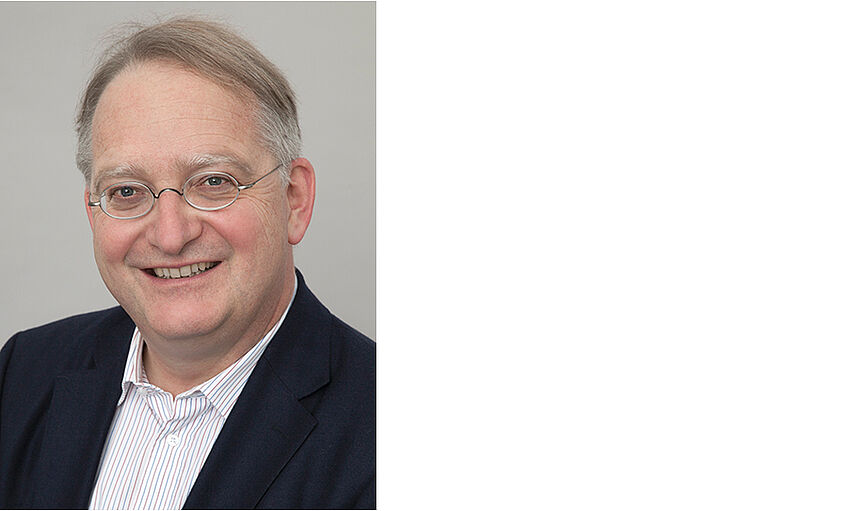
Adam S. Cohen is an Associate Professor in the Department of Art History at the University of Toronto. His research bridges Medieval European Book History , Jewish Art , and Monastic Manuscript Cultures , with a focus on illuminated manuscripts as intersections of theology, politics, and cross-cultural exchange. He co-authored the widely adopted textbook Art and Architecture of the Middle Ages: Exploring a Connected World (2023) and co-edited The Visualization of Knowledge (2020). Research Interests : Examines how medieval art connects abstract theory to daily practice Specializes in Hebrew illuminated manuscripts (e.g., Rothschild Pentateuch) Investigates digital methodologies for manuscript analysis (Utrecht Psalter project) Explores sensory theory in medieval liturgy through the Les cinq sens au Moyen Age volume (2011) Scientific Awards : Leverhulme Visiting Professor, University of Edinburgh (2023) Education : PhD in Art History from Johns Hopkins University (1995).
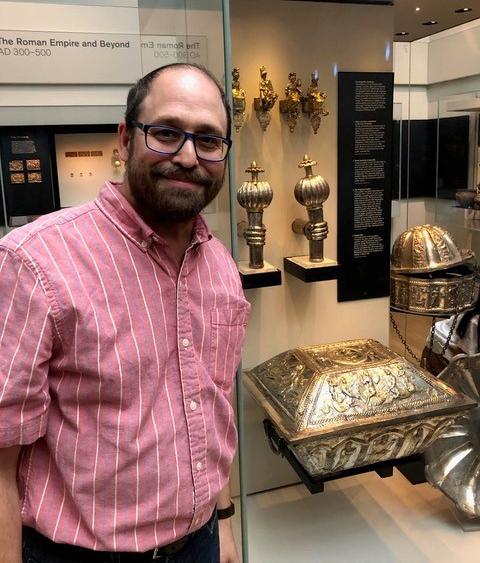
Michael Peppard is a Professor of Theology at Fordham University, specializing in New Testament, Early Christian Studies, and Religion and Public Life. His scholarship bridges biblical interpretation with contemporary issues like politics and Catholic identity in modern culture. PhD in Religious Studies from Yale University MAR from Yale Divinity School Certificate from Yale Institute of Sacred Music BA from University of Notre Dame Dr. Peppard's research focuses on New Testament Studies (Gospels, Christology, Parables, Rhetoric), Early Christianity (Art, Ritual, Coptic Studies, Roman Religion), and Reception History of the Bible (liturgical and artistic interpretations). His recent work explores intersections between Catholic theology and American public life. His 2024 book How Catholics Encounter the Bible examines biblical themes in Catholic worship and imagination. Articles from journals like The Journal of Ecclesiastical History and Journal of Early Christian Studies highlight his expertise in early Christian art, ritual contexts, and theological debates. Manfred Lautenschläger Award for Theological Promise 2018 Eusebius Essay Prize 2014 Catherine Mowry LaCugna 'best article' award
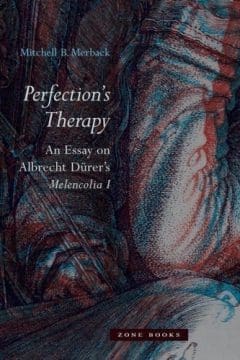
Mitchell B. Merback is the William Arnell and Everett Land Professor & Chair in the Department of the History of Art at Johns Hopkins University's Krieger School of Arts & Sciences. His research focuses on late medieval and northern Renaissance art, particularly German, Austrian, and Low Countries visual culture. Research Themes: Cultural history of pain, pilgrimage rituals, anti-Jewish visual propaganda, and philosophical dimensions of religious imagery Key Projects: Analyzing devotional image phenomenology, Reformation-era art, and Dürer's meditative iconography His work bridges art history with cultural studies, examining how visual artifacts shape historical subjectivity and religious perception. Recent publications include studies on Dürer's Melencolia I and pre-Reformation pilgrimage shrines. Current projects explore 'philosophical images' that invite meditative engagement, as well as studies on tragic witness narratives and dissent in German Renaissance art.
Prof. Dr. Dorothee Gelhard is a full Professor of Comparative Literature (Slavic/German/Romance Philology) at the University of Regensburg since 2002. She founded the Yiddish studies program (2007) and co-established the Master's program in General and Comparative Literature with Jewish studies focus (since 2007). As Principal Investigator of the Graduate School for Eastern and Southeastern European Studies (since 2012), she leads the research group 'Construction, Translation and Transgression in Art and Literature'. She also holds guest professorships at Hebrew University of Jerusalem (2012-2013) and University of Haifa (2014-2015). Specializes in Ernst Cassirer, Aby Warburg, Walter Benjamin, and Emmanuel Levinas Focus on German-Jewish, Russian-Jewish, and Italian-Jewish literatures Key research areas: Literary forms of philosophy, dance studies, and intermediality Her publications and editorial work (E.g., the Pegisha – Begegnung book series) emphasize Jewish cultural encounters with European modernity, including assimilation, secularization, and cultural memory. She has led seminars on dance-literature interactions, analyzing works like Romeo und Julia and Les Ballets Russes collaborations.
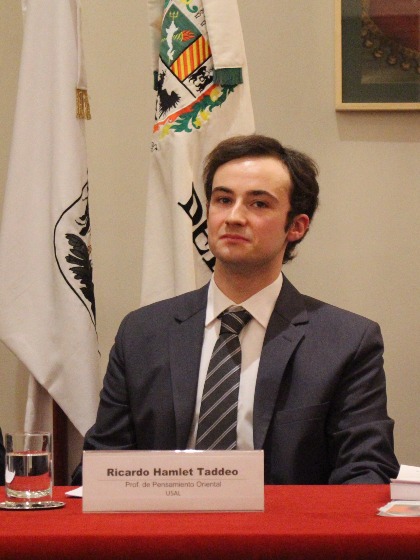
Hamlet Taddeo is a doctoral candidate at the University of Groningen's Faculty of Theology and Religious Studies, Department of Jewish, Christian and Islamic Origins, while simultaneously pursuing doctoral studies in Philosophy at Universidad del Salvador in Argentina. He serves as a Lecturer in Eastern Philosophy and Literature at Universidad del Salvador's Faculty of Philosophy, Letters and Oriental Studies in Buenos Aires. His academic journey spans both European and Latin American institutions, reflecting his transnational scholarly perspective. Taddeo's research focuses on the intersection of religious traditions, particularly exploring connections between Eastern and Western philosophical and theological systems. Comparative Study of Religion Interreligious Dialogue Philosophy of Religion History of Religions Comparative Philosophy Aesthetics in Religious Contexts Hindu Studies and Eastern Philosophical Traditions Taddeo's publication record demonstrates a consistent focus on intercultural and interreligious dialogue, with particular attention to aesthetic dimensions of religious experience and the philosophical encounter between Eastern and Western traditions. His work frequently engages with the thought of Ismael Quiles S.J. and examines how figures bridge cultural and religious divides. Recent publications explore the spiritual dimension of politics, the Bhagavad Gita's role in East-West encounter, and theological aesthetics in interreligious dialogue. His methodological approach combines philosophical analysis with theological inquiry, often drawing connections between seemingly disparate traditions to reveal underlying commonalities in human spiritual experience. Taddeo's work contributes significantly to contemporary discussions about how different religious traditions can engage in meaningful dialogue while maintaining their distinctive identities.
Dr. Sabine Arndt serves as a Postdoctoral Research Fellow at the Academy for Jewish Studies Heidelberg, affiliated with the Heidelberg Academy of Sciences and Humanities where she leads the project Bible Glossaries as Hidden Cultural Carriers since March 2023. Her academic foundation includes a DPhil from the University of Oxford and an MA from the University of Amsterdam, establishing her expertise in Jewish manuscript transmission across cultural boundaries. Her educational trajectory features: Doctor of Philosophy in Oriental Studies, University of Oxford (2016), thesis: Judah ha-Cohen and the Emperor’s philosopher: Dynamics of Transmission at Cultural Crossroads Master of Arts in Semitic Languages and Cultures, University of Amsterdam (2005), specializing in Hebrew, Aramaic, and Jewish Studies with minors in Arabic language and Jewish philosophy Arndt’s research pioneers the study of medieval Hebrew manuscripts as dynamic sites of intercultural scientific exchange. She meticulously analyzes how Jewish scholars mediated knowledge between Arabic, Latin, and Hebrew traditions—particularly through diagrammatic transmission in mathematical optics and Euclidean geometry. Her groundbreaking work on Sefer ha-marʾim reveals how textual errors in diagrams reflect cultural adaptation processes, while her studies of Frederick II’s court expose Jewish intellectuals as central conduits in medieval scientific networks. This interdisciplinary approach bridges codicology, history of science, and Jewish cultural studies. Her publication pattern demonstrates sustained focus on manuscript transmission mechanics: from 2006 analyses of liturgical adaptations to 2024 investigations of diagrammatic fidelity in Hebrew Euclid translations. Recurring themes include the materiality of knowledge transfer, the role of Jewish intermediaries in scientific networks, and Bible glossaries as repositories of cross-cultural encounters—culminating in her forthcoming monograph on Judah ha-Cohen’s intellectual exchanges. Her scholarly recognition includes: AHRC Doctoral Studentship (2011) Scatcherd European Scholarship (2011) Scriptieprijs dissertation award (2006) While no formal advisees are documented, Arndt’s career has been propelled by competitive fellowships including the AHRC Doctoral Studentship. Her conference presentations at Leeds International Medieval Congress and New York symposia demonstrate active engagement in shaping discourse on medieval Jewish scientific networks. Currently embedded in the Bible Glossaries as Hidden Cultural Carriers project at Heidelberg Academy, she previously contributed to Münster University’s Visual in the Medieval Jewish World initiative and Oxford’s Genizah Digitization Project—highlighting her consistent commitment to collaborative, materially-grounded research in Jewish manuscript cultures.
Prof. Dr. habil. Gerd Blum is a distinguished art historian at the University of Vienna’s Faculty of History and Cultural Studies, Institute of Art History, with a secondary affiliation at the Münster Art Academy (University of Fine Arts Münster). His research spans Renaissance architecture, autobiographical art, and intersections between form analysis and iconology. Key focuses include Alberti’s theories, Vasari’s biographies, Palladio’s villas, and modernist painting traditions from Manet to Cézanne. Blum has delivered lectures internationally on topics like Michelangelo’s Moses and the Palladio Method. Blum’s publications include the upcoming The Gain of the Middle (2025), a study on form and iconology synthesis in post-1980 Germany, and Fenestra Prospectiva (2015), analyzing architecturally staged vistas. His work on Vasari’s historiography and Michelangelo’s reception history (2008) remains influential, alongside co-edited volumes like Pendant Plus (2012). Blum bridges classical and modern analysis, addressing themes such as the menorah’s Christian-Jewish symbolism and Nick Ut’s Vietnam photography. Recent lectures (2022–2023) examine Palladio’s Villa Rotonda, wartime art collaborations, and Nazi-era visual culture. Blum’s interdisciplinary approach integrates theological discourse, classical texts, and contemporary art critique, reflecting his extensive engagement with conferences and editorial projects like the Bild + Bild book series.
Jason Bruner is a Professor in the School of Historical, Philosophical and Religious Studies at Arizona State University, specializing in Religious Studies. He serves as Director of the Desert Humanities Initiative and is a Senior Global Futures Scholar. His additional affiliations include the Lincoln Center for Applied Ethics, the Center for the Study of Religion and Conflict (where he serves as interim director in Spring 2024), and the Humanities for the Environment Global Network. Dr. Bruner earned his Ph.D. from Princeton Theological Seminary in 2013, following an M.T.S. from Weston Jesuit School of Theology (2008) and a B.A. from Gardner-Webb University (2005). His academic journey has led to a distinguished career at ASU, where he has served as Faculty Head of Religious Studies (2021-2023) and Associate Head of Undergraduate Studies (2018-2021). His research spans the history and anthropology of Christianity, with particular focus on Sub-Saharan Africa and the United States. Bruner explores lived religion, health, violence, and globalization through both traditional academic scholarship and creative approaches incorporating photography and creative nonfiction. His work examines how religious beliefs and practices manifest in everyday life, particularly in contexts of migration, colonialism, and environmental challenges in the Desert Southwest. The visual and literary arts are integral to his scholarly practice, allowing him to document and interpret religious phenomena in innovative ways. Bruner's publications reveal a scholar deeply engaged with questions of religious violence, conversion, and the global dimensions of Christianity. His work spans historical analysis of the East African Revival to contemporary examinations of American Christian perceptions of global persecution. He has developed a distinctive interdisciplinary approach that bridges religious studies, anthropology, history, and creative expression, often collaborating with colleagues from diverse fields including genocide studies, medical anthropology, and environmental humanities. Zebulon Pearce Distinguished Teaching Award in Humanities (2022-2023) Dr. Bruner has secured significant research funding including grants from the Louisville Institute, Arizona Humanities Council, and ASU's Benson Fund. His current projects include 'Mapping Randolph,' a digital historical map of Randolph, AZ, and a place-based online course on Boyce Thompson Arboretum. He collaborates extensively with colleagues across disciplines, particularly in genocide studies, environmental humanities, and religious conflict resolution, often serving as Principal Investigator for multi-investigator projects. As Director of the Desert Humanities Initiative, Bruner leads a team exploring the intersection of environmental challenges and humanistic inquiry in arid regions. His work connects academic scholarship with community engagement through photography workshops, documentary projects, and public humanities initiatives focused on the unique cultural and ecological landscape of the American Southwest. His leadership extends to multiple university committees addressing curriculum development, interdisciplinary collaboration, and the future of humanities education.
Nora Stene is an Associate Professor in the Department of Culture Studies and Oriental Languages (IKOS) at the University of Oslo , specializing in the Study of Religion . Her academic focus spans Christians in the Middle East, the Coptic Orthodox Church, religious minorities in Norway, and the intersection of migration, secularism, and religious practice. Current research: Mission and Human Rights project analyzing missionary-immigrant interactions Teaching: World Religions (REL 1003), Christianity (REL 2210), Judaism (REL 2240), Gender and Religion (REL 3040/4040) Her research interests include: Religious Change in secular societies, particularly conversion/apostasy dynamics Diaspora Communities with focus on Copts in Egypt, Sudan, and Europe Childhood and Socialization within religious groups Migration Studies examining Muslims in Europe and interfaith encounters Key publication trends: 2019-2023: Increasing focus on Jewish communities and ritual practices in Norway 2002-2017: Consistent work on Coptic diaspora , visual culture , and religious education 2010-2021: Gendered analysis of religious authority and leadership roles Professional engagements: Co-founder of Christians in the Middle East research network Board member of Prismet journal (2010-) Member of Religious Diversity Resource Group at UiO Guest lecturer at multiple institutions
Knut Martin Stünkel is a Privatdozent and Research Associate at the Collaborative Research Center 'Metaphors of Religion' (SFB 1475) at Ruhr University Bochum, affiliated with CERES (Centre for Religious Studies). His academic work bridges theology, philosophy, and intellectual history, with a strong focus on metaphor in religious discourse and interreligious contact. His research interests include: Metaphor and religious language Intellectual history of the Enlightenment and early modern period Religious contact and transfer Figures such as Johann Georg Hamann, Eugen Rosenstock-Huessy, Nicholas Cusanus, and Martin Luther Theology and philosophy of religion Sociology of religion Stünkel's recent publications span topics from medieval religious dialogues to 20th-century totalitarianism, consistently examining how language, metaphor, and form shape religious meaning. His work appears in leading journals such as Entangled Religions , Zeitschrift für Religions- und Geistesgeschichte , and Neue Zeitschrift für Systematische Theologie . He frequently collaborates with scholars like Linda Simonis, Patrick Krüger, and Görge K. Hasselhoff. He has no listed scientific awards in the provided text. As a senior researcher and Privatdozent, he likely mentors junior scholars, though no formal students are listed. His work is embedded in major research projects such as SFB 1475 and previously the Käte Hamburger Kolleg, indicating sustained grant support and institutional collaboration. He is based at Universitätsstr. 90a, Bochum, and can be contacted at knut.stuenkel@gmx.net.
Albrecht Classen is a University Distinguished Professor in the Department of German Studies , recognized as a leading scholar in medieval and early modern literature . With over 135 books and 850 articles, his work spans gender studies, cultural history, and spiritual theology . He serves as editor for Mediaevistik and Humanities , reflecting his interdisciplinary focus. His research explores themes such as female agency in courtly romances, sensory experiences in mystical traditions, and cross-cultural encounters in Jesuit missionary narratives. Articles highlight his expertise in medieval humor, devotional practices, and manuscript culture , while his teaching curriculum emphasizes premodern gender dynamics and medieval happiness narratives . Classen’s scholarly achievements include the Fulbright Grant (2022) and the Ted and Shirley Taubeneck Superior Teaching Award (2002) , underscoring his dual excellence in research and pedagogy. His editorial work and course offerings demonstrate a commitment to interdisciplinary education and global cultural exchange . Key scientific contributions: Analysis of Jewish-Gentile relations in historical texts Studies on German Jesuit missionaries in the New World Examinations of medieval laughter and eroticism Reinterpretations of Arthurian legends in German contexts Comparative studies on selfhood in mystical and modern texts
Prof. Emily Michelson is a cultural and religious historian of early modern Italy, holding a Professorship in the School of History at the University of St Andrews since 2009. Previously, she taught at the University of Utah and earned her BA from Harvard University (1995) and PhD in History and Renaissance Studies from Yale (2006). Research: Her work explores religious diversity, interfaith encounters, and mobility in early modern Italy. Key publications include The Pulpit and the Press in Reformation Italy (2013) and Catholic Spectacle and Rome's Jews (funded by the British Academy and AHRC). Current projects include the ItalianROSE initiative, co-led with Prof. Mary Laven, examining Renaissance objects/spaces of encounter, and co-editing the Routledge series Renaissance and Early Modern Worlds of Knowledge . Teaching: She teaches modules on Renaissance Venice, Early Modern Rome, and interfaith dynamics. Courses include MO1007 (first-year survey) and HI2001 ('History as a Discipline'). Grants & Awards: Recipient of a British Academy mid-career grant (2017) and AHRC early-career fellowship (2016–2019). Projects include studies on religious minorities in early modern Rome and redefining sanctity in the early modern world. Labs/Teams: Collaborates with institutions across St Andrews and Cambridge, contributing to interdisciplinary research on religious history and cultural encounters.
Cathleen Fleck is Professor and Chair of the Department of Visual and Performing Arts at Saint Louis University's College of Arts and Sciences. She holds a Ph.D. and M.A. from Johns Hopkins University and a B.A. from the University of Pennsylvania. Her academic leadership includes directing departmental DEI initiatives and co-founding the Center for Research on Global Catholicism. Her educational background includes: Ph.D., Johns Hopkins University M.A., Johns Hopkins University B.A., University of Pennsylvania Dr. Fleck specializes in medieval Mediterranean art, with research emphases on Crusader-era cultural exchange, Jerusalem’s architectural identities, Islamic and European court art, and the representation of holy sites. She explores how religious and political power is expressed through art and architecture, particularly in the context of Christian, Islamic, and Jewish interactions. Her work bridges historical analysis with contemporary issues, including the 1904 St. Louis World’s Fair’s replica of Jerusalem and its symbolic meanings. Her recent publications reflect a strong focus on architectural reuse, manuscript studies, and cross-cultural encounters during the Crusades. Themes include spolia, devotional imagery, royal and papal patronage, and the visual construction of legitimacy. Her scholarship spans journals like Viator , Source , and Journal of Transcultural Medieval Studies , as well as major publishers such as Brill, Ashgate, and Routledge. Her scientific recognition includes: Diversity, Equity, and Inclusion Fellow, Reinert Center for Transformative Teaching and Learning (2023–2024) CREST Research Fellow, SLU (2024–2025), focusing on 'The Spatial Turn' and the 'Jerusalem in St. Louis' project Dr. Fleck leads the 'Artful Observation' initiative, which integrates visual arts training into pre-medical and health sciences curricula to enhance observational and empathetic skills. She has served on numerous university committees and held leadership roles in professional organizations such as the Italian Art Society (President, 2013–2015) and the International Center of Medieval Art. Her research is supported by interdisciplinary collaborations and institutional programming in global Catholicism and DEI. She is actively involved in academic communities through the National Council of Arts Administrators, College Art Association, Historians of Islamic Art Association, and the Society for the Study of the Crusades and the Latin East. Her departmental leadership has focused on strategic visioning, DEI planning, and faculty development in alignment with national standards from NASAD and Harvard’s Graduate School of Education.