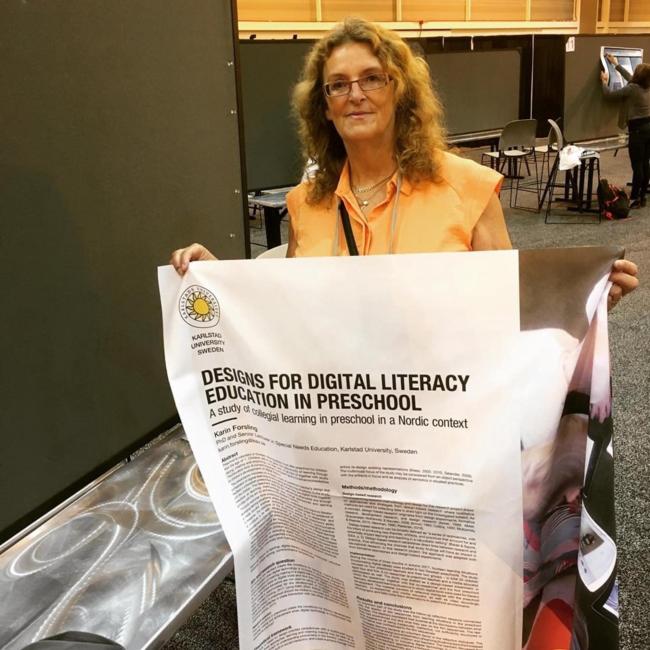
Karin Forsling is a researcher at Karlstad University, focusing on literacy practices, digital learning, and inclusive education in Swedish preschool and primary school contexts. She collaborates extensively with colleagues like Catharina Tjernberg on interdisciplinary projects, emphasizing teacher collaboration and educational design. Key Research Areas: Digital literacy, multimodal writing instruction, inclusive pedagogy, and teacher professional development Collaborations: Active participation in studies involving diverse literacy practices and digital competence in early childhood education Recent Publications: Investigate digitalization strategies, supportive teaching practices, and literacy scaffolding in preschools and lower primary schools Contact: karin.forsling@kau.se
Linda Forssman is an Associate Professor and researcher in developmental psychology at Uppsala University's Department of Psychology, Division of Developmental Psychology. She works at the Uppsala Child & BabyLab, where she conducts research on how young children perceive and interact with their world, and how different experiences shape the development of cognitive, social and linguistic skills during early childhood. Dr. Forssman's research focuses on developmental psychology with particular emphasis on early language acquisition, cognitive development, social development, and infant cognition. Her work explores how various experiences shape children's development across multiple domains, with special attention to vulnerable populations and intervention strategies. She employs methodologies including eye-tracking, longitudinal studies, and randomized controlled trials to investigate fundamental developmental processes. Her recent publications show strong trends in cross-cultural developmental research, early language intervention, social cognition in infants, and the impact of socioeconomic factors on child development. Her work spans multiple methodologies from laboratory experiments to field studies in diverse cultural contexts, including research conducted in rural Malawi. Dr. Forssman has secured significant research funding as Principal Investigator and Co-Investigator on numerous projects. Her major grants include: Promoting Children's Early Language Development in Socioeconomic Disadvantaged Areas (PI, Marcus and Amalia Wallenberg Foundation, €312,200, 2025-2029) How does preschool quality relate to children's learning outcomes? (PI, Swedish Institute for Educational Research, €454,000, 2022-2024) The Impact of Book-Sharing on Infant Language and Cognition (PI, Riksbankens Jubileumsfond, €362,000, 2019-2022) Nordic evidence based high quality early childhood education and care research network (Co-I, Swedish Research Council, €102,500, 2023-2026) She is actively involved with the Uppsala Child & BabyLab, a research environment focused on infant and child development using advanced methodologies including eye-tracking. Her work bridges basic developmental research with practical applications for early childhood education and intervention programs, particularly those targeting children in socioeconomically disadvantaged areas.
Lisa Gustavsson is an Associate Professor in the Department of Linguistics at Stockholm University, where she conducts cutting-edge research on early language acquisition and forensic phonetics. She is affiliated with the Stockholm Babylab, a research group dedicated to studying infant language development through multiple parallel projects and international collaborations. Her research interests focus on early language acquisition, specifically examining speech processing, speech production, and communicative interaction in infants, with particular attention to the acoustic characteristics of speech signals. She also investigates forensic phonetics, exploring speaker identification and profiling techniques for forensic investigations, and how speaker recognition relates to fundamental phonetic processes. Her work bridges theoretical linguistics with practical applications in understanding how infants acquire language. Analyzing her recent publications reveals consistent themes in infant language development research. Her work demonstrates a strong focus on how hyperarticulation in child-directed speech affects language learning, the development of tone perception across different language environments, and the role of social and emotional factors in language acquisition. Her research spans multiple methodologies including behavioral experiments, cross-linguistic comparisons, and neuroscientific approaches to understanding speech processing. Gustavsson leads several significant research projects including Learning First Words (L3WO), which investigates hyperarticulation's effect on infant word recognition; The Effect of Hyperarticulation on Early Language Development (HELD); Distributional Learning: Domain-specificity and the impact of social cues (DIDI); Learning Tones: The influence of pitch accent language experience on lexical tone perception (LETO); Parent Affect in Language Learning (PALL); SoundStart; and the CAPSL-project on statistical learning and auditory predictability. As part of the Stockholm Babylab, Gustavsson works within a collaborative research environment that employs multimodal approaches to study language acquisition longitudinally through parent-child interactions. Her work contributes significantly to our understanding of the complex processes involved in how infants learn language, with implications for both theoretical linguistics and practical applications in speech therapy and language education.
Anna Leiler is a Lecturer in the Department of Psychology and Social Work at Mid Sweden University in Östersund. Her research focuses on refugee mental health, trauma psychology, and cross-cultural psychiatry, particularly examining suicidal ideation, cognitive load during traumatic memory reconsolidation, and psychoeducational interventions. Current Projects : AMIR-Intervention, CoRe (Cognitive load during Reconsolidation), RooT (Refugee mental health over Time), Feeling in your own words Finished Projects : Refugee Health Screener, Teaching Recovery Techniques (TRT) Her recent publications explore prolonged grief in refugee populations, pandemic-related mental health trends, validation of screening tools, and the feasibility of trauma interventions. She also presented work on linguistic insecurity in clinical settings and Sámi cultural idioms of distress. Anna is actively involved in developing scalable mental health solutions for displaced populations, integrating epidemiological data with clinical practice.
Johannes Lunneblad is a Professor at the Department of Education, Communication and Learning at the University of Gothenburg. His research focuses on institutional responses to youth vulnerability, particularly in socially disadvantaged urban areas, examining how schools, social services, and law enforcement interact with marginalized youth. Key themes include migration's impact on education, intercultural pedagogy, and the juridification of youth behavior in schools. Education Background: Not explicitly detailed in the text, but his academic role implies advanced qualifications in education/sociology. Teaching Interests: Courses on learning, culture, language, identity, and ethnography-focused methodologies. Research Interests: Lunneblad's work critically analyzes how institutions frame social problems and youth risk, with a focus on urban schools, migration, and community partnerships. He employs ethnographic methods to explore topics like school-police collaboration, gendered violence, and intercultural education policies. Publications Trends: His recent work emphasizes institutional collaboration challenges, juridical responses to youth violence, and the sociopolitical dimensions of school-community partnerships. Key themes include ethical dilemmas in social work, the categorization of 'risk youth,' and the interplay between policy and practice in disadvantaged areas. Awards: None explicitly listed in the provided text. Grants/Advising: No specific grants mentioned, but his research collaborations (e.g., with Jenny Bengtsson, Thomas Johansson) suggest involvement in funded projects. Advising details are absent. Labs/Teams: Engaged with interdisciplinary groups studying urban education, migration, and social policy at the University of Gothenburg.
Johanna Granhagen Jungner is an Assistant Professor at Karolinska Institutet's Department of Women's and Children's Health, deeply involved in advanced-level education design with clinical expertise from Astrid Lindgren's Children's Hospital in neuropediatrics and pediatric pain management. Her educational background includes: Doctor of Medicine (2019), Karolinska Institutet Master's Degree in Pain - Nursing - Treatment (2005), Luleå University of Technology Bachelor's Degree in Nursing (1998), Karolinska Institutet Her research spans communication across language barriers in pediatric cancer care, pediatric rheumatology implementation studies, and intercultural clinical ethics, focusing on patient-reported experience measures and educational interventions to improve healthcare equity. Current projects investigate language barriers in Nordic pediatric oncology and team-based rheumatology clinics. Recent publications (2016-2024) reveal consistent focus on interpreter-mediated communication in pediatric oncology, patient safety, and transition care in rheumatology, utilizing mixed-methods approaches from qualitative interviews to national surveys. Scientific recognition includes: Nomination for best academic thesis by the National Association for Pediatric Nurses (2018) Best scientific poster at NOBOS 14th biannual conference (2023) She serves as course developer and examiner for 10+ nursing programs including pediatric emergency care, neonatal intensive care, and children's rights, while holding leadership roles in curriculum councils and education committees across KBH and NVS institutions. Active in Eva Broström's Movement, Activity and Health research group and Pernilla Pergert's Pediatric Cancer Research group, she contributes to interdisciplinary teams in neuropediatrics, pediatric oncology, and nursing science.
Ali Mansourian is a Professor of Geomatics at Lund University's Department of Physical Geography and Ecosystem Science, where he serves as Director of the Lund University GIS Centre and Coordinator of the GIS & RS Master Programme. He is actively involved with the United Nations Global Geospatial Information Management (UN-GGIM) Academic Network and previously served on the European Association of Geographic Information Laboratories in Europe (AGILE) council. His academic leadership spans large-scale international research initiatives and capacity-building projects funded by Erasmus+ and SIDA. Mansourian's research focuses on Geospatial Artificial Intelligence (GeoAI), Spatial Data Infrastructures (SDI), and Multi-Criteria Decision Analysis (MCDA) using multi-objective optimization techniques. His work extends to applying GIS in epidemiology and public health, disaster risk management, land-use planning, climate change, environmental management, and sustainability. His research portfolio demonstrates a strong interdisciplinary approach, bridging geospatial technology with critical societal challenges. His recent publications reveal a clear trend toward integrating advanced machine learning techniques with geospatial analysis, particularly in health applications, environmental monitoring, and climate change impacts. The research shows increasing emphasis on spatial ensemble learning, remote sensing applications, and the development of GeoAI tools that make geospatial analysis more accessible through natural language interfaces. His work spans multiple continents, with significant contributions in Africa, Europe, and Asia. Mansourian has extensive experience supervising PhD students and postdoctoral researchers, though specific student names aren't listed in the provided materials. He has coordinated numerous large-scale international projects including Geo-Academy, INTEGRAL, CADEO, and SWEMENA, demonstrating significant grant acquisition and management expertise. His leadership extends to evaluating proposals for major European research grant programs and serving as an invited evaluator for PhD theses. As Director of the Lund University GIS Centre and active member of multiple international networks, Mansourian leads a dynamic research environment focused on advancing geospatial technologies and their applications. His teams work at the intersection of traditional GIScience and emerging artificial intelligence approaches, creating innovative solutions for complex spatial problems across multiple domains including public health, environmental management, and sustainable development.
Linda Häll is a Lecturer at Linköping University, affiliated with both the Department of Behavioral Sciences and Learning (IBL) and the Department of Learning, Aesthetics and Natural Sciences (LEN). Her research focuses on how preschool children construct and negotiate age as a social resource through interaction. Current research: "Doing Age" in educational contexts Methodology: Long-term ethnographic fieldwork Secondary interest: Ethnicity and multiculturalism in early childhood settings Her work builds on symbolic interactionism and ethnomethodology, drawing parallels to "doing gender" theory. Key themes include: Interactive age categorization Superdiversity management in childcare Temporal identity construction Communicative diversity in play Publications span from 2013 to 2025, with recent work examining superdiversity in Swedish school-age educare (2025) and age categorization patterns in preschool (2022). Her research emphasizes practical applications for inclusive educational practices and contributes to understanding how children navigate complex social hierarchies.
Mats Börjesson is a Professor at Stockholm University, affiliated with both the English Department and the Department of Child and Youth Studies. He holds a position at the University Road 14 A campus, located in Stockholm, Sweden. His research interests span interdisciplinary areas including English literature, language studies, child and youth development, education, and cultural studies. While specific publications are listed in the Diva database, detailed article summaries are not provided here. No scientific awards or grants are explicitly mentioned in the available text. Professor Börjesson’s academic profile emphasizes dual departmental affiliations, suggesting potential cross-disciplinary work. His contact information is publicly accessible via his institutional email address.
Roles & Affiliations: Camilla Warnicke is an Associate Professor affiliated with Social Work at Örebro University. She currently serves as a visiting researcher at Stockholm University's Institute of Interpreting and Translation, and works part-time as a research funding advisor at Region Örebro County's Grants Office (RÖL). She is also a researcher and teacher at the Sign Language Interpreter and Deaf-Blind Interpreter Education program in Örebro. She holds an authorized interpreter certification between Swedish and Swedish Sign Language (STS). Research Interests: Her work focuses on social equality, participation, and interaction dynamics between individuals and society. Key areas include interpretation between Swedish and Swedish Sign Language, deaf populations, and deafblindness. She employs Conversation Analysis (CA) to study remote interpreting practices in services like the Swedish Video Relay Service (VRS). Collaborations: Active in multidisciplinary projects such as 'Remote interpreting between spoken and signed languages' (Region Örebro), 'Social equality and road safety' (funded by Swedish Transport Administration), and 'Better communication in congenital deafblindness' (Forte-funded with Linköping University). She also collaborates with the National Knowledge Center for Deafblind Issues (Nkcdb). Teaching & Supervision: Supervises doctoral student Charlotte Ryman at Örebro University's Department of Health Sciences. Teaches at undergraduate, postgraduate, and doctoral levels, including courses on remote interpreting and medical research funding. Leads courses at Stockholm University's sign language interpreting program. Awards & Recognition: None explicitly mentioned in the text. Labs & Teams: Part of research groups 'Deafblindness in a Multidisciplinary Perspective' and 'Social Work and Care across the Life Course (SAOL)'. Involved in initiatives like the 'Sign Language and Deaf-Blind Interpreter Education' program at Fellingsbro Folk High School.
Anna Sarkadi is a Professor in Social Medicine at the Department of Public Health and Caring Sciences, Uppsala University. She is a physician and leads a research group focused on child health, parenting, and mental wellbeing, with a strong emphasis on immigrant and refugee populations. Her work integrates public health, clinical medicine, and social policy to develop and evaluate interventions that promote family and child mental health. Her research interests include social medicine, child and adolescent mental health, parenting support, immigrant and refugee health, developmental disorders, preventive interventions, and public health policy . She employs both qualitative and quantitative methods, with a focus on community-based participatory research, intervention studies, and health services evaluation. Her recent publications (2023–2025) span topics such as mental health resilience in refugee youth, language development screening, teacher wellbeing, and economic hardship screening in child health services. Many of her studies involve co-design with stakeholders, including refugee families, and focus on equity and inclusion. Anna Sarkadi supervises 6 current PhD students 12 graduated PhD students 6 residents in social medicine and public health She is also chairperson of the Swedish Association of Social Medicine, indicating national leadership in her field. Her grants and research projects include evaluations of parenting programs, trauma interventions (e.g., Teaching Recovery Techniques), and studies on socioeconomic determinants of child health. She frequently collaborates with interdisciplinary teams across Sweden and internationally. She leads or contributes to research in labs and teams focused on Child and Adolescent Mental Health Migration and Health Public Health Interventions Family and Parenting Support Her work often involves close collaboration with child health services, schools, and community organizations.
Maria Graziano is an Associate Professor (Docent) and Educational Developer at Lund University Humanities Lab, with additional appointments as Senior Lecturer in Italian Studies at the Centre for Languages and Literature. She is also a researcher with LAMiNATE (Language Acquisition, Multilingualism, and Teaching) and a member of LU Profile Area: Natural and Artificial Cognition. Her educational background includes a double PhD in Linguistics from SESA (European School of Advanced Studies) at the University 'Suor Orsola Benincasa' (Napoli-Italy) and Université Stendhal (Grenoble-France), following postdoctoral work at the University of Alberta, Canada. She has qualifications as Assistant Professor/Senior Lecturer in Linguistics issued by Conseil National des Universités (CNU) France (2010-2014 and 2018-2022). Graziano's research focuses on gesture and its relation to spoken language from developmental and crosslinguistic perspectives. Her work examines how gesture development relates to textual and pragmatic abilities, temporal coordination between gesture and speech in bilingual and monolingual speakers, and gesture production in relation to speech fluency. She currently compares spoken and gestural behaviors across cultures, particularly between Italian and Swedish adult speakers, and investigates cohesion in narrative discourse in Italian children. Her publication record shows a strong focus on gesture-speech relationships, with significant impact as evidenced by 78 citations for her 2018 Frontiers in Psychology article 'When speech stops, gesture stops.' Her recent 2024 article in Frontiers in Communication provides evidence for cultural differences in gesture use between Italians and Swedes. Qualified Teaching Practitioner (2025) New Society of Letters at Lund (2024) Postdoctoral Fellow Research Day - University of Alberta (2011) Third prize for poster presentation at the Postdoctoral Fellow Research Day, University of Alberta (2011) Scholarship for Short Term Scientific Mission from European Science Foundation (2009) Graziano coordinates the research platform LAMiNATE (Language Acquisition, Multilingualism and Teaching) since 2020 and previously coordinated the Language Acquisition Seminar (2017-2019). She provides BA supervision and examination at Örebro University, teaches at Kristianstad Högskola and Malmö University, and has taught Italian Studies at Lund University since 2012. She is actively involved in numerous research projects including TEAM: Transdisciplinary Approaches to Learning, Acquisition, Multilingualism (2024-2029), and previously led projects on gesture production and the expression of pragmatic meaning across languages. She is an active member of the research community with 131 recorded activities including conference participation, public lectures, invited talks, and supervisory roles. Her work demonstrates strong international collaboration, particularly with researchers in Canada, the Netherlands, and across Europe.
Per Östberg is a Professor of Speech and Language Pathology at Karolinska Institutet's Department of Clinical Science, Intervention and Technology. He holds a PhD (2008) and Docent title (2013) from Karolinska Institutet. His research focuses on language dysfunction in neurological disorders, including aphasia, apraxia of speech, and dysphagia, with emphasis on stroke and neurodegenerative diseases like Parkinson's. He co-authored the textbook Klinisk neurovetenskap (2015) and leads projects on patient-reported outcomes and speech-language rehabilitation. Education: Doctor of Philosophy, Karolinska Institutet, 2008 Docent, Karolinska Institutet, 2013 Research Interests: His work spans speech disorders in acquired brain injury, longitudinal studies of apraxia recovery post-stroke, and validating clinical tools like the Eating Assessment Tool. He collaborates internationally on registries for stroke aphasia (I-PRAISE) and investigates neuroimaging correlates of speech motor recovery. Publications Trends: Recent work includes comparative studies of anomia in neurological conditions, randomized trials of aphasia treatments, and eye-tracking analysis in reading disorders. Key themes are interdisciplinary approaches to language assessment and rehabilitation efficacy. Advising: Supervised Martin Cederlöf's thesis on psychosis phenotype risks. Affiliated with Karolinska University Hospital and the Enheten för logopedi F67 unit.
Sebastian Lundström is an Associate Professor and Researcher in the Department of Psychiatry and Neurochemistry at the University of Gothenburg. His work focuses on child and adolescent psychiatry, with a strong emphasis on neurodevelopmental disorders, psychiatric genetics, and twin studies. Key areas of research include autism spectrum disorders, ADHD, eating disorders (e.g., ARFID), and the genetic and environmental underpinnings of mental health conditions. His research employs advanced methodologies such as genome-wide association studies (GWAS), longitudinal twin cohort analysis, and neuroimaging techniques like MEG. Notable contributions include studies on comorbidity patterns in neurodevelopmental disorders, the impact of environmental sensitivity in psychiatric phenotypes, and the genetic architecture of conditions like ARFID and synaesthesia. Lundström has published extensively in high-impact journals such as JAMA Pediatrics, Nature Human Behaviour, and Biological Psychiatry. His work bridges clinical and basic research, aiming to improve diagnostic tools and inform interventions for neurodevelopmental and psychiatric disorders.
Maria Engström is a Professor of Caring Science (Nursing) at the University of Gävle, with a focus on elderly care, digital health integration, and staff wellbeing. Her research spans international collaborations with institutions in Portugal, Spain, Italy, Ireland, Romania, France, and China. Key affiliations: University of Gävle, Region Gävleborg, Sandviken Municipality, Lishui University China. Research themes: Aging well, person-centered care, digital triage tools, nutrition education, and professional competence development. Her recent work explores leadership dynamics in hospitals, technology's impact on caregiver stress, and longitudinal studies of older workers' health. She has supervised doctoral students like Kristin Dellesjö and Maarit Wirkkala, supported by grants from Afa Försäkring, Erasmus+, and the Swedish Growth Agency. Engström’s projects address critical issues such as discharge planning for older adults, digitalization in Swedish Healthcare Direct (1177), and evidence-based tools for elderly care. She also investigates cross-cultural challenges faced by internationally educated nurses in Sweden.