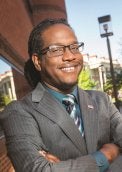
Oneil Harris is an Associate Professor in the Department of Finance at the College of Business, East Carolina University. He has been a faculty member since 2008 and teaches undergraduate and graduate courses in corporate finance, financial markets, and financial risk management, emphasizing real-world applications and critical thinking. Dr. Harris received his Ph.D. from Florida Atlantic University under the supervision of Dr. Jeff Madura. His research primarily centers on corporate governance and corporate restructuring, with publications spanning various domains of finance including executive compensation, IPO pricing, bank efficiency, private placements, and corporate divestitures. His scholarly work has appeared in high-quality journals such as the Journal of Banking and Finance , Financial Review , Journal of Business Research , and Quarterly Review of Economics and Finance . The body of his research reflects a consistent focus on agency problems, corporate decision-making, and market efficiency, particularly in the context of corporate restructurings and governance mechanisms. Dr. Harris is actively involved in student advising and mentoring beyond the classroom, contributing to student development and academic success. Ph.D., Florida Atlantic University
Steven Gjerstad is a Presidential Fellow at the Economic Science Institute within The George L. Argyros College of Business and Economics at Chapman University, Orange, California. His research integrates experimental economics with real-world financial crises, focusing on housing bubbles, market efficiency, and balance sheet dynamics. Contact details include Wilkinson Hall 119 and phone (714) 628-7282. Education: Bachelor of Science, University of Minnesota - Twin Cities Master of Arts, University of Minnesota - Twin Cities Ph.D., University of Minnesota - Twin Cities Gjerstad specializes in experimental validation of economic theories, particularly price adjustment in exchange economies and parallels between historical financial crises (e.g., 1929 vs. 2008). His work examines how household and bank balance sheets drive economic cycles, often collaborating with Nobel laureate Vernon L. Smith. He applies time series econometrics to experimental data, investigating slow convergence to equilibrium and policy implications for banking regulation. His 2009-2021 publications reveal consistent focus on experimental market mechanisms and financial instability. Key trends include analyzing housing bubbles through historical lenses, advocating for bondholder-led bank reorganization over bailouts, and exploring individual rationality in asset markets. Much of his output appears in high-impact journals like Economic Theory and PNAS , alongside public commentary in the Wall Street Journal and international media. No scientific awards, fellowships, or medals are documented in the provided materials. There is no mention of graduate students advised or research grants administered in the source texts. As a core member of Chapman University's Economic Science Institute, Gjerstad conducts experimental research on market behavior and financial systems. The institute functions as his primary research hub, facilitating collaborations on laboratory-based economic analysis and contributing to broader academic discourse through conference presentations and scholarly networks.
Dr Carolin Decker-Lange is a Senior Lecturer in Strategy and Entrepreneurship at Brunel Business School (BBS), joining in February 2023. She previously held academic positions at The Open University, UWE Bristol Business School, the University of Bremen, and WHU – Otto Beisheim School of Management in Germany. Her research spans strategy, entrepreneurship, and sustainability, with a focus on organizational development, interorganizational collaboration, and the Blue Economy. PhD in Management and Habilitation from Freie Universität Berlin Visiting Research Fellow at German Maritime Museum – Leibniz Institute for Maritime History Co-leader of BBS's Blue Economy Research Lab Member of BAM Peer Review College, Strategic Management Society, and Scientific Advisory Board of German Maritime Museum Her research interests bridge strategy and entrepreneurship, examining corporate restructuring, family business governance, innovation in SMEs, and entrepreneurship education. Recent work explores the Blue Economy's potential for global strategy, including ocean impact startups and coastal resilience. She applies mixed-methods research and leads teaching modules such as Strategic Management (UG, PG) and Managing for the Future (MBA). Her publications address topics like sustainable blue bioeconomy, entrepreneurship education outcomes, brand licensing strategies, and dynamic capabilities in SMEs. She has secured internal grants for teaching-related projects at the Open University, including studies on student retention and employability. She has supervised/co-supervised eight PhD students to completion and currently oversees organizational ambidexterity research at BBS. She serves as an external examiner at Cranfield University and the University of Strathclyde. Scientific awards include her Visiting Research Fellowship at the German Maritime Museum. Her teaching roles and research leadership highlight her interdisciplinary contributions to strategy, entrepreneurship, and sustainable business practices.
Steve Striffler is a Professor in the Department of Labor Studies/Anthropology at the University of Massachusetts, Boston. His work bridges anthropological analysis with critical labor studies, focusing on the intersections of corporate power, environmental justice, and transnational worker solidarity. He has published extensively on food systems, labor movements, and socialist frameworks in the Americas. His research explores Corporate concentration in global food industries 21st-century socialist movements in Latin America Labor-environmental synergies in Colombia Food activism historiography Migrant labor dynamics in US poultry processing Recent publications (2024-2009) analyze food system monopolies, anthropological imperialism critique, and labor-environmental coalitions. Despite significant public engagement (12,871+ views), no formal scientific awards are documented in these texts. His scholarship consistently examines power structures across agricultural, industrial, and political contexts.
Stacey Choy is Assistant Professor of Accountancy at the University of Illinois Urbana-Champaign's Gies College of Business. Her research employs innovative methodologies to examine accounting and finance questions, particularly focusing on corporate communication, debt markets, and environmental regulation. She teaches in the accountancy program at Gies College. Research explores information flow between corporate managers and financial stakeholders, using novel datasets including geospatial patterns. Key investigations include private manager-analyst communications, environmental enforcement impacts on lending practices, and debt restructuring processes. Recent publications analyze regulatory compliance mechanisms, disclosure practices, and debt covenant structures.
Spyridon Lagaras is an Assistant Professor of Finance at the Gies College of Business, University of Illinois at Urbana-Champaign. His research focuses on corporate restructuring, labor economics, and entrepreneurship, with a particular emphasis on how institutional environments and policy interventions shape firm behavior and labor market outcomes. Education : While specific academic credentials aren't detailed in the provided text, his academic roles and publications indicate a Ph.D. in Finance or related field from a top-tier institution. Research Interests Corporate restructuring and M&A labor impacts Gig economy dynamics and entrepreneurship Judicial bias in bankruptcy processes Gender disparities in financial sectors Government support mechanisms during crises Awards W.E. Upjohn Institute for Employment Research Early Career Research Award Ewing Marion Kauffman Foundation Knowledge Challenge Grant Grants & Advising Recipient of grants from the Kauffman Foundation and Upjohn Institute. Actively involved in research collaborations with institutions like NBER, ECB, and CEPR. No formal advisees listed, but extensive co-authorship networks suggest mentorship roles. Key Contributions His work bridges corporate finance with labor economics, analyzing how mergers, bankruptcy processes, and gig platforms influence workforce dynamics. Notable studies include the transformative effects of gig economies on entrepreneurship and the long-term labor consequences of M&A activity in Brazil.
Kathy Walsh is a Professor of Finance and the Associate Dean (Research and Innovation) at the University of Technology Sydney (UTS) Business School. She previously held roles as an Associate Professor at Australian National University (ANU) and Sydney University, and served as Research Director at the Centre for International Finance and Regulation (CIFR). Her career spans over two decades with prior experience in the financial services sector and insurance industry. Education: PhD in Finance (Australian Graduate School of Management), First-Class Honours in Finance (Curtin University) Her research focuses on Chinese capital markets, Renminbi internationalization/digitization, corporate governance, and gender diversity. She analyzes the implications of China’s financial policies on global markets and explores retirement housing finance challenges in Australia. Key grants include: RMB internationalisation and implications for Australia (UTS:ACRI, 2024) Reinventing Australia’s approach to gendered violence prevention (Wilson Foundation, 2025) Offshore RMB Hubs (NSW Government & ANU, 2014) Internationalisation of the Renminbi (CIFR & ANU, 2013) Her work bridges academic research with practical financial strategy, including roles as FIRN President and collaboration with policy institutions like CIFR. She emphasizes reform in state-owned enterprises and transparent governance frameworks.
Bart Elmore is Professor in the Department of History at The Ohio State University's College of Arts and Sciences. He holds a Ph.D. from University of Virginia, with previous positions at University of California Berkeley and University of Alabama. His research examines the environmental impacts of capitalism through corporate histories of firms like Coca-Cola and Monsanto. Research explores: Global environmental consequences of corporate strategies Historical development of industrial agriculture Sustainability challenges in consumer economies Political economy of resource extraction Publications demonstrate sustained focus on corporate-environmental interactions, particularly through monograph studies of major firms. Recent books examine Southern capitalism's ecological footprint and agricultural biotechnology. Awards include: Dan David Prize (2022) IACP Food Issues Award (2022) J. Anthony Lukas Award (2020) Gustave Arlt Award (2016) Axiom Business Book Award (2015) Leads interdisciplinary collaborations through the Sustainability Institute at Ohio State. Maintains public engagement through media contributions to Washington Post and The Conversation.
Professor Mia Gray is a Professor of Economic Geography and Fellow of Girton College at the University of Cambridge. Her research focuses on austerity, inequality, and the political economy of work, with a particular emphasis on debt dynamics and regional economic disparities. She leads the Infrastructural Geographies research group and co-edits the Cambridge Journal of Regions, Economy and Society . Research Interests: Austerity’s socio-political impacts, debt mobility across governance levels, regional labor markets, and the geographies of union organizing. She has co-authored an influential book on debt and austerity and collaborated on the interactive play The Great Austerity Debate . Recent Trends in Publications: Her work increasingly explores post-pandemic state transformations, energy crises under austerity, and the spatial dimensions of platform capitalism. Key themes include governance gaps, institutional precarity, and the uneven distribution of austerity’s burdens. Awards: Recognized as an award-winning author for her contributions to economic geography and policy analysis. Advising & Grants: Supervises 4 current PhD students and has mentored over 15 researchers. Active in funding bodies like the Cambridge Centre for Alternative Finance and the Regional Studies Association. Labs/Teams: Infrastructural Geographies Group (Department of Geography), Cambridge Centre for Alternative Finance.
James Albertus is an Assistant Professor of Finance at Carnegie Mellon University's Tepper School of Business, a position he has held since 2017 after serving as an Instructor there from 2016-2017. His research bridges corporate finance, international taxation, and private equity, with significant contributions to understanding tax policy impacts on multinational corporations and financial innovation. His academic credentials include: Ph.D. in Finance from New York University Stern School of Business (2016) B.S. and M.A. in Economics from the University of Michigan, Ann Arbor (2007) Albertus's scholarly work critically examines how tax structures influence corporate behavior, particularly regarding risk-taking, innovation incentives, and cross-border investment strategies. His recent publications analyze the global economic consequences of insolvency reforms and the mechanics of private equity fund financing, revealing how regulatory changes and agency conflicts shape financial decision-making in multinational contexts. This research consistently addresses real-world policy implications while maintaining rigorous theoretical foundations. His publication trajectory shows increasing focus on the intersection of tax policy and corporate finance since 2019, with multiple high-impact studies in top finance journals during 2022-2025. Notably, his collaborative work often centers on empirical analyses of major regulatory shifts like the Tax Cuts and Jobs Act, demonstrating practical relevance for both policymakers and financial practitioners. No scientific awards were documented in the source materials. Teaching records confirm continuous instruction of finance courses since 2017, though no doctoral students or major research grants were specified. His work aligns with Sustainable Development Goals related to economic inequality and decent work, reflecting attention to broader societal impacts of financial systems.
Anthony Kyiu serves as Assistant Professor in Finance and Deputy Director of Postgraduate Taught Programmes at Durham University Business School. His research examines corporate finance, climate policy impacts, and institutional governance in banking sectors. Core research domains: Corporate governance mechanisms Climate finance integration Banking regulation effects Institutional development in emerging economies Publications demonstrate strong focus on environmental accounting (decarbonization efforts), auditor liability, and market reactions to corporate restructuring. Recent work analyzes how employee feedback influences market information efficiency. Currently advises one doctoral candidate in finance. Recognized as Senior Fellow of Advance HE for teaching excellence in corporate finance and financial valuation.
Dariusz Klimek is a researcher at Lodz University of Technology's Institute of Management within the Faculty of Organization and Management. His research interests include sustainable capital management, municipal enterprises, defense industry management, and offset transactions. His publications focus on corporate sustainability, public sector management, and industrial economics. Recent work examines capital management models, social capital in enterprises, and economic transformation in Poland.
Mahfuzul Haque is a tenured Professor of Finance at Indiana State University's Scott College of Business, specializing in Accounting, Finance, Insurance & Risk Management. His extensive academic credentials include a Ph.D. in Financial Economics from the University of New Orleans (1999), dual MBAs from Indiana University-South Bend (1993) and University of Dhaka (1982), and a B.S. in Electrical Engineering from Bangladesh University of Engineering and Technology (1977). His research focuses on risk management , international finance , and emerging markets , with particular expertise in portfolio optimization, financial crises, and banking stability. He has authored over 42 scholarly publications examining investment strategies, market volatility, and economic policy impacts across global markets. Recent publications (2022-2025) demonstrate a strong focus on climate finance, systemic banking risks in MENA, and governance dynamics, while his broader portfolio shows consistent investigation of financial crises, market efficiency, and emerging economies. His work frequently employs empirical methodologies to analyze macroeconomic policies and market behaviors. Major Awards & Honors: Emerald Literati Outstanding Reviewer Award (2018) Exemplary Scholarship recognition (2011, 2018) McGraw Hill Distinguished Paper Award (2015) Best Paper in International Finance, SWFA (2001) He has supervised 4 visiting scholars and served as Ph.D./M.Sc. external examiner. Secured multiple research grants including $6,000 for portfolio optimization studies and $3,000 for volatility research. Regularly presents at major conferences like FMA and FBD, with recent work on capital flows (Lucas Paradox) and bank governance.
Claire Baker serves as a Lecturer in Sociology within the School of Humanities, Arts, and Social Sciences at the University of New England. Her work bridges academic research and practical community engagement, particularly in rural Australian contexts. Her research interests focus on Sociology of Land Use , Economic Sociology , and Micro-Level Social Change . Using Simmel's 'plumb-line' methodology, she connects granular case studies to broader societal transformations, examining how globalization and policy shifts manifest in everyday rural life. Her approach integrates social, economic, and cultural histories to analyze power structures and inequality. Key scientific recognition includes the University Medal and Chancellor’s Doctoral Research Medal . Her publications reveal consistent focus on Australian rural sociology, state policy evolution, and neoliberal economic frameworks, with recent work expanding to transnational comparisons. Baker’s professional experience includes managing the $7.8M Commonwealth-funded Collaborative Research Network for Mental Health and Well-being in Rural Communities. She has held Visiting Scholar positions at Wageningen University and Cardiff University, strengthening international research linkages.
Rasha Alsakka is a Professor of Banking and Finance at Bangor Business School, Bangor University, where she has been employed since January 2010. She serves as Senior Tutor at Bangor Business School (August 2018 - May 2025) and leads the Credit Risk research planning group at the Institute of European Finance (May 2024-Present). She is also a Fellow of the Chartered Management Institute (FCMI) and Fellow of the Higher Education Academy (FHEA). Her educational background includes a BSc in Economics, Postgraduate Diploma in Accounting, MSc in Econ in Accounting and Finance, and PhD in Accounting and Finance, all from Aberystwyth University, plus a Postgraduate Certificate in Higher Education (PGCertHE) from Bangor University. Professor Alsakka's research focuses on credit risk and credit ratings, political economy, ESG and sustainable finance, Fintech, SMEs lending, and credit uncertainty. Her work investigates the interplay between political factors and financial markets, with particular attention to how political preferences influence stock markets and how sovereign credit ratings affect voters' behavior. She examines whether regulatory reforms have improved corporate credit rating quality amid political uncertainty and explores the implications for firms' financing decisions. Her research output demonstrates a consistent focus on the intersection of political economy and financial markets, with recent work examining Brexit's impact on SME lending, the relationship between politicians' connections and sovereign credit ratings, and how political preferences affect stock market volatility. Her publications appear in high-impact journals including Journal of Banking and Finance, European Economic Review, and Journal of Financial Stability. Bangor University Teaching Fellowship (2022) Fellow of the Chartered Management Institute (FCMI) (2022) Fellow of the Higher Education Academy (FHEA) (2013) Outstanding reviewer status for Journal of Banking and Finance (2017) CELT Associate Award (2016) Professor Alsakka has successfully supervised 13 PhD students to completion and currently supervises four doctoral candidates. She has secured research funding from prestigious organizations including the British Academy, Leverhulme Trust, Chartered Banker Institute, and ESRC. She serves as an Associate Editor at the European Journal of Finance and has acted as an external examiner at numerous UK universities including University of Liverpool, De Montfort University, and Bristol University. As a member of the management board of the Institute of European Finance at Bangor, Professor Alsakka leads the Credit Risk research planning group, which has established a reputation for high-quality research in the UK. The group includes Bangor Business School staff, PhD students, and external associate members, creating a collaborative environment for cutting-edge research in credit risk assessment and financial stability.