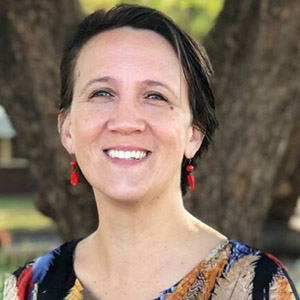
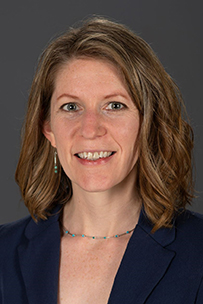
Dr. Sarina Kilham is a Lecturer in Agricultural Extension and Rural Sociology at the Gulbali Institute's Agricultural, Environmental and Veterinary Sciences school. Her research focuses on sustainable rural livelihoods, autonomy in development programs, and biofuel strategies in Brazil and Timor-Leste. She holds a PhD from the University of Technology Sydney (2017) and has extensive experience with international development organizations like the UN and NGOs. Her work bridges sociology and agriculture, addressing food justice, disability-inclusive disaster resilience, and urban food systems innovation. She teaches courses like AGR220 and AGR202, and supervises graduate students examining social dimensions of agriculture and food systems. Recent grants include funding for regenerative agriculture's economic/social dimensions and knowledge translation in agriculture (Soil CRC). She collaborates with the City of Sydney and TASA on urban food systems projects. Awards include grants supporting Timor-Leste education programs and disability advocacy. Her podcast What's Sociology Got to Do with It? highlights applied sociological insights. Kilham's work contributes to UN SDGs on education, sustainable cities, and climate action.
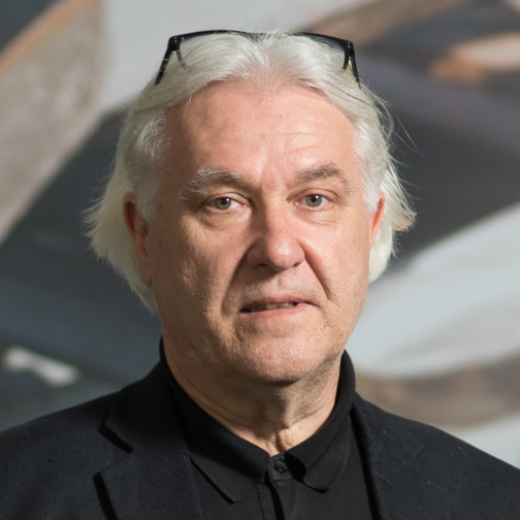
Bruce Baker is a Professor of African Security at Coventry University, specializing in policing, security, and justice reform in post-conflict African contexts. He is a Senior Security and Justice Advisor for the British government’s Civilian Stabilisation Group and Senior Editor of the International Policing book series (CRC Press). Research Focus: African policing, security governance, non-state justice systems, and localized post-conflict reconstruction. Geographic Scope: Zimbabwe, Mozambique, South Africa, Rwanda, Uganda, Sierra Leone, Ethiopia, and other sub-Saharan nations. His publications analyze hybrid security architectures, legal pluralism, and policy challenges in post-war environments. Key themes include democratization, institutional capacity-building, and justice for marginalized populations like sexual violence survivors. Scientific Awards American Society of Criminology's Prize for Best Book in Comparative and International Criminology (2010) for Security in Post-conflict Africa: The Role of Non-State Policing . ESRC Research Fellowship (2003-2005) for studying multilateral policing impacts in Uganda and Sierra Leone. Baker has secured grants from the ESRC, EU (Migration4 Development), British Academy, and HMG Stabilisation Unit for projects on topics such as community security in Ethiopia, irregular migration, and police accountability in post-conflict states.
Oswin Maurer is a tenured Full Professor at the Faculty of Economics and Management, University of Bolzano (Italy). His work focuses on consumer behavior, tourism management, and experimental design with a strong emphasis on sustainability and innovation. He teaches marketing and tourism management courses in both English and German at the Bachelor and Master levels, including the Bachelor in Tourism, Sport and Event Management and the Master in Tourism Management. Research Interests Professor Maurer explores topics such as pro-environmental behavior in tourism, food waste reduction strategies, and the impact of pricing models on tourist spending. His experimental approaches include interventions like persuasive messaging in hotel buffets and analyzing the role of social media in tourism marketing. He has pioneered studies on workation trends and the integration of work and leisure in South Tyrol. Publications His recent work spans AI adoption challenges in hospitality, metaverse-based consumption patterns, and the socio-economic impacts of tourism. Over 50 publications reflect his focus on sustainability, technology, and behavioral economics. Notable contributions include frameworks for place-related pro-environmental actions and studies on tourism's effects on community well-being. Affiliations He leads the Smart Tourism Laboratory and advises the Tourism Management Club. His research collaborations span international journals like Annals of Tourism Research and Sustainability, emphasizing open-access publishing to maximize impact. Grants & Impact His funded projects address critical issues like food waste reduction in tourism settings and the economic implications of all-inclusive travel packages. He actively engages with policy makers through frameworks for estimating tourism carrying capacity and preserving local resources.
Kimberly R. Jordan is an Associate Professor of Instruction in the Management Department at Ohio University's College of Business. She also serves as Director of the Strategic Leadership Certificate and the Early Acceptance Program (EAP) for the Management Master's program. Her research focuses on communication, leadership, storytelling, team dynamics, and organizational engagement. She teaches courses like Strategic Business Communication and Strategic Leadership Onboarding, emphasizing practical skills for students. Education: MSN/MBA in Nursing and Business, Johns Hopkins University (2005/2004) B.S.N. in Nursing, University of North Florida (1996) B.A. in International Affairs, Florida State University (1990) Research Interests: Dr. Jordan explores how effective communication and leadership strategies can enhance team performance, organizational culture, and individual well-being. Her work emphasizes storytelling as a tool for strategic leadership and the impact of feedback processes on collaboration. She also investigates methods to improve educational pedagogy, particularly in fostering positivity and experiential learning through simulations. Awards & Recognition: Best Paper Award (2018) for 'Introducing Business Communication Students to the Power of Positivity.' Teaching & Leadership Roles: She directs the Strategic Leadership Certificate program and oversees the EAP-Mgt initiative. Her teaching spans undergraduate and graduate levels, integrating real-world scenarios and collaborative learning techniques. She has led workshops on topics like healthcare process improvement and strategic leadership models, collaborating with institutions globally. Professional Activities: Dr. Jordan has presented at numerous conferences, including ABC International Conferences and the McDonough Leadership Conference. Her work bridges academic research and practical application, focusing on leadership development and organizational behavior.
Nicoleta MITREA is a Senior Lecturer at the Department of Fundamental, Prophylactic and Clinical Disciplines, Faculty of Medicine, Braila Technical University. Her work focuses on advancing palliative care education, nursing competencies, and patient-centered care models. She actively contributes to international collaborations, particularly in Central and Eastern Europe, aiming to standardize palliative care practices and enhance healthcare leadership. Research interests include palliative nursing, medical ethics, nutrition in oncology, and leadership development for healthcare professionals. She has led projects like the European Palliative Care Matrix and the Central-Eastern European Palliative Care Masterclass, emphasizing experiential learning and competency-based training. Publications span topics such as digital solutions for patient care, cross-cultural communication in pediatric palliative care, and workforce development. Her work bridges clinical practice, education, and policy, with a focus on reducing disparities in palliative care access across regions. Notable contributions include establishing palliative care competency frameworks and evaluating the impact of international training programs on clinical outcomes. Her research often addresses practical challenges in implementing palliative care standards within diverse healthcare systems.
Jennifer Murphy is an Assistant Professor in the School of Social Work at the University of Texas at Arlington, specializing in adolescent mental health service utilization and school-based interventions. Her research examines longitudinal impacts of mental health services, school social work practices, and interprofessional collaboration in educational settings. Education: PhD in Social Work, Virginia Commonwealth University (2023) MS in Disaster Resilience Leadership Studies, Tulane University (2016) MSW in Social Work, Tulane University (2015) BS in Sociology, Virginia Polytechnic Institute and State University (2014) Dr. Murphy's research focuses on critical intersections of child/adolescent mental health, service utilization patterns, and school-based interventions. Her work employs mixed-methods approaches to investigate barriers to mental health access, the role of school social workers, and impacts of adverse childhood experiences. Current projects examine longitudinal service utilization trajectories, campus food insecurity, and refugee mental health. Her publication trends reveal strong emphasis on adolescent mental health service systems (60%), school-based interventions (25%), and methodological innovation in mixed-methods research (15%). Recent work increasingly incorporates cross-cultural perspectives and pandemic-related service adaptations. Scientific Awards: Hans Falk Dissertation Award Scholarship, VCU School of Social Work (2022) RAACE Fellowship, VCU School of Social Work (2020) Dr. Murphy serves as thesis committee member for four Master's students and teaches graduate courses in social policy, research methods, and school social work. She actively reviews for journals including Journal of School Health and Children & Schools , while contributing to university committees on mental health and academic policy. Her professional service extends to the School Social Work Association of America and Society for Social Work and Research.
Dr. Elizabeth M. Gillespie is an Assistant Professor in the Department of Public and Nonprofit Administration at the University of Memphis, where she joined in 2020. She is also an affiliate faculty member with the Institute for Philanthropy and Nonprofit Leadership. Dr. Gillespie has established herself as a prominent researcher in nonprofit organizations and philanthropy, with a particular focus on women's philanthropy, women's grantmaking foundations, social change organizations, and nonprofit fundraising capacity. Her work bridges academic research with practical application through strong connections with the Memphis nonprofit community. Dr. Gillespie's educational background includes: Ph.D. in Public Administration from the University of Nebraska at Omaha (2015-2020) M.P.A. from Drake University (2013-2014) B.A. in History, with minors in French and English, from the University of Iowa (2000-2005) Dr. Gillespie's research centers on philanthropy, women's giving, nonprofit fundraising, grantmaking foundations and funds, and feminist and social change organizations. Her work often examines nonprofit and philanthropic approaches to social change, gender equality, and public administration, incorporating feminist theories and practices. Women's philanthropy forms a central theme in her scholarship, with specific attention to women's grantmaking for economic security, empowerment-focused philanthropy through women's funds, and girls' philanthropy in educational settings. Her research seeks to enhance understanding and advance effective strategies within the nonprofit and philanthropic sectors, fostering impactful social change. Analysis of Dr. Gillespie's publication record reveals a clear trajectory focusing on women's roles in philanthropy and nonprofit leadership. Her work spans theoretical explorations of feminist organizations, empirical studies of women's foundations and funds, and practical applications in community settings. A notable trend is her increasing focus on intergenerational philanthropy, particularly with her 2025 publication on girls' philanthropy in girls' schools. Her research consistently connects feminist theory with organizational practice, demonstrating how women-led philanthropic organizations can drive social change while addressing gender inequities. Through her professional activities, Dr. Gillespie bridges theory and practice in meaningful ways. She performs consultant work for nonprofits, specializing in resource development and capacity building through her role at the University of Memphis. Additionally, she writes grants for small to mid-sized nonprofits through her work with Change Granted. In 2025, she co-founded The Women's Giving Collective (WGC), a philanthropic women's giving circle dedicated to empowering women through collective giving. The WGC invests in causes that strengthen communities, transform lives, and advance gender and social equity through collaborative, values-driven philanthropy. Dr. Gillespie serves on the boards of The Memphis Challenge, Academic Women in Public Administration, and The Arc Mid-South, demonstrating her commitment to community engagement and leadership development. Her nearly decade of prior nonprofit leadership experience, beginning at the Women's Resource and Action Center during her undergraduate studies, informs her academic work and commitment to preparing the next generation of nonprofit leaders.
Prof. Lidija Georgieva is a Full Professor at the Institute for Security, Defence and Peace, Faculty of Philosophy, Ss. Cyril and Methodius University of Skopje. Born in 1960, she earned her PhD in 1997, focusing on collective security mechanisms. She held academic leadership roles including Head of the UNESCO Department of Intercultural Studies and Horizon 2020 project leader (2018–present). Her research spans peacebuilding, conflict resolution, and Balkan social dynamics. She speaks English and has held visiting roles at Open University. Education: Philosophy degrees from UKIM (1984–1994), doctoral work on collective security Key Projects: V4 Fund (2014–2019), TEMPUS coordinator (2009–2013) Teaching: Leads courses on peace theory, European security, and conflict analysis Research interests include gender aspects of security, religion-conflict linkages, and welfare states in Southeast Europe. Over 40 publications include monographs on conflict resolution and NATO-Macedonia relations. Recipient of 2001 Fulbright Scholarship for political science research at University of Maryland. Awards: Fulbright postdoctoral fellowship (2001) Grants: Horizon 2020 (RETOPEA), V4 Fund, TEMPUS Led the Center for Intercultural Studies (2012–2017) and co-authored studies on peace education in the Balkans. Active in defense efficiency analysis using DEA methodologies. Her work integrates quantitative methods with qualitative conflict studies.
Stephan Van Den Broucke is a Professor of Health Psychology at UC Louvain, Belgium. He holds leadership roles including Vice-President for conferences at the International Union for Health Promotion and Education (IUHPE), and membership in advisory bodies such as the WHO/Euro Technical Advisory Group and the European Food Safety Authority's Working Group. His work spans research, policy, and international collaboration. Research focuses on public health psychology, health promotion strategies, health literacy, and accident prevention. He has supervised numerous national/international projects, authored over 150 publications, and contributed to policy advice for global bodies like the European Commission and WHO. He evaluates research proposals for funding agencies across Europe and Asia, advises on training programs, and leads the HealthNest consortium in Belgium. His teaching and training span multiple continents, emphasizing evidence-based public health practices.
Egil Tjåland is an Associate Professor in the Department of Geoscience at the Norwegian University of Science and Technology (NTNU). His research focuses on geophysical methods, seismic attribute analysis, and applications in petroleum engineering and deep-sea mining technologies. His publications demonstrate expertise in seismic interpretation methods, attribute benchmarking, and geophysical data processing. Recent work explores the transfer of oil and gas technologies to deep-sea mining operations. He teaches courses in geophysics, petroleum engineering, and scientific communication. His research contributions include developing seismic analysis tools like A3Mark for attribute benchmarking and investigating elastic parameter estimation methods. No information regarding awards, supervised students, or research grants is provided.
Dr. Emily E. Virtue is an Associate Professor of Educational Research and Program Director for the doctorate in Educational Leadership at Western Carolina University's College of Education and Allied Professions. She specializes in faculty preparation, equity pedagogies, and supporting conditionally-enrolled students. Her prior roles include lecturer in English and Retention and Completion Advisor at WCU, with experience in student wellness and leadership development. Educational Background: PhD in Educational Leadership from Clemson University (2019) MA in English from University of North Carolina Wilmington (2008) BA in Writing from University of Mount Union (2006) Research focuses on bridging equity-driven practices with project-based learning, teacher training for marginalized student populations, and institutional policies to support academic success. Her recent work emphasizes asset-based pedagogies and collaborative frameworks to address systemic inequities in education. Publications consistently explore themes like equity in classroom practices, the impact of learning communities, and strategies for student retention. While no specific awards are listed, her work demonstrates sustained engagement with transformative educational equity initiatives. No grants or advising roles are explicitly detailed in the provided text, though her roles suggest involvement in program coordination and policy development. She has not been associated with specific labs or research teams in the available information.
Dr. Zheng Stefanie Chai is a Lecturer in Business Management at York St John University's London Campus. She holds a PhD from the University of Edinburgh, an MSc from Bayes Business School, and a BSc from Lancaster University. Her research focuses on social innovation, governance of civil society organizations, and crisis management. She has explored topics such as civil society responses to crises like the 2020 pandemic and the governance dynamics of urban commons. Her work has been published in venues like the European Group for Organizational Studies. Chai teaches social innovation, social enterprise, and broader business disciplines at both undergraduate and postgraduate levels. She employs qualitative research methods and systems thinking in her studies. Her academic background includes teaching assistant roles at the University of Edinburgh during her PhD and current lecturer responsibilities in the MBA program at York St John. She collaborates on projects examining civil society governance structures and polycentric frameworks. Chai is a Fellow of the Higher Education Academy (FHEA).
Zhanming Liang is a researcher affiliated with James Cook University, focusing on health service management, digital health transformation, and competency development for healthcare leaders. His work spans cross-cultural studies in China, Iran, and Australia, addressing challenges in hospital management, patient-centered care, and policy implementation. Collaborated on studies related to veterinary management, pandemic response, and telemedicine. Contributed to frameworks for evidence-informed decision-making and digital health competencies. Research interests include: Health Management: Competency frameworks, workforce capacity building, leadership training. Digital Health: Technology adoption, informatics competencies, organizational transformation. Patient-Centered Care: Feedback mechanisms, quality improvement, autonomy in clinical settings. Recent articles highlight trends in digital health transformation, competency development for managers, and human-animal relationships in crisis contexts. Awards and grants are not explicitly mentioned in available data. He collaborates with institutions such as Australian Health Review, BMC Health Services Research, and Routledge.
Dr. Scott Roberts is an Assistant Professor at the Yale School of Medicine , specializing in infectious diseases and serving as Associate Medical Director of Infection Prevention at Yale New Haven Health. His work focuses on preventing healthcare-associated infections, particularly in immunocompromised patients and respiratory viral infections like COVID-19. He holds an MD from Albert Einstein College of Medicine (2014), completed residency at the University of Michigan (2017), and a fellowship at Northwestern Memorial Hospital (2020). Research Interests: Dr. Roberts’ research emphasizes infection prevention strategies, device-related infections, and outbreak management. Recent studies include analyzing SARS-CoV-2 surface contamination in hospitals, optimizing hand hygiene compliance, and investigating viral evolution in chronic infections. Publications Trends: His articles (2022–2024) highlight interdisciplinary approaches to infection control, leveraging technology (e.g., BIM modeling) and human factors engineering to improve patient safety. Key topics include viral transmission dynamics, outbreak investigation, and healthcare worker vaccination adherence. Education & Training: MD: Albert Einstein College of Medicine (2014) Residency: Internal Medicine, University of Michigan (2017) Fellowship: Infectious Diseases, Northwestern Memorial Hospital (2020) Grants & Advising: While specific grants are not listed, his publications suggest active involvement in NIH-funded projects on viral epidemiology and infection control innovations. He mentors clinical teams on infection prevention protocols but no formal advisees are named. Labs/Teams: Collaborates with the Infection Control Team at Yale New Haven Health and the Translational Research Core , focusing on applied solutions for hospital-acquired infections.
Dr. Julie Norman is an Associate Professor (Teaching) in Politics and International Relations at University College London (UCL), specializing in conflict, political violence, Middle East politics, and foreign policy. She holds a PhD from American University and a BA from Duke University. She coordinates UCL's Israel-Palestine Initiative and is a Senior Associate Fellow at RUSI. Her research focuses on protracted conflicts, particularly in the Middle East, using mixed methods to analyze security, rights, and resistance. She has authored/co-authored books such as Gaza: The Dream and the Nightmare (2025), The Palestinian Prisoners Movement (2021), and Understanding Nonviolence (2015). She also leads consultancy projects on conflict sensitivity and resilience for organizations like Christian Aid and UNDP. Dr. Norman is a frequent media commentator on BBC, CNN, and Al Jazeera, and hosts the podcast UCL Uncovering Politics . Her work bridges academia and practice, contributing to policy through expert analysis for governments and international bodies. Education: PhD in International Relations, American University (Washington, DC) BA, Duke University Research Interests: Conflict dynamics, nonviolent resistance, Middle East politics, peacebuilding, political imprisonment, and counterterrorism strategies. Her recent work emphasizes Gaza's political history and public opinion on polarization. Key Contributions: Over 20 years of scholarship on Palestinian resistance, U.S. foreign policy, and humanitarian conflict zones. Her articles span political psychology, security studies, and Middle East policy, with a focus on resilience and grassroots movements. Consultancy & Grants: Led projects on conflict sensitivity for Christian Aid, UNDP Lebanon, and the EU’s Radicalisation Awareness Network. Her work integrates field research in Africa, the Middle East, and Southeast Asia. Labs/Teams: Coordinates UCL’s Israel-Palestine Initiative and collaborates with RUSI on international security.