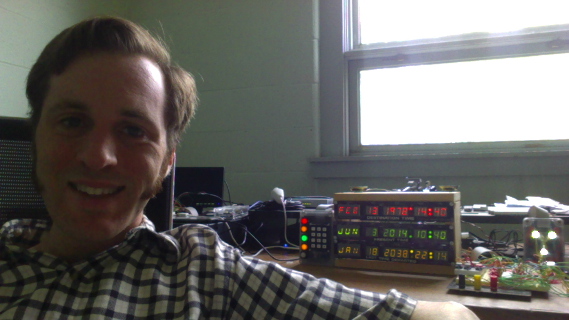
Vincent Weaver is an Associate Professor in the Electrical and Computer Engineering Department at the University of Maine's College of Engineering. He leads the VMW Research Group, focusing on low-level systems research including hardware performance counters, computer architecture, and operating systems. Weaver received his BS in Electrical Engineering from the University of Maryland College Park in December 2000, followed by MS (January 2009) and PhD (May 2010) degrees in Electrical and Computer Engineering from Cornell University. He joined the University of Maine faculty in July 2012 as an Assistant Professor and earned tenure and promotion to Associate Professor in September 2018. His research centers on hardware performance analysis, architectural simulation, and systems programming with emphasis on Linux kernel development and embedded systems. Weaver's work bridges theoretical computer architecture with practical systems implementation, often resulting in open-source tools that advance the field. His publications reveal a consistent focus on performance analysis techniques, code optimization, and security through low-level system understanding. Weaver maintains an active teaching schedule including courses in embedded systems, operating systems, and network engineering. He values students with strong programming skills and encourages open source contributions as part of the learning process. His research group provides hands-on experience with cutting-edge processor architectures and performance analysis tools.
Matthew Fluet is an Associate Professor and Graduate Program Director in the Department of Computer Science at Rochester Institute of Technology's Golisano College of Computing and Information Sciences. He received his PhD in Computer Science from Cornell University and his BS in Mathematics from Harvey Mudd College. Prior to joining RIT, he was a research assistant professor at the Toyota Technological Institute at Chicago. Dr. Fluet's research focuses on programming languages, with particular emphasis on: Functional programming Compiler construction Program analysis Type systems Parallelism and concurrency His research has resulted in several significant projects including Manticore (a heterogeneous-parallel functional programming language), MaPLe/MPL (a functional language for provably efficient and safe multicore parallelism), and contributions to MLton (a whole-program optimizing Standard ML compiler). His work is supported by multiple National Science Foundation grants. Dr. Fluet has published extensively in top programming languages conferences including ICFP, POPL, PLDI, and PPoPP. His recent work focuses on automatic parallelism management, type-and control-flow analysis, and memory management for parallel systems, demonstrating a consistent research trajectory in making parallel programming safer and more accessible through language design. His notable research grants include: National Science Foundation (CISE Research Infrastructure): $224,329 (2014-2017) National Science Foundation (Software and Hardware Foundations): $236,744 (2014-2018) National Science Foundation: $412,261 (2011-2014) National Science Foundation: $91,867 (2008-2012) Dr. Fluet actively mentors graduate students, currently advising several MS project and thesis students. He teaches courses including Programming Skills (with focus on Rust), Compiler Construction, and Programming Language Concepts. He also serves in leadership roles including as Graduate Program Director for the Computer Science MS program and participates in departmental governance through the CS Curriculum Committee and GCCIS Curriculum Committee. He is an active member of the programming languages community, having served on program committees for major conferences and as Information Director for ACM SIGPLAN (2015-2018), demonstrating his commitment to advancing the field through research, education, and community service.
Muhammad Mustafa Rafique is an Associate Professor in the Department of Computer Science at Rochester Institute of Technology's Golisano College of Computing and Information Sciences. His research specializes in optimizing large-scale computing systems, with focus areas including: High-performance computing (HPC) resource management Distributed deep learning acceleration Fault-tolerant cloud architectures GPU-accelerated checkpointing systems Serverless computing frameworks Dr. Rafique's work demonstrates consistent innovation in improving computational efficiency for containerized HPC workflows, multi-GPU scheduling, memory optimization, and distributed training pipelines. His publications frequently appear in premier IEEE/ACM conferences, reflecting contributions to systems performance engineering. While no awards or student advisees are mentioned in available materials, his research collaborations include co-authors from institutions worldwide, indicating active engagement in the high-performance computing research community. Current work explores emerging memory technologies like CXL and advanced containerization techniques for next-generation datacenters.
Yuejie Chi is the Charles C. and Dorothea S. Dilley Professor of Statistics and Data Science at Yale University, with a secondary appointment in Computer Science. She is a member of the Yale Institute for Foundations of Data Science. Previously, she held the Sense of Wonder Group Endowed Professor position at Carnegie Mellon University with affiliations in the Machine Learning Department (MLD) and CyLab. Her career includes a visiting researcher position at Meta's Fundamental AI Research (FAIR) group. Dr. Chi received her Ph.D. and M.A. in Electrical Engineering from Princeton University in 2012 and 2009, respectively, and her B.E. (Hon.) in Electrical Engineering from Tsinghua University, Beijing, China, in 2007. Her educational background laid the foundation for her interdisciplinary research approach spanning statistics, computer science, and engineering domains. Professor Chi's research focuses on the theoretical and algorithmic foundations of data science, with particular emphasis on generative AI, reinforcement learning, and signal processing. Her work lies at the intersection of statistics, learning, optimization, and sensing, addressing fundamental challenges in improving the performance, efficiency, and reliability of AI systems in data-intensive but resource-constrained scenarios. Her group's research is highly interdisciplinary, tackling problems that require theoretical rigor alongside practical implementation considerations. Theoretical foundations of generative models and diffusion processes Algorithmic guarantees for reinforcement learning systems Robust and efficient optimization methods for large-scale problems Low-dimensional structures in high-dimensional data Professor Chi's recent publications reveal a strong trajectory toward addressing fundamental theoretical questions in AI while maintaining practical relevance. Her work demonstrates increasing focus on the interplay between theoretical guarantees and practical implementation, particularly in generative models and reinforcement learning systems. Notable themes include non-asymptotic convergence analysis, robustness guarantees, communication efficiency in distributed settings, and bridging theoretical insights with real-world applications. Among her distinguished recognitions are the Presidential Early Career Award for Scientists and Engineers (PECASE) from the White House, the inaugural IEEE Signal Processing Society Early Career Technical Achievement Award, the SIAM Activity Group on Imaging Science Best Paper Prize, and the IEEE Signal Processing Society Young Author Best Paper Award. She is an IEEE Fellow (Class of 2023) for contributions to statistical signal processing with low-dimensional structures. Additional honors include young investigator awards from NSF, ONR, and AFOSR, and she has been named a Goldsmith Lecturer by IEEE Information Theory Society (2021), a Distinguished Lecturer by IEEE Signal Processing Society (2022-2023), and a Distinguished Speaker by ACM (2023-2026). Professor Chi has mentored an impressive cohort of PhD students and postdoctoral researchers, many of whom have received prestigious fellowships and awards. Her advisees have secured positions at leading institutions including Johns Hopkins University, MIT, UNC Chapel Hill, and major technology companies like Meta, Apple, and Google. Her group has produced numerous award-winning papers and dissertations, including the IEEE SPS Best PhD Dissertation Award. She has successfully secured significant research funding from federal agencies and industry partners to support her interdisciplinary research program. Professor Chi leads a vibrant research group at Yale that maintains active collaborations across multiple disciplines and institutions. Her group's work spans theoretical analysis, algorithm development, and practical implementation, with emphasis on both foundational understanding and real-world applicability. The group has developed several influential frameworks including Robust Gymnasium, a unified modular benchmark for robust reinforcement learning, and has made significant contributions to understanding the theoretical properties of modern AI systems.
Soner Onder is a Professor in the Department of Computer Science at Michigan Technological University, with an affiliated appointment in the Electrical and Computer Engineering department. His work focuses on computer architecture, programming languages, and simulation techniques, contributing significantly to processor design and memory systems research. Dr. Onder received his PhD in Computer Science from the University of Pittsburgh in 1999. His academic career has established him as a leading researcher in computer architecture with publications spanning two decades in top-tier conferences. Dr. Onder's research spans multiple areas of computer architecture and compiler design, with emphasis on processor design, memory systems, and compiler optimizations. He has made significant contributions to memory disambiguation techniques, branch prediction mechanisms, and energy-efficient processor designs. His work often bridges hardware and software domains, exploring how compiler techniques can better exploit architectural features. Recent research focuses on memory dependence prediction, recovery mechanisms for mispredictions, and energy-efficient data access patterns, with his "Future Gated Single Assignment Form" representing an innovative approach to program representation that bridges compiler design and architectural support. US Patent 7747993: Methods and systems for ordering instructions using future values (2010) Dr. Onder has advised numerous PhD students to completion, including Scott Pomerville (2024), Gorkem Asilioglu (2020), Omkar Javeri (2020), and Zhaoxiang Jin (2018). His research has been supported by grants including "Statically Controlled Asynchronous Lane Execution (SCALE)" and "Vectorized Instruction Space (VIS)" projects. He developed the FAST (Flexible Architecture Simulation Tool) for architectural research and continues to lead an active research program with publications appearing in top-tier venues through 2018. Dr. Onder leads research in computer architecture with a focus on practical implementations. His FAST simulation tool provides a flexible platform for testing architectural innovations. His work often involves collaboration with both compiler researchers and hardware designers to create holistic solutions to performance bottlenecks in modern processors, demonstrating the interdisciplinary nature of his research that bridges hardware and software concerns in computer system design.