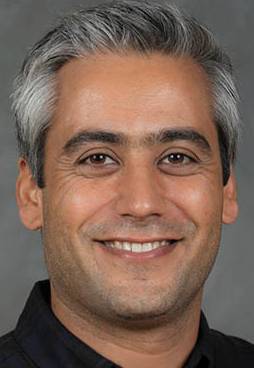
Mir Jalil Razavi is an Assistant Professor in the Department of Mechanical Engineering at Binghamton University. His research focuses on solid mechanics, mechanics of soft/bio materials, and fracture mechanics. He develops analytical and computational models to study mechanical behavior of solid structures, particularly in the context of brain mechanics and biomedical technologies. Education: BS and MS from University of Tabriz (Mechanical Engineering), PhD in Engineering (Mechanics and Materials) from University of Georgia (2018). Research interests include theoretical and computational modeling of brain growth, instability, and folding, with a focus on linking brain mechanics to cortical development. His work integrates interdisciplinary approaches from engineering, computational science, and biology. Current projects explore the mechanical basis of cerebral cortex organization and the role of axonal guidance in brain morphogenesis. He leads the Mechanics of Soft/Bio Materials Lab, advancing computational methods for material discovery and biomechanical analysis. Recent work employs machine learning to predict tissue stiffness and optimize biomaterials for biomedical applications.
Constantine Dovrolis is a Professor at the Georgia Institute of Technology’s School of Computer Science and Director of the Computation-based Science & Technology Research Center (CaSToRC) at The Cyprus Institute since January 2023. His interdisciplinary research merges Network Theory, Data Mining, and Machine Learning, with applications in climate science, biology, neuroscience, and neuro-inspired AI architectures. Education : Bachelor’s (Engr.Dipl.) from Technical University of Crete (1995) M.S. from University of Rochester (1996) Ph.D. from University of Wisconsin-Madison (2000) Research Focus : Recent work emphasizes neuro-inspired machine learning, leveraging brain network principles. Key areas include continual learning, sparse neural networks, and hierarchical task structure discovery. His group’s contributions address challenges in AI adaptability and interpretability. Projects & Funding : Current initiatives include EuroCC2 (HPC competence center), AGORA 3.0, PROTECT, GenAI4ED (EU Horizon Europe), and FINALITY MSCA Network. Funders include NSF, NIH, DOE, DARPA, Google, Microsoft, and Cisco. Labs & Teams : Leads CaSToRC, fostering collaborations in quantum computing, AI, computational modeling, HPC, and policy-driven innovation. Active in training PhD students and postdocs in interdisciplinary computational science.
Anthony Zador is the Alle Davis and Maxine Harrison Professor of Neurosciences at Cold Spring Harbor Laboratory. He received his MD and PhD in Neuroscience from Yale University and has been at CSHL since 1999. His lab studies how brain circuitry enables complex behaviors and develops innovative methods for mapping neural connections at single-neuron resolution. Research focuses on two main areas: 1) How the auditory cortex processes sound and how this is disrupted in neuropsychiatric disorders like autism; and 2) Developing BARseq, a novel method for reconstructing brain wiring diagrams using high-throughput DNA sequencing technology. This approach promises complete connectomes for minimal cost. Zador founded the Computational and Systems Neuroscience (COSYNE) meeting and directs the Center for the Neural Mechanisms of Cognition. His honors include being named a Top 100 Global Thinker and receiving Transformative Investigator awards. Recent work published in Nature and Cell demonstrates breakthroughs in whole-cortex mapping and neural encoding principles. Transformative Investigator Award (2018) Top 100 Global Thinker (2015) Brain Research Foundation Fellow (2014) Gill Symposium Transformative Investigator Award (2018)
Oleg Favorov is a Research Professor at the University of North Carolina at Chapel Hill (UNC), specializing in biomedical imaging and neuroscientific research. His work focuses on neural bases of perception, cortical information processing, and computational algorithms for analyzing biomedical data. He leads a research group exploring the relationship between neuroelectrical activity in the somatosensory cortex and tactile perception, alongside developing advanced signal processing techniques. Dr. Favorov holds a PhD in Physiology from UNC and a BS in Physical Anthropology from Moscow State University. His research integrates experimental neurophysiology, mathematical modeling, and machine learning to uncover how the brain processes sensory information and recognizes complex patterns. Key contributions include novel algorithms for feature extraction, contextually guided neural networks, and diagnostic tools for mild traumatic brain injury (mTBI). His publications span topics such as tactile texture classification, neurovascular imaging, and wearable sensor applications. Dr. Favorov collaborates across disciplines, applying computational methods to clinical challenges like mTBI rehabilitation and affective disorder monitoring. His work emphasizes translational research, bridging basic neuroscience with practical diagnostics and therapeutic development. Notable projects include the CAMP study protocol for evaluating mTBI recovery and the development of the Portable Warrior Test (POWAR) for tactical agility assessment. His lab also pioneers tools like thermal tactile stimulators and smartwatch-based affective switching metrics, demonstrating interdisciplinary impact in both academia and clinical practice.
Constantine Dovrolis is a Professor at the School of Computer Science at the Georgia Institute of Technology (Georgia Tech). He holds an Engr. Dipl. from the Technical University of Crete (1995), an M.S. from the University of Rochester (1996), and a Ph.D. from the University of Wisconsin-Madison (2000). His research integrates Network Science, Data Mining, and Machine Learning with applications in climate science, biology, neuroscience, and sociology. Recent work focuses on neuro-inspired architectures for machine learning based on brain network structures.
William Cunningham is a Professor at the University of Toronto, cross-appointed at the Vector Institute for Artificial Intelligence and the Department of Computer Science. His research integrates artificial intelligence with multi-level approaches from neuroscience, psychology, sociology, and cultural anthropology to study social cognition and group dynamics. The Social Cognitive Science and SocialAI lab focuses on computational models of cooperation, competition, and social judgment, leveraging deep neural networks and multi-agent systems. Cunningham’s work addresses how societies navigate collective challenges through emergent behaviors and algorithmic frameworks like Sorrel and Concordia. Research interests include generative AI ethics, stereotype persistence, and the interplay between computational models and human social structures. He explores how technology and social systems co-evolve, examining topics like polarization, punishment psychology, and cultural influences on cognition. Recent projects use reinforcement learning to simulate generational social norms and analyze mental health in the context of autistic trait camouflage. Cunningham’s interdisciplinary approach bridges machine learning, neuroscience, and social science to address pressing questions about human behavior and societal progress. His work on societal and technological progress emphasizes adaptive systems through frameworks akin to 'patchwork quilts,' highlighting incremental innovation and cultural integration. Public health studies during the pandemic demonstrated how national identity influences policy support, reflecting broader interests in crisis-driven social coordination and computational epidemiology.
Eva Navarro López is a Full Professor in Computing within the School of Interactive Games and Media at the Golisano College of Computing and Information Sciences at Rochester Institute of Technology (RIT). She previously served as Director of the School of Information (iSchool) at RIT and directs the Artificial intelligence and DAta science Research Lab (AiDAs). Navarro is a scientist of international standing with extensive contributions across multiple fields including hybrid dynamical systems, cyber-physical systems, and computational neuroscience. She has held significant positions including member of the Science and Methodology Committee at the International Panel on the Information Environment (IPIE) and affiliate at the Minderoo Centre for Technology and Democracy at University of Cambridge. Eva earned her Ph.D. from the Polytechnics University of Catalonia (Spain) and completed her MSc, BEng, and BSc at the University of Alicante (Spain). Her educational journey reflects her multidisciplinary approach, bridging computer science, mathematics, and engineering disciplines that would later define her research career. Her academic path has taken her through prestigious institutions across four countries: USA, UK, Mexico, and Spain, where she shadowed the footsteps of Alan Turing in Manchester and Santiago Ramón y Cajal in Madrid. Navarro's research interests defy easy compartmentalization, spanning hybrid dynamical systems, cyber-physical systems, network science, mathematical modelling, symbolic AI, control engineering, computational neuroscience, and collective intelligence. Her unique contribution lies in building bridges between traditionally separate fields , transferring ideas from one domain to another to create novel approaches. She approaches research as a 'scientist artist,' viewing both science and art as attempts to understand the world better. Her work on neuroplasticity and brain-inspired computing has led to innovative AI architectures that incorporate knowledge of astrocytes and other brain cells beyond just neurons. Analysis of Navarro's recent publications reveals a strong trend toward interdisciplinary applications of computational methods. Her work spans from fundamental theoretical contributions in hybrid systems and formal verification to practical applications in medical imaging, epidemic modeling, and gender equity in technology. A notable pattern is her consistent focus on nature-inspired models of computation across diverse domains, whether modeling brain function, urban structures, or information ecosystems. Her research increasingly addresses societal implications of technology, particularly regarding gender equity and ethical AI development. 100 Brilliant Women in AI Ethics - 2025 Distinguished Alumni Ambassador 2024 at University of Alicante Women Leader of the Business Ecosystem 2024 Recognized in Spain's Guide to Women Leaders of the Business Ecosystem Navarro has supervised an extensive research team across multiple institutions, mentoring numerous PhD students, postdocs, and research assistants from diverse backgrounds. Her mentoring philosophy emphasizes building communities and education as pathways to change the world. She co-founded ACM-Women Europe and the womENcourage conference series, creating spaces for women in computing. Her research has been supported by significant projects including the UK-funded 'Dynamically Driven Verification of Systems With Energy Considerations,' where she served as principal investigator for the first UK project dedicated to formal verification of nonlinear hybrid systems. As director of AiDAs (Artificial intelligence and DAta science Research Lab), Navarro leads a multidisciplinary team exploring nature-inspired models of computation, learning, and evolution for complex systems. The lab's work integrates insights from neuroscience, mathematics, and computer science to develop new paradigms in AI. Navarro also contributes to TechnoLatinas, a self-organized community focused on supporting technologists and scientists from Latin America, and serves on the Advisory Council for Gender Music Tech, demonstrating her commitment to creating inclusive technology ecosystems.
Laurenz Wiskott is a Professor of Computer Science at the Ruhr-Universität Bochum (RUB), leading the Theory of Neural Systems group at the Institut für Neuroinformatik. His research focuses on machine learning, computational neuroscience, and neuro-inspired AI. He holds affiliations with multiple departments including the Department of Physics and Astronomy, Research Department of Neuroscience, and the International Graduate School of Neuroscience. Wiskott earned his PhD in Physics from RUB in 1995, followed by postdoctoral research at the Salk Institute and Humboldt University Berlin. He has authored over 100 publications, including influential work on Slow Feature Analysis (SFA) and its applications in vision, memory, and reinforcement learning. Notable awards include the 'Best Paper Award' at Machine Learning conferences and recognition for his educational tools like the student advising dashboard. His teaching spans courses on machine learning, computational neuroscience, and AI fundamentals. Current projects include explainable AI, curriculum analytics, and neuro-inspired RL efficiency. Education: PhD in Physics (1995), Ruhr-Universität Bochum Diploma in Physics (1990), University of Osnabrück Studies in Physics (1985–1989), University of Göttingen Research Interests: Slow Feature Analysis, generative models of episodic memory, reinforcement learning, human-centered AI ethics, curriculum analytics, and neuro-inspired machine learning architectures. Grants & Projects: Leads the HUMAINE (Human-Centered AI) initiative and contributed to EU-funded projects like NET-humAIn. Active in educational tech through KI:edu.nrw, developing dashboards for student advising. Labs/Teams: Directs the Theory of Neural Systems lab at INI, collaborating with the Center for Mind and Cognition and the Machine Learning & AI group at RUB.
Dr. Dany Varghese is a Research Fellow in the Department of Computer Science at the University of Surrey's School of Computer Science and Electronic Engineering. He specializes in Learning and Reasoning using Inductive Logic Programming (ILP), focusing on developing transparent and interpretable machine learning systems. As a Fellow of the Higher Education Academy (FHEA), he maintains strong connections with Jyothi Engineering College in India where he previously served as Assistant Professor (2015-2019). His research develops computationally efficient methods for human-like learning from minimal data, particularly for critical applications like plant disease detection and medical diagnostics. He created the PyGol system - an explainable machine learning framework implementing Meta Inverse Entailment principles that outperforms traditional deep learning approaches in few-shot learning scenarios. Dr. Varghese has developed several influential tools including PyILP (Python interface for ILP systems), InfIntE (for microbial interaction inference), and contributes to the Meta Inverse Entailment framework. His collaborative work spans healthcare diagnostics, agricultural technology, and microbial ecology. Scientific Awards: Fellow of the Higher Education Academy (FHEA) Teaching Experience: Lab coordinator for Data Mining & Machine Learning (University of Surrey) Former Assistant Professor at Jyothi Engineering College (India) Lecturer at Government Engineering College (India)
SueYeon Chung is an Assistant Professor of Neural Science at New York University and a Project Leader at the Flatiron Institute's Center for Computational Neuroscience. She will join Harvard University in 2025 as an Assistant Professor in the Department of Physics, affiliated with the Kempner Institute for Natural and Artificial Intelligence and the Center for Brain Science. Her work bridges computational neuroscience and deep learning, focusing on neural computation principles in biological and artificial systems. Education: Ph.D. in Applied Physics from Harvard University (2017), B.A. in Physics and Mathematics from Cornell University (2011). Postdoctoral fellowships at Columbia University and MIT. Research Interests: Neural population geometry, representational learning, statistical physics of neural networks, and interdisciplinary approaches to understanding brain-inspired AI. She develops theoretical frameworks to analyze high-dimensional neural systems and designs biologically plausible neural network models. Recent Work Trends: Focus on representation geometry, manifold capacity, and task-driven neural dynamics. Recent articles explore feature learning beyond traditional dichotomies, alignment with primate visual cortex, and spectral theories of neural networks. Her work emphasizes geometric structures in both biological and artificial systems. Awards: NeurIPS Spotlight Presentations (2021, 2023), Physical Review Letters Editors' Suggestion (2023), ICML Best Paper Award (2020). Grants & Advising: Active in interdisciplinary grants spanning neuroscience and physics. Advises on computational neuroscience projects and co-organizes workshops (e.g., Analytical Connectionism Summer School, CCN Junior Workshop). Teaches courses in statistical mechanics and computational neuroscience. Labs & Affiliations: Leads research groups at NYU and Flatiron Institute. Collaborates with the CILVR Group and Harvard’s Kempner Institute. Active in conferences like COSYNE and NeurIPS, delivering keynote talks globally.
Constantine Dovrolis is a Professor at the School of Computer Science, Georgia Institute of Technology. His affiliations include Machine Learning @ GT and the Online Master of Science in Computer Science (OMSCS) program. He holds a Computer Engineering degree from Technical University of Crete (1995), an M.S. from the University of Rochester (1996), and a Ph.D. from the University of Wisconsin-Madison (2001). His research focuses on cross-disciplinary applications of network analysis and data mining in neuroscience and biology, alongside prior work on Internet economics, network measurement, and protocol adoption. Recent research trends emphasize neuro-inspired machine learning algorithms (e.g., continual learning, sparse networks) and computational methods for biological networks (e.g., brain connectomics, C. elegans analysis). Notable projects include Pythia (network performance diagnosis), GENESIS (agent-based interdomain network modeling), and contributions to climate science via network analysis of CMIP5 models. He has also explored Internet peering dynamics and optimization of network topologies (e.g., water distribution networks). His work bridges theory and practice, with applications spanning computational neuroscience, environmental modeling, and telecommunications infrastructure. Active collaborations include the PuNDIT project for network monitoring and PerfSONAR for performance analysis.
Federico Corradi is an Assistant Professor in the Electrical Engineering Department at Eindhoven University of Technology (TU/e), where he leads the Neuromorphic Edge Computing Systems Lab. He also holds the position of EAISI Foundational Assistant Professor at the Eindhoven Artificial Intelligence Systems Institute. His research focuses on neuromorphic computing and engineering, spanning from efficient computational models to novel microelectronic architectures for deep learning and brain-inspired algorithms. Dr. Corradi's academic background includes a Ph.D. in Neuroinformatics from the University of Zurich and an international Ph.D. from the ETH Neuroscience Centre Zurich (2015). Prior to joining TU/e in 2022, he worked at IMEC in the Netherlands (2018-2022) where he started a group focused on neuromorphic IC design. Before that, he was with Inilabs, a spin-off from the Institute of Neuroinformatics, developing event-based cameras and neuromorphic processors (2015-2018). His research interests center around understanding natural neural computation principles to develop energy-efficient sensing and computing technologies. Key areas include: Neuromorphic computing and engineering Spiking neural networks Event-based vision systems Energy-efficient microelectronic architectures Applications in robotics, machine vision, and biomedical signal analysis Dr. Corradi's recent publications demonstrate a strong focus on practical implementations of neuromorphic systems for edge applications. His work shows consistent innovation in translating theoretical neural models into efficient hardware implementations, with particular emphasis on handling temporal data and developing brain-realistic computational models. The research spans multiple domains including radar signal processing, optical computing, and error correction systems. He serves as an active review editor for Frontiers in Neuromorphic Engineering, IEEE, and IOP Science journals, and participates in technical program committees for several machine learning and neuromorphic conferences including ICTOPEN, AICAS, AIAI, ICONS, NEWCAS, DSD, and EUROMICRO. His work has received significant media attention with coverage from multiple news outlets and social media mentions. Dr. Corradi leads the Neuromorphic Edge Computing Systems Lab, which bridges theoretical neuroscience with practical engineering challenges, creating novel solutions for real-world problems. The lab's research has practical applications in robotics, autonomous systems, and biomedical technologies, reflecting his commitment to developing energy-efficient computing solutions that can operate effectively at the edge.
Bin Shi is a Research Fellow at Eindhoven University of Technology's Department of Electrical Engineering, focusing on photonics, optical communication, and neuromorphic computing. He is a core member of the ECO Research Centre for Integrated Nanophotonics (2014–2025), contributing to next-generation optical networks and photonic integrated circuits. His research expertise includes photonic integrated circuits (PICs), semiconductor optical amplifiers (SOAs), and neural network implementations using optical systems. Key projects involve developing low-cost metro-access networks using SOA-based optical add-drop multiplexer (OADM) nodes and exploring photonic computing architectures for deep learning applications. Recent work emphasizes non-invasive characterization techniques for cascaded SOAs, software-defined electro-optical neural networks, and photonic beamforming systems. He has contributed to over 44 research outputs since 2018, with notable publications in Optics Letters and Optics Express . Shi collaborates internationally on topics like photonic neural networks and nanophotonic devices. He teaches the course 'Brain-inspired optical computation' and has been featured in media for his work on light-based neural networks.
Chrystopher Nehaniv is a full-time Professor in the Department of Biomedical Engineering at the University of Waterloo, actively contributing to research groups including Intelligent and Autonomous Systems, Physical Systems and Mechatronics, and Human Factors and Interfaces. His work bridges mathematical theory with practical applications in robotics and complex systems, reflecting a strong interdisciplinary approach across engineering and cognitive sciences. His research spans algebraic structures in transformation semigroups, complex adaptive systems, and human-robot interaction. Key interests include cellular automata, autopoiesis, dynamical systems theory, and EEG microstate analysis, with significant theoretical contributions to semigroup complexity and practical implementations in domestic service robotics. Recent work emphasizes biologically inspired imitation learning, continual adaptation in human-robot teams, and mathematical modeling of social dynamics in games and neural systems. Analysis of his 15 most recent publications (2024-2025) reveals three dominant trajectories: (1) foundational algebraic work on transformation semigroups and finite groups applied to sandpile models, traffic systems, and game theory; (2) robotics innovations in social referencing, mental imagery, and continual learning for domestic service robots; and (3) neuroscience applications through EEG microstate syntax analysis and neural dynamics modeling. These threads consistently integrate rigorous mathematical frameworks with real-world complex systems challenges. No scientific awards or fellowships were mentioned in the provided materials. While specific student advisees and grant details were absent from the source text, his extensive publication record in human-robot interaction and complex systems suggests active supervision in interdisciplinary robotics projects. The absence of explicit grant mentions contrasts with his high-output research profile across multiple domains. Nehaniv operates within Waterloo's Intelligent and Autonomous Systems research ecosystem, collaborating across physical robotics (mechatronics, human factors) and theoretical frameworks (BIOMICS interaction computing). His work with the iCub robot platform and domestic service robot implementations indicates hands-on laboratory engagement, particularly in social interaction validation and object disambiguation systems.
Bart Dhoedt is a Professor at Ghent University's Department of Information Technology, affiliated with the Internet Technology and Data Science Lab (IDLab). He teaches courses on algorithms, advanced programming, software development, and distributed systems. His research bridges distributed machine learning, edge computing, and hardware-efficient AI. Research interests focus on Distributed Machine Learning (parallel processing across systems), Edge Computing (decentralized data processing), Neuromorphic Computing (brain-inspired hardware), Sensor Fusion (multimodal data integration), and Representation Learning (efficient feature extraction). Recent publications emphasize active inference, robotic navigation, and object-centric AI. Publications (2017-present) show strong trends in robotic autonomy (navigation, manipulation), active inference (Bayesian modeling), and multimodal world models , with applications in industrial automation and cognitive systems. No awards or grants are documented. He leads research at IDLab, collaborating on embedded AI and distributed systems. No advised students or external affiliations are mentioned.