Mamadou Kaba Traore is a Professor at the University of Bordeaux , affiliated with the Production Engineering research group and the MEI team at the Integration, Material to System (IMS) Laboratory. His work focuses on Modeling and Simulation (M&S), Digital Twins , and Multi-Perspective Modeling . Research Interests: Traore's research spans Discrete Event System Specification (DEVS) , HiLLS (High-Level Language for System Specification), Process Mining , and System Inference . He develops frameworks like DMFDT (Data Management Framework for Digital Twin) and contributes to Model-Driven Systems Engineering and Verification & Validation methodologies. Recent Publications: Traore co-authored works on Digital Twin verification, DEVS standardization, and applications of simulation to healthcare and urban systems. His 2023 chapter in the Body of Knowledge for Modeling and Simulation outlines core areas of M&S theory. Earlier studies explore Fuzzy Clustering and Parallel Simulation techniques.
Dr Katherine Harrison serves as Course Director for BA (Hons) Media and English within the School of Humanities and Social Sciences at Leeds Beckett University, where she has taught visual culture and media studies since 2017. Her academic leadership extends to undergraduate dissertation coordination and module development including the innovative 'Space Media' course. Harrison's research centers on visual culture with specialized focus on spatial representations across multiple contexts: outer space media, domestic environments, welfare stigma, and craft practices. Her work intersects gender studies, sociology, and cultural geography, employing innovative methodologies like 'knit 'n' natter' focus groups that challenge traditional research paradigms. Notable projects include Fulbright-Smithsonian research at the National Air and Space Museum archives and Leverhulme/British Academy-funded analysis of welfare television. Her publication trajectory reveals evolving research interests from early work on mid-20th century photographic icons (nuclear imagery, Earth views) through feminist craft studies to contemporary analyses of pandemic leisure and spatial stigma. Recent outputs demonstrate strong interdisciplinary engagement across leisure studies, fat studies, and visual sociology, with significant contributions to understanding how media constructs spatial hierarchies and social stigma. Key awards: Fulbright-Smithsonian Scholar Award (2021-22) for space imagery research Leverhulme/British Academy grant for welfare television analysis AHRC funding for doctoral research on iconic photography Harrison actively supervises PhD candidates in visual culture, gender studies, and space representation while contributing to undergraduate and postgraduate media courses. Her current research on the 'new space age' bridges academic inquiry with practical curriculum development, exemplified by the 'Space Media' module derived from National Air and Space Museum archives research. She collaborates extensively with scholars like Jayne Raisborough and Lisa Taylor on spatial stigma projects.
Prof. Dr. Sabine Pfeiffer holds the Chair of Sociology (Technology – Work – Society) at the Nuremberg Campus of Technology, part of Friedrich-Alexander University Erlangen-Nuremberg. She is an active researcher and thought leader in the sociology of work, with particular expertise in digital transformation, Industry 4.0, and labor capacity. Her work bridges academic research and practical applications in industry, with significant collaborations including the Volkswagen study and advisory roles with government bodies. Professor Pfeiffer's research interests focus on how digitalization transforms work structures and qualifications across various sectors including mechanical engineering, office work, and critical infrastructure. She has developed the Labouring Capacity Index (AV-Index) as a tool to measure living labor capacity and experience as resources for Industry 4.0 transition. Her work examines the intersection of technology, work organization, and social inequality, with particular attention to how workers navigate digital transformation in different occupational contexts. Her recent publications reveal consistent research trends examining the dual transformation of digitalization and sustainability, with particular focus on Volkswagen as a case study. The work explores transformation experience, resources, and readiness across multiple dimensions. She also investigates how AI is perceived and integrated in workplaces, the evolution of office work in digital environments, and the measurement of work through wearables and digital assistance systems. Best Paper Award for keynote speech on 'Work 4.0' at VET Conference in Rostock (2017) Nominated for 'Influencer of the Year 2013' by the Strategy Circle for Mechanical and Plant Engineering Professor Pfeiffer serves on the Council of the World of Work appointed by the Federal Ministry of Labour and Social Affairs, and recently joined the board of directors at bidt (Bavarian Institute of Technology Assessment). She previously served on the Research Advisory Board of the Industry 4.0 Platform and advisory boards at CIDAS. Her research is frequently funded through collaborations with institutions including BIBB (Federal Institute for Vocational Training), WZB Berlin Social Science Center, and industry partners like VDMA. Her work is conducted through the Labouratory research group at the Nuremberg Campus of Technology, which focuses on empirical studies of work in the digital age. The team employs mixed methods approaches including representative surveys, qualitative case studies, and workplace observations to understand the changing nature of work. Recent projects include the diGAP project on good agile project work and studies on digital transformation in mechanical engineering and office work sectors.
Professor Sandra Leaton Gray is a distinguished academic at University College London (UCL), where she serves as Professor of Education Futures at the UCL Institute of Education (IOE) within the Curriculum, Pedagogy & Assessment department. She also holds significant governance roles as a member of the UCL Council, the main governing body of the university, and as a Senior Member of Wolfson College, University of Cambridge. Her academic career spans multiple institutions including the University of East Anglia and the University of Cambridge, with a consistent focus on the intersection of education, technology, and social policy. Professor Leaton Gray's educational background includes: Doctor of Philosophy from University of Cambridge (2004) Master of Philosophy from University of Cambridge (1999) ATQ07 - Holder of a PGCE in higher education, secondary education, further education, lifelong learning from Roehampton University (1993) Her research interests center on the sociology of technology and its impact on children and young people, with particular emphasis on AI ethics in educational contexts. She explores education futures, the future of assessment, educational testing, and curriculum reform through a critical lens that considers digital ethics, children's biometrics, and the knowledge economy. Her work addresses pressing contemporary issues including the recovery from the COVID-19 pandemic's impact on education systems, with a strong commitment to addressing educational inequality and promoting democratic values in technologically mediated learning environments. Professor Leaton Gray approaches these topics through the frameworks of sociology, policy analysis, and educational futures thinking, always with attention to the lived experiences of learners in digital contexts. Professor Leaton Gray's extensive publication record reveals a clear trajectory of increasing focus on digital technologies in education, particularly AI and biometrics, while maintaining her foundational interest in educational sociology and policy. Her recent work demonstrates a sophisticated understanding of how technological systems intersect with power structures in educational assessment and how these dynamics impact equity and access. The growing emphasis on AI in her recent publications reflects both the rapid development of educational technologies and her strategic positioning at the forefront of critical analysis of these innovations. Professor Leaton Gray has received numerous professional recognitions: Fellow of the College of Teachers (since 2007) Fellow of the Incorporated Society of Musicians (since 1993) Fellow of the London College of Music (since 1990) Principal Fellow of the Higher Education Academy (since 2005) Senior Member of Wolfson College, University of Cambridge (since 2006) As an advisor and consultant, Professor Leaton Gray has significantly influenced education policy at national and international levels, working with organizations including the UN, UK Government, EU Commission, OECD, Royal Colleges of Medicine, British Dental Association, International Baccalaureate Organisation, BBC, Channel 4, Pearson, and the Biometrics Institute. Her current role as Researcher in Residence at the University of Passau, Germany (2024-2025) leading the project 'Education Futures: Visions of Artificial Intelligence, Biometrics and Digital Surveillance within Bavarian Schools' demonstrates her ongoing commitment to shaping educational practices through research. She has also directed significant projects including the 'My Life Online' research project, the 'Future of the Artificially Intelligent Examination,' and the 'Optimising 2020 secondary school transition processes during the Covid-19 pandemic.' Professor Leaton Gray is actively involved in several important governance and advisory roles that extend her influence beyond traditional academic boundaries. She serves as a member of the UK Government's College of Experts in the Ministry of Culture, Media and Sport (DCMS), the UK Ministry of Science, Innovation and Technology, the Privacy Expert Group of the Biometrics Institute, the UK Cabinet Office's International Best Practice Advisory Group, and as an expert advisor to the UK Government's Centre for Data Ethics and Innovation. Her participation in the OECD's ONE AI working group further demonstrates her international standing in the field of educational technology policy.
Krystal A. Smalls serves as Associate Professor and Director of Graduate Studies in the Department of Anthropology within the College of Liberal Arts & Sciences at the University of Illinois Urbana-Champaign. She maintains cross-appointments as Associate Professor in African American Studies, Linguistics, and the Center for African Studies, reflecting her transdisciplinary research approach. Her educational background includes a PhD in Anthropology from the University of Pennsylvania (2015) and a BS from Cornell University (2000). Her research program examines how young people in Black communities create meaning through discourse and practice, with particular attention to digital spaces and urban environments across the African diaspora. Smalls' research interests focus on linguistic anthropology, sociolinguistics, and cultural anthropology with emphasis on race, semiotics, digital space, personhood, gender, discourse, language ideology, hip hop, migration, and African diaspora communities (particularly Liberia and the US). Her work specifically investigates discourses and practices that constitute Black life, Blackness, antiblackness, and anti-antiblackness through ethnographic research in various Black diaspora locations. Her recent publications demonstrate a consistent analytical trajectory examining how language practices function as public refusals of antiblack raciolinguistic ideologies. The 2024 monograph Telling Blackness represents a significant theoretical contribution to raciosemiotics, while subsequent articles explore digital subjectivity, corporeal representation in memes, and the semiotic production of Black femininities. Smalls has conducted extensive fieldwork with young urbanites in Monrovia, Liberia and Philadelphia, PA, and is developing new research with the Gullah Geechee community of coastal South Carolina. Her methodological approach combines ethnographic observation with critical discourse analysis to examine how talk, movement, and digital communication constitute meaningful acts within racialized contexts.
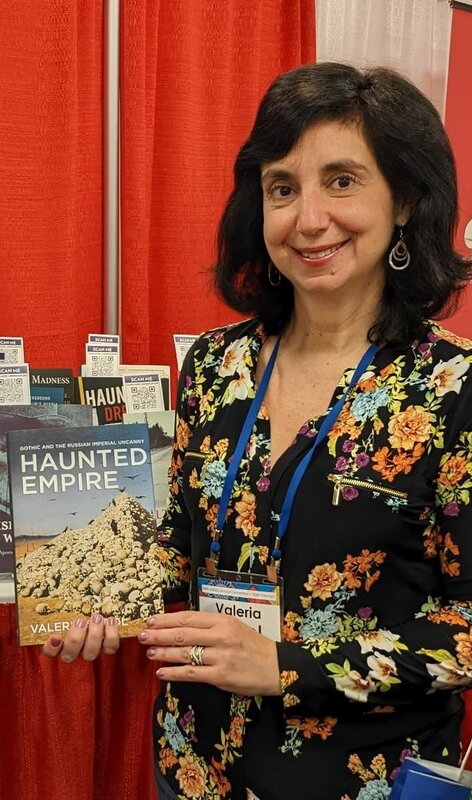
Valeria Sobol is a Professor at the Department of Slavic Languages & Literatures within the School of Literatures, Cultures & Linguistics at the University of Illinois at Urbana-Champaign. She holds a Ph.D. from Columbia University (2003) and a diploma from Kyiv Taras Shevchenko University (1994). Education Ph.D., Columbia University, 2003 Diploma of Higher Education, Kyiv Taras Shevchenko University, 1994 Her research spans Russian and Ukrainian literature from the 18th to 19th centuries, focusing on intersections of literature with law, medicine, and psychoanalysis , race in 19th-century Russia , and imperial Gothic . Her publications include two monographs: Febris Erotica: Lovesickness in the Russian Literary Imagination (2009) and Haunted Empire: Gothic and the Russian Imperial Uncanny (2020), which explores Gothic literature's role in destabilizing Russian imperial identity. The 15 most recent articles (2005-2022) analyze topics such as Gothic aesthetics in Russian-Ukrainian literature, ethnographic discourse in Lermontov, and intersections of emotion physiology with literary realism. Her work frequently engages with postcolonial studies , literature and science , and national identity debates. Scientific Awards Campus and LAS Dean's Excellence in Undergraduate Teaching Awards (2023) AAUS Best Article Prize (2018-19) NEH Fellowship (2015-16) NEH Summer Stipend (2014) CAS Associate (2014-15) CAS Beckman Fellowship (2005-06) She contributes to interdisciplinary research through affiliations with the Russian, East European, and Eurasian Center , Comparative and World Literature Program , and European Union Center . Her courses include Russian Golden Age literature, Tolstoy, Pushkin, and cross-cultural studies of Russia's interactions with the Caucasus and Ukraine.
Mikkel Wallentin is a Professor at the School of Communication and Culture, Aarhus University, specializing in Cognitive Science. He investigates the intricate relationships between language, brain, and cognition through interdisciplinary research combining neuroscience, linguistics, and psychology. His research interests include psycholinguistics, neurolinguistics, neuropragmatics, spatial memory, language comprehension, and inner speech . He employs methods such as fMRI, behavioral experiments, and corpus analysis to explore how cognitive processes are embodied in linguistic behavior. His work also touches on gender differences in language development, depression detection via lexical choice, and aging in spatial communication. Wallentin's recent publications reveal a strong focus on emotional inner speech, its physiological effects, and its role in self-regulation , alongside studies on early language acquisition and linguistic pragmatics. His work bridges theoretical linguistics with cognitive neuroscience, often involving cross-linguistic and clinical populations. Principal Investigator, SCALA: Spatial Communication and Ageing across Languages (2024–2028) Participant, Cognition, Language and Music (2009–2013) Participant, Mass Experiment 2016 He has been actively involved in public dissemination, delivering lectures such as 'Language: A Window into the Mind' and contributing to media on topics like julefilm psychology and developmental language disorders. With over 127 research outputs, he maintains a robust scholarly presence in cognitive science.
Professor Hanem El-Farahaty is a Professor in Linguistics, Translation and Interpreting at the School of Languages, Cultures and Societies, University of Leeds, UK. She holds a PhD from the University of Leeds and has two BA degrees and an MA from the University of Mansoura, Egypt. Her academic roles focus on Arabic media, translation, and interpreting, with a strong research orientation in legal and political discourse. PhD in Translation Studies, University of Leeds MA in Applied Linguistics, University of Mansoura BA in English Language and Education, University of Mansoura BA in English Language and Literature, University of Mansoura Her research interests span comparative linguistics , Arabic/English legal translation , corpus-based translation , media and political translation , and critical discourse analysis , with a particular focus on political satire and multimodal communication in the Arab world. She investigates gender, modality, and constitutional language using corpus-driven methodologies. The analysis of her recent publications reveals a consistent trend in legal corpora development , deontic modality , and political discourse in Arabic and English contexts. Her work bridges translation theory, legal linguistics, and digital media, often using multimodal and corpus-based approaches to analyze political satire and constitutional texts. Her scientific recognition includes: Senior Fellow of the Higher Education Academy (SFHEA) Fellow of the Chartered Institute of Linguists (FCIL) She supervises PhD students and is actively involved in academic leadership, having organized major conferences and panels on Arabic translation and Middle Eastern studies. She has received no explicit mention of grants, but her extensive publication and conference activity suggest sustained research funding. She is a member of several professional bodies, including BRISMES, IATIS, FLITE, and ILLA. She contributes to academic communities through editorial roles, including membership in the Scientific Committee for the Leeds Language Scholar Journal and the International Journal of Translation, Interpretation, and Applied Linguistics . Her work is deeply embedded in interdisciplinary research, connecting linguistics, law, politics, and digital culture.
Tim Schneider is a Ph.D. student at the Intelligent Autonomous Systems lab of Technische Universität Darmstadt , working in collaboration with École Centrale de Lyon under the Aristotle project. His research focuses on robotics , particularly at the intersection of active perception , tactile sensing , and robotic manipulation . His work investigates how robots can develop environmental understanding through physical interaction , drawing parallels to children's exploratory behavior . Key projects include tactile reinforcement learning , active inference for manipulation , and visuo-tactile sensor fusion in dynamic tasks. Recent publications emphasize foundation models for tactile learning , sensor simulation (TacEx), and multi-modal control systems (AllmAN). He supervises theses on topics ranging from teleoperation feedback to haptic MNIST benchmarks , with a focus on reinforcement learning applications in robotic systems.
Andreas Fender is a researcher at the Visualization Institute of the University of Stuttgart (VISUS), affiliated with the Schmalstieg Working Group. He has held postdoctoral positions at ETH Zurich (Switzerland) and the University of Sussex (England), following his PhD at Aarhus University (Denmark) with an internship at Microsoft Research (USA). His research focuses on Human-Computer Interaction, particularly in Augmented and Virtual Reality (AR/VR) and camera networks. He develops novel input methods for productivity and artistic expression in Mixed Reality environments, creating hybrid physical-digital systems like OptiBasePen, PressurePick, InfinitePaint, and DeltaPen. Recent work includes contributions to Mixed Reality input methods (UIST 2024, CHI 2022) and collaborative systems (Asynchronous Reality). Projects like GuitarPie (UIST 2025) and OptiBasePen (UIST 2024) demonstrate his focus on mobile interaction and ergonomic design. Scientific accolades include the Best paper award at CHI 2022 Best application paper award at ISS 2019 . At VISUS, he collaborates with Dieter Schmalstieg and leads hiring for PhD students and PostDocs exploring physical-digital workflows, artistic tools, and critical AI engagement. His work integrates machine learning, hardware prototyping, and spatial user interfaces to redefine future workplaces.
Professor Andreas Geiger leads the Autonomous Vision Group (AVG) at the University of Tübingen , heading the Department of Computer Science and serving as core faculty at the Tübingen AI Center . He is Principal Investigator in the ML in Science cluster of excellence and CRC Robust Vision , while coordinating the ELLIS PhD program . Develops machine learning models for computer vision, NLP, and robotics Focus on 2D/3D representations, geometry/material reconstruction, and robust AI Applications in autonomous vehicles, VR/AR, and document analysis His research has produced hundreds of publications with significant impact, including multiple best paper awards at top venues. The Scholar Inbox platform he co-created revolutionizes academic paper discovery, winning business model awards at Tübingen AI Center spinoff events. Key research areas include: Neural rendering and 3D scene understanding Self-driving perception and planning systems Simulation frameworks for autonomous validation Efficient reinforcement learning architectures Recent awards include: CVPR 2024 Best Paper Sage 10-Year Impact Award 2024 IEEE PAMI Young Researcher Award 2018 Active in CyberValley and ELLIS Institute Tübingen , he maintains strong industry collaborations through initiatives like the ML ⇌ Science Colaboratory . His group's work appears in journals like TPAMI and conferences including SIGGRAPH 2025.
Gro Trondalen is a Professor of Music Therapy at the Norwegian Academy of Music. She holds a PhD specializing in music therapy for young people with eating disorders and has expertise in the Bonny Method of Guided Imagery and Music (GIM). Her work spans clinical practice, education, and research, focusing on mental health, relational dynamics through music, and ethical considerations in therapy. Trondalen has led major academic programs including the Master’s and PhD programs in Music, and directed the Center for Research in Music and Health (CREMAH). Her research emphasizes music’s role in fostering relational healing, particularly for vulnerable populations. Notable projects include Sounding Relationship (1999–2004), exploring music therapy with anorexia patients, and Musicians and Health (2011–2015). She actively contributes to international bodies like the World Federation of Music Therapy and European Association for Music and Imagery. Trondalen has authored/co-authored 2 monographs, 6 edited books, and numerous articles across languages. Her recent work addresses ethical musicality and contemporary developmental psychology applications in therapy. She supervises master’s and PhD students while advocating for music therapy’s role in public health, including dementia care initiatives.
Ana Isabel Vieira is an Adjunct Professor at the Alcoitão School of Health, where she serves as Director of the Department of Physiotherapy. She is affiliated with the Business Research Unit (BRU-ISCTE) - Data Analytics Group, integrating academic, clinical, and community-focused roles. Her career spans over three decades in physiotherapy practice and education. Bachelor's in Physiotherapy (1990, Alcoitão School of Health) Postgraduate in Psychomotricity and Therapeutic Relaxation (1994, Faculty of Human Kinetics) Master's in Educational Sciences - Health Education (2006, University of Lisbon) PhD in Health Sciences - Neurological Rehabilitation (2017, Catholic University of Portugal) Her research focuses on neurological rehabilitation , gerontological physiotherapy , and community health initiatives . Notable work includes tactile discrimination studies in elderly populations, social touch assessment tools, and multidisciplinary aging research. She leads projects addressing dementia prevention , community accessibility , and informal caregiver support . Recent publications demonstrate her engagement with frailty assessment , post-stroke rehabilitation , and oral-motor dysfunction in aging populations. Her work has been published in journals like Journal of Oral Rehabilitation and Physiotherapy Theory and Practice. Career Award (2018, Alcoitão Higher School of Health) Performance Bonus (2009, Holy House of Mercy of Lisbon) Honorable Mention for Communication (2009, XXII Taipas Meeting) An active academic mentor, she supervises multiple Master's theses and serves on doctoral juries. Her professional activities include community projects like Cascais Cuida , Tango Argentino in Parkinson's , and SIRS (Solidão e Isolamento em Idosos) . She participates in international research networks including the World Wide Fingers project.
Prof. Dr. habil. Fernand Hörner serves as Professor of Cultural Studies at Hochschule Düsseldorf within the Faculty of Social Sciences and Cultural Studies. He holds multiple significant leadership positions including Director of the Center for Digitalization and Digitality (Zentrum für Digitalisierung und Digitalität), Internationalization Commissioner, and Program Director of the MA Transforming Digitality. Additionally, he serves as Deputy Director of the Department of Media and Interaction at the Doctoral College of Universities of Applied Sciences NRW and as Speaker of the Working Group on Popular Culture and Media in the Society for Media Science. He is also the co-founder and co-editor of the Song Lexicon (Songlexikon). Prof. Hörner's research focuses on interdisciplinary analysis of popular culture, particularly music videos, examining the intersection of digital transformation and musical expression. His work explores voice as a semantic and aesthetic phenomenon, content analysis of user comments in digital spaces, and the theoretical frameworks for understanding media convergence. His methodological approach combines cultural theory, discourse analysis, and semiotics to investigate how popular culture forms meaning across different media platforms. His scholarly output reveals a consistent trajectory from his early work on dandyism and cultural identity toward contemporary digital culture and media convergence. The most recent publications demonstrate increasing focus on digital reception patterns, social media phenomena, and the transformation of musical culture in the digital age. His work maintains a strong theoretical foundation while engaging with contemporary cultural phenomena from music videos to viral social media gestures. Prof. Hörner has developed significant research infrastructure through the Song Lexicon project, which contains approximately 300 scholarly analyses of songs across various genres since the beginning of sound recording. This resource examines songs through multiple dimensions including historical context, cultural significance, reception history, and audiovisual presentation. His academic journey includes a habilitation at the University of Basel (2019), professorship at HSD since 2012, previous positions at Albert-Ludwigs-University Freiburg, and doctoral work on dandyism completed in 2007. His scholarly contributions span musicology, cultural studies, media theory, and digital humanities with particular attention to the interplay between visual and auditory elements in contemporary media culture.
Katrin Bromber is a distinguished academic specializing in African Studies with a focus on East Africa, particularly Ethiopia. She serves as an Adjunct Professor in the Department of African Studies at the University of Vienna and is a prominent researcher at the Leibniz Center for Modern Orient (ZMO) in Berlin, where she has led various research units including "Age and Generation" (2020-2023) and "Progress: Ideas, Agents, Symbols" (2014-2019). Her academic career spans over three decades with significant contributions to the understanding of sports history, linguistic studies, and transregional connections in Africa. Habilitation in African Studies, University of Vienna (2009) PhD in African Linguistics, University of Leipzig (1993, magna cum laude) M.A. in Swahili Studies, University of Leipzig (1988) Professor Bromber's research interests center on African Studies, African Linguistics, Sports History in Ethiopia, Modernity Studies, and Transregional Networks. Her work examines how sports, particularly in Ethiopia during the imperial period (1920-1974), served as vehicles for modernity, national identity formation, and transregional connections. She has pioneered research on the concept of "translocality" as a framework for understanding cross-border relations in the Global South, with particular focus on the Indian Ocean region. Her scholarship demonstrates how physical culture, youth organizations like the YMCA and Boy Scouts, and sporting infrastructure were integral to Ethiopia's engagement with global modernity during the mid-20th century. Analysis of her most recent publications reveals a consistent scholarly trajectory examining the intersections of sports, modernity, and transregional networks in Ethiopia and beyond. Her work spans historical periods from World War II through Ethiopia's imperial era to contemporary times, demonstrating how physical culture and sporting practices served as conduits for global connections and local transformations. Bromber's research shows particular strength in analyzing how sports infrastructure, youth organizations, and bodily practices became sites for negotiating modern identities within Ethiopia's engagement with global networks. Her methodological approach combines historical anthropology with linguistic analysis, creating rich interdisciplinary insights into Africa's relationship with global modernity. Professor Bromber has held numerous significant academic positions and research grants throughout her career. She has served as Principal Investigator for the Berlin Graduate School of Muslim Cultures and Societies since 2018 and leads the BMBF-funded research consortium "De:link // Re:link - Local perspectives on transregional (dis-)entanglements" since 2020. Her editorial work includes serving on the Advisory Boards of Studies of the Department of African Languages and Cultures (SDALC) and Stichproben. Vienna Journal of African Studies since 2015, and she has chaired the Academic Association for the Studies on the Horn of Africa (WAKHVA) since 2012. Based at the Leibniz Center for Modern Orient, Professor Bromber is deeply embedded in collaborative research networks across Europe and Africa. Her leadership of the "De:link // Re:link" project demonstrates her commitment to developing methodological approaches that center local perspectives in transregional studies. Her work bridges academic disciplines including history, anthropology, linguistics, and sports studies, creating innovative frameworks for understanding Africa's place in global networks of exchange and transformation.