Dr. rer. nat. Thomas Hermann is a faculty member at Bielefeld University's Faculty of Engineering, leading the Ambient Intelligence Group and coordinating the Computer Science program. He specializes in sonification, auditory data science, and smart environments. Head of Ambient Intelligence Working Group Computer Science Program Coordinator Member of multiple academic advisory boards His research focuses on interactive sonification for biomedical applications, quantum systems, and smart environments. Key projects include ECG sonification for cardiac diagnosis, real-time auditory feedback in swimming, and sonic interfaces for AR cooperation. Recent publications span 2025 with Python-based sonification tools ( pya AGen ), quantum system sonification, and ST-elevation myocardial infarction monitoring. He contributes to open-access supplementary materials and interdisciplinary workshops. As a researcher , Hermann develops practical sonification frameworks like Panson for facial behavior analysis, CardioScope for portable ECG monitoring, and Base Cube One for smart environments. His work bridges academic research with industry applications.
Anja Liekfeld serves as Adjunct Professor of Ophthalmic Optics/Optical Device Technology at Brandenburg University of Technology since 2018 while concurrently holding the position of Chief Physician at Klinikum Ernst von Bergmann's Department of Ophthalmology in Potsdam since 2009. Her dual roles bridge academic research in optical engineering with clinical ophthalmology practice, focusing on technological advancements for eye care delivery. Her educational foundation includes medical studies at Essen and Berlin Universities (1986-1992), state examination (1992), ophthalmology residency at Charité (1994-1997), specialist certification (1997), doctoral degree magna cum laude (1997), and habilitation on capsular bag models for cataract research (2007). Liekfeld's research centers on optical properties of intraocular lenses, clinical applications of medical devices in ophthalmology, refractive surgery techniques (laser and IOLs), cataract surgery technologies, glaucoma diagnostics/therapy, and gerontological ophthalmology. Her work emphasizes translating engineering principles into clinical solutions for complex vision correction challenges. Over 25 years of publications reveal evolving expertise from molecular glaucoma research to advanced IOL development. Recent work focuses on multifocal/toric lenses, dysphotopsia analysis, and visual outcomes measurement, demonstrating consistent innovation at the optics-clinical interface with practical applications for patient care. Her accolades include: DOG/SFO Travel Grant (2000) DGII Best Presentation Award (2008) DOC Gold Medal (2011) Focus Magazine Top Doctor (2013-2021) Stern Magazine Top Doctor (2022) As an educator, she trains surgical assistants, diet technicians, and operating room staff while teaching ophthalmology to visually impaired pedagogy students at Humboldt University. She conducts international wet labs for surgeons and optometrists, serves on editorial boards for Concept and Karger Kompass Ophthalmologie, and reviews for major ophthalmology journals. Active in professional societies including DGII, ESCRS, DOG, BBAG, and BDOC, she chairs Brandenburg's Ophthalmology Examination Board since 2021 and serves on the board of Die Augenchirurginnen e.V. Her research utilizes human capsular bag models for cataract studies and maintains focus on improving optical device performance in clinical settings.
Prof. Dr. med. Franz Lennard Ricklefs is a Senior Physician and Head of the Working Group at the Department of Neurosurgery, University of Hamburg Faculty of Medicine. He is a Medical Specialist in Neurosurgery with cross-disciplinary expertise in neuro-oncology, molecular pathology, and extracellular vesicle research. Affiliations: University Medical Center Hamburg-Eppendorf (UKE), European Liquid Biopsy Society (ELBS), International Consortium on Meningiomas (ICOM) Research Interests: His work focuses on neurosurgical oncology, particularly glioblastoma and meningioma pathobiology. He investigates DNA methylation patterns, extracellular vesicle biomarkers, and liquid biopsy implementation in clinical neuro-oncology. Additional interests include surgical outcomes for epilepsy and aneurysm management. Article Trends: Over the last decade, Dr. Ricklefs has published extensively on: Extracellular vesicle applications as liquid biopsy markers DNA methylation subclasses for glioblastoma and meningioma Multicenter surgical outcome benchmarking Immune evasion mechanisms in neuro-oncology Technological innovations in neurosurgical visualization Molecular characterization of rare CNS tumors Professional Contributions: He co-authored the MISEV2023 guidelines for extracellular vesicle studies and participates in international consensus reviews for meningioma classification. His collaborations span institutions across Europe and North America.
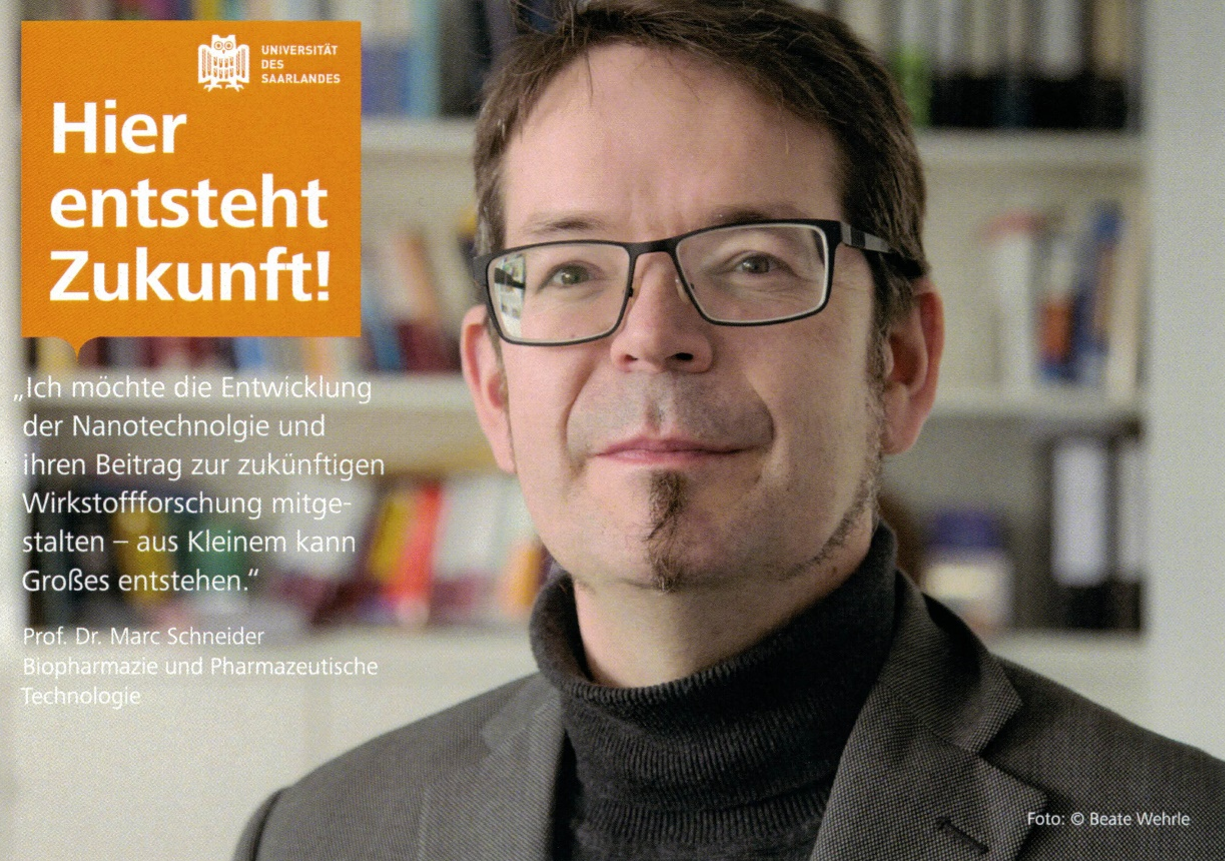
Prof. Dr. Marc Schneider holds a professorship in Biopharmaceutics and Pharmaceutical Technology at Saarland University's College of Pharmacy . His research focuses on colloidal drug delivery systems, particularly nanostructured and non-spherical particle engineering for overcoming biological barriers in pulmonary and transdermal applications. He leads an internationally recognized lab in Saarbrücken, collaborating with Helmholtz Institute for Pharmaceutical Research Saarland (HIPS) and trinational institutions. Research Highlights: Development of inhalable nano/microparticle systems Surface modification of gelatin nanoparticles Characterization of mucus-penetrating particles 3D printing for microneedle fabrication Atomic Force Microscopy (AFM) for nanoparticle analysis Selected Scientific Awards: European Journal of Pharmaceutics and Biopharmaceutics Best Paper Award (2018) for mucus-penetrating nanoparticles Recognized in 'Ausgezeichnete Orte im Land der Ideen' competition (2018) for 'Nano-Mais' drug delivery system Collaborative Networks: Co-editor for Advanced Drug Delivery Reviews special issue on biological barriers Key participant in trinational Master's program in Biomedicine with Strasbourg, Mainz, and Luxembourg Active in Controlled Release Society (CRS) conferences and local chapters
Dr. Thomas E. Winkler serves as Head of Junior Research Group at the Institute of Microtechnology within the Faculty of Mechanical Engineering at Technische Universität Braunschweig, with additional affiliation to the Center of Pharmaceutical Engineering (PVZ). His research bridges microtechnology and biomedical applications through innovative engineering solutions. Dr. Winkler earned his Dipl.-Ing. in Biophysics and Nanotechnology from Johannes Kepler University, Linz (2005-2011), followed by a Ph.D. in Bioengineering from the University of Maryland, College Park (2011-2017). After completing postdoctoral research at KTH Royal Institute of Technology, Stockholm (2017-2021), he established his independent research group at TU Braunschweig. His research program focuses on developing advanced microfluidic platforms for biomedical applications, with particular emphasis on creating Lab- and Organ-on-a-Chip systems, bioelectrochemical sensors, and iPSC-based cellular models for neuropsychiatric disorder research. This interdisciplinary work combines engineering precision with biological complexity to address pharmaceutical and medical challenges. Fulbright Foreign Student Fellow (2011-2017) Marie Skłodowska-Curie Actions – Individual Fellowship (2018-2020) Dr. Winkler leads the Biomicrosystems Integration research group, which maintains strong connections with the Center of Pharmaceutical Engineering. His laboratory work represents TU Braunschweig's strategic commitment to interdisciplinary research at the intersection of mechanical engineering and life sciences, with applications in drug development and personalized medicine.
Benedikt Günther is a research scientist at the Technical University of Munich (TUM) working within the Chair of Biomedical Physics led by Prof. Dr. Franz Pfeiffer. His research focuses on the Munich Compact Light Source (MuCLS), a laboratory-scale inverse Compton X-ray source that provides synchrotron-like radiation for biomedical applications. Günther plays a key role in developing, optimizing, and characterizing this innovative technology, contributing to both its fundamental physics and practical medical applications. His primary research interests center around X-ray physics and imaging techniques, particularly laser enhancement cavities for inverse Compton X-ray sources, X-ray microscopy, dynamic phase-contrast imaging, and X-ray spectroscopy. Günther's work bridges fundamental physics with practical medical applications, developing instrumentation that brings synchrotron-quality imaging to conventional laboratory settings. His research has significant implications for improving medical diagnostics while making advanced imaging techniques more accessible. Analysis of Günther's publication record reveals a consistent focus on advancing compact X-ray source technology and its applications. His work demonstrates expertise in both theoretical modeling and experimental implementation, with publications spanning instrument development, imaging techniques, and specific medical applications. The research shows progression from fundamental source characterization to increasingly sophisticated biomedical applications, particularly in breast imaging, dental diagnostics, and materials science. 2019 Best Poster Award at the combined meeting of the 68th Denver X-ray Conference (DXC) & 25th International Congress on X-ray Optics and Microanalysis (ICXOM) for 'Full-Field Structured Illumination Super-Resolution X-ray Transmission Microscopy' Günther regularly presents his work at major international conferences including the International Particle Accelerator Conference, High-Brightness Sources and Light-driven Interactions Congress, and specialized X-ray imaging meetings. His research is conducted within the Munich Compact Light Source facility, a collaborative project involving physicists, engineers, and medical researchers working to develop laboratory-scale synchrotron technology for widespread biomedical use.
F. Ömer Ilday is a distinguished physicist and Alexander von Humboldt Professor at Ruhr University Bochum since July 2023, holding a joint appointment in the Faculty of Electrical Engineering and Information Technology and Faculty of Physics and Astronomy. His pioneering work in ultrafast laser technology has transformed non-linear laser-matter interactions, with applications spanning precision manufacturing, medical surgery, and nanofabrication. Education: PhD in Physics, Cornell University (2003) Postdoctoral Research Scientist, Massachusetts Institute of Technology (2003-2005) Ilday's research centers on ultrafast laser development and materials science, focusing on GHz-repetition-rate burst-mode systems, nonlinear laser lithography, and self-organization phenomena. His interdisciplinary approach bridges photonics, plasma physics, and materials engineering to enable breakthroughs in nanostructuring, silicon processing, and laser-based manufacturing. Current work emphasizes developing high-power laser sources and exploring fundamental laser-matter interaction mechanisms for next-generation applications. His recent publications (2023-2025) reveal dominant trends in high-repetition-rate burst-mode lasers (up to 50 GHz), ablation efficiency optimization, and nonlinear laser lithography for 3D silicon structuring. These works demonstrate strong convergence between fundamental physics and industrial applications, particularly in medical surgery, nanofabrication, and materials synthesis, with increasing emphasis on self-organization principles in laser systems. Scientific awards: Turkish Academy of Sciences Outstanding Young Scientist Award (2006) Marie Curie International Reintegration Grant (2006) ERC Consolidator Grant (2014) - Turkey's first ERC Advanced Grant (2022) Election to Academia Europaea Election to Turkish Academy of Sciences Membership in Turkish and American Physical Societies Ilday has secured major competitive grants including two ERC awards and a Marie Curie fellowship, directing research teams at Bilkent University's Ultrafast Optics & Lasers Laboratory (UFOLAB) which developed technologies adopted globally. At RUB, he is establishing the Center for Complex Laser-Matter Interactions as an interdisciplinary hub fostering collaborations between photonics, plasma research, and materials science, with explicit goals for spin-off company formation and transdisciplinary innovation in manufacturing technologies. As founding director of UFOLAB at Bilkent University, Ilday developed laser systems deployed by research institutions worldwide and established Turkey's first laser company. His RUB center integrates electrical engineering and physics expertise to advance complex laser-matter interaction research, focusing on self-organizing laser systems, nanostructuring techniques, and applications in semiconductor manufacturing and medical technology through close industry partnerships.
Thomas Efferth is Full Professor and Director of the Institute of Pharmaceutical and Biomedical Sciences at Johannes Gutenberg University Mainz, Germany. He leads the Department of Pharmaceutical Biology, specializing in molecular pharmacology and drug discovery. His research spans cancer therapeutics, infectious diseases, and traditional Chinese medicine, with a strong focus on artemisinin and natural products. Education includes a PhD from the German Cancer Research Center (1990) and habilitation from RWTH Aachen University (1997). Professional positions include research leadership at the German Cancer Research Center (2005), associate professorship at Heidelberg University (2007), and his current role since 2009. Research interests integrate systems biology approaches with: Molecular mechanisms of anticancer drugs Bioinformatic pharmacology for personalized medicine Artemisinin repurposing for cancer/viral infections Toxicological profiling of natural products Publications demonstrate strong focus on phytomedicine, antiviral therapies, and cancer drug resistance. Awards and honors include: Qihuang International Award (2017) World Academy of Sciences membership (2018) Stanford Top 2% Scientist citation ranking (2020) Dr. Wilmar Schwabe Award (2006) Multiple honorary professorships in China/Hong Kong Editorial leadership includes Editor-in-Chief roles for Phytomedicine and board memberships in 20+ journals. Society roles feature vice-presidency of the Specialty Committee on Immunology of TCM and executive positions in IUPHAR and DPhG.
Dr. Burkhard Maess is a Research Professor and Group Leader at the Max Planck Institute for Human Cognitive and Brain Sciences, leading the Methods and Development Group Brain Networks. His research focuses on auditory and language processing, signal analysis, and dynamic modeling of neuronal networks. He holds a Diploma in Physics (University of Leipzig, 1987) and a PhD in Physics (University of Leipzig, 1990). His career includes postdoctoral positions at the Academy of Sciences of the GDR and the Free University of Berlin before joining the MPI in 1995. Since 2000, he has led research groups on MEG/EEG signal analysis and cortical network dynamics. His work integrates advanced neuroimaging techniques like MEG and EEG to study sensory processing, neural network dynamics, and the effects of aging on auditory attention. Key contributions include developing high-resolution BEM-FMM methods for source localization and analyzing cross-frequency coupling in neuroscience data. His group also explores spinal cord electrophysiology and the neural underpinnings of perceptual decision-making. Dr. Maess’ research spans cognitive neuroscience, biomedical engineering, and computational modeling, with a focus on bridging empirical findings with theoretical frameworks in neuroscience.
Dr. Jing Wang is a Professor in the Department of Bioinformatics at Southern Medical University's School of Medicine, with extensive research at the intersection of artificial intelligence and biomedical applications. Her work demonstrates strong cross-disciplinary collaboration across medical institutions, engineering departments, and computer science research groups. Her primary research interests include Artificial Intelligence in Healthcare , Biomedical Engineering , and Traditional Chinese Medicine Informatics , with recent publications showing particular expertise in medical imaging analysis, diagnostic assistance systems, and clinical decision support. Her work spans both theoretical algorithm development and practical clinical implementations. Analysis of her 15 most recent publications (2025-2026) reveals a strong trend toward clinically applicable AI systems, with approximately 60% of publications focused on medical diagnostics and treatment support systems. The remaining publications demonstrate expertise in industrial applications of computer vision and fundamental AI research. Her work shows consistent collaboration with both domestic Chinese institutions and international research groups. Notable scientific contributions include: Development of 'Tianyi', a traditional Chinese medicine language model for clinical practice Innovations in bionic soft robotics for rehabilitation assistance Novel approaches to medical image analysis for cancer diagnostics Her research program appears well-funded with consistent publication output across high-impact journals in biomedical engineering, AI, and medical informatics. Current work suggests strong emphasis on translating AI research into clinical practice, particularly in diagnostic support systems and rehabilitation technology.
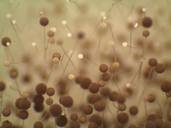
Prof. Vera Meyer is a Professor in the Department of Applied and Molecular Microbiology at Technische Universität Berlin’s Faculty III - Process Sciences. Her research focuses on optimizing fungal production systems for bioactive compounds, antifungal agents, and secondary metabolites. She leads projects such as the MY-CO SPACE exhibition, exploring fungal-based materials in architecture and sustainability. Notable contributions include work on Aspergillus niger morphology, pyomelanin synthesis for radiation shielding, and co-authoring over 150 publications. Meyer holds patents on fungal biosynthetic processes and collaborates internationally on interdisciplinary bioeconomy initiatives. Contact: vera.meyer@tu-berlin.de . Education details are not explicitly listed, but her career includes leadership roles in TU Berlin’s biotechnology programs and UniCat collaborations. Research emphasizes systems biology approaches to microbial engineering, combining microbiology, mathematics, and engineering for predictive models of cellular processes. Recent projects include the MY-CO SPACE exhibition at Bundeskunsthalle Bonn (2025-2026), showcasing fungal-based construction materials.
Dr. Carolin Vollenberg serves as a Post-Doctoral Researcher at the Chair of Information Systems & Transformation Management within the Faculty of Computer Science at the University of Duisburg-Essen (UDE). Her academic journey includes a PhD from the University of Muenster (2021-2025), an M.Sc. in Technical Consulting and Management from Hochschule Hamm-Lippstadt (2018-2020), and a B.Eng. in Biomedical Technology from the same institution (2014-2018). Prior to her current position, she worked as a Research Assistant at South Westphalia University of Applied Sciences and gained industry experience at Zapp Systems GmbH. PhD in Business Informatics (2021-2025), University of Muenster M.Sc. Technical Consulting and Management (2018-2020), Hochschule Hamm-Lippstadt B.Eng. Biomedical Technology (2014-2018), Hochschule Hamm-Lippstadt Research Focus: Vollenberg specializes in the governance of lightweight IT systems, digital transformation in public and healthcare sectors, and process mining applications. Her work bridges technical implementation with organizational behavior, particularly examining resistance to automation in sensitive domains like healthcare. She investigates how organizations navigate unintended consequences of technology adoption, with emphasis on RPA (Robotic Process Automation), omnichannel transformation, and data-driven process optimization. Her research methodology combines ethnographic field studies with quantitative process analysis. Publication Trends: Analysis of her 16 publications (2020-2025) reveals strong focus on healthcare IT (45% of works), public sector digitalization (30%), and foundational process management (25%). Recent output shows increasing emphasis on ethical dimensions of process mining and sustainability applications. Her collaborative work spans multiple European institutions with consistent publication in top IS conferences (ICIS, ECIS, HICSS). Best Paper nomination at HICSS-55 (2022) Associate Editor for General Track at Internationale Tagung Wirtschaftsinformatik (WI) 2025 Professional Engagement: Vollenberg actively contributes to academic discourse through editorial roles and peer review. Her industry collaborations with healthcare providers and public sector entities demonstrate applied research impact. Current projects examine virtual nursing transformations and crisis-responsive RPA implementations, reflecting her commitment to solving real-world operational challenges through information systems innovation.
Dieter Uckelmann serves as Professor of Information Logistics and Scientific Director of the Institute for Applied Research at Stuttgart University of Applied Sciences (HFT Stuttgart). He holds multiple leadership positions including Spokesperson for the research focus 'Smart Technologies, Processes and Methods' at HFT Stuttgart since March 2023 and Scientific Director of the Institute for Applied Research since September 2023. His academic journey began with mechanical engineering studies in Braunschweig, followed by doctoral research at the University of Bremen focusing on 'Quantifying the Value of RFID and the EPCglobal Architecture Framework in Logistics.' Uckelmann's research spans Internet of Things applications across Industry 4.0, logistics, smart buildings, and smart cities, with significant contributions to educational technology including learning analytics and AI in teaching. His work bridges technical innovation with practical implementation, particularly in digital transformation of laboratories and smart city infrastructure. He has led numerous research projects including KNIGHT (AI for teaching), InDeckLe (earth composite ceiling systems), iCity initiatives, and DigiLab4U (online laboratories). His publication record shows a clear progression from foundational RFID and IoT research toward emerging technologies like the Industrial Metaverse, 5G applications, and AI-driven educational systems. Recent work demonstrates strong integration of physical and digital systems, particularly in urban environments and educational contexts, with increasing emphasis on sustainability and energy efficiency applications. Co-editor of International Journal of RF-Technologies: Research and Applications Member of PhD Association BW, Research Unit III Computer Science and Electrical Engineering Mentor in the HAWCareer mentoring program Program Committee Member for IEEE RFID, IEEE/ITMC, AIET, and other major conferences Associate Editor for Journal of Online and Biomedical Engineering Professor Uckelmann actively mentors students and researchers, with his team contributing to projects across smart city infrastructure, digital learning platforms, and industrial IoT applications. He leads the Industrie 4.0 Laboratory which focuses on industrial IoT applications, digital twins, and the industrial metaverse, with research spanning RFID, RTLS, wireless sensor networks, AR/VR, and IoT architectures. His work extends to international collaborations including visiting professorships at Auburn University and the University of Parma.
Prof. Dr. Heiko Paulheim is a Professor of Data Science and currently serves as University Vice President at the University of Mannheim. He leads the Data and Web Science Group (DWS), which focuses on Web Data Mining, Knowledge Graphs, and Semantic Web technologies. His research group contributes to open source knowledge graphs like DBpedia and develops new knowledge graphs such as WebIsALOD and DBkWik. As of October 1, 2024, he has limited teaching capacity due to his vice presidential duties. Prof. Paulheim's research interests span Knowledge Graphs, Semantic Web, Web Data Mining, Machine Learning, and Natural Language Processing. His work particularly focuses on knowledge graph refinement, embedding techniques (notably RDF2vec), and applications in various domains including news recommendation, biomedical informatics, and environmental monitoring. His group develops practical tools like the RapidMiner Linked Open Data Extension and RDF2vec for knowledge graph applications. His recent publications demonstrate a strong focus on knowledge graph embeddings, with particular attention to RDF2vec variants, applications in news recommendation systems, biomedical data integration, and spatio-temporal knowledge graphs for environmental monitoring. His work bridges theoretical advances in knowledge representation with practical applications across multiple domains. Among his notable achievements are a nomination for the Best Paper Award at CAiSE 2025 and securing an Open Science Grant for the SpatialBenchRAG project. His research has significant impact in both academic and industrial contexts, with multiple papers accepted at top conferences like ISWC and ESWC. Prof. Paulheim has supervised numerous PhD students including Alexander Brinkmann and Michael Schlechtinger, and has led several research projects including the DFG Project Mine@LOD, State of BW Project SyKoW², and BMBF Project DS4DM. His group maintains strong industry connections with partners like SAP AG, Daimler AG, and IDS.
Ario Sadafi is a researcher at the Technical University of Munich (TUM) , affiliated with the Chair of Computer Science Applications in Medicine under Prof. Nassir Navab. His work spans medical image analysis , machine learning , and computational pathology , with a strong focus on developing AI-driven solutions for microscopic imaging in hematology and oncology. Research Focus: Multiple Instance Learning for weakly supervised medical image classification. Explainable AI for biomedical single-cell imaging. Continual and cross-domain learning for robust diagnostic models. Microscopic image analysis for blood cell disorders and leukemia subtyping. Teaching Contributions: Sadafi has been actively involved in teaching courses such as Computer Aided Medical Procedures , Medical Augmented Reality , and Deep Learning for Medical Applications . He also supervises practical courses and seminars in 3D Computer Vision and Machine Learning in Medical Imaging . Labs & Collaborations: He works closely with the MEDIA (Medical Image Analysis) and NARVIS labs at TUM, contributing to projects in surgical data science , generative models , and robotics & ultrasound . Publications Impact: His research output (2018–2025) emphasizes AI-driven hematology , with applications in red/white blood cell classification, leukemia subtype diagnosis, and interpretable deep learning models for clinical use.