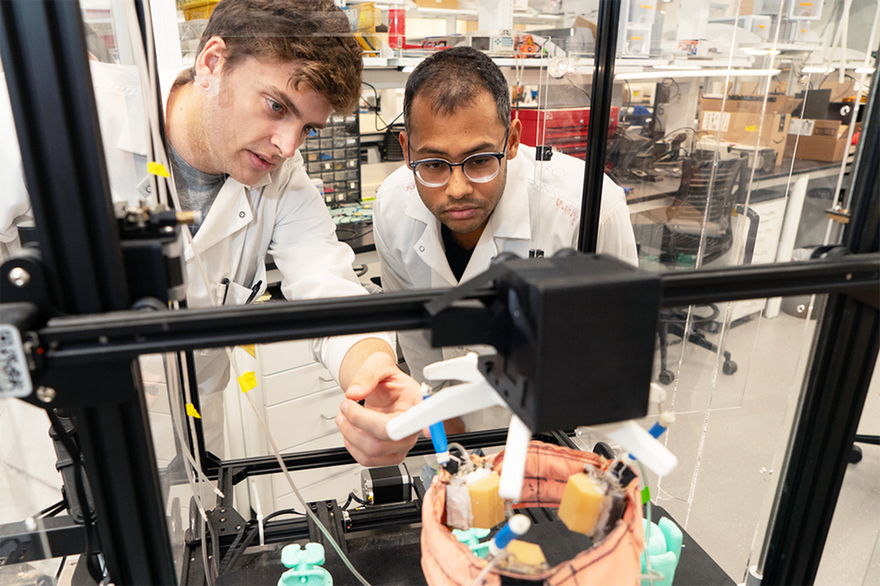
Victoria Webster-Wood is an Associate Professor at the College of Engineering , Carnegie Mellon University , where she leads the Biohybrid and Organic Robotics Group (B.O.R.G) . Her research integrates organic materials into robotics as structures, actuators, sensors, and controllers for biohybrid robots and prosthetics. Education: Ph.D., Mechanical Engineering, Case Western Reserve University (2017) M.S., Mechanical Engineering, Case Western Reserve University (2013) B.S., Mechanical Engineering, Case Western Reserve University (2012) Research Interests focus on biohybrid robotics , biologically inspired systems , soft robotics , additive manufacturing , biomechanics , and computational modeling . Her work spans applications in medical robotics , micro/nano manufacturing , and environmental monitoring . Scientific Awards include being named to ASME’s 2025 MechE Watch List and awarded MIT Technology Review’s 35 Innovators Under 35 (2023) . Collaborations involve projects like neurodegenerative disease therapy tools and soft robotic tactile sensors for manufacturing , supported by the Manufacturing Futures Institute and NextManufacturing Center .
Dr. Minliang Yang is an Assistant Professor in Food Sustainability at North Carolina State University's Department of Food, Bioprocessing & Nutrition Sciences. Her research focuses on system-level analyses (TEA, LCA, machine learning) to advance food sustainability, particularly through plant-based foods, cellular agriculture, and greenhouse gas mitigation strategies. She holds a B.S. in Food Science from Henan University of Technology (2012), M.S. and Ph.D. in Agricultural and Biosystems Engineering from Iowa State University (2014/2018), and a postdoctoral fellowship at Lawrence Berkeley National Laboratory (2022). Her work spans biofuel production, bioproduct valorization, and sustainable biorefinery systems. Key contributions include optimizing biomass pretreatment methods (e.g., low-moisture anhydrous ammonia), developing plant-based platforms for human milk oligosaccharides, and evaluating the economic viability of carbon-negative fuels. Dr. Yang's interdisciplinary approach integrates engineering, biology, and economics to address global food system challenges. Recent publications emphasize co-processing agricultural residues, machine learning-driven process modeling, and cost-benefit analyses of bio-based materials. Her research highlights the potential of integrating plant biotechnology with advanced analytics to create scalable, sustainable solutions for food and energy systems.
Harald Pichler is an Associate Professor and Team Leader at the Institute of Biotechnology (IMBT) at Graz University of Technology. His research focuses on membrane biology, enzyme engineering, and industrial biotechnology using yeast systems like Pichia pastoris . Key projects include engineering microbial membranes for protein secretion, optimizing biocatalysts for terpenoid synthesis, and studying lipid interactions with membrane proteins. Collaborations with companies like DSM and LONZA highlight industrial applications of his work. Research interests span microbial membrane modifications, sterol biosynthesis, and metabolic engineering for producing valuable metabolites. Major contributions include developing yeast strains for high-throughput screening of terpenoids and engineering hydratases for biocatalytic applications. His team also explores protein secretion pathways and membrane protein expression in yeasts, with patent filings for key genetic targets. Current projects involve lipid raft dynamics, SARS-CoV-2 spike protein interactions with membranes, and low-cost cell culture media alternatives. Collaborations with academic partners like the University of Geneva and Wageningen University emphasize interdisciplinary approaches. Publications frequently address membrane biophysics, enzyme mechanisms, and yeast strain engineering, reflecting a blend of fundamental and applied research.
Prof. Wei Zhang is a Matthew Flinders Distinguished Professor in Industry and Marine Biotechnology at Flinders University's College of Medicine and Public Health. As a globally recognized leader in biochemical engineering since 1989, he pioneered the establishment of Australia's third-generation marine bioproducts industry and founded the Centre for Marine Bioproducts Development (2009). Director, Advanced Marine Biomanufacturing and Bioproducts Technology Inaugural Research Director, Marine Bioproducts Cooperative Research Centre (MBCRC) Series Editor, Springer-Nature's Advances in Marine Bioprocesses and Bioproducts Specialty-Chief Editor, Frontiers in Marine Science His research focuses on marine biotechnology , bioprocess engineering , and bioenergy , with particular emphasis on value-added utilization of marine resources, microalgal biofuels, and integrated bioprocessing systems. Over his career, he has secured over A$50 million in research funding, including the A$270 million MBCRC grant. Recent publications highlight innovations in: Subcritical water extraction of bioactives from marine algae Supercritical CO2 lipid extraction from tuna byproducts Functional food development using marine-derived compounds Bioprocessing optimization for marine bioproducts Award highlights include: South Australia Science Excellence Award (2022) Australian Eureka Prizes finalist (2022) Young Tall Poppy Science Award (2008) He has chaired 30+ international conferences and serves as President of the Asia-Pacific Marine Biotechnology Society, while maintaining editorial leadership in five international journals.
Dr. Christoph Diehl is a researcher at the Faculty of Chemistry , affiliated with the Organic Chemistry and Biocatalysis Group at the University of Bielefeld . His work focuses on synthetic biology and biocatalysis, particularly in developing biochemical systems for CO 2 fixation and complex molecule synthesis. Current Affiliation: University of Bielefeld, Faculty of Chemistry Research Group: Organic Chemistry and Biocatalysis / Center for Biotechnology (CeBiTec) Research Interests Dr. Diehl specializes in: Designing synthetic CO 2 fixation cycles (THETA, HOPAC) Developing in vitro biochemical networks Engineering biocatalytic enzyme cascades Optimizing carbon utilization for chemical production Integrating machine learning with metabolic engineering Creating cell-free systems for biomanufacturing Publication Trends His recent work emphasizes synthetic CO 2 fixation pathways, biocatalytic cascade design, and machine learning-guided optimization of metabolic systems. He has pioneered modular approaches for terpene/polyketide synthesis from CO 2 and developed novel carboxylation modules.
Professor Kripa K. Varanasi is a faculty member in the Department of Mechanical Engineering at the Massachusetts Institute of Technology, operating within the School of Engineering. Her interdisciplinary research spans physico-chemical phenomena, thermal-fluids, interfacial science, and electrochemical systems, with applications in energy, water, biomedical technologies, and sustainable manufacturing. Alumnus of Indian Institute of Technology Madras (B.Tech, 1998), MIT (M.S. 2002, Ph.D. 2004) Former GE Global Research lead with multiple technology awards Her research program uniquely bridges fundamental surface science with scalable industrial solutions, evidenced by startup ventures like LiquiGlide, Infinite Cooling, and AgZen. Expertise lies in Nanostructured surfaces , electrochemical fluid control , and bio-inspired material design . The group's visible light-responsive TiO 2 surfaces enable transformative approaches to oil-water separation and microfluidic manipulation. Scientific recognition includes: NSF Career Award DARPA Young Faculty Award ASME Bergles-Rohsenow Heat Transfer Award MIT Graduate Advising Excellence Award Multiple startup competition victories Key publications reveal systematic innovations in optically modulated wetting , dye-sensitized interfacial engineering , and industrial fluid dynamics . The group's startups have won prestigious competitions including the MIT-100K and MassChallenge Diamond Winner distinction.
Kangsoo Kim is an Assistant Professor in the Department of Electrical and Software Engineering at the Schulich School of Engineering, University of Calgary, where he leads the Human-X Interaction (HXI) Lab. He holds a Ph.D. in Computer Science from the University of Central Florida and previously served as a postdoctoral researcher at the University of Delaware and the Synthetic Reality Lab at UCF, with an additional appointment in the College of Nursing. Education: Ph.D. in Computer Science, University of Central Florida, 2018 M.S. in Electronics and Computer Engineering, Hanyang University, 2011 B.S. in Electronics and Computer Engineering (Cum Laude), Hanyang University, 2009 Dr. Kim's research focuses on Human-Computer Interaction, particularly in immersive eXtended Reality (XR), including Virtual, Augmented, and Mixed Reality. His work explores virtual avatars, social interaction in XR, perception and cognition, and the integration of XR with IoT and digital twins. He investigates how embodied virtual humans influence social presence, trust, and user behavior in educational, healthcare, and industrial settings. His recent publications span top-tier venues such as IEEE TVCG, ISMAR, and IEEE VR, with themes centered on virtual agents, empathy in XR, avatar embodiment, and industrial applications of XR and digital twins. Trends include the use of AI-powered avatars, physiological feedback integration, and XR for public education and infrastructure safety. Scientific Awards: AKCSE Early Achievement Award (2023) Innovation Award at TechConnect World (2021) ACM SUI Best Paper Award (2019) ICAT-EGVE Best Demo Audience Choice Award (2020) ACM VRST Best Student Paper Award (2017) Dr. Kim actively mentors students and has advised numerous graduate researchers in areas including virtual pets, avatar behavior, XR for health, and industrial applications. He has secured research funding through competitive fellowships and grants, including UCF Graduate Fellowships and IEEE VR Doctoral Consortium support. He has also contributed to patents in AR magnification and serves as an Associate Editor for Presence: Virtual and Augmented Reality. He leads the HXI Lab, which conducts interdisciplinary research bridging computer science, psychology, and engineering to advance XR technologies for real-world impact in education, healthcare, and industry.
Professor Will Shu at the Department of Biomedical Engineering , University of Strathclyde, is a leading expert in 3D bioprinting and biofabrication technologies. His research focuses on creating functional tissue constructs using microfluidic systems , hydrogels , and nanoparticle engineering , with applications in bone repair , cardiovascular models , and infectious disease treatment . Key research areas: 3D Bioprinting , Biomaterials , Microfluidics , Tissue Engineering , Biomechanics Notable innovations: degradable DNA biolubricants , self-healing triboelectric nanogenerators , carbon dots for bone infection His 2025-2023 publications demonstrate expertise in fluorescence-based nanometrology , precision cancer surgery simulation , and biofilm modeling . Current work includes digital twin surgery and biofabrication standardization . Scientific Awards : Recipient of 11 unspecified prizes (including Scopus citations and policy references ) As an active PhD supervisor , he leads projects in bioprinting , tissue regeneration , and medical device development , evidenced by 99 research outputs and 25 projects listed on Scopus.
Jason Szafron is an Assistant Professor in the Department of Biomedical Engineering at Carnegie Mellon University’s College of Engineering. He leads a research group focused on developing computational tools to understand and treat cardiovascular diseases, particularly congenital heart defects, pulmonary vascular diseases, and fetal growth restriction. His work integrates biomechanical modeling with experimental data to improve treatment planning and medical device design. Education: B.S. in Biomedical Engineering, Texas A&M University (2015) M.S. and Ph.D. in Biomedical Engineering, Yale University (2018, 2020) Postdoctoral Research Fellow at Stanford University’s Department of Pediatrics (2023) Research Interests: Simulation tools for cardiopulmonary disease progression Biomechanical modeling of vascular adaptation Computational frameworks for organ-scale growth remodeling Optimization of tissue-engineered vascular grafts His lab combines experimental and computational approaches to study disease mechanisms, with a focus on mechanobiological and immunological factors driving vascular pathology. Publications highlight advancements in pulmonary hypertension modeling, vascular graft design, and open-source diagnostic tools like HemoLens. Recent work emphasizes personalized treatment planning via neural network-based digital twins. Awards: Parker B. Francis Fellow (2022–2025) for pulmonary disease research Labs/Teams: Director of the Szafron Lab at CMU, focused on translational cardiovascular engineering. Collaborates with Stanford University and Mayo Clinic on clinical applications.
Rebecca Sherbo is an Assistant Professor in the Department of Chemistry and Chemical Biology at Northeastern University, affiliated with the College of Engineering. Her research focuses on electrochemical and biological methods to produce sustainable chemical products like fuels, foods, and fertilizers from gases and renewable energy. Key areas include nitrogen reduction to ammonia, microbial food production using CO₂ and N₂, and integrating electrochemistry with microbial growth systems to enhance efficiency. Her work addresses global challenges such as reducing reliance on fossil fuels in fertilizer production and minimizing agricultural environmental impacts. The Sherbo Lab develops hybrid systems combining inorganic materials and biological organisms to achieve carbon-neutral and nitrogen-efficient processes. Recent advancements include genetic engineering tools for Xanthobacter autotrophicus and innovative palladium membrane reactor designs for hydrogenation reactions. Research highlights include electrolytic deuteration of unsaturated bonds, CO₂ conversion to fuels, and ligand-mediated improvements in palladium nanoparticle performance. Her studies emphasize scalable, energy-efficient solutions for chemical synthesis and environmental sustainability. She actively publishes in electrochemistry, catalysis, and bioengineering fields, with a focus on translating lab innovations into real-world applications.
Paulo Jorge Da Silva Bartolo is a Professor at the School of Mechanical & Aerospace Engineering, Nanyang Technological University (NTU), and Executive Director of the Singapore Centre for 3D Printing (SC3DP). He holds the President's Chair in Additive Manufacturing and has previously served as Chair Professor of Advanced Manufacturing at the University of Manchester (2014-2021) and founded the Centre for Rapid and Sustainable Product Development at the Polytechnic Institute of Leiria (2007-2013). Current: Professor, NTU Singapore 2014-2021: Chair Professor, University of Manchester 2007-2013: Director, Centre for Rapid and Sustainable Product Development (Portugal) His research spans the interface of biology and engineering , focusing on additive manufacturing for medical applications. Key areas include 3D-printed scaffolds for bone tissue engineering , graphene composites , biomanufacturing , and functionally graded materials in construction. His work integrates materials science with mechanical engineering to advance regenerative medicine and sustainable manufacturing. Prominent trends in his recent publications include multi-material scaffolds for bone regeneration, electrospinning techniques , and smart nanogels for environmental sensing. These studies emphasize nanotechnology integration , biomimetic design , and precision manufacturing across biomedical and civil engineering domains. Fellow of CIRP (International Academy of Production Engineering) Commendation from Portuguese Government (2021) Commendation from Polytechnic Institute of Leiria (2014) Council Award Afonso Lopes Vieira for Innovation (2009) With over 600 publications, 22 edited books, and 16 patents, Bartolo's work drives cross-disciplinary innovation. He has served on evaluation panels for the European Research Council , EPSRC , BBSRC , and funding agencies across Portugal, Italy, Netherlands, Belgium, France, Canada, Switzerland, and South Africa. As Academic Lead for Industry 4.0 at the Thomas Ashton Institute and former Head of the Manufacturing Group at the University of Manchester, he bridges digital manufacturing with health and safety research. His leadership extends to the EPSRC Global Challenges Research Fund and Manufacturing Futures panels.
Blake N. Johnson is a Professor in the Grado Department of Industrial and Systems Engineering at Virginia Tech. He holds a B.S. (2008) from the University of Wisconsin-Madison, a Ph.D. (2013) in Chemical Engineering from Drexel University, and completed a postdoc at Princeton University (2013-2015). His research focuses on smart manufacturing, biosensing, and autonomous materials science, with notable contributions in 3D bioprinting and theory-guided machine learning for biosensor optimization. He has received prestigious awards including the NSF CAREER Award (2022) and SME Outstanding Young Manufacturing Engineer Award (2020). Key professional roles include: Professor, Virginia Tech (2025–present) Associate Professor, Virginia Tech (2022–2025) Assistant Professor, Virginia Tech (2015–2022) Research interests span biosensors, biomanufacturing, and machine learning-driven material discovery. His lab develops innovative solutions for medical diagnostics, tissue regeneration, and sustainable materials. He teaches courses such as ISE 5984 (Additive Manufacturing) and ISE 2204 (Manufacturing Processes). Notable achievements include pioneering work on 3D-printed anatomical nerve regeneration pathways and developing high-throughput platforms for hydrogel characterization. Media highlights include coverage of his NSF CAREER Award and breakthroughs in biosensor reliability.
Eric Mosher Young is an Associate Professor in the Department of Chemical Engineering at Worcester Polytechnic Institute (WPI), affiliated with Biomedical Engineering and Bioinformatics & Computational Biology. He holds the Leonard P. Kinnicutt Assistant Professorship and received the 2020 NSF CAREER Award. His education includes a B.S. in Chemical Engineering and Biological Engineering (summa cum laude) from the University of Maine, a Ph.D. in Chemical Engineering from the University of Texas at Austin, and a postdoctoral fellowship in Biological Engineering at MIT. His research focuses on synthetic biology, metabolic engineering, and protein engineering, leveraging chemical engineering principles to reprogram microbial metabolism for biofuel, biomaterial, and biosensor applications. Key strengths include systems biology, genetic circuit design, and collaboration across academia and industry. He emphasizes interdisciplinary education, integrating technical proficiency with social impact analysis and entrepreneurship through WPI’s project-based learning model. Notable achievements include patents on yeast genome engineering, leadership in the Synthetic Biology Knowledge System project, and featured publications in Nature Communications and ACS Synthetic Biology . His work aligns with UN Sustainable Development Goals 3 (Health), 4 (Education), 7 (Energy), 8 (Economic Growth), 9 (Industry), and 11 (Sustainable Cities). Young’s lab at WPI’s Life Sciences & Bioengineering Center actively collaborates on projects like transparent cellulose materials and probiotic yeast development. He advises student projects via Digital WPI, emphasizing hands-on problem-solving in biotechnology.
Rainer Hahn is an Associate Professor in Biochemical Engineering at the Institute of Biochemical Engineering, Department of Biotechnology and Food Sciences, University of Natural Resources and Life Sciences, Vienna (BOKU). He also serves as Head of the Downstream Processing Unit at the BioIndustrial Pilot Plant and is a key researcher at the Austrian Center of Industrial Biotechnology (ACIB). His work is centered on bioprocess engineering with a strong focus on downstream processing and biopharmaceutical purification. University: University of Natural Resources and Life Sciences, Vienna (BOKU) School: Department of Biotechnology and Food Sciences Department: Institute of Biochemical Engineering Role: Associate Professor, Head of Downstream Processing Unit His research interests span Bioprocess Engineering , Downstream Processing , Industrial Biotechnology , Pharmaceutical Technology , and Chemical Biology . He investigates advanced purification techniques, particularly in chromatography and protein separation processes. His recent work emphasizes multicomponent adsorption, protein A affinity systems, and purification of complex biomolecules like secretory immunoglobulin A (sIgA). The trend in his recent publications reveals a strong emphasis on protein purification , chromatographic modeling , and process optimization in biopharmaceutical manufacturing. His work integrates experimental analysis with mathematical modeling to improve efficiency and predictability in downstream operations, especially in multi-component systems. Topics such as continuous chromatography , pH transients , and affinity resin development reflect his leadership in advancing industrial bioprocessing. His notable scientific awards include: HOUSKA PRIZE (Recognition Award) - 2016 Dissertation Prize of the Austrian Society for Biotechnology - 2002 Rainer Hahn has been actively involved in numerous research projects funded by FWF, national enterprises, and private foundations, focusing on biopharmaceutical purification and process development. He mentors students and contributes to academic training through lectures and supervision. He is also a dedicated reviewer for leading journals such as Journal of Chromatography A , Biotechnology and Bioengineering , and Separation and Purification Technology . His work is closely tied to industrial applications, particularly in the development of scalable and efficient biomanufacturing processes. He is associated with the BioIndustrial Pilot Plant and collaborates with ACIB, contributing to innovation in industrial biotechnology. His research group focuses on developing robust downstream strategies for next-generation biopharmaceuticals.
Brenda Parker serves as Associate Professor in the Department of Biochemical Engineering within University College London's Faculty of Engineering Sciences. She co-founded the Bio-Integrated Design Lab (Bio-ID) with Professor Marcos Cruz from the Bartlett School of Architecture, establishing an internationally recognized research platform exhibited at Centre Pompidou, London Design Festival, and Venice Biennale. Her academic journey began with an MEng in Biochemical Engineering from UCL, including specialization in microbial ecology at Caltech, followed by PhD research on non-natural amino acid synthesis via BBSRC CASE studentship with Dowpharma. Her research focuses on sustainable bioprocess design and bio-integrated architecture, addressing industrial biotechnology scalability through algal biotechnology, bioremediation systems, and circular biomaterials. The Bio-ID Lab's work spans microbiome-inspired green infrastructure, robotic fabrication of biohybrid materials, and sustainable sound absorption solutions – exemplified by the INDUS algal bioremediation project winning the Water Futures Design Challenge and Beazley Designs of the Year shortlist. Current teaching includes leadership of UCL's second-year Design and Professional Skills course and directorship of the radical interdisciplinary MSc in Bio-Integrated Design. Key Awards: Churchill Travelling Fellowship (2014) Public Engagement Award from Society for General Microbiology (2011) Royal Academy of Engineering Leadership Award Professor Parker actively mentors through her MSc program while leading research collaborations with Shell (Algal Biotechnology Consortium), Cambridge Water, and EU-funded projects including Energetic Algae and Innovation in Crops. Her Bio-ID Lab maintains strong industry partnerships through Phytofutures Ltd commercialization efforts. The lab's multidisciplinary approach integrates biochemical engineering with architectural design, creating novel platforms for urban ecosystem health and sustainable material innovation through living systems.