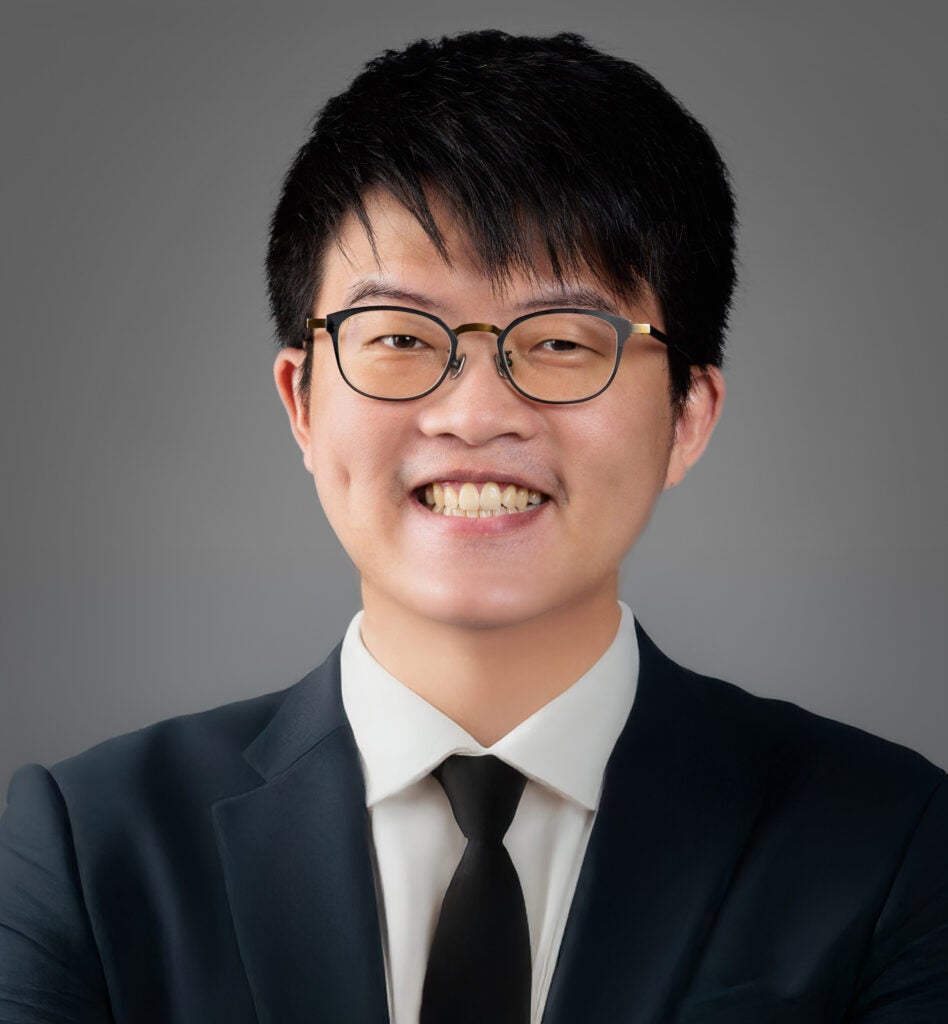
Dr. Fang-Cheng Liang is a Lecturer in the Department of Materials Science and Engineering at the National University of Singapore (NUS), joining in 2024. Previously, he served as a Research Assistant Professor at the Research and Development Center for Smart Textile Technology, National Taipei University of Technology (NTUT), Taiwan, where he advised PhD and Master’s students. He holds dual Ph.D. degrees in Organic Chemistry and Polymer Science & Engineering from Université Grenoble Alpes and NTUT (2019). His interdisciplinary research focuses on sustainable self-healing soft materials, reconfigurable liquid crystal elastomers, and metal particle applications for 3D-printed micro/nanostructures, soft robotics, and wearable electronics. Key research interests include: Self-healing polymers tailored for electronic skin and underwater devices Functional liquid metal composites for soft wearable electronics Perovskite-based optoelectronics with enhanced stability MXene-reinforced piezoelectric nanogenerators for energy harvesting Notable achievements include: Featured journal cover articles in Advanced Materials (2023) and Advanced Science (2021) Member of the Materials Horizons Community Board Over 20 peer-reviewed publications in top journals like Advanced Functional Materials and Chemical Engineering Journal His research group emphasizes synergistic material design, with recent breakthroughs in underwater self-healing polymers for soft electronics and laser nanophotonics applications. Projects often bridge polymer science, nanotechnology, and device engineering to address challenges in environmental sustainability and wearable technology.
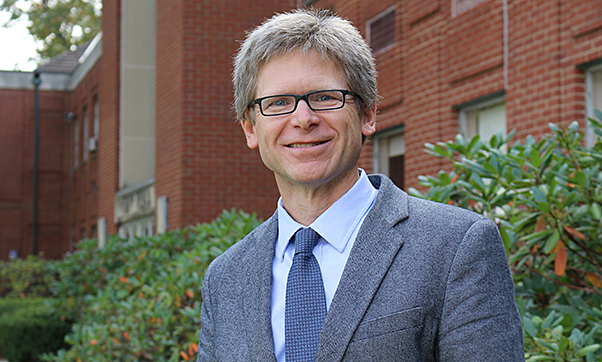
Miguel P. Eckstein is a Professor in the Department of Psychological & Brain Sciences at the University of California, Santa Barbara (UCSB). His research focuses on computational human vision, visual attention, and perceptual learning, with applications in medical imaging and bio-inspired computer systems. He holds affiliations with the Vision and Image Understanding Lab and has served on editorial boards for journals like Journal of Vision and Journal of the Optical Society of America A . Education: Bachelor's Degrees in Physics and Psychology, UC Berkeley Doctoral Degree in Cognitive Psychology, UCLA Research interests integrate behavioral psychophysics, EEG, fMRI, and computational modeling to understand visual perception and decision-making. Applied work includes improving diagnostic accuracy in medical imaging and developing bio-inspired AI systems. Awards & Recognition: National Academy of Sciences Troland Award (2019) Guggenheim Fellowship (2021) National Science Foundation CAREER Award He has published over 170 articles across interdisciplinary journals, including Proceedings of the National Academy of Sciences , Nature Human Behavior , and Neural Information Processing Systems (NIPS) .
Hamed RAHIMI NOHOOJI is a Postdoctoral researcher at the University of Luxembourg's Interdisciplinary Centre for Security, Reliability and Trust (SnT), specifically within the Automation department under Prof. Holger Voos's research group. He holds a Ph.D. from Curtin University (Australia, 2018) and has held research positions at the National University of Singapore, UC Louvain, University of Pisa, and the University of Birmingham. His research focuses on soft robotics , adaptive control systems , and human-robot interaction , with notable contributions to projects like the EU H2020 CYBERLEGs Plus Plus initiative and Singapore's A*STAR-funded soft gripper development. His work spans neuroadaptive control , reinforcement learning , and fault-tolerant systems , with applications in space robotics, wind turbine control, and collaborative robotics. With over 900 citations and an H-index of 18 (Google Scholar, 2023), his publications appear in top journals like Mechanical Systems and Signal Processing (IF 8.934) and Neurocomputing (IF 5.779). He has authored four Springer book chapters and served as a guest editor for journals including Frontiers in Robotics and AI and IEEE Transactions on Industrial Electronics . Research interests include: Soft Robotics : Design of compliant actuators, jamming grippers, and topology-optimized soft mechanisms Control Systems : Barrier Lyapunov functions, Nussbaum gain techniques, and neuroadaptive methods Human-Machine Collaboration : Adaptive trajectory optimization for safe human-robot interaction Space Applications : Soft robotics for extraterrestrial missions and compliant systems for space environments His recent articles emphasize constrained control systems , reinforcement learning for robotics , and lightweight gripper design for aerial platforms . His work often bridges theoretical control principles with practical robotic implementations in dynamic environments. Scientific achievements include a Student Travel Award at the 2016 Australasian Conf on Robotics and Automation. He has edited topical collections on Human-Robot Interaction and Soft Robotics , reflecting his leadership in shaping the field's research directions. Labs/Teams: Member of the Automation & Robotics Research Group at SnT, collaborating with Prof. Holger Voos and international partners on EU-funded projects.
Mark Minor is a Researcher in the Department of Mechanical Engineering at the University of Utah. His research focuses on wearable robots, virtual reality, soft robotics, haptics, and automated ground vehicles. He has contributed to projects like the MeLLO Data Library and developed haptic terrain display technologies. Key articles include work on augmented RF propagation modeling and digital spectrum twins, reflecting his interdisciplinary approach spanning robotics, control systems, and human-robot interaction. His recent work emphasizes autonomous vehicle control systems, soft robotic materials, and safety mechanisms in human-robot collaboration. Collaborations include contributions to the POWDER platform for radio dynamic zones and advancements in multi-sensory VR interfaces. Notable research themes include terrain modeling for robotics, bio-inspired mechanisms, and improving mobility technologies for assistive devices. His work integrates both hardware development and algorithmic innovation, particularly in haptic feedback and modular robotic systems.
Pamela Abshire is a Professor in the Department of Electrical and Computer Engineering and the Institute for Systems Research at the University of Maryland, College Park. She holds the rank of Fischell Institute Fellow and is affiliated with the Maryland Robotics Center, Brain and Behavior Institute, and Robert E. Fischell Institute for Biomedical Devices. Her work bridges VLSI circuit design and bioengineering, focusing on performance-resource tradeoffs in natural/engineered systems. Education: B.S. Physics (Caltech, 1992), M.S. and Ph.D. in Electrical Engineering (Johns Hopkins University, 1997 and 2001). Pre-UMD career included R&D roles at Medtronic (1992-1995). Research focuses on CMOS biosensors, low-power microsystems, and bio-inspired designs for applications like cell-based sensing, robotics, and medical devices. Notable projects include nose-on-a-chip odor detection systems, ant-like microrobots, and lab-on-CMOS platforms for real-time cell monitoring. Awards include IEEE Fellow (2018), NSF CAREER Award (2003), and 2021 University Distinguished Scholar-Teacher honor. Active in academic leadership roles including ADVANCE Professor (2020-2021) and editorial work for IEEE Transactions on Circuits and Systems. Grants include NSF funding for olfactory sensing, AFOSR bio-inspired flight tech, and DARPA CogniSense initiatives. Her Integrated Biomorphic Information Systems Lab collaborates on semiconductor innovation through partnerships like the Mid-Atlantic Semiconductor Collaborative. Labs/Teams: Leads the Integrated Biomorphic Information Systems Lab and contributes to Microelectronics at Maryland group. Co-develops biohybrid systems integrating CMOS, MEMS, and biological components.
Elio Tuci is a Professor at the Faculty of Computer Science , University of Namur , Belgium (since 2022). Prior roles include Senior Lecturer at Middlesex University London (2016–2018) and Lecturer at Aberystwyth University (2010–2016). He holds a PhD in Computer Science and Artificial Intelligence from the University of Sussex (2004) and a Master in Experimental Psychology from Sapienza University of Rome (1996). His research lies at the intersection of bio-inspired robotics , computational intelligence , and collective decision-making . He designs control mechanisms for autonomous agents to operate in complex environments, drawing inspiration from biological systems. Key themes include agent-environment interaction, communication in multi-robot systems, and the relationship between morphological structure and behavior. Recent work involves robot swarming models for Caenorhabditis elegans behavior; synchronization mechanisms in e-puck2 robots; evolutionary dispersal strategies under information costs. He co-organizes the WIVACE workshops and leads projects like BABOTS (swarming biological robots) and AUTOMATic (urban traffic management). His research has been featured in media outlets discussing robotics and self-driving technology. He advises PhD students and collaborates with teams at the Namur Digital Institute (NADI) and Namur Institute for Complex Systems (naXys) . Grants and projects focus on autonomous systems, transgenic organisms, and complex network synchronization.
Ludovico Minati is a multidisciplinary researcher with appointments as a Specially-Appointed Associate Professor at Tokyo Institute of Technology (Japan) and Visiting Researcher at the University of Trento's Center for Mind/Brain Sciences (CIMeC). He holds concurrent positions as Visiting Professor at the Institute of Nuclear Physics – Polish Academy of Science and serves as a contract lecturer at the Free University of Bolzano. Education: PhD in Neuroscience, Brighton & Sussex Medical School (2012) Dr. Hab. in Physics, Institute of Nuclear Physics – Polish Academy of Science (2017) MSc in Applied Cognitive Neuroscience, University of Westminster (2008) MSc in Medical Physics, The Open University (2009) MSc in Science, The Open University (2006) BSc in Physical Science, The Open University (2009) BSc in Information Technology, The Open University (2004) Research Focus: Minati investigates emergent synchronization phenomena in nonlinear electronic and neural systems, developing bio-inspired electronic circuits to model brain dynamics. His work bridges experimental physics, neural network theory, and robotics, emphasizing chaotic oscillators, brain connectivity analogs, and hardware implementations of neural-like dynamics across multiple scales. Publication Trends: Recent articles (2015-2019) demonstrate consistent focus on nonlinear synchronization phenomena, experimental chaos in electronic circuits, and neural-electronic analogies. Research evolves from fundamental oscillator networks toward applications in robotics control systems and multi-scale brain modeling, with increasing complexity in hardware implementations. Honors & Recognition: Chartered Engineer (CEng), UK Engineering Council Chartered Physicist (CPhys), UK Institute of Physics Chartered Scientist (CSci), UK Science Council IEEE Senior Member Editorial Leadership: Holds editorial positions for Chaos Solitons & Fractals , IEEE Access , Frontiers in Physiology , Entropy , and Complexity , contributing to special issues on nonlinear systems and neural engineering.
Kirstin Hagelskjaer Petersen is an Assistant Professor and Aref and Manon Lahham Faculty Fellow at Cornell University's School of Electrical and Computer Engineering , while also serving as Visiting Professor at Germany's Cluster of Excellence IntCDC (University of Stuttgart). She directs Cornell's Collective Embodied Intelligence Lab , pioneering bio-inspired robotics solutions. B.S. in Electro-technical Engineering (Odense University College of Engineering, 2005) M.S. in Computer Systems Engineering (University of Southern Denmark, 2008) Ph.D. in Computer Science (Harvard University, 2014) Her research focuses on collective robotic systems that emulate natural swarms (ants, bees, termites), emphasizing hardware-software co-development , human-swarm interaction , and bio-hybrid collectives . By integrating environmental dynamics into design, her work addresses scalable autonomy, error tolerance, and physical interaction optimization. Publications demonstrate expertise in soft robotics , swarm coordination , and biological-behavior translation across disciplines like entomology and architecture. Her ShadowSense technology (2020) enables touch detection through shadow imaging, reducing sensor complexity while maintaining privacy. Packard Fellowship for Science and Engineering (2019) Elisabeth Schiemann Kolleg Fellow (2016) Science Magazine Top 10 Scientific Achievement (2014) She leads NSF-funded projects on inflatable social robots for emergency guidance, collaborating with entomologists and plant scientists. Her lab develops bio-inspired solutions for digital agriculture and autonomous construction, with applications in emergency response and environmental monitoring.
Giovanni Iacca is an Associate Professor at the University of Trento's Department of Information Engineering and Computer Science (DISI), where he serves as Coordinator of the Master's Degree in Computer Science and Deputy Director of the Information Engineering and Computer Science Doctoral School. He leads the Distributed Intelligence and Optimization Lab (DIOL) and teaches courses including Computer Architectures, Introduction to Machine Learning, Bio-Inspired Artificial Intelligence, and Optimization Techniques across multiple academic programs. PhD in Computer Science, University of Jyväskylä, Finland (2011) MSc in Computer Engineering, Technical University of Bari, Italy (2006) Professor Iacca's research focuses on the intersection of evolutionary computation, machine learning, and optimization with applications in distributed systems and robotics. His work spans from theoretical foundations of memetic computing and multi-objective optimization to practical implementations in soft robotics, embedded systems, and healthcare applications. Recent efforts emphasize interpretable AI, particularly in reinforcement learning contexts, where his team develops methods to make decision processes transparent while maintaining performance. His research bridges the gap between fundamental algorithmic development and real-world engineering challenges, with over 15 years of industrial experience in optimization applied to engineering, logistics, and scheduling. Analysis of his recent publications reveals a strong trend toward interpretable AI systems, particularly in reinforcement learning contexts, with significant contributions to federated learning optimization, evolutionary neural architecture search, and applications in healthcare scheduling. His work consistently combines evolutionary algorithms with modern machine learning techniques to solve complex optimization problems across diverse domains including soft robotics, batteryless edge computing, and supply chain management. Scientific Awards: EvoApplications Best Paper Award (2017) UKCI AWARENESS Best Paper Award (2012) IEEE CIS Outstanding Student-Paper Award (2011) Professor Iacca actively supervises a large research group with numerous PhD students across multiple doctoral programs, including Information Engineering and Computer Science, Industrial Innovation, and the National PhD in Artificial Intelligence for Society. His lab has secured significant research funding through collaborations with industry partners and international research consortia. Recent grants support work on interpretable reinforcement learning, federated optimization, and applications of evolutionary computation in healthcare and robotics. He has also been appointed to editorial roles for prestigious journals including IEEE Transactions on Evolutionary Computation and Evolutionary Intelligence. The Distributed Intelligence and Optimization Lab (DIOL) under Professor Iacca's leadership comprises over 30 researchers including postdocs, PhD students, and master's students. The lab maintains strong international collaborations and has developed specialized expertise in evolutionary computation, interpretable AI, and optimization for embedded systems. Current projects include work on the EIC Pathfinder Challenge "Awareness Inside," development of methods for batteryless edge intelligence, and applications of evolutionary algorithms to healthcare scheduling problems.
Erik J. Anderson is a Professor of Mechanical Engineering at Grove City College. His research bridges engineering and biology, focusing on aquatic biomimetic robotics, undulatory/jet propulsion, flow sensing, and fluid dynamics. He teaches courses in applied fluid dynamics, biomechanics, mathematical methods, and senior design projects.
Paolo Motto Ros is a Researcher specializing in biomedical engineering, wearable systems, and low-power electronics. He has extensive experience in event-driven signal processing , functional electrical stimulation , and biocompatible sensor design , with a focus on human-machine interfaces and implantable devices. His research interests include: Biomedical instrumentation Wireless power/data transmission Surface electromyography (sEMG) Low-complexity embedded systems Plant impedance monitoring Neuroprosthetics Recent publications highlight collaborations with institutions on piezoelectric skin sensors , CMOS neural implant circuits , and plant health monitoring systems . His work spans applications in healthcare, robotics, and environmental technology.
Valeria Criscuolo is a Researcher in the Neuroelectronic Interfaces department at RWTH Aachen University. She holds a PhD in Chemical Sciences from the University of Naples Federico II, earned in 2017, and has extensive experience in organic electronics and bio-inspired materials. Her career spans roles at the University of Washington, University of California, Santa Cruz, University of Rome Tor Vergata, and the Italian Institute of Technology. Bachelor’s Degree in Chemistry (2006–2010) Master’s Degree in Chemical Sciences (2010–2013) PhD in Chemical Sciences (2014–2017) Her research focuses on bio-inspired organic materials for optoelectronic devices, including OLEDs and wearable epidermal sensors. Recent work explores azobenzene-based semiconductors for neuromorphic platforms and 3D conductive structures for bioelectronic applications. She has contributed to understanding skin bioimpedances and developing light-driven morphing pillars for biointerfacing. Valeria’s publications highlight interdisciplinary trends merging chemistry, neuroscience, and materials science. Topics include melanin-inspired OLEDs, neurohybrid devices, and sustainable organic electronics. Her work bridges fundamental material synthesis with practical applications in wearable sensors and neuromorphic engineering.
Peter Janků serves as an Assistant Professor at the Department of Informatics and Artificial Intelligence within the Faculty of Applied Informatics at Tomas Bata University in Zlín, Czech Republic, a position he has held since 2019 following his appointment as assistant (2015-2019). Educational background: Ph.D. in Information Technology, Tomas Bata University in Zlín (2011-2019) Ing. (Master's) in Information Technology, Tomas Bata University in Zlín (2009-2011) Bc. (Bachelor's) in Information Technology, Tomas Bata University in Zlín (2006-2009) Research Interests: Dr. Janků specializes in Artificial Intelligence with emphasis on Swarm Intelligence and Robotics, evidenced by international collaborations at premier institutions including IRIDIA (Brussels), SwarmLab (NJIT), and Bristol Robotics Laboratory. His work integrates bio-inspired computing methodologies with multi-agent systems development. Scientific Awards: No awards or fellowships were documented in the provided materials. Advising and Grants: The source text contains no references to graduate students supervised or research funding secured. His academic activities focus on teaching and international research exchanges through Erasmus program engagements. Laboratory Affiliations: Active collaborations include IRIDIA (Université Libre de Bruxelles), SwarmLab at NJIT (USA), Bristol Robotics Laboratory (UK), and Japanese institutions including The University of Tokyo during 2019 research internships.
Giuseppe Carbone is a Full Professor at the Department of Mechanics, Mathematics & Management, Politecnico di Bari, Italy. His research bridges theoretical and experimental mechanics, specializing in tribology, contact mechanics, viscoelastic materials, adhesion phenomena, and biomimetic engineering. He employs advanced numerical simulations and experimental methodologies to address complex mechanical challenges. Primary research domains include: Fundamentals of viscoelastic contact mechanics and friction dynamics Surface engineering for tribological optimization Biomimetic approaches for material and system design Advanced lubrication systems and bearing technologies Analysis of his 15 most recent publications (2024-2025) reveals a consistent focus on viscoelastic material behavior under dynamic contact conditions. Key trends include: Integration of numerical and experimental techniques for contact mechanics Innovations in adhesion/friction modeling for rough surfaces Applications in robotics, automotive systems, and bio-inspired engineering Development of novel computational methods for tribological systems
Professor Dan Luo is a faculty member in the Department of Electronic and Electrical Engineering at Southern University of Science and Technology (SUSTech). He earned his Bachelor's and Master's degrees from Tianjin University in 2004 and 2007, respectively, and completed his Ph.D. at Nanyang Technological University, Singapore in 2012. After working as a Research Fellow at NTU, he joined SUSTech as an Assistant Professor in 2013, was promoted to Associate Professor in 2018, and became a Full Professor in 2024. His educational background includes: Ph.D. in Electronic Engineering (2007-2012), School of Electrical & Electronic Engineering, Nanyang Technological University, Singapore M.E. in Electronics Engineering (2004-2007), School of Precision Instruments & Optoelectronic Engineering, Tianjin University B.E. in Electronics Engineering (2000-2004), School of Precision Instruments & Optoelectronic Engineering, Tianjin University Professor Luo's research focuses on liquid crystal technology and its applications. His work spans liquid crystal optoelectronic devices, energy-saving smart windows, biochemical optical sensors, augmented reality displays, and liquid crystal elastomer actuators. His research has significant implications for display technology, sensor development, and soft robotics, with particular expertise in blue-phase liquid crystals and liquid crystal elastomer materials. His numerous publications demonstrate expertise in liquid crystal photonics, with recent work focusing on blue-phase liquid crystals, liquid crystal elastomer actuators, and augmented reality displays. His research often involves interdisciplinary collaboration, particularly with materials science and optical engineering, and has resulted in over 140 papers with more than 3,900 citations and an H-index of 34. Professor Luo has received several prestigious awards: Otto Lehmann Award, Karlsruhe Polytechnic University, Germany (2011) Chinese Government Award for Outstanding Self-Financed Students Abroad (2011) SPIE Scholarship in Optics and Photonics (2012) IEEE Photonic Society Graduate Student Fellowships (2012) Southern University of Science and Technology Excellent Mentor Award (2016) Southern University of Science and Technology Young Research Award (2017) Southern University of Science and Technology Excellent Teaching Award (2017) Shenzhen Advanced Educator (2018) Talent of Peacock Program B, Shenzhen "Outstanding Youth" project of the Guangdong Basic and Applied Basic Research Foundation (2020) Professor Luo actively mentors students and has secured funding from multiple sources including the National Natural Science Foundation of China. He leads research projects related to liquid crystal technology and has been instrumental in developing SUSTech's capabilities in optoelectronics and photonics. His research group focuses on flexible robots and flexible sensors, with opportunities for postdoctoral researchers and research assistants. Professor Luo's laboratory work centers on liquid crystal technology applications, particularly in smart windows, optical sensors, and soft robotics. His team has made significant contributions to blue-phase liquid crystal research and liquid crystal elastomer actuator development, with applications ranging from energy-efficient building materials to advanced medical sensors.