Jérôme Héricourt is a Lecturer at the University of Lille 1, affiliated with the EQUIPPE laboratory . His academic background includes a graduate degree from Sciences-Po Paris, a doctorate, and accreditation to direct research (HDR) in economics from the University of Paris 1 Panthéon-Sorbonne. He has taught at the University of Paris 1 Panthéon-Sorbonne, University of Paris-Est Créteil, and Sciences-Po Paris. Research Interests : His work spans two primary domains: (1) monetary policy and corporate behavior under financial constraints, and (2) political economy , focusing on factors shaping voting criteria and individual political choices. His 2012 publication on immigration perception highlights intersections between public opinion, media discourse, and policy development. Collaborations & Affiliations : Collaborated with Gilles Spielvogel on immigration studies. Active within the EQUIPPE (Études et QUantifications en Politique Publique et Environnement) laboratory, a multidisciplinary research center at the University of Lille 1.
Daniel Schnurr holds the Chair of Machine Learning, especially Uncertainty Quantification at the University of Regensburg since August 2022, where he conducts research at the intersection of artificial intelligence, data economics, and digital market regulation. Previously, he headed the Data Policies research group at the University of Passau, building his expertise in the economic and regulatory aspects of digital markets. His educational background includes a doctorate in business informatics from the Karlsruhe Institute of Technology (2016), where he also worked for three years as a research associate at the Institute for Information Systems and Marketing. He completed his undergraduate and master's studies in Information Systems at KIT (2007-2013), with international experience at Concordia University in Canada and Singapore Management University. Professor Schnurr's research focuses on the technical, economic, and social implications of new machine learning methods and data as a decisive competitive factor and driver of innovation in digital markets. His work examines how data functions as both an economic asset and regulatory challenge, particularly in contexts of market power, competition policy, and AI governance. He investigates uncertainty quantification in machine learning systems while considering their broader economic and societal impacts. His publication portfolio demonstrates consistent output in top-tier journals including Management Science, Journal of Information Technology, and Journal of Competition Law & Economics, with recent work increasingly focusing on AI regulation, data access remedies, and uncertainty-aware AI systems. The trajectory shows evolution from telecommunications infrastructure research to contemporary digital market and AI regulation issues. As a Research Fellow at the Centre on Regulation in Europe (CERRE) since 2022, he has authored numerous policy reports addressing regulation of cloud computing services, digital platforms, and data economy frameworks. His policy contributions bridge academic research with practical regulatory implementation, particularly regarding the European AI Act and Digital Services Act. His research program involves experimental approaches to understanding data markets, human-AI interaction dynamics, and regulatory effectiveness. Through his work at CERRE and collaborations with international scholars, he contributes to shaping evidence-based digital policy in the European context while maintaining strong connections to academic research communities in information systems and economics.
Chris Till is a Senior Lecturer in Sociology at Leeds Beckett University, specializing in the intersection of digital technologies, health practices, and social theory. His academic work critically examines how digital health technologies mediate contemporary social relations and subject formations within capitalist structures. Dr. Till's educational background includes studies at Nottingham Trent University and the University of Leeds. His research primarily focuses on self-tracking devices, corporate wellness programs, and the sociological implications of digital health technologies within contemporary capitalism. His scholarly work reveals consistent themes around digital labor, biopolitical control through health technologies, and the transformation of exercise and wellness practices into forms of labor under financialized capitalism. Till's research demonstrates how seemingly personal health tracking practices become integrated into broader systems of capital accumulation and social control. His publications show a clear trajectory examining the sociological dimensions of digital health, with particular attention to how corporate wellness initiatives transform individual health behaviors into productive labor for capital. The recurring themes across his work include the examination of self-tracking as a form of digital labor, the commercialization of bodies through wellness technologies, and the construction of new subjectivities within digital capitalism. As an educator, Till has developed academic writing tools to support student development, demonstrating his commitment to pedagogical innovation alongside his research interests in digital practices.
Tiffany D. Barnes is a Professor in the Department of Government at the University of Texas at Austin. She holds a PhD from Rice University and specializes in Comparative Politics with a focus on gender and politics, Latin American politics, and political leadership. Her research examines institutional influences on political behavior through quantitative and qualitative methods. Education: PhD, Rice University Her work has secured over $600,000 in grants and includes authorship of four books: Gendering Legislative Behavior , Working Class Inclusion , The Representational Consequences of Electronic Voting Reform , and Women, Politics, and Power . She co-edits the Elements in Gender & Politics series for Cambridge University Press and serves as editor at the British Journal of Political Science . Scientific awards include the Emerging Scholar Award (2018), Early Career Award (2017), Alan Rosenthal Prize (2017), and Richard F. Fenno, Jr. Prize (2024). She founded The Empirical Study of Gender Research Network (EGEN) and has held prestigious fellowships at Notre Dame and Tulane.
Max H. Bazerman is the Jesse Isidor Straus Professor of Business Administration at Harvard Business School, specializing in negotiation, decision making, and behavioral ethics. His academic career spans several decades during which he has become a leading authority on how cognitive biases and ethical considerations influence organizational decision processes. Professor Bazerman's primary research interests include negotiation strategies, ethical decision making, judgment heuristics, and bounded awareness. His work explores how individuals and organizations can recognize and overcome cognitive limitations to make more ethical and effective decisions. He has pioneered research on blind spots in ethical judgment, the psychology of complicity, and decision architectures that promote better choices. His publications reveal a consistent focus on practical applications of behavioral science to real-world business challenges. Recent work examines resource allocation during crises, ethical leadership frameworks, and the role of experimentation in improving organizational decision making. The research shows increasing emphasis on systemic ethical failures and how individuals contribute to complicity in unethical behavior. Honorary doctorate from the University of London Life Achievement Award from the Aspen Institute's Business and Society Program Distinguished Educator Award from the Academy of Management Academy of Management Career Award for Scholarly Contributions to Management Lifetime Achievement Award from the Organizational Behavior Division of the Academy of Management Ethisphere's 100 Most Influential in Business Ethics Daily Kos' Heroes recognition for whistleblowing on the Bush Administration's corruption of the RICO Tobacco trial Bazerman has advised numerous organizations including Abbott, Aetna, AIG, Alcoa, Allstate, Amgen, and many others across 30 countries. His work bridges academic research and practical application, with significant influence on how businesses approach ethical decision making and negotiation strategy. He has trained doctoral students who now hold positions at leading business schools worldwide, including Harvard, Wharton, Kellogg, and Stanford.
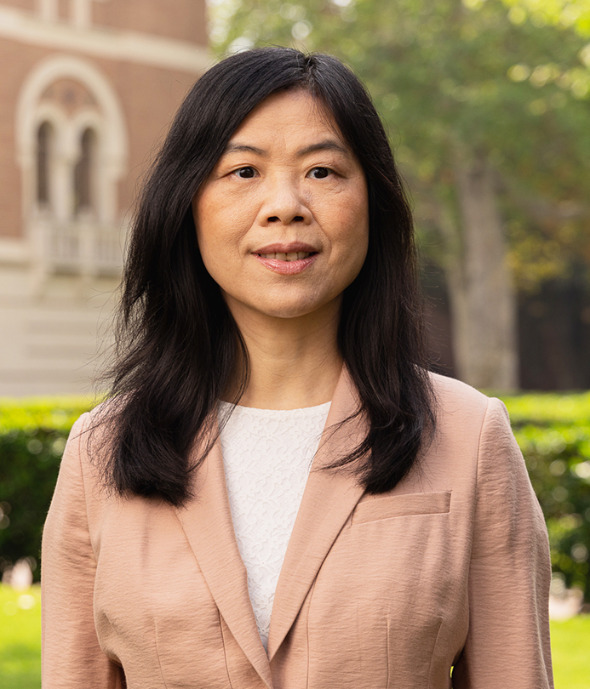
Sha Yang serves as the Ernest Hahn Professor of Marketing at the Marshall School of Business, University of Southern California, where she has held full-time faculty positions since 2017 after progressing from Assistant to Associate Professor roles at New York University and UC-Riverside. Her research examines interdependencies in consumer preferences, social influences on decision-making, and competitive dynamics in advertising, pricing, and platform growth. Her educational background includes a PhD in Marketing (2000) and MA in Statistics (1998) from Ohio State University, complemented by an MA in Economics (1995) and BA in International Economics (1994) from Renmin University of China. Her methodological expertise spans Bayesian methods, structural modeling, and data analytics applied to consumer behavior. Yang's research portfolio reveals consistent focus on digital marketing phenomena, with recent work analyzing cross-category spillovers in advertising, review impacts under negotiated pricing, and psychological pricing effects in luxury markets. Her publications in Journal of Marketing , Management Science , and Marketing Science demonstrate interdisciplinary approaches bridging econometrics and behavioral insights. Among her recognitions is the Marketing Science Institute Young Scholar award. She has served as Associate Editor for Journal of Marketing (2017-present) and Marketing Science (2017-2024), reflecting her scholarly impact. Marketing Science Institute Young Scholar Associate Editor, Journal of Marketing (2017-present) Associate Editor, Marketing Science (2017-2024) VP, INFORMS Society for Marketing Science Administratively, Yang served as Vice Dean and Senior Vice Dean for Faculty and Academic Affairs at Marshall School of Business (2020-2023), overseeing faculty development and academic strategy. Her current research integrates causal inference methods with media and entertainment industry applications, supported by grants from marketing research institutions.
Dr. Michael Gyensare is a Lecturer in the Department of Leadership and Management at the University of Kent. His research focuses on entrepreneurship, organizational behavior, and leadership dynamics, with particular emphasis on expatriate thriving, psychological contracts, and sustainable HRM practices in both global and African contexts. His scholarly work spans topics like entrepreneurial phronesis, cultural intelligence in international assignments, and polychronicity in venture performance. Recent publications examine green HRM strategies, frugal innovation in emerging markets, and the impact of chronic health challenges on entrepreneurial outcomes. His 2025-2024 publications reveal trends in entrepreneurial cognition, cross-cultural management, and resilience-building in volatile environments. Awards: No specific honors identified in the provided text.
Sir Paul Collier is a distinguished Professor of Economics and Public Policy at the Blavatnik School of Government, University of Oxford, where he also directs the Centre for the Study of African Economies. He serves as the Oxford Academic Director of the International Growth Centre, a collaboration between the London School of Economics and Oxford University. Professor Collier has established himself as a leading authority on development economics, particularly focusing on African economies, poverty reduction, and the political economy of development. His academic journey includes significant public service, having served as Director of the World Bank Research Development Department from 1998 to 2003. He currently advises the International Monetary Fund Strategy and Policy Department and writes regularly for major publications including The Independent and The New York Times. His extensive contributions to economic thought have been recognized with numerous prestigious awards. Professor Collier's research interests span a wide range of critical development issues. He has made significant contributions to understanding the "bottom billion" - the poorest populations in the world - and has developed innovative approaches to addressing regional inequality, natural resource management, and the political barriers to development. His work consistently bridges academic rigor with practical policy applications, making complex economic theories accessible to policymakers and the general public alike. His publications reveal a consistent focus on practical solutions to development challenges. Recent works have examined urbanization in developing countries, the relationship between elections and economic performance, infrastructure investment in Africa, and the cultural foundations of economic success or failure. His research demonstrates how institutional design, cultural factors, and appropriate policy frameworks can enable neglected regions to "spiral up" toward prosperity. A.SK Social Science Award (2013) Arthur Ross Prize (for The Bottom Billion) Handesblatt Prize (for The Future of Capitalism) Adam Smith Prize by Glasgow's Philosophical Society (2023) Global Citizenship Award by Belgium's cooperative movement (2018) Professor Collier is actively engaged in advising governments on practical approaches to regional renewal. His recent work emphasizes the importance of local agency, collective learning, and moral leadership in addressing the challenges faced by neglected communities in both developed and developing countries. He challenges conventional economic orthodoxies that prioritize market forces alone and advocates for more nuanced, context-specific policy approaches that recognize the complex interplay of economic, social, and political factors in development processes.
Boris Jukic is a Professor and Director of Applied Data Science at the Reh School of Business , Clarkson University. With a PhD from the University of Texas at Austin, he teaches courses such as Visual Basic Programming for Business Applications and Development of Business Applications on the Internet. Dr. Jukic's research focuses on: Management and pricing of networks and telecommunication services Application of data management and presentation strategies in e-business and e-commerce IT architecture's impact on organizational success metrics His recent publications highlight trends in data warehousing , IT architecture , and business intelligence . Notable subfields include data modeling , incentive-compatible pricing , and process-data integration . Contact: Email: bjukic@clarkson.edu Phone: 315/268-3884 Office: 227 Bertrand H. Snell Hall, Clarkson University
David Newburn is an Associate Professor in the Department of Agricultural and Resource Economics at the University of Maryland, College of Agriculture and Natural Resources. His research focuses on environmental and resource economics, particularly land-use regulations for farmland and forest preservation, and water quality in the Chesapeake Bay. He develops spatial models to manage urban sprawl and evaluates incentive-based programs for conservation practices. Research Areas: Land-Use Change and Urban Sprawl Water Quality Trading and Conservation Spatial Economic Modeling Payment for Ecosystem Services (PES) Collaborations: NSF-funded Baltimore Ecosystem Study (BES) National Center for Smart Growth Chesapeake Bay Program Scientific and Technical Advisory Committee Recent Publications: Highlight trends in household behavior, land-use policy effectiveness, and coastal adaptation to climate impacts. Articles span environmental economics, urban ecology, and interdisciplinary sustainability research. Education: B.S., University of Maryland, College Park (1991) Ph.D., University of California, Berkeley (2002)
Joseph Francois is a Professor of Economics and Director at the World Trade Institute (WTI) , affiliated with the Economic Institute at the University of Bern. He previously served as Deputy Director of the NCCR Trade Regulation (2015–2017) and held professorships at Johannes Kepler Universität Linz, Erasmus University Rotterdam, and other institutions. His research spans international economics, trade policy, globalization, environmental economics, and computable general equilibrium (CGE) modeling. Key focus areas include cross-border production chains, trade in services, open economy competition policy, financial market integration, and the interplay between trade agreements and sustainability goals. Scientific distinctions include a Fellowship at the Centre for Economic Policy Research (London). His methodological expertise includes CGE modeling, econometric estimation of large nonlinear systems, and policy analysis of trade disputes, carbon border adjustments, and non-tariff measures. Education: Ph.D. in Economics, University of Maryland BA in Economics and History, University of Virginia He has contributed extensively to policy briefs and technical reports, particularly in analyzing trade impacts on employment, economic development, and environmental outcomes.
Dr. Oussama AMMAR is a Full Professor of Strategy and serves as Dean of Programs at Montpellier Business School since November 2020. He leads the development and internationalization of academic programs, overseeing operations including student mobility, career services, and quality initiatives. Previously, he held roles as Dean of the US Campus of SKEMA Business School in Raleigh, North Carolina, and Associate Dean of Undergraduate Programs at SKEMA’s Lille campus. His academic leadership spans faculty management, curriculum design, accreditation compliance, and strategic planning. His research focuses on business model innovation, strategic management in SMEs, and change management. Notable contributions include studies on Alibaba’s strategic capabilities, gender leadership in IT sectors, and participative innovation in organizations like SNCF. He has also explored synergies between economic intelligence and knowledge management to enhance organizational absorption capacity. Dr. AMMAR’s career includes over 20 years of teaching strategic management across diverse audiences. His academic leadership roles at both Montpellier Business School and SKEMA reflect his expertise in global academic governance and program development. He holds a global perspective shaped by roles in France, the US, China, and Brazil.
Anna Dreber is the Johan Björkman Professor of Economics at Stockholm School of Economics and Editor at the Journal of Political Economy Microeconomics. Her research focuses on meta-science, investigating the credibility of scientific results through replication studies and prediction markets. She has led large-scale replication projects in experimental economics, psychology, and social sciences. Additional research examines gender differences in economic preferences and hormonal influences on decision-making. She teaches Gender Economics and develops meta-science methodologies through Lab2 research hub and Institute for Replication.
Dan A. Iancu is an Associate Professor of Operations, Information & Technology at Stanford Graduate School of Business, affiliated with the Emmett Interdisciplinary Program in Environment and Resources (E-IPER). He holds a BS from Yale, SM from Harvard, and PhD from MIT. His research bridges operations, finance, and sustainability, focusing on dynamic optimization under uncertainty and its applications in supply chains, FinTech, and healthcare. Notable work includes designing financing solutions for global supply chains and promoting ethical analytics. Education: BS in Electrical Engineering (Yale, 2004), SM in Engineering (Harvard, 2006), PhD in Operations Research (MIT, 2010). Professional experience includes a Goldstine Fellowship at IBM Research and teaching roles at Wharton and INSEAD. He has won multiple awards including INFORMS Optimization Society (2009) and JFIG (2013) prizes. Research emphasizes fairness and environmental impact, with recent projects on sustainable palm oil production and climate impacts of digital supply chains. His work appears in Management Science, Operations Research, and Mathematics of Operations Research. Awards include Srivani Faculty Scholar (2023–24) and teaching commendations at Harvard, MIT, and INSEAD. He advises on multi-disciplinary projects involving engineering, environmental science, and business students.
Professor Linda M. Burton is a leading sociologist and ethnographer specializing in child welfare, poverty, and family dynamics. Currently serving as Dean of Berkeley Social Welfare (2019-2024) and holding the Eugene and Rose Kleiner Chair, she previously held the James B. Duke Professorship at Duke University and directed its Center for Child and Family Policy. Education: PhD in Sociology from the University of Southern California Leadership: Dean at Berkeley Social Welfare, Director of Duke's Center for Child and Family Policy, Co-director of Duke's undergraduate International Comparative Studies program Her research integrates life course theory, developmental frameworks, and ecological perspectives to examine: Intergenerational family structures and role transitions Context/place influences on family dynamics Childhood adultification and accelerated life courses Recent publications focus on health disparities, welfare reform impacts, and multi-method ethnographic approaches. Key subfields include poverty, African-American families, rural/urban contexts, racial inequality, and kinship networks. Scientific honors include: 2022 Fellow of the American Academy of Social Work and Social Welfare 2017 Dean’s Excellence in Mentoring Award (Duke University) 1996 American Family Therapy Academy Award for Innovative Contributions Burton's ethnographic work spans decades, with landmark studies like the Three-City Study (2002-2006) and the Family Life Project (2003-2008). She has mentored extensively in child development and multi-generational research.