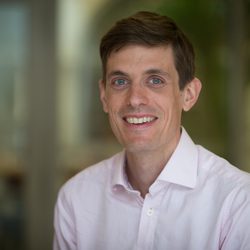
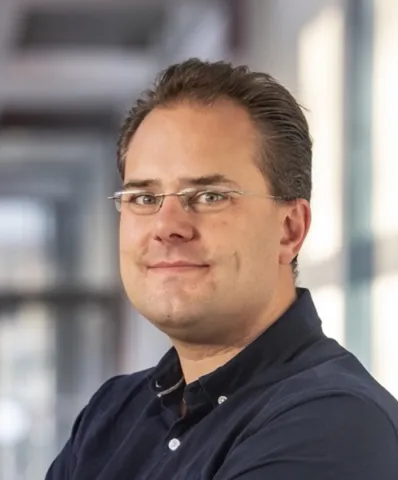
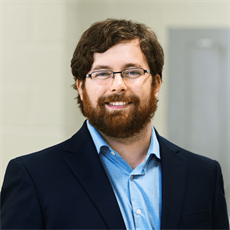
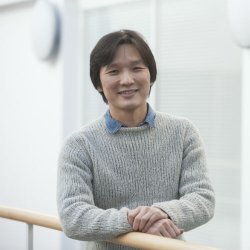
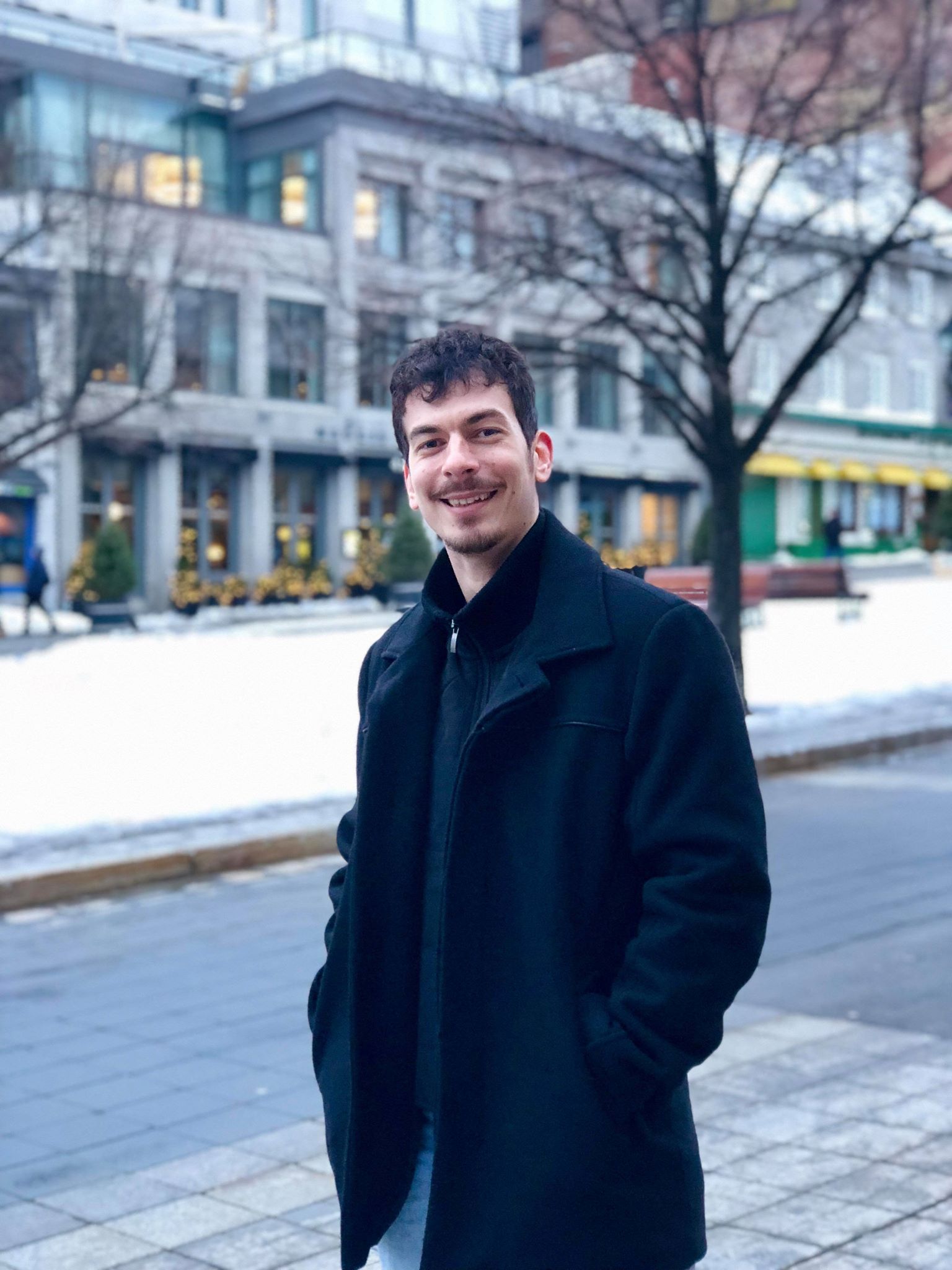
Michael A Osborne is Professor of Machine Learning at the University of Oxford and leads the Bayesian Exploration Lab . He serves as Director of the EPSRC Centre for Doctoral Training in Autonomous Intelligent Machines and Systems and co-directs the Oxford Martin AI Governance Initiative. His research focuses on Bayesian optimization, Gaussian processes, and probabilistic numerics with applications in quantum devices, battery modeling, and AI governance. Key Positions: Professor of Machine Learning, University of Oxford Official Fellow, Exeter College Co-founder of Mind Foundry Lead Researcher, Oxford Martin Programme on Technology and Employment Research Themes: Probabilistic modeling for quantum systems Uncertainty quantification in energy storage AI safety and societal impact analysis Automated experimental design Quantum device calibration Probabilistic numerical methods Technical Contributions: Bridging reality gap in quantum devices Efficient Bayesian quadrature techniques Personalized neurostimulation algorithms Automated measurement protocols Quantum-classical hybrid ML
Perla Maiolino serves as an Associate Professor in Engineering Science at the University of Oxford and Principal Investigator of the Soft Robotics Lab (SRL) within the Oxford Robotics Institute. Her academic foundation includes BEng, MEng, and PhD degrees in Robotics and Automation from the University of Genoa, where she pioneered CySkin technology for distributed tactile sensing in robots—later exhibited at the Science Museum in London. She expanded her expertise during a 2017-2018 postdoctoral fellowship at Cambridge University's Biologically Inspired Robotics Lab, focusing on soft robotics and tactile perception. Dr. Maiolino's research centers on developing artificial skin systems, soft robotic actuators, and distributed sensing architectures. Her work bridges biological inspiration with engineering innovation to create robots capable of safe human interaction and dexterous manipulation in unstructured environments. Key contributions include compliant beaded-string jamming mechanisms for anthropomorphic fingers, monolithic 3D-printed soft pneumatic arms (JAMMit!), and distributed time-of-flight sensor networks for robotic self-awareness. Recent publications (2024-2025) reveal a strong convergence of tactile sensing with machine learning, featuring optical flow for gesture recognition, diffusion models for artificial skin simulation, and zero-shot sim-to-real transfer techniques. Her team has made significant advances in multi-modal sensing integration, variable stiffness actuation, and scene flow estimation for robots operating in dynamic surroundings. Scientific Awards No specific awards were documented in the provided institutional materials. Advising and Grants While her leadership of the Soft Robotics Lab implies active student supervision and grant management, detailed information about advisees or funded projects was not included in the source documentation. Labs and Teams As Principal Investigator of the Soft Robotics Lab at Oxford Robotics Institute, Dr. Maiolino directs research on tactile perception systems, soft actuation mechanisms, and sensor-integrated robotic structures. The lab's work focuses on applications requiring safe physical interaction, including healthcare robotics and human-robot collaboration scenarios, with emphasis on multi-material 3D printing and embedded sensing technologies.
Professor Thomas Blumensath is a Professor of Signal and Image Processing at the University of Southampton and a Fellow at the Alan Turing Institute. He is the Academic Lead in Image Processing and Reconstruction at the University's μ-VIS X-ray Imaging Centre and Director of Research at the Institute of Sound and Vibration Research (ISVR). His research focuses on advanced algorithms for solving inverse problems in tomographic imaging, combining machine learning, optimization, and statistical methods. Key areas include X-ray tomography strategies, GPU-accelerated reconstruction, and multimodal imaging applications. Education: B.Sc. (Hons) Music Technology and Audio System Design, University of Derby (2002) PhD in Electronic Engineering (Bayesian Signal Processing), University of London (2006) Research Interests: Professor Blumensath's work spans theoretical and applied signal/image processing, with emphasis on tomographic imaging techniques. His current projects address efficient reconstruction methods, spectral X-ray CT, and applications in manufacturing and plant science. He collaborates with advanced imaging facilities like Diamond Light Source and ISIS neutron imaging beamline. Key Contributions: His research bridges computational methods (e.g., compressed sensing) with practical imaging challenges, including limited-angle tomography and stereo imaging strategies. He leads the National Research Facility for Lab X-ray CT and has developed the TIGRE reconstruction toolbox. Grants & Projects: Active funding includes EPSRC projects on tomographic sensitivity monitoring and CT-based manufacturing inspections. Completed projects cover constrained reconstruction, AM process verification, and industrial CT metrology. Awards: Alan Turing Institute Fellowship Teaching & Leadership: He teaches modules on machine learning, biomedical image processing, and robotics. Leads the BEng Control Engineering program at the Joint Education Institute with Harbin Engineering University. Labs/Teams: Active in the Signal Processing, Audio and Hearing research group (SPAH) and the Institute for Life Sciences. Oversees the μ-VIS X-ray Imaging Centre's research initiatives.
Richard Nickl is a Professor of Mathematical Statistics at the University of Cambridge, affiliated with the Department of Pure Mathematics and Mathematical Statistics (DPMMS) and the Statistical Laboratory. His research focuses on high-dimensional inference, Bayesian nonparametrics, statistics for partial differential equations, and inverse problems. He has held significant grants, including an ERC Advanced Grant (2024–2029) and an EPSRC Programme Grant (2022–2027). His work bridges statistics, probability, and analysis, with contributions to theoretical foundations and computational methods in non-linear inverse problems. Key research interests include Bayesian posterior consistency, statistical inference for diffusions, and polynomial-time algorithms for high-dimensional posteriors. Notable publications include foundational monographs such as Mathematical foundations of infinite-dimensional statistical models (2016), which earned a PROSE Award, and recent advancements in Bayesian nonparametric inference for McKean-Vlasov models (2025). His group organizes workshops, such as the 2024 Statistical Aspects of Non-Linear Inverse Problems conference. Awards: 2017 PROSE Award in Mathematics. Grants: ERC Advanced Grant, EPSRC Programme Grant. Lab/Team: Research Group in Mathematical Statistics at DPMMS, focusing on inverse problems and Bayesian methodology.
Professor Tim Dodwell holds a personal chair in Machine Learning at the University of Exeter, spanning the Department of Mechanical Engineering and the Institute of Data Science and AI. He leads the Data Centric Engineering Group and serves as co-founder and CTO of digiLab, a deep tech startup. His prestigious appointments include a 5-year Turing AI Fellowship from the Alan Turing Institute and the Romberg Visiting Professorship at Heidelberg University in Scientific Computing. His academic foundation includes a 1st class BSc in Mathematics from the University of Bath (2004-2008) and a PhD in Applied Mathematics from the Bath Institute of Complex Systems (2009-2012), where he researched variational models for complex materials under Professors Giles Hunt and Mark Peletier. Dodwell's research pioneers the intersection of applied mathematics, probabilistic machine learning, and high-performance computing, with signature contributions to Multilevel Methods in Bayesian Inverse Problems , Generative Hybrid Modelling , and Machine Learning in Safety Critical Engineering . His work bridges theoretical data science with industrial applications across nuclear fusion, aerospace materials, air traffic control, nuclear decommissioning, water treatment, and urban solar energy systems. His major recognitions include: Turing AI Fellowship (2019-2024) Romberg Visiting Professorship at Heidelberg University Visiting Professorship at MIT Prize Fellowship in Engineering Mathematics (2013-2015) Pro Vice Chancellors Fellowship (2015-2018) Through competitive fellowships and digiLab initiatives, Dodwell secures funding for uncertainty quantification research while driving real-world impact in sustainability sectors. His dual academic-industry roles enable rapid translation of theoretical advances into engineering solutions, particularly through digiLab's twinLab platform which delivers 60,000x acceleration in simulation workflows. He directs the Data Centric Engineering Group at Exeter and co-founded digiLab's multidisciplinary team comprising AI specialists, domain experts, and educators. The organization operates through three synergistic pillars: developing AI solutions for critical infrastructure, building the twinLab platform for industrial ML deployment, and running an ML academy for practitioner training through datacamps, internships, and specialized courses.
Professor Tony Shardlow is affiliated with the Department of Mathematical Sciences at the University of Bath , UK. His research spans Stochastic Differential Equations , Bayesian Inverse Problems , Statistical Shape Modelling , and Numerical Analysis , with applications in data science, medical imaging, and computational physics. Labs/Teams : IMI (Institute for Mathematical Innovation), Prob-L@b (Probability Laboratory at Bath), SAMBa (EPSRC Centre for Doctoral Training in Statistical Applied Mathematics). Recent Research Trends : Focus on geometric shape analysis using flow fields, stochastic PDEs for particle dynamics, and Bayesian inference techniques in industrial and medical contexts. Collaborative work bridges computational mathematics with applications in hip dysplasia assessment and pesticide delivery systems. Advising : Supervised Fengpei Wang's PhD thesis on dimension reduction and Sinkhorn algorithms. Collaborates with researchers like N. D. F. Campbell and C. Poon. Teaching : Offers MA30170 - Numerical Solution of Elliptic PDEs.
Dr. Masoumeh Dashti is an Associate Professor in Mathematics at the University of Sussex, UK, affiliated with the School of Mathematical and Physical Sciences. She holds a PhD in Mathematics from the University of Warwick (2008) and prior degrees in Mechanical Engineering from Sharif University of Technology and Tehran Polytechnic. Her research focuses on Partial Differential Equations, Inverse Problems, Bayesian Inference, and their applications in fluid dynamics and epidemiology. Key research interests include: Bayesian approaches to inverse problems, sparsity-promoting estimators, uncertainty quantification, and mathematical modeling of epidemics on networks. She has contributed to foundational work on Besov priors and MAP estimator consistency in nonparametric Bayesian frameworks. Her publications span topics like network inference from epidemic data, contraction rates of posterior distributions, and fluid-structure interaction problems. She has secured grants including 'Two-dimensional stochastically perturbed shallow water equations' (2019-2023) and 'Confronting High Dimensional Network Models With Data' (2018-2022). Currently, she serves as an Associate Editor for SIAM-ASA Journal on Uncertainty Quantification and AIMS Foundations of Data Science . Teaching expertise includes Functional Analysis, Partial Differential Equations, and Calculus of Several Variables at both undergraduate and postgraduate levels.
Dr. Yongchao Huang is a Lecturer (Assistant Professor) in the School of Natural and Computing Sciences at the University of Aberdeen, where he has been employed since August 2023. He also holds affiliations with the University of Oxford and the University of Cambridge through past postdoctoral and collaborative roles. He is actively involved in research, teaching, and academic service, and is currently accepting PhD students. His educational background includes: DPhil in Engineering Science, University of Oxford (2013–2017) Additional training in Machine Learning at Oxford (2015–2019) Dr. Huang's research focuses on fundamental and physics-informed machine learning, with core interests in Bayesian inference, variational methods, generative modeling (especially score-based), reinforcement learning, and interdisciplinary AI applications in mechanics, biology, energy, climate, and finance. A central theme of his work is the inference and sampling of probability densities, particularly through innovative particle-based and physics-inspired computational frameworks. He founded the Computational and Physical Learning (CPL) lab at Aberdeen in 2023. His recent publications (2020–2025) reflect a strong trend in probabilistic machine learning, with increasing focus on physics-based inference methods such as electrostatics, fluid dynamics, and material point methods. These works bridge machine learning with applied mathematics and physical simulation, demonstrating a unique interdisciplinary approach. Topics span Bayesian neural networks, acoustic wave propagation, mortality modeling, and adversarial cybersecurity. Dr. Huang has received academic recognition through invitations to serve on program committees and editorial roles: Program Committee Member, ECAI 2024 Organizing Committee, Bioinference 2024 Guest Editor, Journal of Theoretical Biology Senior Scientific Advisor to a UK firm He has supervised 57 MSc theses independently and currently supervises one PhD student. He has secured research engagement through collaborations with institutions including Oxford, Cambridge, and industry partners. His teaching includes courses such as Introduction to Software Engineering , Software Process and Management , and Computational Intelligence at Aberdeen, as well as practicals in inference at Cambridge. Dr. Huang leads the Computational and Physical Learning (CPL) lab at the University of Aberdeen, a curiosity-driven research group focused on foundational advances in machine intelligence. Though currently a solo researcher due to limited resources, the lab emphasizes end-to-end research and open collaboration. He encourages student mobility and interdisciplinary exploration.
Dr Yvo Pokern is an Associate Professor in Statistics at University College London since 2018. His research focuses on computational statistics and machine learning, with expertise in diffusion processes and Bayesian methodology. He earned his PhD in mathematics under Andrew Stuart, a Masters at Paris XI with a dissertation at the Max-Planck-Institute in Leipzig, and was a postdoctoral researcher at Warwick University with Gareth Roberts and Wilfrid Kendall. His primary research interests include statistical inference for diffusion processes (particularly hypoelliptic diffusions and diffusions on manifolds), Bayesian methods such as Markov chain Monte Carlo, and statistical applications in spectroscopy (ENDOR). His work combines theoretical rigor with practical applications in diverse scientific domains. Analysis of his recent publications reveals a consistent theme of developing and applying advanced statistical techniques to complex real-world problems, including traffic flow, fingerprint analysis, and magnetic resonance spectroscopy. Dr Pokern has supervised numerous PhD students, several of whom have gone on to academic careers. Notable former students include Mai Ngoc Bui (now lecturer at the British University Vietnam) and Tjun Yee Hoh (now lecturer at UCL School of Management).
Dr. David R. Themens is an Associate Professor in Space Environment within the Space Environment and Radio Engineering (SERENE) group in the School of Engineering at the University of Birmingham. He specializes in modeling and mitigating the impacts of space weather on radio communications and navigation systems, with a particular focus on the ionosphere's effects on these technologies. Dr. Themens earned his academic credentials from Canadian institutions: BSc (Hons) in Physics from the University of New Brunswick (2011) MSc in Atmospheric and Oceanic Science from McGill University (2013) PhD in Physics from the University of New Brunswick (2018) His research primarily focuses on four interconnected areas: ionospheric modeling, ionospheric physics, measurement techniques, and radio propagation. Dr. Themens is particularly interested in the interaction between the ionosphere and the atmosphere, specifically how lower atmospheric forcing drives variability within the ionosphere and the interactions between the ionosphere and thermosphere. He is the principal developer of the Empirical Canadian High Arctic Ionospheric Model (E-CHAIM) , a high-latitude alternative to the International Reference Ionosphere (IRI) used for HF/UHF signal propagation modeling. His work includes exploring synergistic properties of different earth observation instruments, measurement technique development, data assimilation, and empirical modeling. Analysis of Dr. Themens' recent publication record reveals a strong emphasis on space weather phenomena, ionospheric modeling, and radio propagation. His work spans from fundamental ionospheric physics to practical applications in navigation and communication systems. Key themes include the development and validation of ionospheric models, analysis of space weather events (including the May 2024 geomagnetic superstorm), and the impact of solar phenomena on Earth's upper atmosphere. His research increasingly incorporates advanced data assimilation techniques and leverages multiple observational platforms including radar systems, GNSS networks, and satellite measurements. Dr. Themens holds significant leadership positions in the international space science community: Co-Chair of IAG-GGOS Joint Study Group on Understanding Ionospheric and Plasmaspheric Processes (2023-present) Chair of URSI Data Assimilation Working Group (2023-present) Co-Chair of IAGA Geospace Data Assimilation Working Group (2023-2027) URSI Commission G Early Career Representative (2023-2029) Chair of Canadian Association of Physicists Division of Atmospheric and Space Physics (2022-present) Dr. Themens actively mentors graduate students and is 'always looking for new Ph.D. students interested in the ionosphere, data assimilation, and radio propagation.' His research has been supported through contracts with Defence Research and Development Canada (DRDC) and various international collaborations. He leads the Canadian High Arctic Ionospheric Models (CHAIMs) project, which builds upon his doctoral work developing the E-CHAIM model. At the University of Birmingham, he teaches courses in Space System Engineering and Design, Space Mission Analysis and Design, and Space Environment.
Professor Ana Ferreira is a leading seismologist at University College London, focusing on deep Earth structure and earthquake source processes. Her research integrates seismic and geodetic data to understand planetary dynamics from the surface to the lowermost mantle. Her work includes pioneering seismic tomography, such as the SGLOBE-rani 3D anisotropy model, and earthquake source analysis using InSAR and normal mode data. She leads the Seismological Laboratory and teaches Seismology II and Field Geophysics. Recent projects include the UPFLOW experiment, which deployed 49 ocean bottom seismometers in the Atlantic, and studies on Greenland ice sheet evolution and Tonga volcanic eruptions. Her EU-funded research emphasizes multidisciplinary data integration and numerical modeling. Key article trends cover mantle anisotropy, global tomography, earthquake source inversion, cosmology-inspired machine learning, and ocean bottom seismology applications in geodynamics and cryospheric processes.
Naratip Santitissadeekorn is a Senior Lecturer in Data Assimilation at the School of Mathematics and Physics, University of Surrey, where he is affiliated with the Mathematics at the Interface Group. His work bridges mathematics, data science, and real-world applications in urban planning, crime analysis, and geophysical fluid dynamics. Dr. Santitissadeekorn received his PhD from Clarkson University in 2008, with a dissertation titled "Transport Analysis and Motion Estimation of Dynamical Systems of Time-Series data." His doctoral research was supervised by Professor Erik Bollt. Following his PhD, he completed two significant postdoctoral positions: from 2008-2011 at the University of New South Wales, Sydney, Australia, working with Professor Gary Froyland on numerical techniques for finite-time Lagrangian coherent set identification, with applications to delimiting the polar vortex and Agulhas rings; and from 2011-2014 at the University of North Carolina-Chapel Hill, working with Professor Chris Jones on data assimilation projects. Dr. Santitissadeekorn's research focuses on inverse problems and data assimilation in geophysical fluid dynamics, the applications of Lagrangian Coherent Structures (LCS), and computational ergodic theory. His work combines theoretical mathematics with practical applications, particularly in urban growth modeling and crime analysis. He has developed innovative methods for identifying coherent structures in fluid flows, estimating transition probabilities from spatiotemporal data, and creating data-driven frameworks for urban expansion scenarios. His research demonstrates how mathematical techniques can be applied to solve real-world problems in environmental science, urban planning, and public safety. An analysis of Dr. Santitissadeekorn's recent publications (2020-2023) reveals a strong focus on urban expansion modeling and network analysis. His work on urban growth has evolved from basic cellular automata models to sophisticated frameworks that manage uncertainty through parameter clustering and growth mode identification. His research on Hawkes processes has advanced ensemble-based filtering techniques for analyzing count data in large networks. These publications demonstrate a consistent pattern of applying mathematical rigor to complex spatiotemporal phenomena, with increasing emphasis on data-driven approaches and practical applications. Dr. Santitissadeekorn has made significant contributions to data assimilation methods, particularly through the development of the extended Poisson-Kalman filter (ExPKF) for urban crime modeling. His teaching includes courses in Algebra and Bayesian Statistics, reflecting his expertise in both theoretical and applied mathematics. While specific awards are not mentioned in the available information, his extensive publication record in high-impact journals demonstrates recognition within his field. Dr. Santitissadeekorn's research has practical implications for urban planning and law enforcement. His work on urban expansion models helps planners understand different growth trajectories, while his crime modeling research contributes to improved police patrolling strategies. His interdisciplinary approach, combining mathematics, computer science, and domain-specific knowledge, positions him at the forefront of applying data science to societal challenges.
Alexandros Kontogiannis is a research fellow at the University of Cambridge, Department of Engineering, specializing in fluid dynamics and applied mathematics. His work combines Bayesian inference, machine learning, and physics-informed algorithms to solve inverse problems in magnetic resonance velocimetry (MRV) and fluid-structure interaction. EPSRC National Fellow in Fluid Dynamics Member of Energy, Fluids and Turbomachinery Division Research Focus: Development of digital twin frameworks that integrate MRV data with Navier-Stokes equations to reconstruct flowfields, infer rheological parameters in non-Newtonian fluids, and estimate hidden quantities like pressure and wall shear stress. Key innovations include: Physics-informed compressed sensing for sparse MRV data Simultaneous boundary shape and flowfield estimation Bayesian turbulence model parameter learning Scientific Awards: ASME Fluids Engineering Division Graduate Student Scholar (2021) Technical Chamber of Greece (TEE) Award (2018) Limmat Foundation Academic Excellence (2017) Mentzelopoulos Scholarship for international studies (2017) Greek State Scholarships Foundation Award (2012) Key Contributions: Algorithms for 3D flow reconstruction with adaptive discretization, viscous signed distance field regularization, and multi-objective aerodynamic shape optimization. His methodologies enable 27x reductions in MRI scanning time while maintaining diagnostic accuracy.
Kolyan Ray is a Senior Lecturer (equivalent to Associate Professor) in Statistics at the Department of Mathematics, Imperial College London. He holds affiliations within the Faculty of Natural Sciences and contributes to the Statistics research group. His research focuses on Bayesian nonparametrics, causal inference, variational inference, inverse problems, and asymptotic statistics. Academic Background: PhD in Statistics from the University of Cambridge (supervised by Richard Nickl) Postdoc at Leiden University under Aad van der Vaart Lecturer (Assistant Professor) at King’s College London before joining Imperial Professional Roles: Associate Editor at the Electronic Journal of Statistics His work bridges theoretical and applied statistics, with emphasis on foundational methods and interdisciplinary applications. He maintains an active research program in statistical methodology and collaborates across academic institutions.
Dr. Wei Dai is a Senior Lecturer (Associate Professor) in the Department of Electrical and Electronic Engineering at Imperial College London, part of the Faculty of Engineering. He holds affiliations with the EPSRC Centre for Maths of Precision Healthcare and the Communications and Signal Processing group. His research focuses on sparse signal processing, machine learning applications in signal processing, linear and bilinear inverse problems, wireless communications, and random matrix theory. Notably, he contributed to the first compressive sensing DNA microarray prototype and has a highly cited 2009 paper on compressive sensing reconstruction. Dr. Dai's educational background includes a Ph.D. in Electrical and Computer Engineering from the University of Colorado at Boulder (2007) and postdoctoral research at the University of Illinois at Urbana-Champaign (2007-2010). His work bridges theoretical signal processing with practical applications in sensing, communication systems, and biomedical signal analysis. He leads research initiatives in gridless DOA estimation, robust beamforming, and cortico-muscular coupling analysis using advanced optimization techniques. His research outputs span topics like spectral compressed sensing, Bayesian methods for integrated sensing-communication systems, and dictionary learning for causal discovery. Ongoing work emphasizes low-rank matrix recovery, distributed compressed sensing, and mathematical frameworks for super-resolution localization. Dr. Dai collaborates across disciplines, leveraging signal processing innovations for healthcare technology and next-generation wireless systems.