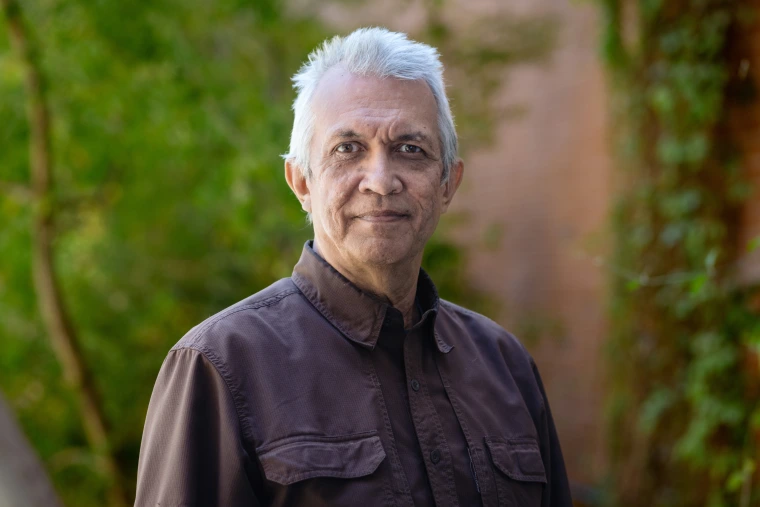
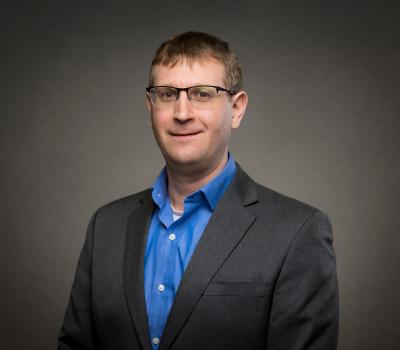
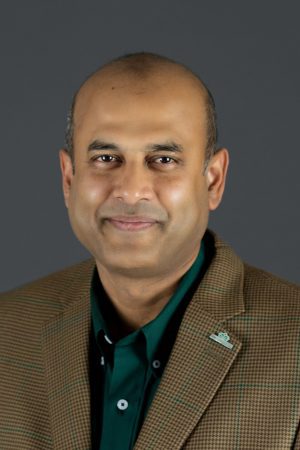
Hoshin V. Gupta is a Regents' Professor at the University of Arizona, holding joint appointments in the Department of Hydrology and Atmospheric Sciences, Technology-Public Policy/Markets, Global Change GIDP, and Remote Sensing and Spatial Analysis GIDP. He specializes in interdisciplinary research at the intersection of hydrology, climate science, and decision-making frameworks. Education: PhD in Systems Engineering from Case Western Reserve University (1984). Research focuses on surface water hydrology, climate modeling, and the integration of hydrologic processes with policy analysis. Techniques include computational modeling, machine learning, remote sensing data assimilation, and Bayesian methods. His work addresses uncertainty quantification, decision support systems, and the human-water nexus. Professional roles include membership in the Promotion and Tenure Committee and leadership in interdisciplinary initiatives through Global Change and Remote Sensing GIDPs.
Michael Multerer is an Associate Professor at the Faculty of Informatics, Università della Svizzera italiana (USI). His research focuses on multiresolution methods, scattered data analysis, and numerical analysis with applications in computational mathematics and engineering. He leads projects such as the SNSF Starting Grant on multiresolution methods for unstructured data, emphasizing nonlinear approximation and kernel-based techniques. Research Interests: Development of fully discrete multiresolution methods for unstructured data Wavelet theory and kernel matrix algebra Uncertainty quantification in partial differential equations Scattered data compression and approximation Key Software Contributions: FMCA: Fast multiresolution covariance analysis for scattered data Bembel: Boundary element library for solving Laplace and Helmholtz equations SPQR: Anisotropic sparse grid quadrature in MATLAB Funding: Holder of the SNSF Starting Grant (2025) for advancing multiresolution techniques in unstructured data processing. Labs/Teams: Active in the research group at USI’s Faculty of Informatics, collaborating with institutions like TU Darmstadt and University of Basel on numerical methods and engineering applications.
Mojtaba Dirbaz is an Adjunct Professor at the Department of Civil, Architectural, and Environmental Engineering within the Armour College of Engineering at Illinois Institute of Technology. His doctoral degree in Civil Engineering (Structural Engineering) was awarded by Illinois Institute of Technology in 2013. His research focuses on advancing structural health monitoring and infrastructure assessment through Bayesian methodologies. Key interests include damage detection, modal analysis, and uncertainty quantification in civil engineering systems. His work applies probabilistic frameworks to bridge condition assessment and structural integrity evaluation using limited or uncertain field data. Recent publications emphasize Bayesian updating techniques for infrastructure diagnostics, integrating visual inspection and modal data to enhance reliability in structural condition assessment. No scientific awards are explicitly listed. Advising roles and grants are not mentioned in available records. No affiliated labs or teams are noted in the provided information.
Prof. Dr. Benjamin Burkhard is a Professor at the Institute of Earth System Sciences within the Faculty of Natural Sciences at Leibniz University Hannover. He serves as Deputy Head of the Examining Board for Landscape Sciences (MSc) and holds management responsibilities in the Physical Geography and Landscape Ecology Section. Additionally, he represents professors on the Faculty Council and the Examination Board for Geography (BSc), demonstrating his significant institutional involvement. His research spans three primary domains: physical geography and landscape ecology (focusing on mapping and analysis of landscape structures, processes and functions across different spatio-temporal scales), ecosystem services (with emphasis on modeling, quantification and mapping), and human-environmental relations (particularly indication, modeling and land use assessments). This interdisciplinary approach positions him at the forefront of environmental systems research. Prof. Burkhard's scholarly output reveals a strong focus on ecosystem services assessment methodologies, with recent publications addressing standardized ecosystem condition assessments, cultural ecosystem services valuation, and marine ecosystem services mapping. His work demonstrates a clear progression from theoretical frameworks toward practical applications for environmental management and policy-making, with increasing emphasis on participatory approaches and standardized assessment protocols. He leads numerous significant research projects including 'SMILES: Enhancing Small-Medium Islands resilience by securing the sustainability of Ecosystem Services' (2022-2026), 'SELINA: Science for Evidence-based and sustainable decisions about natural capital' (2022-2027), and long-term erosion monitoring projects in Lower Saxony. These projects reflect his commitment to addressing pressing environmental challenges through rigorous scientific investigation. Prof. Burkhard actively contributes to developing methodological frameworks for ecosystem services assessment, participating in European research networks and initiatives that bridge the gap between scientific research and practical environmental management applications. His work has established him as a key contributor to the evolving field of ecosystem services science and its application in policy contexts.
Karl Haapala is a Professor in the Department of Mechanical, Industrial, and Manufacturing Engineering at Oregon State University (OSU), where he directs the Industrial Sustainability Lab and the OSU Energy Efficiency Center. He holds a Ph.D. from Michigan Technological University (2008) and has over $38M in research funding from agencies like DOE, NSF, and industry partners. His expertise spans sustainable manufacturing, life cycle engineering, and process modeling for environmental performance improvement. He has published over 150 peer-reviewed works and received awards such as the 2014 SME Outstanding Young Manufacturing Engineer Award and the 2019 Fulbright Scholar Award to Tampere University, Finland. Education: Ph.D., Mechanical Engineering-Engineering Mechanics, Michigan Technological University (2008) M.S., Mechanical Engineering, Michigan Technological University (2003) B.S., Mechanical Engineering, Michigan Technological University (2001) Research Interests: Dr. Haapala focuses on sustainable design and manufacturing, including life cycle assessment (LCA), process modeling for environmental efficiency, additive manufacturing sustainability, and education in sustainable engineering. His work bridges theoretical frameworks with industrial applications, emphasizing collaboration with SMEs and global partners. Grants and Partnerships: He leads the DOE Industrial Assessment Center at OSU and collaborates with the CESMII Western Smart Manufacturing Innovation Center. His industry partnerships include Boeing, Caterpillar, HP Inc., and Tillamook. Awards: 2023 SME Distinguished Faculty Advisor 2019 Fulbright Scholar Award 2015 ASME DFMLC Best Paper 2012 CIRP LCE Best Paper Labs and Teams: Directs the Industrial Sustainability Lab, focusing on smart manufacturing, energy efficiency, and circular economy solutions. Engages in international collaborations, including a 2019-2020 Fulbright appointment at Tampere University to advance additive manufacturing sustainability.
Prof. Mohammad Qamarul Islam is a Professor in the Statistics Department at Middle East Technical University (METU), Turkey, a position held since 2016. Previously, he served as Professor (2010-2016), Associate Professor (2005-2010), and Assistant Professor (1999-2005) in the Economics Department at Cankaya University. His academic career spans over four decades with prior appointments at METU (1983-1999) and Pakistani institutions including Gomal University and Karachi University. Education: Ph.D. in Statistics (1989), Middle East Technical University, Turkey M.Sc. in Statistics (1972), University of Karachi, Pakistan Research Focus: Prof. Islam specializes in advanced statistical methodologies with emphasis on Statistical Inference and Robust Methods . His work bridges theoretical statistics and practical applications through Nonparametric Techniques , Multivariate Analysis , and Econometric Modeling . Current investigations focus on regression under non-standard error distributions and experimental design optimization, contributing significantly to statistical theory validation in real-world scenarios. Publication Trends: His 2012-2016 publications reveal concentrated expertise in multivariate regression under non-ideal conditions (non-normal/elliptical errors), demonstrating methodological innovations for robust parameter estimation. Recent work extends to model uncertainty quantification in time series, reflecting his evolving focus on practical statistical challenges in economic and scientific data analysis. Academic Service: Information regarding student advising, research grants, laboratory affiliations, or scientific awards is not documented in the provided materials.
Taufiquar Khan is a Professor and Chair of the Department of Mathematics and Statistics at the University of North Carolina at Charlotte (UNC Charlotte). Previously, he held professorial positions at Clemson University between 2000 and 2020, advancing from Assistant Professor to Professor of Mathematical Sciences. His academic leadership roles include Chair at UNC Charlotte since 2020 and various administrative roles at Clemson, including Associate Director for Graduate Studies and Director of Global Engagement Initiatives. He holds a Ph.D. in Applied Mathematics from the University of Southern California (2000) and degrees in Mathematics, Physics, and Aerospace Engineering from USC and Occidental College. His research focuses on inverse problems, computational mathematics, and their applications in biomedical imaging, engineering systems, and environmental science. Notable contributions include advancements in electrical impedance tomography, machine learning for inverse problems, and mathematical modeling of traffic systems. He has authored over 50 peer-reviewed publications and supervised multiple graduate students. Dr. Khan’s awards include a Humboldt Research Fellowship (2007) and Summer Faculty Fellowships at Brooks Air Force Laboratory. He has led international collaborations, including roles at Khalifa University and the University of Bremen. His work bridges theoretical mathematics with practical applications in healthcare, energy systems, and environmental sustainability.
Dr. Xiaohui Qi is an Assistant Professor in the Department of Mechanical and Construction Engineering at Northumbria University since 2020. His research focuses on reliability analysis of geotechnical structures, probabilistic site investigations, and data-driven methods for predicting geotechnical and geological properties. Prior affiliations include postdoctoral roles at Nanyang Technological University (2017-2020) and the University of Macau (2015-2017), alongside a PhD from Wuhan University (2015) and an exchange at the National University of Singapore (2012-2015). His work addresses uncertainty in geotechnical engineering through Bayesian back-analysis, spatial variability characterization, and AI-driven predictive modeling. Key interests include slope stability, braced excavations, and soil parameter estimation using limited data. Recent research trends emphasize integrating machine learning (e.g., Bayesian methods, generalized additive models) with geostatistical techniques for 3D site reconstruction and geological interface prediction. His studies often compare methodologies (e.g., coupled Markov chains vs. stochastic simulations) to optimize spatial prediction accuracy. Collaborations span institutions in Singapore, China, and elsewhere, with a focus on applications like subway construction and foundation design uncertainties. No scientific awards are listed, but his 1625 citations highlight impactful contributions to geotechnical reliability and data analytics.
Alvaro Nosedal Sanchez is an Associate Professor in the Teaching Stream and Associate Chair (STATS) at the Department of Mathematical and Computational Sciences , University of Toronto Mississauga. His research integrates statistical theory with real-world applications in climate science, transportation, and disaster management. Research Interests Nonparametric Regression Gaussian Markov Random Fields Linear Models Bayesian Statistics Application of Statistical Methods Publication Trends His work spans 2012–2019 , focusing on statistical methodologies for transportation systems, climate modeling, and disaster response. Key themes include spatial statistics, algorithm development, and probabilistic modeling. Recent publications emphasize logistic regression in utility coordination and Gaussian Markov Random Fields in climate analysis. Teaching STA 215: Introduction to Applied Statistics STA 218: Statistics for Management and Economics STA 256/258/260: Core statistics and probability courses STA 302: Regression Analysis STA 313: Topics in Statistics STA 437: Applied Multivariate Statistics STA 457: Applied Time Series Analysis
Katherine Ellen von Stackelberg is a Senior Research Scientist in the Department of Environmental Health at Harvard T.H. Chan School of Public Health. She holds leadership roles as Team Leader for the Biogeochemistry of Global Contaminants Group (Sunderland Lab) and Director of Research Translation for the Harvard Superfund Research Program (MEMCARE). Her interdisciplinary work bridges environmental science, risk assessment, and policy development. Education: AB, cum laude in General Studies from Harvard College (1988) ScM in Environmental Health and Health Policy from Harvard School of Public Health (1998) ScD in Environmental Science and Risk Management from Harvard School of Public Health (2006) Her research focuses on the intersection of environmental exposures, ecosystem services, and human health. Key areas include: Risk assessment frameworks for environmental contaminants (PFAS, metals, PCBs) Valuation of natural capital and biodiversity through ecosystem integrity indices Development of probabilistic bioaccumulation models for aquatic systems Socio-ecological approaches to planetary health and regenerative futures She teaches courses on socio-ecological systems that analyze economic drivers of environmental degradation. Her scholarly publications demonstrate consistent focus on environmental risk assessment methodologies, with recent expansion into global contaminant distribution, ecosystem service valuation, and health impacts in vulnerable populations. Research frequently incorporates machine learning, spatial modeling, and decision-analytic frameworks. Dr. von Stackelberg has served on the US EPA's Board of Scientific Counselors and National Academies panels, and regularly reviews for the European Commission Horizon program. She leads multiple projects on risk assessment frameworks and contaminant bioaccumulation modeling.
Arash Mohammadi is an Assistant Professor in the Department of Electrical and Computer Engineering at Concordia University, Montreal, Canada. He holds a PhD from the University of Toronto (2015) and was formerly affiliated with Amirkabir University of Technology, Iran. His research bridges signal processing, artificial intelligence, and biomedical applications. Research Interests: Signal and image processing for healthcare (e.g., lung cancer detection, ECG analysis) Machine learning for smart grids and cyber-physical systems AI in mobile edge computing and 6G networks Transformer and diffusion models for medical and motion data Federated and efficient deep learning for edge devices His recent publications (2021–2025) in top venues like IEEE TSP, ICASSP, and AAAI demonstrate a strong focus on applying cutting-edge AI—especially vision transformers, Mamba architectures, and diffusion models—to critical domains such as medical diagnostics, gesture recognition, and network security. Trends include multimodal fusion, uncertainty quantification, and efficient model design. Scientific Contributions: Developed novel frameworks like NYCTALE and MIXCAPS for lung nodule malignancy prediction Introduced CacheMamba and TEDGE-Caching for edge network optimization Advanced EMG-based gesture recognition using hybrid and transformer models Contributed to cybersecurity in smart grids via attack detection models He actively advises students and collaborates with researchers such as Konstantinos N. Plataniotis and Jamshid Abouei. He has contributed to special issues on neurorehabilitation and AI for COVID-19 diagnosis. His work often involves interdisciplinary teams and real-world applications in healthcare and smart infrastructure.
Franca Hoffmann is an Assistant Professor of Computing and Mathematical Sciences at the California Institute of Technology (Caltech), and an International Scientific Advisor at Quantum Leap Africa (QLA) at the African Institute for Mathematical Sciences (AIMS). Previously, she held positions including a Bonn Junior Fellow at the Hausdorff Center for Mathematics and the AIMS-Carnegie Research Chair in Data Science. She leads the Doctoral Training Program in Data Science at QLA in Rwanda. Education : B.S. (Imperial College London, 2010), M.S. (2013), Ph.D. (University of Cambridge, 2017). Her thesis focused on partial differential equations and their applications, honored with the 2016 Imperial College Outstanding Student Achievement Award. Research Interests : Interface of model-driven and data-driven approaches, including PDE analysis (nonlinear drift-diffusion equations, kinetic theory, optimal transport) and data analysis (inverse problems, Bayesian inference, clustering algorithms). Her work bridges theoretical foundations with applications in mechanics, social sciences, and machine learning. Teaching : Courses include Environmental Physical Organic Chemistry and Special Topics in Applied Mathematics at Caltech. She has organized workshops and conferences globally, emphasizing capacity-building in African mathematical sciences. Awards : 2016 Imperial College Outstanding Student Achievement Award. Labs/Teams : Leads the DTP-DS at QLA and co-organizes initiatives like the Young African Mathematicians Bonn Visitor Program. Active in promoting interdisciplinary education and outreach in Africa.
Prof James Raymer is a Professor at the School of Demography , Australian National University (ANU). He joined ANU in 2013 as a Vice Chancellor’s Strategic Appointment and led the transition of the Australian Demographic and Social Research Institute into the School of Demography, serving as Head until 2016. Education: PhD in Geography from the University of Colorado, Boulder. His research focuses on spatial demographic processes , population projections , and migration modeling . He specializes in understanding how migration influences subnational population change , using Bayesian methods and statistical frameworks. Recent publications (2025-2024) address international migration trends in Australia, demographic forecasting , and school enrollment projections . Key subfields include migration dynamics, population structure analysis, and policy-driven demographic modeling. He has secured major grants from the Australian Research Council , National Health and Medical Research Council , and UK/EU agencies. Consultancy work includes advising the European Commission , UN Statistical Division , and Australian Capital Territory Government. He is affiliated with The Migration Hub and Poplab , collaborating on projects like Long-Term Fertility Projections and Demographic trends in the ACT .
Prof. Dr. Florian Steinke is a Professor and Head of the Energy Information Networks and Systems Department at Technische Universität Darmstadt. His academic career spans roles at Siemens Corporate Technology (2009–2016) and a PhD in machine learning at the Max Planck Institute for Intelligent Systems (2006–2008). His research focuses on algorithmic energy management, distributed control systems, machine learning applications in energy grids, and resilient smart grid design. Education: PhD in Machine Learning (Max Planck Institute for Intelligent Systems, 2006–2008) Diplom in Computational Physics (University of Tübingen & University of Washington, 1999–2005) Research Interests: Development of cyber-physical systems for energy grids Optimization of thermal-electric systems using game theory and stochastic control Integration of social media data for demand forecasting Cybersecurity measures against adversarial attacks on grids Recent work emphasizes probabilistic grid modeling, resilient energy market design, and AI-driven control strategies for Fourth Generation district heating grids. His platform ecosystem research aims to support the energy transition through data-driven solutions. Labs/Teams: Leads the Energy Information Networks and Systems research group, focusing on interdisciplinary projects combining automation, data science, and energy systems engineering.
Didier Nibbering is an Assistant Professor (Lecturer) in the Department of Econometrics and Business Statistics at Monash University, Faculty of Business and Economics, Melbourne, Australia. His research lies at the intersection of econometrics, statistics, and computational methods. Research Interests: His primary research areas include high-dimensional inference, forecasting, and semi-parametric Bayesian inference. He works on developing and applying advanced statistical models for complex economic and financial data, particularly in contexts involving large-dimensional datasets and latent variable structures. The recent publications indicate a strong focus on Bayesian computational techniques, state space models, variational inference, and forecasting applications in economics and environmental modeling. His work combines theoretical rigor with practical applications in policy-relevant domains such as carbon emissions forecasting. Scientific Contributions: Developed novel hybrid MCMC methods for high-dimensional latent variable models. Advanced variational approximations for state space models using importance sampling. Proposed asymmetric grouping methods for improved forecasting of carbon emissions. Contributed to a comprehensive modern review of Bayesian forecasting in economics and finance. Introduced high-dimensional extensions to multinomial logit models. Advising and Grants: While specific details about PhD students or grant funding are not provided in the text, his active publication record and collaborations suggest ongoing research supervision and external funding involvement typical for early-career faculty. He has collaborated with prominent researchers in econometrics such as Gael Martin, David Frazier, and Richard Paap. Labs and Teams: There is no explicit mention of lab affiliations or research teams, but his work appears to be part of the broader econometrics and statistics research group at Monash University, with international collaborations including Stanford University.