- String Theory
- Quantum Gravity
- Quantum Field Theory
- +۴ مورد دیگر
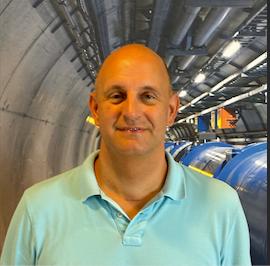
Marcus Spradlin is a Professor of Physics at Brown University with expertise in theoretical physics, particularly string theory, quantum gravity, and mathematical aspects of quantum field theory. His research focuses on fundamental structures in high energy physics with significant contributions to scattering amplitudes and cluster algebra applications. Education: A.B. in Physics, Princeton University, 1996 (summa cum laude) Master of Advanced Study in Mathematics, University of Cambridge, 1997 (with distinction) M.A. in Physics, Harvard University, 1999 Ph.D. in Physics, Harvard University, 2001 Spradlin's research program centers on the mathematical foundations of quantum field theory and string theory. He investigates scattering amplitudes in N=4 super Yang-Mills theory, exploring connections between cluster algebras and physical phenomena. His work bridges abstract mathematical concepts with concrete applications in particle physics, particularly examining dualities, geometric structures, and recently, celestial holography approaches. An analysis of Spradlin's publication record reveals a consistent focus on mathematical structures in scattering amplitudes, with numerous papers in the Journal of High Energy Physics and Physical Review. His work shows a progression toward increasingly sophisticated mathematical frameworks, with a notable trend toward celestial holography and geometric approaches to quantum field theory in his most recent publications. Collaborations with Anastasia Volovich form a significant portion of his research output. Teaching: PHYS 0030 - Basic Physics A PHYS 0040 - Basic Physics B PHYS 1970C - String Theory for Undergraduates PHYS 2030 - Classical Theoretical Physics I PHYS 2040 - Classical Theoretical Physics II PHYS 2320 - Quantum Theory of Fields II PHYS 2340 - Group Theory Spradlin maintains an active research program alongside his teaching responsibilities. His publication record shows consistent output with high citation counts, particularly for his work on polylogarithms and scattering amplitudes, indicating significant influence in theoretical physics. He appears to be part of Brown University's theoretical physics research group with connections to other institutions like Harvard University.