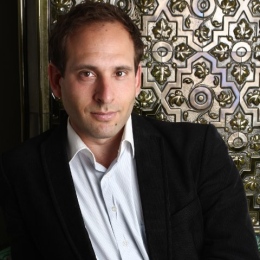
Forrest E. Morgan is a Senior Lecturer at the Carnegie Mellon Institute for Strategy & Technology (CMIST), where he has been affiliated since 2017. He retired from the RAND Corporation in 2019 after a 16-year tenure as a senior political scientist specializing in defense strategy and military applications of emerging technologies. Prior to RAND, he spent 27 years in the U.S. Air Force, serving in roles such as signals intelligence analyst, space operations officer, and professor at the Air University School of Advanced Air and Space Studies (SAASS). His research focuses on deterrence theory, crisis stability, military AI ethics, space policy, and nuclear strategy. Morgan holds a PhD in Policy Studies from the University of Maryland. His work bridges academic analysis with operational military challenges, addressing topics such as escalation management in conflicts, the strategic implications of AI, and organizational frameworks for space warfare. He has authored/co-authored influential studies on China's nuclear posture, future warfare scenarios, and the creation of a dedicated U.S. Space Force. His publications (2010–2020) reflect a sustained engagement with cutting-edge defense issues, including space deterrence, AI ethics, and hybrid warfare dynamics. While no formal awards are listed, his extensive contributions to defense policy analysis and military education underscore his impact in strategic studies. His affiliation with CMIST positions him at the intersection of technology and global security challenges.
Elke Schwarz is a Professor of Political Theory at Queen Mary University of London, School of Politics and International Relations. Prior to this role, she held academic positions at UCL, Anglia Ruskin University, and Leicester University. Her work focuses on the intersection of ethics, technology, and warfare, particularly in the context of military artificial intelligence (AI), autonomous weapon systems, drones, and robots. Elke holds a BBA from Belmont University (USA), an MA in Conflict Studies from King’s College London, and a PhD from the London School of Economics and Political Science (LSE). She is the author of Death Machines: The Ethics of Violent Technologies and has published widely on topics such as algorithmic ethics for lethal autonomous weapons systems and the ethics of military AI. Her research interests include ethics, military AI, autonomous weapon systems, digital technologies, apocalyptic studies, war studies, critical security studies, political theory, philosophy of technology, and posthumanism. She has received notable fellowships, including the 2024 Leverhulme Research Fellowship, the 2022/23 CAPAS Fellowship, and the RSA Fellowship. She also secured a British Academy/Leverhulme Small Grant (2017–2019) for research on military ethical values in autonomous weapons systems. Elke is actively involved in public engagement, serving as Vice-Chair of the International Committee for Robot Arms Control (ICRAC), an Associate of the Imperial War Museum (IWM), and collaborating with organizations like Drone Wars UK, Stop Killer Robots, and the Alan Turing Institute. Her work bridges academia, policy, and civil society to address ethical and security challenges posed by emerging technologies.
Dr. Craig Douglas Albert is a Professor of Political Science and Graduate Director of the PhD in Intelligence, Defense, and Cybersecurity Policy and the Master of Arts in Intelligence and Security Studies at Augusta University. His work bridges academic research and real-world policy, with expertise in global security threats and digital warfare. Education: PhD in Political Science and Government, University of Connecticut (2009) Master of Arts in Political Science and Government, University of Connecticut (2003) Bachelor of Arts in Political Science and Government, Augusta State University (2001) Research Focus: Dr. Albert's work centers on the evolving landscape of international conflict, with emphasis on: Information warfare tactics and propaganda dissemination across social media platforms Geopolitical implications of artificial intelligence in military and security operations Cybersecurity policy frameworks for major powers (US, China, Russia) Ethnic conflict dynamics and political philosophy in security contexts His research consistently examines how technology transforms traditional power structures and conflict mechanisms. Publication Trends: Recent works (2022-2024) demonstrate a strong focus on AI-driven information warfare, social media manipulation, and great-power competition. Over 60% of publications analyze technological impacts on security, while 30% address propaganda mechanics. Emerging themes include TikTok's national security risks, pandemic intelligence systems, and Middle Eastern disinformation campaigns. Media & Policy Engagement: Testified before US Congress Joint Subcommittee on Foreign Affairs Regular commentator for Fox News, Forbes, CTV Canada, VOA, and international outlets Council on Foreign Relations Higher Education Ambassador Advised US Army Cyber Center of Excellence workshops on AI threats Labs & Teams: Leads research initiatives on disinformation detection and cybersecurity policy through Augusta University's intelligence programs, collaborating with military cyber units on threat analysis.
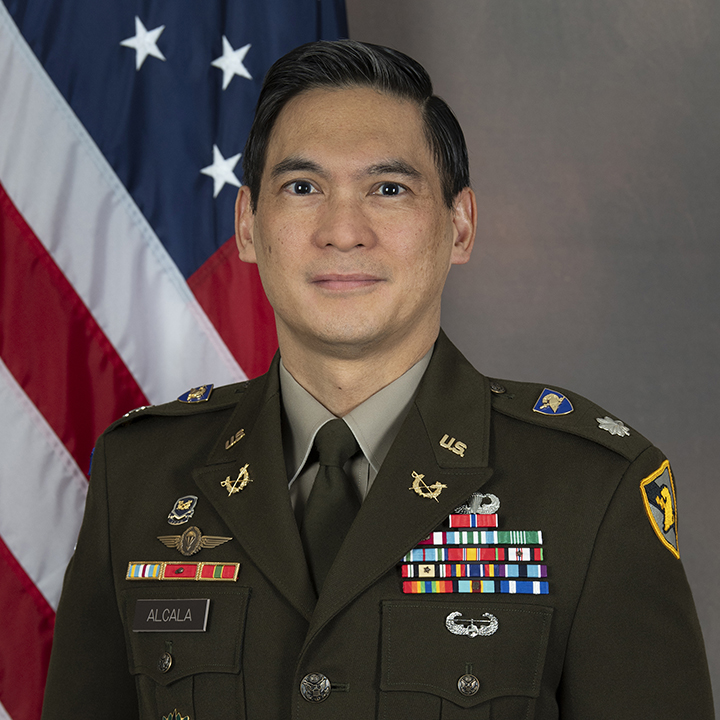
LTC Ronald Alcala is an Academy Professor and Associate Dean for Strategy & Initiatives at the United States Military Academy at West Point. He also serves as Executive Editor of the West Point Press and Articles of War. A former Judge Advocate, he has held diverse legal roles in criminal law, international law, and administrative law, including assignments in Iraq and Afghanistan. Education: B.A. in History and Classics from Williams College J.D. from George Washington University Law School MALD from Fletcher School of Law and Diplomacy, Tufts University LL.M. in Military Law from The Judge Advocate General’s School Research Interests focus on Law of Armed Conflict , International Law , and Cultural Heritage , particularly examining legal frameworks in conflict zones, digital cultural preservation, and the intersection of technology with warfare ethics. Recent Publications address topics such as Ukraine's legal challenges in war, lethal autonomous weapons regulation, digital cultural property, and human remains in conflict contexts. These works span interdisciplinary themes including military law, technological ethics, and cultural preservation. Scientific Awards: NATO’s Serge Lazareff Prize for excellence in legal services ASIL’s 2023 Richard R. Baxter Military Prize Leadership & Grants: Co-editor of a major Oxford University Press book on emerging technologies and law of war; elected member of ASIL’s Law of Armed Conflict Interest Group. His work has influenced policy on non-combatant evacuations and cultural property protection.
Hendrik Huelss is an Assistant Professor of International Relations at the Center for War Studies (CWS), Department of Political Science and Public Management, University of Southern Denmark. He is also an associated Senior Researcher in the European Research Council (ERC) project AutoNorms (2020-2025). Previously, he held a post-doctoral position at the University of Kent (2016–2020). Education: PhD in Political Science, University of Copenhagen MBA in Sustainability Management, Leuphana University of Lüneburg MSc in European Politics and Governance, London School of Economics and Political Science MSc in Political Science, University of Potsdam Research Interests: Focuses on the intersection of international norms and military technology, particularly AI and autonomous weapons systems. Combines constructivist/poststructural theories with science and technology studies to explore governance frameworks, ethical implications, and global security dynamics. Key themes include AI's impact on warfare, regulatory mechanisms, and norm evolution in international relations. Key Projects: ERC AutoNorms (2020–2026): Examines norms around weaponized AI through comparative practices. ERC HuMach (2024–2028): Investigates human-machine interaction in military AI. AutoPractices (2024–2025): Focuses on governance of AI in weapon systems. Publications: Highlights include co-authoring Autonomous Weapons Systems and International Norms (2022) and articles in Journal of European Public Policy , International Political Sociology , and Review of International Studies . Recent work explores AI's normative challenges in global governance and cross-cultural narratives on military AI use. Teaching: Involves courses on international relations, remote warfare, and human rights in security contexts at the University of Southern Denmark.
Karl Aberer is a full Professor for Distributed Information Systems at École polytechnique fédérale de Lausanne (EPFL) since 2000. From 2005 to 2012, he led the Swiss National Research Center for Mobile Information and Communication Systems (NCCR-MICS). Currently serving as Vice-President of EPFL responsible for information systems, he contributes to academic leadership while maintaining an active research profile. His research spans Distributed Systems Data Mining Machine Learning Social Computing Web Science Graph Neural Networks with recent work focusing on multimodal learning, federated unlearning, and social media analysis. He serves on the editorial boards of the VLDB Journal ACM Transactions on Autonomous and Adaptive Systems World Wide Web Journal and contributes to PeerJ Computer Science.
Jeroen van den Hoven is a Professor at the Faculty of Technology, Policy and Management at Delft University of Technology . He serves as Editor in Chief of Ethics and Information Technology (Springer) and Founding Chair of the CEPE conference . His affiliations include advisory roles in the EU Commissioner Reding's ICT group , grants from the Dutch Research Council , and collaborations with industry leaders like SUN, IBM, and Getronics . Research Interests Van den Hoven's work bridges ethics, artificial intelligence, and public policy . He focuses on value-sensitive design , responsible innovation , and moral philosophy applied to emerging technologies. His research addresses AI governance , privacy , and ethical frameworks for autonomous systems , with applications in healthcare, military technology, and smart cities . Scientific Contributions His recent publications explore trust in foundation models , transparency in AI , and human control over autonomous systems . Themes include epistemic dependence in healthcare AI , democratic integrity in digital eras , and ethical guidelines for military applications . Awards & Grants Recipient of multiple Dutch Research Council grants , he advocates for ethical design principles and chairs international conferences on computer ethics . His advisory roles span Dutch government commissions and EU ICT policies .
Stuart J. Russell is a Distinguished Professor of Computer Science at the University of California, Berkeley, holding the Smith-Zadeh Chair in Engineering. He is also a Professor of Cognitive Science, a Professor of Computational Precision Health at UCSF, and an Honorary Fellow of Wadham College, Oxford. His research spans artificial intelligence, machine learning, probabilistic reasoning, robotics, and AI ethics. Russell co-authored the seminal textbook Artificial Intelligence: A Modern Approach and founded the Center for Human-Compatible AI (CHAI). He has advised international organizations on AI policy and ethics, including roles with the OECD and the Global Partnership on AI. Educations: B.A. (1st class honors) in Physics, University of Oxford (1982) Ph.D. in Computer Science, Stanford University (1986) Research Focus: Russell’s work addresses foundational AI challenges, including safe AI control, long-term societal impacts of AI, and ethical frameworks for autonomous systems. He emphasizes aligning AI with human values and has warned against risks of uncontrolled autonomous weapons. Labs & Affiliations: He leads the Center for Human-Compatible AI, co-directs the Kavli Center for Ethics, Science, and the Public, and collaborates with BAIR (Berkeley AI Research) and the Simons Institute for the Theory of Computing. His interdisciplinary work bridges computer science, philosophy, and public policy.
Frederik Carl Windfeld is a Researcher at the European University Institute in the Department of Political and Social Sciences. His work explores intersections of International Relations , Critical Security Studies , and Visual Politics , with a focus on Artificial Intelligence and Autonomous Technologies in global governance contexts. Nationality: Denmark (2022 cohort) Email: frederikcarl.windfeld@eui.eu His research interrogates the epistemic struggles surrounding Lethal Autonomous Weapons Systems (LAWS) and examines visual representations of security issues through lenses like Gothic Aesthetics and Media Framing . Recent publications include analyses of LAWS governance, visual politics in Aleppo, and bureaucratic dynamics in OECD internships. Windfeld's academic work connects broader themes of Global Ordering and Security Norms with specific methodological approaches to Visual International Politics and Technological Diplomacy . His thesis Artificial Agency and International Security is supervised by Stephanie Hofmann and Stefano Guzzini.
Pietro Sanna serves as a Contract Professor at the Department of Political and International Sciences (DiSPI) at the University of Genoa, Italy, while also acting as an Expert for the Department of Naval, Electrical, Electronic, and Telecommunications Engineering (DITEN). His teaching responsibilities span multiple master's programs including Engineering Technology for Strategy (and Security), International Relations, and Administration and Public Policies across academic years 2024-2026. His research concentrates on International Law with specialized focus on Law of Armed Conflicts, European Union Law, and Commercial Law intersections. He actively examines emerging legal challenges in Artificial Intelligence applications for warfare, international trade regulations under Incoterms®, and transport infrastructure liabilities within EU frameworks. His scholarly work bridges traditional legal doctrine with contemporary technological and geopolitical developments. Analysis of his publication trends reveals consistent exploration of legal adaptation to technological disruption, particularly regarding AI in military contexts and digital governance in EU policy. His work demonstrates methodological rigor in applying international legal principles to commercial disputes and infrastructure management while maintaining critical engagement with evolving jurisprudence from European and Italian courts.
Leonard A. Kahn currently serves as the Dean of the College of Arts and Sciences and Professor of Philosophy at Loyola University New Orleans. He also holds the ex officio position of Gerald N. Gaston Distinguished Professor in Religion & Science. Prior to joining Loyola, Kahn taught in the Department of Philosophy at the U.S. Air Force Academy in Colorado Springs, Colorado, and served as the 2021-2022 Donald and Beverely Freeman Fellow at the U.S. Naval Academy's Stockdale Center for Ethical Leadership. Kahn completed his DPhil at Oxford University (Magdalen College) under the supervision of Derek Parfit and Roger Crisp. His academic journey includes being a Post-Doctoral Research Fellow at the University of Calgary, a Visiting Scholar at both the Yale University Center for Bioethics and the Hastings Center for Bioethics, and a Visiting Lecturer at the University of North Carolina at Chapel Hill and the University of Reading in the UK. His primary research focuses on moral theory and applied ethics , particularly the ethics of technology and just war theory . Kahn's teaching portfolio spans political philosophy, philosophy of law, philosophy of mind and action, feminist philosophy, and both decision and game theory. He has taught courses including Ethics, Making Moral Decisions, Philosophy of the Human Person, Seminar: Matters of Life and Death, Philosophy and Feminism, Seminar: The Ethics of War, Global Ethics, and Ethics and Artificial Intelligence. Analysis of Kahn's 15 most recent publications reveals a consistent focus on applied ethical dilemmas across multiple domains. His work spans military ethics (particularly just war theory and autonomous weapons systems), technology ethics (especially AI and cybersecurity), medical ethics, and political philosophy. A recurring theme throughout his scholarship is the application of consequentialist frameworks to contemporary ethical challenges, with particular attention to how theoretical principles translate to real-world decision-making in complex situations. Donald and Beverely Freeman Fellow at the U.S. Naval Academy's Stockdale Center for Ethical Leadership (2021-2022) Editor of John Stuart Mill's On Liberty (Broadview Editions, 2014) While specific information about his advisees is not provided in the available materials, Kahn's extensive teaching experience across numerous philosophy courses suggests significant mentorship of undergraduate students. His position as Dean of the College of Arts and Sciences at Loyola University New Orleans places him at the center of academic administration, where he oversees faculty development, curriculum design, and strategic planning for the university's liberal arts programs. Kahn's research appears to be supported through academic fellowships such as his Naval Academy appointment, though specific grant details are not mentioned in the provided materials. Kahn maintains active scholarly engagement through his editorial work (including co-editing Consequentialism and Environmental Ethics with Avram Hiller and Ramona Ilea) and contributions to edited volumes on topics ranging from autonomous vehicles to medical deportation. His professional affiliations include connections with major bioethics centers (Yale, Hastings) and military education institutions (U.S. Naval Academy, U.S. Air Force Academy), reflecting the interdisciplinary nature of his work at the intersection of philosophy, technology, and public policy.
Juan Luis Fuentes Osorio serves as a University Professor in the Department of Criminal Law, Philosophy of Law, Moral Philosophy and Philosophy at the University of Jaen, Spain. His academic work is anchored within the Criminal Law, Criminology, Democracy and Fundamental Rights research group, where he contributes to interdisciplinary scholarship at the intersection of legal theory and societal protection mechanisms. He earned his PhD from the University of Jaen in 2003 with the dissertation "The anticipation of criminal protection and preparatory acts of crime," supervised by Dr. Guillermo Portilla Contreras. This foundational work established his expertise in criminal law theory and preparatory acts doctrine. His research spans Criminal Law, Criminology, Environmental Criminal Law, Corporate Criminal Liability, and Hate Speech regulation. He critically examines the tension between theoretical legal frameworks and practical enforcement challenges, particularly regarding environmental protection mechanisms and corporate accountability structures. His scholarship consistently addresses the philosophical underpinnings of criminal responsibility while engaging with contemporary issues like digital hate speech and ecological crime. Analysis of his 2021-2025 publications reveals three dominant thematic clusters: environmental criminal law effectiveness (focusing on enforcement gaps and sanction proportionality), corporate criminal liability (examining penalty determination for legal entities), and hate speech regulation (analyzing legal boundaries in digital spaces). His work demonstrates methodological rigor through comparative legal analysis and empirical assessment of judicial practices. Within the Criminal Law, Criminology, Democracy and Fundamental Rights research group, he collaborates on projects exploring the constitutional dimensions of criminal justice and the protection of fundamental rights within democratic frameworks. His institutional affiliation provides the foundation for sustained scholarly contributions to Spanish and European criminal law discourse.
Mark Klamberg is a Professor of International Law at Stockholm University , where he serves as head of subject for public international law. His affiliations include deputy director of the Stockholm Centre for International Law and Justice (SCILJ) , research fellow at the Centre for International Law Research and Policy (CILRAP), and scholar-in-residence at American University's Washington College of Law. He also acts as a nonresident Senior Fellow at the Atlantic Council, expert for the Consultative Council at Ukraine's National School of Judges, and consultant for the International Criminal Court's Al-Hassan case. Education: Jur. Dr. (Stockholm University), LL.M. (Raoul Wallenberg Institute), Jur. Kand. (Lund University) Klamberg's research focuses on international criminal law , surveillance and privacy , AI governance , and legal frameworks for states of emergency . His recent publications and projects analyze topics like universal jurisdiction, UN Security Council dynamics, and digital evidence in international trials. He has also contributed to leading textbooks such as Sverige och folkrätten and serves as chief editor for the Commentary on the Law of the ICC . He has taught public international law and international criminal law at Stockholm University's law program, supervised PhD students in socio-legal methods, and lectured at institutions including Uppsala University (Master's in Human Rights, International Humanitarian Action, and Euroculture programs) and Edinburgh Law School (LLM International Criminal Law). His scholarly output spans over 70 publications, with recent works addressing AI regulation, state emergency powers, and prosecution of corporate war crimes.
Bernd Heinrich is a Professor of Criminal Law, Criminal Procedure Law and Copyright Law at the University of Tübingen's Law Faculty since 2015. Previously, he served as a Professor at Humboldt-Universität zu Berlin (2003-2015) and University of Konstanz (2002-2003). He is a member of Fachkollegium 113 'Rechtswissenschaften' of the Deutsche Forschungsgemeinschaft (DFG) since April 2020. Professor Heinrich's research focuses on the doctrine of the General and Special Parts of the German Criminal Code, with particular emphasis on Weapons Law, War Weapons Law, Explosives Law, Association Criminal Law, Copyright Law, and Media Criminal Law. His scholarly work includes numerous monographs, textbooks, commentaries, and articles in leading journals. His research has evolved to address contemporary challenges in criminal law, including digital technologies, autonomous vehicles, hate speech on social media, and triage decisions in emergency situations. He has developed extensive teaching materials (approximately 150 worksheets) that are regularly updated and made available online. Professor Heinrich maintains active international collaborations through the 'Netzwerk Ost-West' with law faculties in Riga, Kiev, and Tbilisi. He regularly conducts research stays in Rio de Janeiro (focusing on Media Criminal Law) and Cape Town (focusing on Corruption Criminal Law and Money Laundering). He has supervised numerous doctoral dissertations and habilitations, contributing significantly to the development of the next generation of criminal law scholars in Germany and internationally.
Dr. Lauren Gould is an Assistant Professor in Conflict Studies at Utrecht University's Department of History and Art History. She leads the Intimacies of Remote Warfare (IRW) programme and Realities of Algorithmic Warfare (RAW) project, focusing on the evolving Western approach to warfare and its impact on civilian populations. Her research integrates fieldwork with Western militaries and conflict zones in the Middle East and East Africa, aiming to influence academic, public, and policy debates. Gould co-founded the Contesting Governance platform under Institutions for Open Societies and serves on the board of the Nuhanovic Foundation Centre for War Reparations. She coordinates UU Summer Schools on Conflict Analysis and Leadership, and co-promotes three PhD candidates. Research interests include autonomous weapon systems, civilian harm mitigation, and the ethical implications of algorithmic warfare. Recent work examines swarm technology experimentation and NATO AI supervision. Gould's Transparency Road Map initiative with Dutch Defense led to policy changes protecting civilians in military operations. She frequently contributes to media discussions on Gaza war ethics, drone warfare, and military accountability through op-eds in The Conversation, NRC, and De Groene Amsterdammer. Teaching responsibilities include the Conflict Studies and Human Rights Master's program and public lectures series Concerning War and Conflict. Her work appears in journals like Security Dialogue and Global Society, emphasizing interdisciplinary approaches to modern warfare challenges.