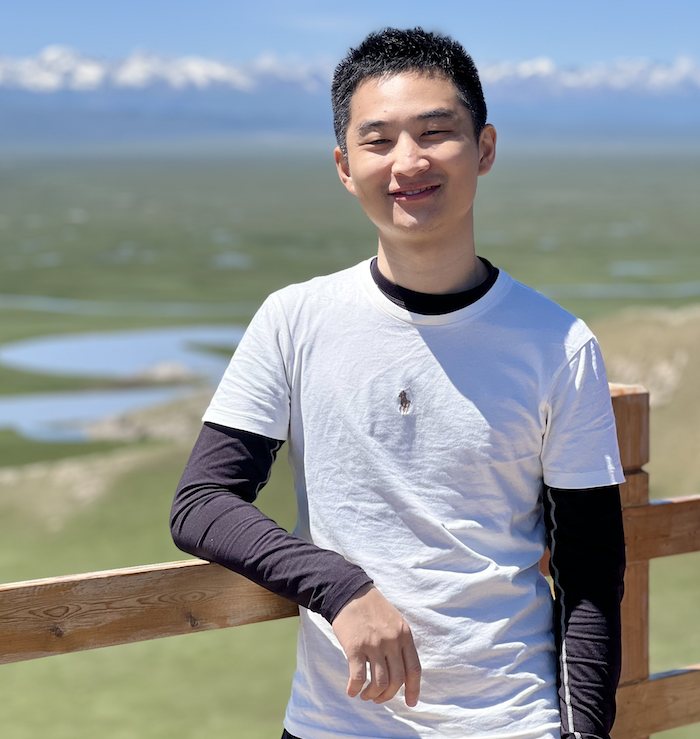
Sandeep Reddivari is an Associate Professor and Interim Graduate Director at the School of Computing, University of North Florida . Holding a Ph.D. in Computer Science and Engineering from Mississippi State University, his work focuses on software engineering , particularly requirements engineering , visual analytics , and software maintenance , with funding from the NSF, US Army Corps of Engineers, NSA, and UNF Foundation. Education : Ph.D. (2014, Mississippi State University), M.S. (2009, Texas A&M University), B.Tech. (2006, JNTU) Research Themes : Requirements Engineering, Visual Analytics, Data Mining, Machine Learning, GenAI, Software Security Teaching : Courses in Software Engineering, Data Science, and Database Systems Awards : NSF Grant Recognition (2024), Best Doctoral Symposium Poster (2013), Outstanding Graduate Teaching Award Nominee (2018) Publications span top venues like IEEE RE, ICSE, and COMPSAC, with a focus on combining visual analytics and machine learning to enhance software decision-making. His lab at UNF mentors students in directed independent studies, emphasizing code navigation , blockchain , and educational software tools .
Armando Fox is a Professor in the Department of Electrical Engineering and Computer Sciences at UC Berkeley, where he co-leads the ASPIRE Lab and directs the Berkeley MOOCLab. His work focuses on integrating online learning research into educational frameworks. He holds a PhD, MS and BS from Berkeley, Illinois, and MIT respectively. Fox's research spans applied statistical machine learning, Software as a Service (SaaS), cloud computing, parallel programming, and innovative online education methods. He pioneered Berkeley's first MOOC on software engineering and co-authored the textbook Engineering Software as a Service . His recent publications demonstrate strong focus on: AI-enhanced education tools and assessment systems Cloud-based learning management architectures Generative AI for collaborative programming education Automated testing frameworks for computer science Significant awards include: NSF CAREER Award ACM Distinguished Member Scientific American 50 top researcher recognition Fox previously contributed to Intel Pentium Pro microprocessor design and founded a mobile computing company based on his dissertation research.
Bowen Xu is an Assistant Professor in the Department of Computer Science at North Carolina State University (NC State), College of Engineering. His research focuses on software engineering, machine learning, and program analysis, particularly in securing AI models and improving code quality. He holds a PhD from Singapore Management University (SMU), where he also conducted postdoctoral research. Education: PhD in Computer Science, Singapore Management University (SMU) Postdoctoral Researcher, SMU School of Computing and Information Systems Research Interests: AI for Code, Backdoor Attacks on Code Models, Vulnerability Detection Code Representation Learning, Model Compression, Safety of AI Systems Chatbot Development for Developers, Automatic Code Review Key Contributions: Developed PTM4Tag+, a Stack Overflow tag recommendation system using pre-trained models Explored stealthy backdoor attacks in code and reinforcement learning systems Pioneered work on automatic vulnerability repair using LLMs and broader input analysis Awards: 2022: Honorable Mention Award (ACSAC) 2018: Highly Commended Full Paper Award (ESEM) Service Roles: Editorial Board Member, Empirical Software Engineering Journal Program Committee Co-chair for ICSE/FSE Research Tracks Organized workshops like FORGE, MaLTeSQuE, and SEA4DQ Labs & Teams: Leads the Softmax Lab at NC State, advising 12+ students across PhD, Master's, and undergraduate levels. Alumni include industry professionals at Microsoft, Barclays, and Marvell Semiconductor.
Toby Murray is a Professor in the School of Computing and Information Systems at the University of Melbourne, where he serves as Director of the Defence Science Institute and Co-Lead of the Computer Science Research Group. His work bridges formal methods, cybersecurity, and practical system security, with significant contributions to verified security and vulnerability detection. Murray's research focuses on building highly secure computing systems cost-effectively, with expertise in formal verification, information flow security, and vulnerability detection. His current research projects include Verisimilar (Verified, Secure Machine Learning), EDEFuzz (Detecting excessive data exposure in web applications), COVERN (Proving information flow security of concurrent programs), and Time Protection (Proving timing channel freedom for seL4). His work combines theoretical rigor with practical implementation, resulting in multiple open-source tools including SecC, Legion, and Underflow. Murray's recent publications demonstrate a consistent focus on verified security properties across diverse domains, from neural networks to concurrent systems. His work often bridges the gap between formal methods and practical security concerns, with increasing attention to machine learning security and policy implications of technical security measures. His publications span top venues in security, formal methods, and software engineering. Distinguished Paper Award at ICSE 2024 for EDEFuzz work on detecting excessive data exposure in web applications Extensive media commentary on cybersecurity issues including CrowdStrike outage analysis and social media regulation Regular contributions to The Conversation and Pursuit on cybersecurity policy matters Murray has advised numerous PhD students to completion, including Lianglu Pan (EDEFuzz), Zhiyuan Zhang, Mo Zhang, and Renlord Yang. He currently supervises multiple PhD students working on security verification, machine learning security, and web application security. His service includes being Program Chair for CSF'25, Associate Editor for IEEE Security & Privacy and ACM TOPS, and membership in IFIP's WG 1.7 and WG 2.3. His research group has developed multiple significant software tools including SecC (Verified Security for Concurrent C Programs), Legion (Principled Automatic Test Case Generation), and Underflow (Compositional Vulnerability Detection for C Programs), all available under open source licenses. Murray's work often involves discovering and reporting bugs in security analysis tools during his research, demonstrating the practical impact of his verification approaches.
Dr. Anton Ragni is a Senior Lecturer in Speech and Language Technologies at the University of Sheffield's School of Computer Science, where he serves as Assessments Lead and contributes to the Speech and Hearing (SpandH) research group. His educational background includes: BEng in Information Technology from the University of Tartu (2005) MEng in Information Technology from the University of Tartu (2007) PhD from the University of Cambridge (2013) Ragni's research centers on machine learning approaches for speech and language processing, with core expertise in automatic speech recognition (ASR), expressive speech synthesis, spoken language translation, information retrieval, and conversation modeling. His work increasingly integrates self-supervised learning and foundation models to address challenges in speech technology and cross-domain applications like music processing. Analysis of his recent publications reveals a strong trend toward applying speech processing techniques to music understanding and developing robust ASR systems for specialized populations, including hearing-impaired users and children. His work demonstrates consistent innovation in leveraging contextual information and novel architectures like energy-based models. His scientific recognition includes: Best Student Paper Award at IEEE ASRU 2011 for 'Generative kernels for noise robust ASR' Ragni has secured significant research funding as Principal Investigator and Co-Principal Investigator: EPSRC grant 'Exemplar-based Expressive Speech Synthesis' (2021-2023, £218,290) as PI Innovate UK grant 'Automatic voice conversion for transforming professional adult voice actors to artificial child voice actors' (2021-2023, £173,605) as Co-PI He actively contributes to the Speech and Hearing research group, focusing on advancing speech technology through interdisciplinary collaboration and real-world applications.
Sebastian Michelmann is an Assistant Professor of Psychology at New York University's College of Arts and Science. His research focuses on understanding how temporal dynamic content is neurally represented and processed in episodic memory, with particular emphasis on fast-timescale memory retrieval mechanisms and their interaction with event knowledge. He employs electrophysiological methods (EEG/MEG), computational modeling, and behavioral experiments to study memory formation under naturalistic conditions. Education: PhD in Psychology from the University of Birmingham (2018), thesis awarded the Glushko Dissertation Prize (2020) Master's (Diploma) in Psychology from Julius-Maximilians-Universitaet Wuerzburg (2014) Postdoctoral research at Princeton University (2018–2023) under Professors Ken Norman and Uri Hasson Research interests include neural oscillations, event segmentation, and the role of generalized event knowledge in memory retrieval. His work bridges cognitive neuroscience with computational approaches, exploring how the brain encodes, stores, and retrieves temporally precise information. Key research directions involve studying how memory processes are embedded in continuous experience and developing tools to analyze neural data (e.g., intracranial EEG re-referencing). Recent studies explore event boundary detection using large language models and investigate the neural correlates of natural language comprehension through ECoG datasets. Scientific Awards: Glushko Dissertation Prize (2020) Laboratory activities focus on future projects combining electrophysiology with computational modeling to understand interactive dynamics of episodic memory. Collaborative efforts include developing semi-automatic alignment tools and cloud-based neuroimaging frameworks.
Prof. Dr.-Ing. Torsten Zesch serves as Deputy Scientific Director, Member of the Executive Board, and Head of the Research Professorship for Computational Linguistics at FernUniversität in Hagen since March 2022. He previously held W2 and W1 Professorships for Sprachtechnologie (Language Technology) at Universität Duisburg-Essen from 2014-2022. Zesch is also Spokesperson of the Advisory Board of the German Society for Computational Linguistics and Language Technology (GSCL) since 2024, having previously served as GSCL President from 2018-2024. Dr. Zesch completed his dissertation (Dr.-Ing.) in Computer Science at Technische Universität Darmstadt in 2009. His research spans robust language processing systems, analysis of non-standard language structures, and educational applications of language technology, with particular focus on automatic content scoring and spelling error correction for learner language. Zesch's recent publications reveal a strong focus on integrating language technology with educational applications. His work demonstrates expertise in developing practical NLP solutions for educational assessment, including transformer-based spelling error feedback systems, hierarchical automatic scoring methods, and leveraging LLMs for educational applications despite cold-start problems. He also maintains significant research in hate speech detection, particularly in multimodal contexts and visio-linguistic models. As leader of the Computational Linguistics research professorship within the CATALPA research center, Zesch directs a team investigating how language technology can support educational processes. His projects DAKODA and KISS-Pro focus on language acquisition and educational applications. He has contributed significantly to the field through numerous publications in top NLP and educational technology venues, with over 100 publications spanning from 2006 to present.
Thomas W. Price is an Assistant Professor in the Department of Computer Science at North Carolina State University's College of Engineering. He directs the Help through INTelligent Support (HINTS) Lab and is affiliated with NCSU's Center for Educational Informatics. His work bridges computer science, education, and artificial intelligence to create intelligent learning environments. Dr. Price earned his M.S. and Ph.D. in Computer Science from NC State University in 2015 and 2018 respectively, and was named the College of Engineering Doctoral Scholar of the Year in 2018. His research focuses on computing education with an emphasis on automatically generating programming hints and feedback using student data. He has evaluated innovative programming environments including block-based and frame-based systems, and designs intelligent support tools that integrate with these technologies. His work examines how students seek and use help in both classroom and online settings, with particular interest in open-ended programming projects, data-driven feedback systems, and understanding student programming behaviors. His recent publications reveal a strong trend toward integrating AI and educational data mining techniques to support programming education. His work spans from fundamental research on student help-seeking behaviors to practical tools that provide immediate feedback, detect student struggles, and offer personalized support. A significant portion of his recent work addresses emerging challenges like student use of generative AI tools and detecting AI-generated code submissions. College of Engineering Doctoral Scholar of the Year (2018) Exemplary Paper Award from International Conference on Educational Data Mining Exemplary Paper Award from ACM Technical Symposium on Computer Science Education Recognition by STARS Computing Corps for leadership in computing outreach Dr. Price mentors several Ph.D. students including James Skripchuk, John Thomas Bacher, and Keith Tran. He has secured over $4 million in research funding from the National Science Foundation for projects including infrastructure for sustainable innovation in computer science education, data-driven technologies for STEM instruction, and intelligent support for creative programming projects. His research has practical applications in classroom settings and aims to create scalable solutions that don't place additional burden on instructors. As director of the HINTS Lab, Dr. Price leads a team investigating how to re-imagine educational programming environments as adaptive, data-driven systems. The lab focuses on supporting students working in creative, open-ended contexts through automated tools for planning, hint generation, and progress monitoring. Their research emphasizes practical methods that can scale to new classrooms and contexts while providing personalized support tailored to individual student needs.
Jie Wang is a Professor of Computer Science at the University of Massachusetts Lowell's R. Miner School of Computer and Information Sciences. He joined UMass Lowell in 2001 as a Full Professor and chaired the department for 9 years from 2007 to 2016. He serves as Director for China Partnership of the US-based Consortium for Mathematics and Its Applications (COMAP) since 2011. Prior to UMass Lowell, he was Assistant Professor and then Associate Professor of Computer Science at the University of North Carolina. Professor Wang's research spans multiple areas including text mining algorithms and systems, data modeling, combinatorial optimizations, network security, wireless sensor networks, and computational complexity theory. His work has evolved from theoretical foundations in computational complexity (1980s-early 2000s) to practical applications in data analysis, intelligent text automation, and AI systems. His recent publications focus on AI-Oracle machines, LLMs, text mining, document engineering, and network security. His research portfolio demonstrates a clear evolution from theoretical computer science to applied research with practical impact. The publications show increasing focus on AI, text mining, and document engineering in recent years, while maintaining foundations in algorithm design and network security. His work bridges theoretical computer science with real-world applications across multiple domains. Honorary Advisor (2013) - NeoUnion Hong Kong Education Science Culture Organization MHE Scholar (2012) - Ministry of Higher Education, China PMYR Award for Major New Initiatives (2010) - University of Massachusetts Lowell Teaching Excellence Award (2002) - University of Massachusetts Lowell Nominee of Board of Governors' Teaching Excellence Award (2000) - University of North Carolina Professor Wang has graduated 18 PhD students and is currently directing 5 PhD students. His research has been funded by the National Science Foundation, IBM, Intel, and other companies totaling approximately $4.8 million. He is active in professional service, including chairing conference program committees, serving as journal editors, and as editor-in-chief of a book series on mathematical and interdisciplinary modeling. His laboratory work focuses on text mining systems, network security applications, and computational models for practical problems.
Prof. Tegawendé F. Bissyandé is a Chief Scientist in the Professor category at the Interdisciplinary Centre for Security, Reliability and Trust (SnT) at the University of Luxembourg. He holds the prestigious position of ERC Fellow and serves as Principal Investigator of the NATURAL project focused on Artificial Intelligence for Program Repair. His research spans software engineering, cybersecurity, and artificial intelligence, with particular emphasis on applying machine learning techniques to software development and security challenges. Dr. Bissyandé's research interests include: Software Debugging (especially bug localization and program repair) Software Security (especially malware detection and analysis) Code Search (both free-form and semantic code-to-code) Machine Learning and Natural Language Processing for software engineering Cyber-security applications in mobile and cloud environments His recent work demonstrates a strong focus on leveraging Large Language Models (LLMs) for various software engineering tasks. Analysis of his 15 most recent publications reveals several key trends: extensive application of LLMs to program repair and code generation; innovative approaches to Android security and malware detection; development of novel techniques for code search and understanding; and exploration of the intersection between natural language processing and software engineering. His research increasingly bridges theoretical software engineering with practical applications in mobile security and developer productivity tools, with a significant portion of his work focusing on Android ecosystem security and program repair technologies. Dr. Bissyandé has received numerous prestigious awards throughout his career: APSEC Best ERA Paper Award (2018) for 'LSRepair: Live Search of Fix Ingredients for Automated Program Repair' IPSJ SIG SE Excellent Research Award (2018) for 'FaCOY: a Code-to-Code Search Engine' FOSS Impact Paper Award (2018) for 'Characterizing Deprecated Android APIs' SANER Best ERA Paper Award (2016) for 'Parameter Values of Android APIs: A Preliminary Study on 100,000 Apps' ASE Best Paper Award (2012) for 'Diagnosys: automatic generation of a debugging interface to the Linux kernel' As an active member of the software engineering research community, Dr. Bissyandé serves on program committees for major conferences including ICSE, ASE, and ISSTA, and has been an Area Chair for ICSE 2024. His industry partnerships include significant collaborations with BGL BNP Paribas (since January 2019), Luxembourg Stock Exchange (since January 2018), and Paul Wurth (January 2015 to 2018), demonstrating the practical impact of his research. He leads the SerVAL lab at SnT, which focuses on software validation and analysis, with particular expertise in mobile security and program repair technologies, and actively mentors PhD candidates through FNR research grants.
Yeting Li is a researcher at the Institute of Information Engineering, Chinese Academy of Sciences, with academic affiliation at the University of Chinese Academy of Sciences. Their work bridges software security and artificial intelligence, focusing on practical vulnerabilities in modern systems. Research spans vulnerability analysis in Kubernetes ecosystems, AI-driven binary similarity detection , and semantic-enhanced static analysis for baseband firmware. Recent work explores large language models for security applications including fuzz driver generation and data contamination mitigation in benchmarking, alongside accessibility-focused testing for speech recognition systems. Publications reveal a clear trajectory toward integrating AI with traditional security analysis, particularly in containerized environments and binary code analysis. Emerging themes include LLM-based tooling for vulnerability identification and specialized testing methodologies for emerging technologies like automatic speech recognition and deep learning operators. Key contributions include Kubernetes resource injection vulnerability studies, Aster for stutterer accessibility testing, and ACETest for deep learning operator validation. Research demonstrates consistent focus on empirical evaluation of security tools across ASE, ICSE, and ISSTA venues from 2023-2025.
Guher Gorgun is a Professor affiliated with the Faculty of Education at the University of Alberta, holding a role in the Dean’s Office. Their research focuses on educational measurement, psychometrics, and learning analytics, with a strong emphasis on leveraging machine learning and natural language processing for advancing assessment design and analysis. Key contributions include work on adaptive testing frameworks, automated question generation, and anomaly detection in educational data. Research interests span test-taking engagement dynamics , non-cognitive skill measurement , and data-driven approaches to formative assessment . Recent studies explore the intersection of AI and educational assessment, including LLM applications for item generation and bias mitigation in predictive models. They have published extensively on topics like response time modeling, Bayesian knowledge tracing, and the psychometric evaluation of cross-cultural instruments. Publications highlight innovation in digital assessment analytics, such as behavioral engagement modeling and sequential process analysis. While no formal awards are listed, their prolific output reflects significant contributions to the field of educational measurement. Advising and grant details are not explicitly mentioned, but their research collaborations likely involve interdisciplinary teams focused on educational technology and data science.
Kihong Heo is an Associate Professor at the School of Computing, Korea Advanced Institute of Science and Technology (KAIST), where he leads the Programming Systems Laboratory. He received his Ph.D. in Computer Science & Engineering from Seoul National University and previously served as an Assistant Professor at KAIST (2017-2019) and a Post-doctoral Researcher at the University of Pennsylvania (2009-2017). His research focuses on developing program reasoning systems for safe and reliable software, with three main thrusts: AI-based program analysis systems for detecting deep semantic software bugs, general-purpose program simplification systems for secure and efficient software, and scalable program synthesis systems for automatic software generation and repair. His work bridges formal methods, programming languages, and machine learning to address critical challenges in software reliability and security. Prof. Heo's recent publications demonstrate a strong trend toward integrating machine learning techniques with traditional program analysis and verification methods. His research spans compiler correctness (particularly for JavaScript engines), mobile security verification, and automated program transformation. The work on 'Safeguarding Mobile GUI Agent via Logic-based Action Verification' (MobiCom 2025) and 'Optimization-Directed Compiler Fuzzing for Continuous Translation Validation' (PLDI 2025) exemplifies his focus on practical verification techniques for real-world systems. ACM SIGSOFT Distinguished Paper Award (FSE 2025) Amazon Research Award (2024) The Soo-Young Lee Teaching Innovation Award, KAIST (2024) Prize for Excellence in Teaching, KAIST (2024) Best Artifact Award, ICSE (2022) ACM SIGPLAN Distinguished Paper Award, PLDI (2019) Prof. Heo actively mentors graduate students, currently advising three Ph.D. students (Yeonhee Ryou, Taeeun Kim, Sujin Jang) and four Master's students. He serves on program committees for major conferences including ICSE, PLDI, OOPSLA, and SAS, and is an Associate Editor for ACM Transactions on Software Engineering and Methodology (TOSEM). His Programming Systems Laboratory develops tools like Sparrow, a state-of-the-art static analyzer for C programs that applies abstract interpretation techniques to verify the absence of fatal bugs.
ZGHAL Mourad is a Researcher-Lecturer at CESI LINEACT, holding an HDR (2008) from Sup’Com, Carthage University and a PhD in Electrical Engineering (2000) from University Tunis Manar. He specializes in Optimization, IoT, Sensors, and Smart Healthy Cities , with a strong focus on Photonic Crystal Fibers and Nonlinear Optics . Education: HDR in Engineering (2008), Sup’Com, Carthage University PhD in Electrical Engineering (2000), University Tunis Manar Engineering Degree in Telecommunications (1995), Sup’Com, Carthage University Research Interests: Mourad’s work bridges IoT sensor networks with optical communication systems . He pioneers mid-infrared supercontinuum generation in chalcogenide fibers and explores optical mode multiplexing for high-speed communications. His recent work integrates federated learning for intrusion detection in smart grids and optimizes photovoltaic energy systems for building decarbonization . Publications Trends: His 2023–2025 work emphasizes AI-driven energy management , cybersecurity for IoT , and federated learning frameworks . Earlier contributions (2016–2019) focused on nonlinear optical effects in photonic fibers and high-bit-rate networks . Awards: Elected Vice-Präsident of the International Commission for Optics Fellow Optica (ex OSA) and SPIE Associate scientist at ICTP (UNESCO Category 1 Institute) Advising & Grants: Supervised 9 PhD students (e.g., Z. MONLA’s work on BIM/VR in building maintenance). Active member of the LINEACT Scientific Council and CTI Commission des Titres d’Ingénieurs. Labs & Teams: Leads the Engineering and Numerical Tools research team at CESI LINEACT. Collaborates with IMT Télécom SudParis as an Adjunct Professor.
Joseph Timoney is a professor at the Department of Computer Science , Maynooth International Engineering College , Maynooth University. He teaches undergraduate programs in Computer Science and Music Technology, with expertise in audio signal processing, musical sound synthesis, and digital modeling of analog subtractive synthesis. His research spans sound synthesis algorithms, audio watermarking, and ubiquitous music ecosystems.