Philippa Gardner is a Professor in the Department of Computing at Imperial College London, holding a UK Research and Innovation Established Career Fellowship (2018–2023). She leads the Research Institute on Verified Trustworthy Software Systems (VeTSS, 2017–2023) and is renowned for her work on program specification and verification, particularly in concurrent separation logics and the development of the Gillian platform for symbolic analysis of real-world languages like C and JavaScript. PhD from the University of Edinburgh (1992), supervised by Professor Gordon Plotkin FRS. EPSRC Advanced Fellowship at Cambridge (1998), followed by a lectureship at Imperial (2001) and promotion to Professor (2009). Her research bridges program verification, symbolic execution, and bi-abduction, focusing on robust mechanised language specifications. She has pioneered library specifications for JavaScript and WebAssembly, emphasizing environment robustness and scalable compositional reasoning. The Gillian platform unifies classical symbolic execution, separation-logic verification, and bi-abduction-based testing. Philippa has received prestigious awards, including the Royal Academy of Engineering Fellowship (2020), President and Rector’s Award for Teaching (2013), and Microsoft Research — Royal Academy of Engineering Senior Fellowship (2005–2009). She has secured significant grants from Amazon, Facebook, EPSRC, and GCHQ for projects like Gillian and JSVerify. She actively supervises PhD students and teaches the Scalable Software Verification course. As General Chair of POPL ’24 and organizer of the Isaac Newton Institute’s Verified Software program (2022), she shapes academic discourse. Her editorial roles and conference committee memberships further underscore her influence in programming languages and formal methods.
Alastair F. Donaldson is a Professor in the Department of Computing at Imperial College London, where he leads the Multicore Programming Group. His academic career spans positions as a Visiting Researcher at Microsoft Research Redmond, a Postdoctoral Research Fellow at the University of Oxford, a Research Engineer at Codeplay Software Ltd., and PhD studies at the University of Glasgow. Notably, he served as Director of GraphicsFuzz, an Imperial College spinout acquired by Google in 2018, demonstrating significant industry impact from his academic research. Donaldson's research focuses on Programming Languages, Compilers, Verification, Testing, and Multicore Programming, with particular expertise in randomized testing methodologies for compilers and program analyzers. His work bridges theoretical computer science with practical software engineering applications, developing innovative techniques like metamorphic testing for graphics shader compilers and systematic approaches for testing memory persistency models. His research output shows consistent progression toward increasingly sophisticated testing frameworks for verification-aware languages and GPU programming interfaces. Analysis of his 15 most recent publications reveals a strong trend toward applying fuzzing and randomized testing techniques to increasingly complex systems, including zero-knowledge proof circuits, large language models for code generation, and WebGPU APIs. His work consistently addresses the challenge of verifying correctness in systems where traditional testing approaches fall short, with growing emphasis on industrial deployment of compiler testing techniques. Throughout his career, Donaldson has maintained exceptional service to the academic community, serving on program committees and as chair for numerous prestigious conferences including SPLASH, PLDI, POPL, ECOOP, and ISSTA. His leadership roles have included Program Chair for ECOOP and General Chair for PLDI, reflecting his standing within the programming languages research community. As an advisor and mentor, Donaldson has contributed to the PLMW (Programming Languages Mentoring Workshop) with talks on 'The Lean Researcher' and 'Hacks to Compensate for Lack of Novelty in Programming Languages Research,' demonstrating his commitment to nurturing the next generation of researchers. His work on integrating compiler fuzzing into continuous integration pipelines represents significant practical impact on software development practices.
Camil Demetrescu is a Professor of Computer Science at Sapienza University of Rome, with a Ph.D. in Computer Engineering from the same institution (2001). His research spans performance profiling, programming language design, algorithmics, and computer security, focusing on software reliability and optimization. Education: Ph.D. in Computer Engineering from Sapienza University of Rome (2001) Research Interests include performance analysis of software systems, graph algorithm implementation, incremental computing, symbolic execution, and computer security. As a glider aircraft pilot, he combines technical rigor with a passion for aviation. Recent Publications (2011-2022) address concolic execution, path profiling, runtime code replacement, and symbolic fuzzer development. Key themes: software diagnostics, program analysis, and security engineering. Conference Contributions : Active in PLDI, ICSE, ASE, and SPLASH series as author and committee member since 2011.
Frank Kammer is a researcher at the Technical University of Central Hesse , actively engaged in teaching and research projects. He co-leads the RegioTainment platform with Biebertal municipality and contributes to the SEA Project , an open C++ library for space-efficient algorithms. Teaching : Database Systems (CS1020), Software Engineering (CS1023), Efficient Algorithms (CS2353), Artificial Intelligence (CS2364/WK1613), etc. Research : Focuses on space-efficient graph algorithms, temporal graph exploration, and algorithm engineering. His work addresses computational challenges in huge datasets and memory-constrained devices , with applications in planar graph encoding, vertex separators, and student feedback systems. Advising : Supervised theses on topics including data-driven analytics platforms, low-code integration, cloud orchestration, and AI-optimized marketing campaigns. Collaboration : Works with students like Max Stephan, Timon Pellekoorne, and Johannes Meintrup on algorithm implementation and educational tools. Projects like RegioTainment emphasize digital community networking to preserve rural culture while embracing modernity.
Professor Heike Trautmann is a distinguished academic at Paderborn University, where she serves as Professor of Machine Learning and Optimisation in the Department of Computer Science within the Faculty of Computer Science, Electrical Engineering and Mathematics. Since April 1, 2025, she also holds the position of Vice President for International Relations at the university. Her academic career spans prestigious institutions including the University of Münster, where she was Professor of Data Science: Statistics and Optimization from 2013 to 2023, and the University of Twente, where she serves as Guest Professor of Data Science until February 2026. Dr. Trautmann's educational background includes: University Studies in Statistics (Diploma), TU Dortmund, Germany (1997-2000) University Studies in Economic Mathematics (First Diploma), TU Dortmund, Germany (1996-1998) PhD student at Graduate School of Production Engineering and Logistics, TU Dortmund University (2002-2004) Habilitation in Statistics, TU Dortmund University, Germany (April 15, 2013) Professor Trautmann's research program centers on cutting-edge topics in artificial intelligence and optimization. Her primary research interests include (Trustworthy) Artificial Intelligence, Machine Learning, Data Science, Automated Algorithm Selection and Configuration, Exploratory Landscape Analysis, (Multiobjective) Evolutionary Optimisation, and Data Stream Mining. She leads the Machine Learning and Optimisation research group at Paderborn University, which develops innovative approaches for understanding and improving optimization algorithms through landscape analysis and automated configuration techniques. Her work bridges theoretical foundations with practical applications, particularly in the domains of trustworthy AI and algorithm selection. Her extensive publication record reveals a clear trajectory toward increasingly sophisticated integration of deep learning with traditional optimization techniques. Recent work demonstrates a strong focus on multi-objective optimization problems, exploratory landscape analysis using deep learning methods, and the development of automated algorithm configuration systems. A notable trend is the application of transformer architectures to landscape analysis, as seen in her Deep-ELA work, which represents a significant innovation in the field. Her research consistently addresses the challenge of characterizing complex optimization problems to enable better algorithm selection and configuration. Professor Trautmann has received notable recognition for her scholarly contributions, including: GECCO Best Paper Award for "Deep reinforcement learning for instance-specific algorithm configuration" As an academic leader, Professor Trautmann has secured significant research funding for projects including "Towards Robustness of Disinformation Campaign Detection Algorithms in Open Online Media in the Context of Trustworthy AI" and "Automated rail transport as a backbone for sustainable, networked mobility in rural areas." She actively mentors students through her teaching of advanced courses in machine learning, optimization, and data science. Her industry connections, stemming from her previous work as an Analytics Consultant at Roland Berger Strategy Consulting, enable her to bridge academic research with practical applications. Professor Trautmann leads the Machine Learning and Optimisation research group at Paderborn University, which collaborates extensively with international partners. She is a key supporter of the Confederation of Laboratories for Artificial Intelligence Research in Europe (CLAIRE) and a member of the European Research Center for Information Systems (ERCIS). Her group maintains strong connections with research centers across Europe, particularly through her involvement with the Transregional Collaborative Research Centre 318.
Professor Andreas Dietzel serves as the Director of the Institute of Microtechnology at Braunschweig University of Technology, where he leads research in micro- and nanoscale engineering. He previously held the position of Dean of the Faculty of Mechanical Engineering from 2019 to 2021 and has been instrumental in establishing the university's Engineering for Health research focus. His leadership extends to coordinating the SMART BIOTECS research initiative and serving on the board of the Engineering for Health core research area. Professor Dietzel's academic foundation includes: Diploma in Physics from Georg-August-Universität Göttingen (1980-1986) PhD in Physics from Georg-August-Universität Göttingen under Prof. Dr. D. Harder (1986-1989) His research spans the intersection of microtechnology, biomedical applications, and advanced manufacturing. Professor Dietzel specializes in developing microfluidic platforms for biomedical analysis, with particular focus on lab-on-chip systems, MEMS fabrication, and laser microprocessing techniques. His work bridges engineering principles with healthcare applications, contributing significantly to the Engineering for Health research area at TU Braunschweig. The integration of microscale engineering with pharmaceutical and medical applications represents a central theme throughout his career. Analysis of his recent publications reveals a strong emphasis on microfluidic systems for biomedical applications, particularly in drug delivery and diagnostics. His research group has made significant contributions to lipid nanoparticle synthesis, oocyte analysis, and pathogen detection systems. There's a clear trend toward increasingly sophisticated integration of sensing modalities within microfluidic platforms, with growing emphasis on real-time monitoring and automation capabilities. The work spans fundamental fluid dynamics, advanced fabrication techniques, and practical healthcare applications. Professor Dietzel actively contributes to the scientific community through service on program committees for major conferences including IEEE MEMS, IEEE Transducers, and 3M Nano, and as a reviewer for international journals such as Sensors & Actuators, Journal of Microelectromechanical Systems, and Micro- and Nanofluidics. As Director of the Institute of Microtechnology, Professor Dietzel oversees a multidisciplinary research environment focused on micro- and nanoscale engineering. His institute serves as a hub for the Engineering for Health research area, collaborating with pharmaceutical scientists, medical researchers, and industry partners to develop innovative healthcare solutions. The institute maintains state-of-the-art facilities for microfabrication, laser processing, and microfluidic device characterization.
Dr.-Ing. Anne Gutschmidt is a researcher at the University of Rostock's Department of Computer Science, actively engaged in participatory business modeling and technology acceptance. She combines expertise in behavioral data analysis with empirical research methodologies. Current roles: Research Assistant at Chair of Business Informatics Administrative roles: Program Manager (Bachelor of Business Informatics), Internship Manager Key projects: Coordinator of Center for Artificial Intelligence in MV (2020-2022) Collaborations: Chair of Business Informatics, Chair of Software Engineering Her research focuses on participatory enterprise modeling , emphasizing human-computer interaction and tool support for collaborative modeling environments. She investigates psychological ownership dynamics in modeling sessions and explores media comparisons (multi-touch tables vs traditional methods). Major funding sources include the European Fund for Regional Development and the Ministry of Economic Affairs of Mecklenburg-Vorpommern . Her methodological expertise spans controlled experiments, behavioral observation, and digital tool evaluation.
Prof. Dr.-Ing. habil. Peter Danielis holds an Extraordinary Professorship in Parallel Systems at the Institute of Computer Science, University of Rostock. His research focuses on parallel and distributed systems with applications in time-sensitive networking, autonomous underwater vehicles, and industrial IoT. He serves as Deputy Director of the Institute of Computer Science (IFI) and participates in editorial boards for multiple conferences and journals. His primary research interests span Parallel Systems , Distributed Computing , and Time-Sensitive Networking , with significant contributions to mobile opportunistic networks and real-time communication in industrial settings. Current projects include cooperative navigation of autonomous underwater vehicles (AUVs) and distributed communication networks for IoT applications. His work bridges theoretical research with industrial implementation, particularly in deterministic networking for critical infrastructure. Analysis of his recent publications (2020-2025) reveals strong emphasis on Time-Sensitive Networking (TSN) for industrial automation, with 7 of 15 recent papers directly addressing TSN scheduling, reliability, and traffic management. Secondary focus areas include Autonomous Underwater Vehicle coordination (3 papers) and Mobile Opportunistic Networks for urban sensing. His methodology combines simulation, protocol design, and real-world validation. Professional affiliations include membership in the Institute of Electrical and Electronics Engineers (IEEE). He serves as TPC member and editorial board member for various conferences and journals. His teaching portfolio covers High Performance Computing, Operating Systems, and Complex Software Systems. As Deputy Director of the Institute of Computer Science, he oversees academic operations while maintaining active research leadership. His laboratory work focuses on real-time communication systems and underwater vehicle networks, utilizing simulation frameworks like OMNeT++ for protocol validation. Current research directions include adaptive TSN scheduling and cooperative AUV navigation in dynamic environments.
Marcellus Siegburg is a Research Associate in the Department of Computer Science / AI at the University of Duisburg-Essen, working under Prof. Dr. Janis Voigtländer in the Formal Methods in Computer Science group. His responsibilities include teaching courses on programming paradigms and modeling, with ongoing instructional activities scheduled through 2025. His research focuses on applying formal methods to educational contexts, particularly in: Automated generation of exercises for modeling tools (Petri nets, UML diagrams) Development of assessment systems for programming languages (Haskell) Integration of formal verification tools like Alloy into pedagogical workflows Model-driven development for educational technologies His publications demonstrate a consistent focus on automating computer science education components, combining formal methods with practical teaching tools. The work emphasizes scalability and diversity in exercise generation while maintaining academic rigor. As part of the Formal Methods research group, he collaborates on projects involving domain-specific languages and automated assessment systems. No awards, grants, or student advising relationships are documented in available materials.
Timo Houben is a Geoscientist, Data Scientist, and Modeller working in the Department of Monitoring and Exploration Technologies at the Helmholtz Centre for Environmental Research - UFZ in Leipzig, Germany. His work focuses on environmental data science, machine learning applications for environmental monitoring, and groundwater modeling. He is actively involved in several research projects including AIAMO (Artificial Intelligence and Mobility) and has contributed to developing tools for urban air quality monitoring and soil moisture prediction. Houben holds a Ph.D. in Groundwater Modeling from the Helmholtz Centre for Environmental Research - UFZ (2017-2020), supervised by Sabine Attinger. Prior to this, he earned a Master of Science in Applied Geosciences with a focus on Engineering Geology, Hydrogeology and Geophysics from RWTH Aachen University (2013-2016), and a Bachelor of Science in Applied Geosciences from the same institution (2009-2013). Houben's research spans multiple interdisciplinary areas at the intersection of environmental science and data science. His primary interests include urban small-scale air quality monitoring and modeling, AI and high-performance computing applications for environmental problems, and machine learning for automated quality control of environmental sensor data. He has developed expertise in spectral analysis of environmental signals, particularly for groundwater level fluctuations, and has created Python tools for aquifer characterization. His work bridges theoretical modeling with practical applications for environmental monitoring and management. His recent publications demonstrate a strong trend toward integrating machine learning with environmental monitoring systems. Houben has made significant contributions to spectral analysis methods for groundwater parameter estimation, urban air quality monitoring through digital twin technology, and machine learning applications for soil moisture prediction. His work increasingly focuses on explainable AI methods for environmental applications, particularly for quality control of sparse sensor networks. The interdisciplinary nature of his research connects hydrogeology, data science, and urban environmental management. Houben is actively involved in several research teams and projects. He co-chairs the PhD-Team Data Science at UFZ and previously chaired the Machine Learning Café. His current work with the AIAMO project focuses on developing an urban digital twin for environmentally sensitive mobility planning in Leipzig. He has contributed to the development of AquiPy, a Python tool for aquifer characterization, and has been involved in spectral analysis of groundwater level fluctuations to estimate hydrogeological parameters.
David Schäfer is a Researcher in the Department of Monitoring and Exploration Technologies Research Data Management at the Helmholtz Centre for Environmental Research - UFZ in Leipzig, Germany. He has been working at UFZ since January 2019, following his previous position in the Department of Computational Hydrosystems from March 2013 to December 2018. His research focuses on environmental data management systems with particular expertise in timeseries data handling and quality control. Dr. Schäfer is the developer of SaQC (System for Automated Quality Control), a significant contribution to automated environmental data validation. His work bridges environmental science with computational approaches to enhance data reliability for hydrological and environmental research. Dr. Schäfer's technical specialization includes scientific programming for environmental data systems, supporting UFZ's research in water resources, environmental monitoring, and computational hydrosystems. His contributions enable more robust data handling across multiple research projects focused on environmental change and resource management.
Dr. Maurice Rekrut is an Associated Member at the German Research Center for Artificial Intelligence (DFKI) in Saarbrücken, Germany, and part of the Ubiquitous Media Technology Lab (UMTL) at Saarland University. Based at the Saarland Informatics Campus, he conducts cutting-edge research at the intersection of neural engineering and interactive systems, with a focus on translating EEG-based discoveries into practical human-machine interfaces across diverse domains including autonomous vehicles and medical technology. His research centers on Human-Computer Interaction, Brain-Computer Interfaces, Neural Engineering, and Applied Machine Learning, with specialized expertise in silent speech recognition, intent detection, and adaptive interface design. He pioneers techniques for electrode reduction in EEG systems, transfer learning from overt to silent speech, and multimodal integration of physiological signals to overcome current BCI limitations. His work bridges theoretical neuroscience with real-world applications in neurosurgery, virtual reality, and public transport accessibility, emphasizing user-centered design to enhance system robustness and usability. Analysis of his 15 most recent publications (2020-2024) reveals a strategic shift toward deployable BCI solutions, characterized by three key trends: optimization of silent speech recognition through gamified training and transfer learning, hardware constraint reduction via electrode minimization, and multimodal data fusion (EEG/eye-tracking) for context-aware interaction. This trajectory demonstrates increasing focus on practical implementation challenges across autonomous driving, surgical robotics, and VR environments, moving beyond proof-of-concept toward clinically and industrially viable systems. Dr. Rekrut has mentored 14 graduate students through thesis supervision, guiding research on silent speech BCIs, EEG-based intent recognition, and VR neurofeedback applications. His advisees have produced significant work including automated BCI training frameworks, electrode reduction methodologies, and surgical microscope control systems. While specific grant details aren't provided, his research is institutionally supported by DFKI and Saarland University, with notable contributions to the Mobia project for inclusive public transport and collaborations on autonomous systems development. As a core member of the Ubiquitous Media Technology Lab within DFKI's Cognitive Assistants department, he collaborates in a multidisciplinary team exploring human factors in interactive systems. The lab's research ecosystem spans virtual reality illusions, haptic feedback systems, and sports technology, with recent achievements including IEEE VR best paper awards and novel toolkits for psychophysical experimentation. Current initiatives focus on perceptual detection thresholds for VR hand redirection and GPU-accelerated reinforcement learning frameworks.
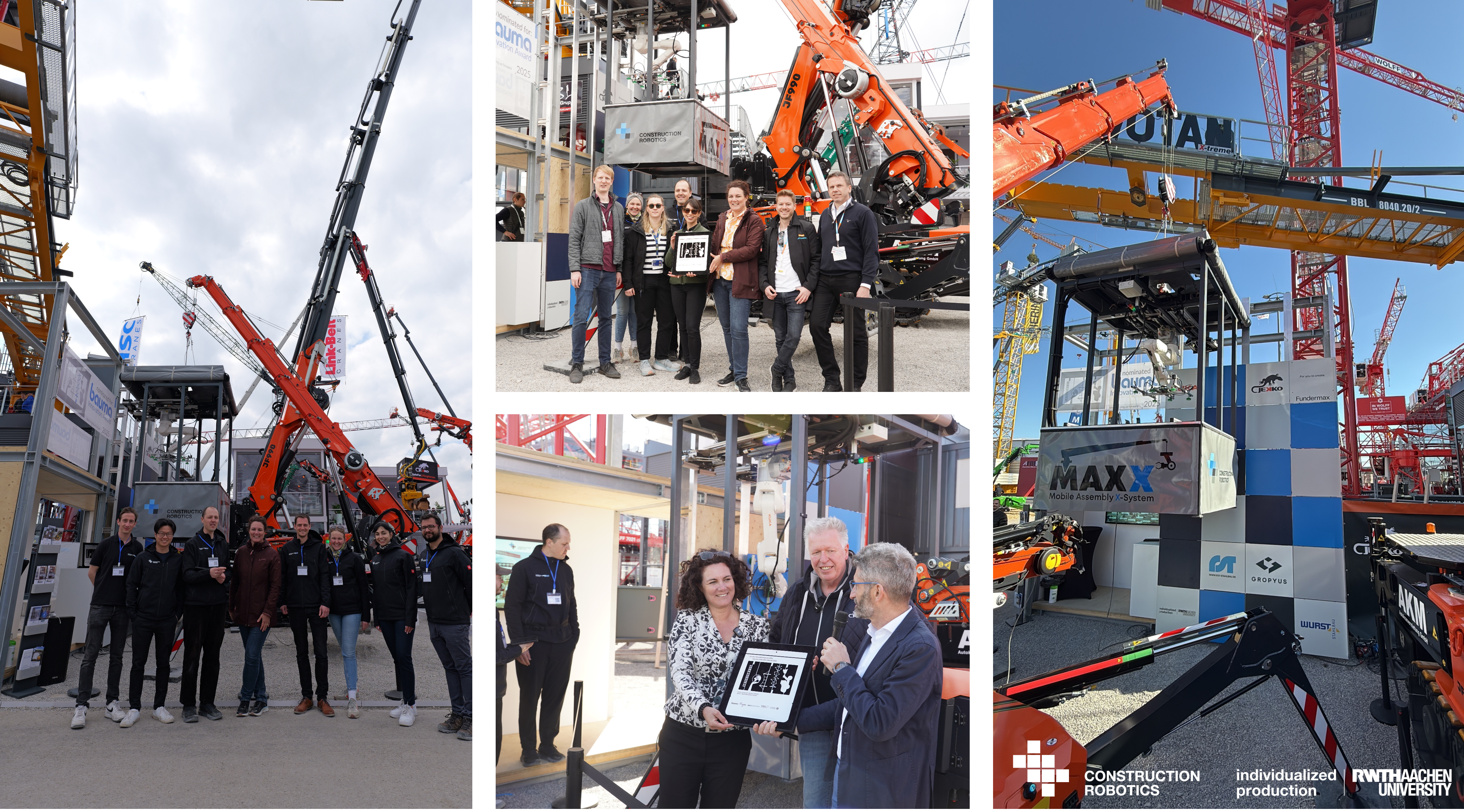
Prof. Dr. Sigrid Brell-Cokcan is a full-time Professor at the Chair of Individualized Building Production at RWTH Aachen University. Her work focuses on integrating construction robotics , 5G networks , digital twins , and BIM to advance automation in the construction industry. She leads projects like MAXX (awarded the bauma Innovation Award 2025 ) and TARGET-X, emphasizing interdisciplinary collaboration with industry partners such as KUKA AG, Jekko Srl., and Fraunhofer Institutes. Research Highlights: 5G-enabled robotic deconstruction Semantic data connectivity for steel assembly Ontology-driven automation frameworks Human-robot collaboration in unstructured environments Recent Trends: Focus on 5G networks for real-time construction monitoring Development of semantic digital twins for steel fabrication Integration of Vision Transformers and edge computing in robotic systems Rule-based automation for acoustic façade analysis Scientific Awards: bauma Innovation Award 2025 (Research category) for the MAXX project Her collaborations span HOCHTIEF ViCon , UNIBERG GmbH , and the 5G-Industry Campus Europe . She also contributes to teaching and international research programs like the Research-Driven Project on construction robotics.
Klaus Pohl is a full Professor for Software Systems Engineering at the University of Duisburg-Essen. He serves as founding director of paluno – The Ruhr Institute for Software Technology – and was the scientific founding director of the Irish Software Engineering Research Centre (lero) from 2005 to 2007. His academic career spans roles as program and general chair for major conferences like CAiSE 2017, ICSE 2013, and SPLC 2005/2008. His research focuses on self-adaptive systems, cloud computing, cyber-physical systems, and requirements engineering. Key sub-disciplines include proactive adaptation, variability management, and data protection in distributed environments. His work bridges theoretical advancements with industrial applications, particularly in embedded and service-oriented systems. Recent publications (2024–2023) emphasize explainable reinforcement learning, decentralized coordination of adaptive systems, runtime privacy mechanisms, and predictive business process monitoring. These works span journals like Computing and conferences such as ACM SIGSAC , IEEE ACSOS , and Springer LNCS , reflecting interdisciplinary collaboration. Klaus Pohl has co-authored over 300 peer-reviewed papers and six textbooks, including foundational guides for requirements engineering. His leadership in research projects and advisory roles for enterprises underscores his impact on both academia and industry.
Peter Alois Francois is a Research Fellow at South Westphalia University of Applied Sciences, Faculty of Computer Science, where he contributes to the Transformation Management (TM) group. He leads research in the project "Construction and Evaluation of Reference Models and Components for AI-supported Process Automation" and teaches process management and automation to practitioners and management teams. His academic credentials include: M.Sc. in Business Informatics (2019-2021) from Fachhochschule Dortmund B.Eng. in Engineering Management with IT (2015-2016) from Staffordshire University B.Sc. in International Studies of Business Administration and Computer Science (2014-2019) from Fachhochschule Südwestfalen His research centers on business process management with specialized focus on low-code reuse ecosystems and citizen developer dynamics. He investigates cognitive biases in digital transformation and vendor lock-in effects in automation platforms, bridging theoretical frameworks with industrial applications from his prior roles at NDR and DB Regio AG. His work emphasizes practical implementation of process automation in organizational contexts. Analysis of his publications (2022-2025) reveals a cohesive research trajectory toward systematic reuse of automation artifacts. Key themes include organizational capability building for BPM, critical evaluation of RPA adoption goals, and architectural frameworks for enabling citizen developers. His work consistently addresses the intersection of human factors and technical systems in process automation. The TM-group he belongs to is actively expanding its research capacity in information systems and transformation management, with ongoing recruitment for new research positions to strengthen their innovation focus.