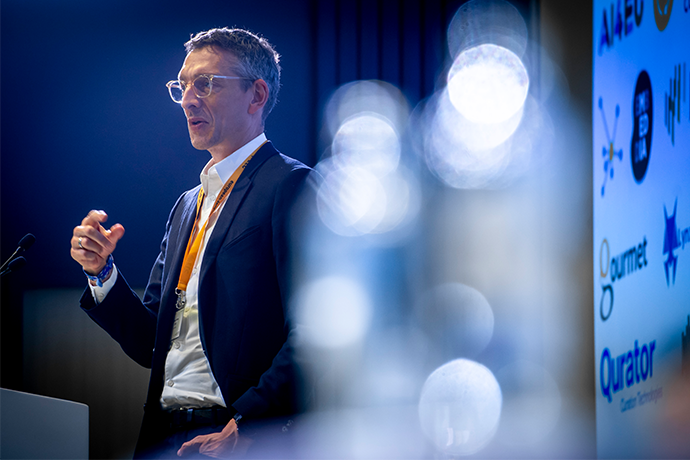
Alberto Barrón-Cedeño is an Associate Professor at the Department of Interpreting and Translation, University of Bologna (Italy). He holds a PhD in Artificial Intelligence from Universitat Politècnica de València (Spain) and has served as a former Scientist at Qatar Computing Research Institute (Qatar) and an Alain Bensoussan fellow at Universitat Politècnica de Catalunya (Spain). His research focuses on computational propaganda detection, automated fact-checking systems, and natural language processing applications in combating misinformation. Education: PhD in Artificial Intelligence, Universitat Politècnica de València, Spain Research Interests: Dr. Barrón-Cedeño specializes in developing AI-driven solutions for detecting disinformation, particularly in social media and news content. His work emphasizes computational propaganda analysis, fake news detection during crises (e.g., the COVID-19 pandemic), and designing tools to assist human fact-checkers. He leads initiatives such as the CLEF CheckThat! Lab to advance interdisciplinary approaches in misinformation research. Awards: Alain Bensoussan fellowship (Universitat Politècnica de Catalunya) Advising & Grants: While no formal advisees are listed, he collaborates extensively with global teams on funded projects related to computational fact-checking and propaganda detection. Labs & Teams: Core contributor to the CLEF CheckThat! Lab, which coordinates international efforts to develop benchmarks and tools for detecting check-worthy claims and fake news.
Oliver Karras is a researcher, data scientist, and lecturer at the Data Science and Digital Libraries research group at TIB – Leibniz Information Centre for Science and Technology. He holds a BSc, MSc, and PhD in Computer Science from Leibniz University Hannover. His research focuses on FAIR scientific knowledge, Open Research Knowledge Graph (ORKG), and national research infrastructure projects like NFDI-4Ing and FAIR-DS. He is a member of the German Informatics Society (GI) and spokesperson of the Requirements Engineering (RE) group, contributing to conferences and journals as a reviewer. Previously, he was a research associate and PhD student in the Software Engineering group at Leibniz University, leading the DFG project ViViReq on video integration in requirements engineering. His research interests include Data Science, AI, Knowledge Representation, Software Engineering, Requirements Engineering, Empirical Research, and Open Science. He has published over 60 papers in these areas, with notable contributions to knowledge graphs, FAIR data, and reproducibility frameworks. His work emphasizes organizing scientific knowledge for accessibility and collaboration across disciplines. He is actively involved in initiatives like the ORKG, promoting sustainable literature reviews and open science practices. His professional contributions extend to tool development, such as OntoAligner for ontology alignment and SciKGTeX for semantic annotation in LaTeX. Oliver Karras collaborates with institutions like Leibniz University, contributing to the NFDI consortium and energy research projects. His expertise bridges technical innovation and academic rigor, addressing challenges in knowledge management and reproducibility. His current roles include advancing TIB’s research infrastructure and fostering interdisciplinary collaboration through knowledge graph applications.
Georg Rehm is an Honorary Professor for Computational Linguistics and Language Technology at Humboldt University Berlin and a Principal Researcher at the German Research Center for Artificial Intelligence (DFKI) in Berlin, where he serves as Deputy Director of the DFKI Lab Berlin. He is also the Head of the German-Austrian Chapter of the World Wide Web Consortium (W3C) based at DFKI Berlin. Rehm has over 300 scientific publications and extensive experience in leading major research projects in computational linguistics and language technology. His research focuses on Natural Language Processing, Computational Linguistics, and Artificial Intelligence, with specific interests in multilingual language technologies, semantic web, digital humanities, and language data spaces. He has led numerous significant projects including European Language Grid, OpenGPT-X, and NFDI4DataScience. Rehm is particularly active in initiatives promoting digital language equality in Europe by 2030. Rehm's recent work demonstrates a strong focus on large language models, scholarly document processing, scientific knowledge representation, and climate-related fact-checking systems. His publications span across multiple high-impact venues including ACL, ESWC, and LREC, with a notable emphasis on practical applications of language technology in real-world scenarios. DFKI Research Fellow (2018) As an active member of the academic community, Rehm regularly serves as an expert for the European Parliament, reviews EU projects, and organizes numerous scientific conferences and workshops. His leadership extends to multiple European initiatives aimed at advancing language technology infrastructure and promoting digital language equality across Europe.
Rhema Linder is a Teaching Assistant Professor in the Department of Electrical Engineering and Computer Science at the University of Tennessee, Knoxville. His academic journey includes a BS in Computer Science and Mathematics from LeTourneau University (2009) and a PhD in Computer Science from Texas A&M University (2019). Prior to his current role, he served as a postdoctoral researcher at the PAIRS lab at UT Knoxville. His research focuses on Human-Computer Interaction (HCI), AI Art, Information Visualization, and Creative Cognition. He explores how AI and software systems can enhance creative productivity, particularly in collaborative online environments. His work integrates theories from creative cognition, social science, and HCI to design tools for engineering, design, and scholarship. Rhema has held internships at Adobe Research and Microsoft Research, contributing to projects in data science and human-computer interaction. His GitHub repositories include open-source projects like kivy-games, demonstrating his engagement with software development and educational tools. His research interests emphasize multidisciplinary approaches, blending art, technology, and social science to innovate in creative online spaces. He is actively involved in the PAIRS lab, focusing on advancing understanding of human-AI collaboration and information management systems.
Jose Sixto Garcia is a Professor of Communication Sciences at the University of Santiago de Compostela, where he also serves as the Director of the Institute of Social Media (City of Culture of Galicia). His academic career includes a Doctorate in Communication and Journalism (awarded the Extraordinary Doctorate Award), an MBA, and a Master's in Teacher Training. He specializes in digital media, social networks, and journalism innovation, focusing on topics like AI in newsrooms, risk communication, and media convergence. Director: Institute of Social Media (Galicia) Affiliations: IDEGA and Faculty of Communication Sciences His research explores the Fourth Industrial Revolution's impact on journalism, influencer marketing, and transparency in media. He has authored over 20 books, including Marketing and Communication and Fundamentals of Digital Marketing . Garcia has published extensively in peer-reviewed journals and contributes to media outlets like El Correo Gallego . Key Research Areas: Social Media Strategy, Digital Journalism, Media Ethics Notable Work: Co-creation of journalistic content, analysis of YouTube channels in media distribution Awards include the Extraordinary Doctorate Award (2011) and recognition for contributions to media innovation. His work bridges academic research and practical applications, emphasizing digital literacy and ethical communication practices.
Guillaume Cabanac is a Full Professor of Computer Science at Université de Toulouse, affiliated with IRIT UMR 5505 CNRS (IRIS team) and the Institut Universitaire de France. His work spans Scientometrics , Research Integrity , and Information Retrieval , with a focus on detecting scientific misconduct through computational methods. Key projects: Problematic Paper Screener , Decontamination of Scientific Literature Chair Service: Editorial Board Member at JASIST (2017–present) and Scientometrics (2013–present); Program Chair for multiple BIR workshops at ECIR Awards: Nature's 10 Scientist (2021), Young Researcher Prize at INFORSID'08 His research combines meta-studies of scientific literature , Crowdsourced fact-checking , and analysis of academic networks , addressing challenges in publication ethics and digital library systems.
Dr. Lea Frermann is an active researcher in computational linguistics and natural language processing, with a focus on media framing analysis, fairness in AI, and Bayesian modeling of semantic categories. Her work bridges machine learning with social science applications, particularly in political discourse and climate communication contexts. PhD in Bayesian models of category acquisition (University of Edinburgh, 2017) Key collaborations with University of Melbourne, ACL, EMNLP, and CoNLL communities Research emphasizes: Media framing analysis across cultures Explainable AI for bias detection Bayesian approaches to language understanding Word association modeling for value systems Computational methods for political discourse analysis Applications in mental health support forums Recent publications focus on large language models' limitations in hierarchical reasoning, multimodal categorization, and systematic fairness evaluation frameworks. Collaborations show strong connections with researchers like Timothy Baldwin, Trevor Cohn, and Omri Abend.
Lisa Cohen is an Associate Professor of Organizational Behaviour and Desautels Faculty Fellow at McGill University's Desautels Faculty of Management, where she also serves as Acting Associate Dean of Research. She holds a PhD in Business Administration from the University of California, Berkeley, an MBA from Duke University, and a BA in Sociology from Kalamazoo College. Her research focuses on job design, organizational structure, and the dynamics of work in entrepreneurial contexts. Education : PhD, Business Administration, Haas School of Business, University of California, Berkeley (USA) MBA, Fuqua School of Business, Duke University (USA) BA, Sociology, Kalamazoo College (USA) Research Interests : Cohen investigates how tasks are bundled into jobs and jobs into organizations, emphasizing startups and top management teams. Her work explores hiring processes, the impact of AI on work structures, and the coevolution of tasks and expertise. She has published in top journals like Academy of Management Journal , Administrative Science Quarterly , and American Journal of Sociology . Awards & Grants : SSHRC Insight Grant (2020-2025): Task Mobility SSHRC Insight Grant (2013-2018): Beyond Warm Bodies 2016-2021: Desautels Faculty Fellow 2013 Best Paper Award, Administrative Sciences Association of Canada Advising & Labs : Cohen has advised across startups and large firms, focusing on management team structures. She collaborates with the McGill Dobson Centre for Entrepreneurship and is affiliated with the Delve Initiative exploring modern work dynamics.
Dr. Neil Thurman is a Professor at Ludwig Maximilian University of Munich and a Senior Honorary Research Fellow at City, University of London. His career spans over two decades in digital journalism, focusing on news production and consumption in the internet era. He has held leadership roles in academic programs like the Erasmus Mundus Master's in Journalism and directed research initiatives on media automation, personalization, and audience behavior. Neil's research explores the impact of AI and social media on journalism, with a focus on automated newsgathering, content personalization, and audience analytics. His work has been honored with four 'Best Paper' awards at the International Symposium on Online Journalism (2006–2009). He has published extensively on live blogging, computational journalism, and ethical challenges in digital media. His recent publications highlight trends in news automation and AI ethics audience perception of algorithmic content streaming platform influence on media choices cross-border media consumption regulatory challenges in digital spaces journalistic principles in multiplatform environments Scientific Awards : Top Paper, International Symposium on Online Journalism (2006–2009) Staff Research Prize, City University London (2007) Award for Distinguished Contributions to Teaching and Learning (2001) Silver Apple Award (1995) As an external examiner and academic leader, Neil has shaped journalism education globally. He mentors PhD candidates and collaborates with institutions like Google, Reuters Institute, and the BBC. His work bridges theory and practice, influencing both scholarly and industry standards.
Dr. Uchitha Jayawickrama is a Senior Lecturer (equivalent to Associate Professor) in Information Systems at the Centre for Information Management, Loughborough Business School, Loughborough University. He holds a PhD, MBA, BSc (Hons), PgCHPE, and is a Senior Fellow of the Higher Education Academy (SFHEA). His research focuses on ERP implementations, knowledge management, AI applications in SMEs, digital transformation, and blockchain ethics. He has over 30 peer-reviewed publications and 2 best paper awards. Before academia, he worked as an Oracle Functional Consultant and IBM Solutions Manager, with expertise in ERP systems like SAP and Oracle E-Business Suite. He leads the MSc Information Systems and Digital Innovation program and manages the SAP University Alliance. His teaching spans undergraduate and postgraduate levels, and he supervises doctoral researchers. He has organized research seminars and contributed to course development in higher education. Research highlights include ERP responsiveness via big data, AI’s role in decision-making, and blockchain ethics. His work bridges academic research with industry needs, emphasizing practical solutions for SMEs and public sector organizations. Awards include recognition for innovative contributions to information systems and digital innovation. He actively reviews for journals/conferences, serves on editorial boards, and advises on ERP selection/implementation for Midlands SMEs and city councils. His interdisciplinary approach integrates technology, management, and societal impact.
Elena Simperl is a Professor at King's College London, UK, with former affiliations at the University of Southampton and Karlsruhe Institute of Technology. Her work focuses on knowledge graphs, semantic web technologies, and AI-driven data management. She leads research in collaborative knowledge engineering, dataset search, and AI ethics, contributing to projects like the TheyBuyForYou platform for public procurement transparency. Her research interests span knowledge representation, crowdsourcing, and human-AI collaboration. Notable contributions include advancing methods for knowledge graph construction, improving data quality via crowdsourced and automated approaches, and exploring the societal impact of AI systems. She has co-edited major conferences such as ISWC and ESWC, and her work bridges technical innovation with practical applications in public policy and information systems. Key projects include developing frameworks for dataset usability, AI-ready data infrastructure, and systems for fact-checking visual content. Her collaborations span academia and industry, addressing challenges in data governance, misinformation detection, and ethical AI deployment.
Dr. hab. Agnieszka Łukasik-Turecka, Prof. KUL is a Full Professor at the John Paul II Catholic University of Lublin (KUL), Faculty of Social Sciences, Department of Political Systems and International Communication. She specializes in Political Communication Disinformation Studies Media Analysis Political Propaganda Election Campaign Strategies Her research focuses on disinformation mechanisms during crises (e.g., Russia-Ukraine war , COVID-19 pandemic ), political discourse in religious contexts (e.g., Russian Orthodox Church ), and evolving media roles in elections. She has led KUL-funded projects on Polish media disinformation (2022–2023) and participated in Erasmus+ staff mobility programs at Université Paris 8. Recent publications analyze Pro-Kremlin bot networks Gender dynamics in Belarusian opposition Political communication in Putin's Russia Kremlin narratives blaming NATO/USA for Ukraine invasion and she co-edited the journal Studia i Analizy Nauk o Polityce (2023). Awards include the Silver Medal for Long Service and multiple KUL Rector Awards . She organized international conferences like International, Interdisciplinary Research Project 'Threats to Democracy: Nationalism, Populism, Extremism' and International Conference 'Man, Society and the State in an Unstable World' , and serves on the editorial boards of Addiction & Social Media Communication and Studia i Analizy Nauk o Polityce .
Maria Cruz Negreira Rey is an Assistant Professor at the Department of Communication Sciences, Faculty of Communication Sciences, University of Santiago de Compostela. She is affiliated with the Institute of Studies and Development of Galicia (IDEGA). Her research focuses on digital media innovation, hyperlocal journalism, and the intersection of technology with news production. She holds a Doctorate (2020) from the same university, with a thesis on hyperlocal cybermedia in Spain, supervised by Dr. Xosé López García. Her academic work emphasizes the transformation of journalism in the digital age, particularly exploring AI integration in communication sectors, audience-driven journalism, and challenges posed by news deserts. Key research areas include media geography, risk communication (e.g., radon gas reporting), and the adaptation of journalism to platforms like TikTok and Twitch. She has also studied comparative models of hyperlocal media in Spain and the Netherlands, and the role of digital native media in societal communication. Her publications highlight trends such as the blurring boundaries between traditional journalism and citizen-generated content, the ethical implications of AI in media, and the strategic reinvention of local journalism in the face of technological disruption. While no formal awards are listed, her prolific output reflects significant contributions to media studies and communication science. Her research extends to media labs, innovation in public service broadcasting, and the sociability functions of online media networks. She collaborates on projects mapping media landscapes, such as Galicia’s digital media ecosystem, and analyzing the impact of instant messaging platforms like WhatsApp in news dissemination.
Oscar Romero Moral is a Professor at the Polytechnic University of Catalonia (UPC), affiliated with the Department of Services and Information Systems Engineering at the Barcelona School of Informatics (FIB). He leads research in the inSSIDE, inLab FIB, and DTIM groups, focusing on data management, data science, and big data technologies. His work emphasizes knowledge graphs, data governance, and machine learning integration with data systems. Affiliations: UPC, inSSIDE, inLab FIB, DTIM Group Research Interests: Data Management, Data Engineering, Big Data, Knowledge Graphs, Data Governance, Machine Learning Integration He has authored over 276 academic contributions, including peer-reviewed articles on federated healthcare data systems, GPU-accelerated workflows, and graph-driven data integration. His recent work addresses challenges in heterogeneous computing, automated data governance, and scalable data architectures. Romero has served on the program committees of major conferences like VLDB, ICDE, and EDBT, and led competitive research projects in data systems and analytics. He collaborates extensively with industry partners and academic institutions, driving innovations in distributed data management and edge computing.