Prof. Helmut Grabner is a Professor at the Zurich University of Applied Sciences (ZHAW), leading the Visual Intelligence and Applications Group and the Entrepreneurship initiatives within the School of Engineering. His work bridges computer science, medical technology, and visual communication, with a focus on Extended Reality (XR), surgical training simulations, and AI-driven decision making. Education: PhD in Computer Science (Graz University of Technology, 2008), Master's in Computer Science (2008), and a Certificate of Advanced Studies in Higher Education (ZHAW, 2021). Prior to academia, he held roles including CTO at Logitech and co-founder of upicto, applying computer vision in industry and startups. Research spans augmented reality medical training tools, NMR spectrum analysis via deep learning, and understanding visual engagement in advertising. Awards include the prestigious Koenderink Prize (2018) for contributions to computer vision. Projects include Immersive Education frameworks, bias-mitigation in venture capital algorithms, and surgical proficiency measurement systems. Teaching includes courses on Visual Computing, Machine Learning, and Deep Learning. His work integrates academic research with practical applications in healthcare, education, and entrepreneurship.
Prof. Dr. Reinhold Decker is a full professor of business administration with a focus on marketing and market research at Bielefeld University's Faculty of Economics, where he has been affiliated since 1997. He currently serves as the Rector's Representative for Cooperation with Business, BRIC, and Research Transfer (since October 2023), following previous roles as Vice Rector for Information Infrastructure and Business (2019-2023), Vice Rector for Information Management (2015-2019), and Vice Rector for Financial Affairs and Resources (2012-2015). He is also the Scientific Director of BI2000plus - Research Projects on the Region since 2005 and a member of the Bielefeld Graduate School of Economics and Management (BiGSEM). Decker earned his degree in industrial engineering with a focus on OR/Computer Science in 1988, received his doctorate in 1993, and completed his habilitation in 1997, all from the University of Karlsruhe (KIT). His academic career includes visiting professorships at the University of Vienna, Moscow Academy of Economics, University of Veliko Turnovo, Universidade NOVA de Lisboa, Université Paris III – Sorbonne Nouvelle, and the University of Maryland. His research focuses on the development and empirical testing of methods and models for acquiring and analyzing consumer data, particularly from social media, and data-driven, consumer-centric development of intelligent products and services. His work spans social media analysis, buyer behavior modeling, brand image analysis, web mining in marketing, and internet-based preference measurement. Decker's interdisciplinary approach bridges marketing, data science, and consumer behavior, with increasing emphasis on intelligent systems and digital transformation in marketing contexts. Analysis of his 15 most recent publications reveals a strong focus on emerging technologies in marketing, including augmented reality, voice assistants, and social media analytics. His research increasingly examines privacy concerns in the digital age, sustainability communication, and the integration of AI in consumer decision-making processes. The interdisciplinary nature of his work is evident in publications spanning marketing journals, data science publications, and technology-focused outlets. Member of the Scientific Council of the journal Argumenta Oeconomica Cracoviensia (since 2013) Associate Editor of the journal Behaviormetrika (since 2012) Member of the Editorial Board of the Springer series Studies in Classification, Data Analysis, and Knowledge Organization (since 2004) Vice President of the European Association for Data Science – EuADS (2018-2022) Decker has served on numerous editorial boards and scientific program committees, including for the International Federation of Classification Societies. His extensive reviewing work spans prestigious journals such as Journal of Business Research, Journal of Product Innovation Management, and Review of Managerial Science. His leadership extends to project management, including BiLinked (2025), Bielefeld 2000plus (2024), and Bielefelder DatenNarrative (2022). Decker has also edited multiple volumes and special issues on data analysis and marketing, demonstrating his commitment to advancing methodological approaches in business research. As Scientific Director of BI2000plus, Decker leads interdisciplinary research projects focused on regional development. His work bridges academia and industry through initiatives like the Bielefeld Center for Data Science (BiCDaS) and the Bielefeld Graduate School in Theoretical Sciences. His recent projects emphasize data narrative techniques, linking data analysis with effective communication strategies for diverse audiences.
Professor David Xu is a distinguished faculty member in the Department of Information Systems at City University of Hong Kong, where he has served as Professor since 2023 after progressing from Associate Professor (2017-2023). Prior to joining CityU, he held academic positions at Wichita State University from 2011-2017, culminating in the Bomhoff Endowed Professor of Business title in 2017. His educational background includes a PhD in Management Information Systems from the University of British Columbia (2011), an MPhil in Information Systems from City University of Hong Kong, and a First-class honors BBA in Business Administration from Lingnan University. As Programme Leader for both BBA Information Management and Bachelor's Degree in Information Systems programs since 2018, he plays a significant administrative role in curriculum development. Professor Xu's research spans human-computer interaction, artificial intelligence applications, and technology adoption across diverse domains. With over 90 publications including 40+ journal papers in top-tier venues like MIS Quarterly and Information Systems Research, his work demonstrates exceptional scholarly impact. His Google Scholar metrics (3,300+ citations, h-index of 22) reflect substantial influence in the field. His recent publications reveal a strategic focus on AI ethics, information cocoon mitigation in social media, healthcare applications of AI, and digital transformation effects on business. The work spans theoretical contributions and practical implementations, with increasing emphasis on societal impacts of technology. AIS Early Career Award (2018) AIS Distinguished Member – Cum Laude (2020) Multiple teaching excellence awards (2021, 2024, 2025) ICIS and ISR Best Associate Editor Awards (2020-2021) Numerous paper award nominations across major conferences Professor Xu has secured significant research funding including NSFC, RGC GRF, and CityU Strategic Research Grants totaling millions in funding. His current projects address critical issues like AI beauty filters, depression treatment systems, and information cocoon mitigation. As Senior Editor for Information Systems Journal and Associate Editor for Information Systems Research, he shapes the field's scholarly discourse while supervising DBA and PhD students across multiple programs.
Denny Yu is an Associate Professor at the Edwardson School of Industrial Engineering, Purdue University. His work bridges human factors, neuroergonomics, and healthcare safety through advanced sensor systems and AI. Primary Affiliation : Edwardson School of Industrial Engineering, Purdue University Research Themes : Surgical ergonomics, autonomous vehicle human factors, cognitive workload assessment, multimodal physiological sensing Dr. Yu's research focuses on neuroergonomics and human-robot interaction , particularly in surgical and transportation contexts. His team develops sensor-based systems for workload monitoring, including: EEG-eye tracking fusion for situation awareness Wearable exoskeletons for surgical posture support Computer vision tools for lifting task risk analysis Smart infusion pump usability frameworks AI-driven surgical coaching systems Recent publications emphasize deep learning applications in soft tissue deformation estimation and real-time adaptive systems for robotic surgery augmentation. His work spans both occupational health (veterinary surgeons, airport workers) and medical device innovation domains.
Abey Campbell is an Assistant Professor in Computer Science at the School of Computer Science, University College Dublin. He holds roles such as Deputy Programme Director for Computer Science, Director of UCD VR Lab, and 1st Year Stage Coordinator. His research focuses on Augmented Reality (AR), Virtual Reality (VR), Mixed Reality (MR), and Multi-Agent Systems with applications in education, healthcare, and human-computer interaction. Campbell has coordinated modules like Augmented and Virtual Reality, Computer Graphics, Game Development, and Mobile Computing. He earned his BSc and PhD in Computer Science from University College Dublin. His work explores touchless interaction technologies, machine learning agents in STEM education, and ethical implications of emerging technologies. Notable contributions include RenderKernel for real-time rendering systems and studies on AR's role in decision support systems. Campbell has secured a grant from Enterprise Ireland for collaborative design documentation and participates in professional activities like peer reviewing for Frontiers in Virtual Reality and IEEE conferences. His collaborative projects include developing AR tools for veterinary training and evaluating immersive VR experiences in nursing education. The UCD VR Lab under his direction focuses on applied research in spatial computing and interactive systems.
Dr. Olivia Petit is a Lecturer and researcher in Marketing at KEDGE Business School specializing in consumer neuroscience, sensory marketing, and digital marketing. Her research employs advanced methodologies including functional magnetic resonance imaging (fMRI) studies to investigate mental imagery and multisensory interactions in consumer experiences. Her research interests focus on consumer neuroscience , sensory marketing , digital marketing , AR/VR applications , and food marketing . Dr. Petit examines how sensory cues influence consumer behavior, particularly in digital environments, with emphasis on visual, auditory, and tactile elements that shape consumer experiences and decision-making processes. Analysis of her recent publications (2021-2024) reveals a strong trajectory toward multisensory digital experiences , ethical considerations in customer experience , and advanced applications of extended reality in marketing contexts. Her work bridges neuroscience, psychology, and business applications with particular focus on food and beverage marketing. Scientific recognition includes: Nestlé Foundation award (2012) EMAC McKinsey Marketing Dissertation Award (2015) Dr. Petit has established significant collaborations with researchers across Europe and has published in top-tier journals spanning marketing, neuroscience, psychology, and food science domains. Her work demonstrates a consistent focus on understanding the cognitive and sensory mechanisms underlying consumer behavior in both traditional and digital contexts. Her laboratory work incorporates advanced technologies including virtual reality systems and neuroimaging techniques to explore how multisensory cues influence consumer perception, decision-making, and behavior in retail and online environments.
Jorge Camba is an Associate Professor at the School of Engineering Technology and holds a courtesy appointment in the Department of Computer Graphics Technology at Purdue University . He also serves as a Senior Research Scientist (by courtesy) in the Department of Industrial Engineering at the University of Naples Federico II , Italy. PhD in Systems and Engineering Management (Universidad Politécnica de Valencia, Spain) MSc in Digital Media (East Tennessee State University) MSc in Computer Science (Universidad de Vigo, Spain) His research explores intelligent CAD systems , digital manufacturing , and mixed reality environments , focusing on model quality assurance , design intent communication , and collaborative design tools . Recent work investigates spatial cognition in CAD education , geometric variability analysis , and annotation-driven knowledge management . Key trends in his publications include parametric modeling strategies , 3D annotation systems , and XR applications in design evaluation. Awards include the Purdue Faculty Scholar (2021) and I3B Fellow (2021). He has presented at conferences on topics like Industry 4.0 , space habitat design , and digital product quality .
Thomas Ludwig is a Professor of Information Systems with a focus on Cyber-Physical Systems at the University of Siegen. He holds a PhD (summa cum laude) from the same institution and has led numerous research initiatives in Industry 4.0, digital transformation, and human-centered technology design. His work spans augmented reality (AR), gamification, and AI integration in manufacturing. Ludwig co-founded and coordinates the 'Mittelstand 4.0-Kompetenzzentrum Siegen' to support SMEs in digitalization. He has authored over 50 publications in top-tier journals and conferences, including Computer Supported Cooperative Work (CSCW) and Proceedings of the ACM on Human-Computer Interaction . His research has been recognized with awards such as the IHK Preis 2017 for Best Dissertation and the Artur-Woll-Preis. Education: Diplom-Wirtschaftsinformatiker from University of Siegen (2012), PhD in Information Systems (2016), with a focus on socio-technical systems and mobile/social media research. Research Interests: Cyber-Physical Systems, AR applications, gamification design, AI in production planning, and digital competency frameworks for SMEs. He leads projects like Fusion, KOKOS, and EKPLO, addressing challenges in collaborative work, disaster management, and industrial digitalization. Grants & Projects: Projects include EU-funded EMERGENT, BMBF-funded KOKOS, and the self-acquired EKPLO initiative for APS systems in SMEs. He also coordinates the Zukunftszentren KI NRW and the EDIH Südwestfalen. Awards: 32. IHK Preis 2017, Artur-Woll-Preis, pwc-Preis, and multiple best paper awards at international conferences. Labs/Teams: Part of the Cyber-Physical Systems Lab at University of Siegen and the interdisciplinary team behind the 'Rendezfood' and 'Advanced Planning Systems' initiatives.
Elaine Mosconi is a Full Professor at the Université de Sherbrooke since 2024, with prior roles as Associate Professor (2017-2024) and Visiting Professor at institutions like Université Lumière Lyon 2 and École Nationale Supérieure des Mines de Saint-Étienne. She holds a PhD in Administration from Université Laval (2014), an MSc in Industrial Engineering from Universidade de Sao Paulo (2003), and a BSc in Library & Information Science (1999). Université de Sherbrooke | Full Professor (2024-), Associate Professor (2017-2024) Université Laval | Visiting Scholar (2019-2023) International collaborations in France, Brazil, USA, Sweden Her research focuses on Digital Transformation , Industry 4.0 , and Collaborative Innovation , with emphasis on organizational value creation through technology adoption and information literacy. She has secured over $1,649,623 in grants from NSERC, CRSH, MITACS, and provincial agencies, including a $5M grant for SME digital transformation programs. Recent articles explore plastic waste circular economy , enterprise social media maturity , and Industry 5.0 workforce adaptation . Her work bridges business intelligence with sustainable supply chain practices. Scientific Awards : Dean's Research Award (2024) ASAC Best Paper in Technology & Innovation Management (2022) Multiple Academic Coach/Mentor of the Year (2019-2021) Nominated for Inspiration Award (Quality of Service) (2017-2018) As a conference organizer and track chair for IAMOT, HICSS, and AMCIS, she leads initiatives in digital transformation frameworks. Her pedagogical projects include developing a data literacy assessment tool for business leaders and co-creating a knowledge management framework for decision performance.
Vinh Nguyen is an Assistant Professor in the Department of Mechanical and Aerospace Engineering at Michigan Technological University, where he directs the Michigan Tech Center for AI and coordinates the NIST-PREP program. His research focuses on advanced manufacturing through Industry 4.0, human-robot-machine interaction, and physics-based/data-driven modeling. He has developed solutions for machining, additive manufacturing, metal forming, and robotic assembly to promote smart and sustainable manufacturing. Prior to joining Michigan Tech in 2022, he was a National Research Council Postdoctoral Fellow at NIST (2020–2022). Dr. Nguyen earned his PhD (2020), MS in Mechanical Engineering (2017), and MS in Electrical & Computer Engineering (2017) from Georgia Institute of Technology. He received dual bachelor’s degrees in Electrical and Mechanical Engineering from Rensselaer Polytechnic Institute (2014). His research portfolio spans Advanced Manufacturing Industry 4.0 and 5.0 Human-Robot Interaction Physics-Based/Data-Driven Modeling Industrial Automation based on his lab’s interdisciplinary focus on human-centric, resilient solutions. His recent publications address trends in Machine Learning for Manufacturing Autonomous Vehicle Sensors Hybrid Additive/Subtractive Manufacturing Augmented/Mixed Reality Interfaces Industrial Robot Diagnostics Material-Specific Machining with keywords spanning Robotics, Data Science, and Industrial Engineering.
Dr. Christopher Collins is a Professor of Computer Science at Ontario Tech University, leading the Visualization for Information Analysis Lab (vialab). He holds a PhD from the University of Toronto (2010) and focuses on interdisciplinary research in information visualization, human-computer interaction, and natural language processing. His work addresses challenges in information overload, text analytics, and novel interfaces such as touch, pen, VR/AR. Collins' research has been featured in top-tier venues like ACM CHI and IEEE Transactions on Visualization and Computer Graphics, earning honorable mentions and over $3M in funding as sole PI. He serves on the IEEE VIS Executive Committee and Board of Governors at Ontario Tech University. Education: PhD in Computer Science, University of Toronto (2010) MSc in Computer Science, University of Toronto (2004) BSc (Hons) in Computer Science, Memorial University (2001) Research Interests: Collins' work spans information visualization , pen+touch interfaces , visual analytics , and text-driven systems . He explores how interactive technologies can democratize complex data analysis, particularly in education, healthcare, and creative domains. Recent projects include gaze-driven learning tools, context-aware camera interfaces, and bias-mitigating product review analysis. Awards: ACM CHI Honorable Mention Award IEEE VIS Honorable Mention Award Grants & Impact: Secured $3M+ in research funding. Media coverage includes New York Times and CBS Sunday Morning for innovations in visualization and text analytics. Teaches courses in human-computer interaction, computer graphics, and information visualization. Labs & Collaborations: vialab develops tools like Lexichrome , ConToVi , and NeuroSight . Active in IEEE Visualization and ACM Interactive Media communities. Collaborates with academia and industry globally.
Idelfonso Nogueira is an Associate Professor at the Department of Chemical Process Technology, Norwegian University of Science and Technology (NTNU). His research focuses on integrating artificial intelligence, advanced control, and system optimization to address challenges in Industry 4.0/5.0. Key research areas include AI-driven product/process development, interpretable machine learning for process systems, multi-scale system integration, and adaptive digital twins. He collaborates extensively with global universities, institutes, and industries to advance sustainable industrial solutions. His work emphasizes digitalization, hybrid modeling, and optimization frameworks, as seen in publications on pressure swing adsorption, fragrance engineering, and CO2 capture systems. He also promotes innovative teaching methods, including augmented reality for chemical engineering education. Recent publications highlight advancements in digital twin frameworks, machine learning for crystallization processes, and optimal control strategies. His research bridges theoretical models with practical applications, ensuring robustness and reliability in industrial contexts.
Olga Chkanikova is a Researcher at the University of Borås , affiliated with the Faculty of Textiles, Engineering and Business and the Department of Business Administration and Textile Management . Her work focuses on digital transformation in the fashion industry, sustainability-oriented innovations, and supply chain dynamics, with a particular emphasis on cultural and operational shifts driven by technologies like 3D modeling and digital twinning. As a co-supervisor for doctoral students, she contributes to advancing research in these areas. Key research themes: Digital Fashion, Circular Economy, Business Model Innovation Contact: olga.chkanikova@hb.se Her recent publications analyze the intersection of technology, sustainability, and institutional frameworks in fashion and retail sectors. She has explored the scalability of fashion-tech solutions, the role of third-party certifications in supply chains, and the cultural dimensions of digital transformation.
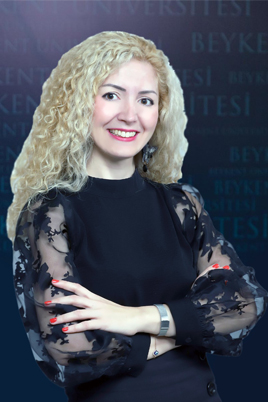
Sevgi AYDIN serves as an Assistant Professor in Logistics Management at Beykent University's Faculty of Business. Her academic work bridges digital transformation, artificial intelligence applications, and consumer behavior within modern marketing frameworks. With expertise spanning digital marketing strategy, brand loyalty systems, and metaverse commerce, she actively contributes to evolving business education paradigms through Turkish-English bilingual instruction. Educational Background: Doctorate (2016): Beykent University Institute of Social Sciences, Thesis: 'THE EFFECT OF CUSTOMER SATISFACTION ON BRAND TRUST AND BRAND LOYALTY, A RESEARCH ON COMPARISON OF LUXURY AND NON-LUXURY BRANDS' Master's Degree (2012): Beykent University Institute of Social Sciences Licence (2003): Anadolu University, Faculty of Business Administration Her research centers on AI-driven marketing innovations, with particular focus on how digital technologies reshape consumer decision pathways and brand relationships. Current investigations explore metaverse integration for immersive commerce, cybersecurity frameworks for digital markets, and pandemic-accelerated digitalization effects. Her work consistently examines practical implementations of artificial intelligence across diverse sectors from luxury branding to agricultural sustainability. Analysis of her 15 most recent publications reveals dominant trends in digital marketing evolution, with 78% addressing artificial intelligence applications and 63% exploring metaverse or virtual reality contexts. Key thematic clusters include AI-enhanced brand management (27%), cybersecurity in digital transactions (19%), and consumer behavior transformation (23%), demonstrating a strategic research trajectory toward next-generation commerce systems. Academic Supervision: SEVİL AYDIN (2024): 'THE USE OF SOCIAL MEDIA IN HOSPITAL CHOICE AND THE EFFECT OF WORD-OF-MOUTH MARKETING ON BRAND LOYALTY' RUKEN BAYONET (2021): 'The role of the food engineer in ensuring occupational health and safety management in food businesses producing hot meals' MERYEM BALTACI (2023): 'The Future of Graphic Design and the Impact of Artificial Intelligence on Graphic Design: Maw Agency Client Applications'
João Guerreiro is a Visiting Assistant Professor at ISCTE-IUL (Instituto Universitário de Lisboa) with a PhD in Marketing from the same institution. He is affiliated with the Iscte Business School, where he teaches undergraduate and master's degree courses in marketing and decision support systems, applying data mining techniques to analyze large information sets. His research expertise spans three interconnected domains: Decision Support Systems - particularly in banking and insurance sectors where he has held executive positions Neuroscience Applied to Marketing - utilizing eye-tracking and studying autonomic emotional responses to consumer stimuli Corporate Social Responsibility - examining cause-related marketing and pro-environmental behavior in tourism Dr. Guerreiro's recent publications (2020-2023) reveal a strong emphasis on immersive technologies, with multiple studies on virtual reality applications in consumer behavior, augmented reality's impact on purchasing decisions, and cross-cultural differences in digital marketing effectiveness. His methodological approach frequently incorporates text mining, sentiment analysis, and neuromarketing techniques to uncover deeper consumer insights. His industry experience in decision support systems provides practical grounding for his academic work, creating a valuable bridge between theoretical marketing concepts and real-world business applications in financial sectors.





.jpg?width=150&height=150&length=150&name=Joao%20Guerreiro%20(4).jpg)