Prof. Dr. rer. nat. habil. Stephan Kopf is a faculty member at the Faculty of Spatial Information, where he holds the Professorship in Informatics and Geoinformatics. He actively contributes to research in geographic information systems (GIS), computer graphics, computer vision, and multimedia technologies. His academic leadership roles include serving as Dean and as a member of the Faculty Council, with advisory roles in the Senate. His research spans crowd simulation , image/video retargeting , augmented reality platforms , and interactive learning systems . He focuses on algorithm development for GIS, temporal effects in re-captured video, and scalable solutions for classroom interactivity. His work frequently integrates machine learning, mobile computing, and geospatial data. For teaching, he oversees courses such as Internet Technologies, Informatics, and Programming in degree programs like Geoinformatics/Management and Surveying. He supervises theses involving programming-centric topics like mobile app development , VR applications , and astronomical analysis of geospatial data .
Dr. Shanti Krishnan is a Senior Lecturer in the School of Engineering at Swinburne University of Technology, where she conducts interdisciplinary research at the intersection of physics, engineering, and cybersecurity. Her work spans fundamental physics experiments and practical industrial applications. Her research focuses on nuclear and plasma physics , particle physics , and astronomical sciences , with key contributions to muon tomography for monitoring mining infrastructure, dark matter detection via the SABRE South experiment at the Stawell Underground Physics Laboratory, and instrumentation development for the W. M. Keck Observatory. She also explores cybersecurity in Industry 4.0 , particularly through digital twin technologies and anomaly detection in cyber-physical systems. Her recent publications highlight advancements in muon-based navigation for space exploration, cosmic ray-based cybersecurity systems, and simulation of dark matter detectors. These works demonstrate a strong trend toward applying particle physics principles to real-world engineering and security challenges. Dr. Krishnan has received multiple grants, including external funding from HILT CRC Limited and internal grants from Swinburne University, supporting projects such as impact-driven learning materials for net zero in heavy industries and digital twin applications for blood product manufacturing. Development of Impact driven learning materials for net zero in heavy industries – HILT CRC Limited (2025) Rapid Scenario Testing using digital twin for sustainable and scalable manufacturing of blood products – Swinburne University (2024) A Dynamic In-bed Weight Monitoring System for Aged Care Facilities – Cloud Burst Software Pty Ltd (2023) She is actively supervising PhD students, including a project on using digital twins and machine learning to detect cyber-attacks in Industry 4.0 manufacturing systems. Her work is supported by collaborations with institutions such as Caltech, UC Observatories, ANU, and W. M. Keck Observatory, reflecting a strong international research network. Dr. Krishnan leads and contributes to multidisciplinary research teams focusing on detector development, secure industrial systems, and sustainable manufacturing. Her lab and project teams integrate physics, engineering, and data science to solve complex real-world problems.
François Bodin is a Professor at University of Rennes 1, actively involved in research at IRISA (Institut de Recherche en Informatique et Systèmes Aléatoires). He leads the Logica research team which focuses on data logistics—developing methods to organize distributed processing chains while considering technical performance, environmental sustainability, data governance, and long-term viability. His work spans multiple interdisciplinary projects including AQMO for air quality monitoring, RUDI for metropolitan open data platforms, and Numpex for Exascale computing. His research interests primarily focus on: Data Logistics and Distributed Processing Systems Exascale and High Performance Computing Sustainable and Energy-Efficient Computing Practices Open Data Platforms for Smart City Applications Parallel Programming and Software Optimization Professor Bodin's recent work demonstrates a strong commitment to reconciling digital performance with environmental sustainability. His projects like AQMO (air quality monitoring) and RUDI (metropolitan data platform) showcase practical applications of his research in urban environments. The Numpex project represents his leadership in preparing French scientific and industrial applications for exascale computing capabilities. Notably, he has made a personal commitment to environmental sustainability by declaring 'For environmental reasons, starting the 01/01/2020 I will not take the plane anymore.' His scientific contributions span several key areas: Exascale computing preparation and software development Metropolitan open data platforms and governance Energy-efficient computing practices Astronomical data processing through the ECLAT laboratory Professor Bodin actively participates in research recruitment and collaborates with various institutions including CNRS, Inria, and industry partners to advance his field. His work bridges theoretical computer science with practical urban and environmental applications, making significant contributions to both academic research and real-world problem solving.
Michael Lesser is an Astronomer at Steward Observatory, Director of the Imaging Technology Lab, and a Research Professor in the College of Optical Sciences at the University of Arizona. His educational background includes: Ph.D. from The University of Arizona (1988) Dr. Lesser's research centers on astronomical instrumentation, with expertise in optimizing scientific Charge Coupled Device (CCD) detectors and CMOS imagers. He develops advanced techniques for back illumination, packaging, backside charge, and antireflection coating, enabling global applications in both astronomical observations and industrial imaging systems. His work spans visible and ultraviolet imaging, spectroscopy, and specialized software technologies critical to modern detector performance. He directs the Imaging Technology Lab near the University of Arizona main campus, which pioneers innovations in scientific imaging hardware and methodologies for diverse research and commercial applications.
Robert J. Nemiroff , University Professor of Physics at Michigan Technological University's College of Sciences and Arts , is a distinguished astrophysicist and Fellow of the American Physical Society. Known for co-creating the Astronomy Picture of the Day (APOD) in 1995 and founding the Astrophysics Source Code Library (ASCL) in 1999, he has significantly advanced open science and public engagement. His research spans gamma-ray bursts, gravitational lensing, and cosmological constraints, with a focus on relativistic effects and observational innovation. Education PhD in Astronomy and Astrophysics, University of Pennsylvania Research Interests Nemiroff's work explores gamma-ray bursts as cosmological probes, gravitational lensing phenomena, and relativistic illumination fronts to orient nebulae. He pioneered CONCAMs , fisheye cameras deployed globally for all-sky monitoring, and investigated unconventional ideas like ultralight energy and dark energy-Higgs connections . His recent studies include Cherenkov radiation coherence and AI-generated astronomical imagery. Scientific Awards NSF CAREER Award (1997) MTU Research Award (2012) MTU University Professor (2021) Exceptional Graduate Mentor Award (2021) Advising and Grants Mentoring eight PhD students, including Bijunath Patla (Harvard) and Lior Shamir (Lawrence Tech), Nemiroff emphasized collaborative research. His NSF-funded projects included deploying CONCAMs at major observatories and developing the ASCL, which now lists 2600+ codes. He also led interdisciplinary efforts to post free online courses like 'Physics X' and 'Astro 101'. Labs and Teams He led the Night Sky Live (NSL) project, creating a global network of fisheye cameras for cloud and transient monitoring. The ASCL, now housed at MTU, remains a critical resource for code transparency. His work often involved partnerships with NASA, Kitt Peak, and institutions in Thailand, Chile, and Israel.
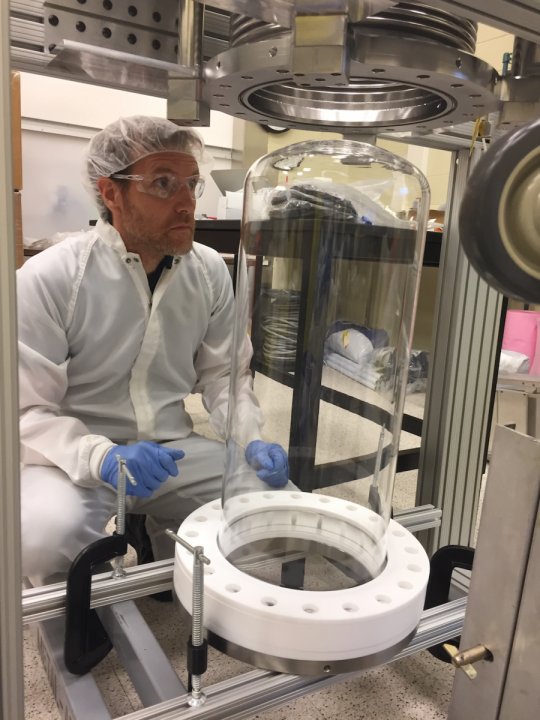
Ken Clark is an Associate Professor and Graduate Chair in the Department of Physics, Engineering Physics and Astronomy at Queen's University, affiliated with the McDonald Institute and TRIUMF. He holds a B.Sc. from the University of Toronto, M.Sc. from Trent University, and Ph.D. from Queen's University. His research focuses on dark matter detection via the PICO experiment and neutrino studies through the IceCube collaboration at the South Pole. He leads construction efforts for the PICO 500 detector and serves as analysis coordinator for the IceCube upgrade. Clark's work bridges particle astrophysics, neutrino physics, and cosmic ray detection. Education: B.Sc., University of Toronto M.Sc., Trent University Ph.D., Queen's University Research Interests: Dark matter detection (PICO experiment), neutrino physics (IceCube collaboration), astroparticle physics, and cosmic ray interactions. Clark collaborates with institutions like the University of Alberta, Northwestern University, and Fermilab. His recent projects include advancing bubble chamber technology and optimizing IceCube's sensitivity to dark matter interactions. He also explores neutrino cross-section measurements and the proposed PINGU sub-detector for enhanced detection capabilities. Joint appointments at TRIUMF provide access to cutting-edge detector development resources. Awards and grants are not explicitly listed, but his work reflects significant contributions to international collaborations. Students and lab teams are engaged in PICO and IceCube experiments, though specific advisees are not detailed here. His research aims to address fundamental questions about the universe's structure and dark matter's role.
Robert Morehead serves as an Associate Teaching Professor in the Department of Astronomy and Astrophysics at Pennsylvania State University, where he maintains active research and teaching responsibilities. His institutional contact details include email rcm242@psu.edu and telephone 814-863-9684, reflecting his ongoing engagement with the academic community through both instructional and research channels within the university's astronomical sciences division. Dr. Morehead's primary research focus centers on exoplanet discovery and characterization through statistical analysis of Kepler mission data. His methodological expertise includes approximate Bayesian computation, transit timing variation analysis, and multi-band photometric validation techniques. Key research areas encompass exoplanet population statistics, false positive rate mitigation in transit surveys, multi-planet system architectures, and the development of simulation frameworks for modeling planetary system formation and evolution. His work bridges observational astronomy with advanced computational statistics to address fundamental questions in planetary science. Analysis of his publication record from 2013-2025 reveals consistent contributions to exoplanet population studies, with particular emphasis on statistical validation methods for Kepler candidates. His research demonstrates evolving sophistication in handling large datasets through simulation-based approaches, with increasing focus on software development (notably ExoplanetsSysSim) and Bayesian inference techniques. The thematic progression shows movement from initial candidate validation toward comprehensive population modeling, reflecting broader trends in the field toward data-intensive exoplanet characterization. Scientific Awards: No scientific awards documented in available source materials While the provided documentation contains no explicit references to doctoral advisees or formal student supervision, Dr. Morehead's active research program suggests potential involvement in graduate education through course instruction and research project guidance within the astronomy department. No grant funding information appears in the current source materials, though his publication record implies participation in collaborative research initiatives requiring external support. His current research trajectory, evidenced by the 2025 ExoplanetsSysSim publication, indicates ongoing development of computational frameworks for exoplanet system simulation, suggesting continued leadership in methodological approaches to exoplanet population studies within the Penn State astronomy community.
Chi-Kwan Chan is a tenure-track Research Professor at the University of Arizona , affiliated with the Steward Observatory and Department of Astronomy. He serves as Associate Astronomer and holds key leadership roles in the Event Horizon Telescope (EHT) Collaboration , including Secretary of the EHT Science Council (2020-2022). Research Interests Extreme Astrophysics & Gravity Quasars and Active Galactic Nuclei Theoretical and Computational Astrophysics GPU acceleration for astrophysics simulations Machine learning in data processing Cloud computing infrastructure Scientific Contributions Dr. Chan pioneered the use of GPUs to accelerate black hole modeling, developed novel algorithms for astrophysical research, and built cloud computing infrastructures for handling large observational datasets. His work focuses on integrating advanced computational techniques with theoretical astrophysics. Awards Data Science Fellow Leadership He leads the Software and Data Compatibility and Gravitational Physics Working Groups in the EHT Collaboration, serves as PI of Black Hole PIRE, and holds leadership roles in the Theoretical Astrophysics Program (TAP) and Research Computing Governance Committee.
Aurelio F. Bariviera is an Associate Professor of Economics and Financial Mathematics at Universitat Rovira i Virgili, Spain, and a Visiting Professor at Universidad Nacional de La Plata, Argentina. He holds a PhD from Universitat Rovira i Virgili, following postgraduate studies at Università degli Studi di Padova and an undergraduate degree from Universidad Nacional de La Plata. His research focuses on quantitative finance, information theory, econophysics, and financial econometrics. Notably, two of his papers (2017) in Economics Letters and Physica A were recognized as Highly Cited Papers in Web of Science. Education: Bachelor’s Degree: Universidad Nacional de La Plata (Argentina) Postgraduate Diploma: Università degli Studi di Padova (Italy) PhD: Universitat Rovira i Virgili (Spain) Research Interests: Quantitative Finance Information Theory and Entropy Applications Econophysics and Financial Networks Cryptocurrency Market Dynamics Machine Learning in Finance Policy Uncertainty Analysis Recent Article Trends: Focus on cryptocurrency interconnections, market shocks, and regulatory frameworks Analysis of commodity and policy uncertainty impacts using wavelet and copula techniques Applications of clustering and machine learning in financial forecasting Awards: Highly Cited Paper in Web of Science (2017): Economics Letters Highly Cited Paper in Web of Science (2017): Physica A Advising & Grants: Consortium on Cloud Computing, Big Data & Emerging Topics Research projects on cryptocurrency regulation, trajectory clustering, and renewable energy forecasting Labs/Teams: Active in interdisciplinary teams applying data science to finance, transportation systems, and astronomy digitization.
John Kececioglu is a Professor in the Department of Computer Science at the University of Arizona, maintaining his office in Gould-Simpson Hall (GS 727). Holding a Ph.D. from the University of Arizona (1991), he bridges theoretical computer science with practical applications in biology and astronomy through rigorous algorithmic development. His research spans computational biology, algorithm design, and combinatorial optimization, with significant contributions to protein sequence alignment, metabolic network analysis, and astronomical alert systems. Recent work focuses on hypergraph-based pathway inference in cellular reaction networks and robust optimization for metabolic engineering, while his astronomy collaborations include the ANTARES broker system for real-time classification of transient events. Analysis of his 2018-2024 publications reveals a dual research trajectory: bioinformatics work emphasizing hyperpath algorithms for metabolic networks (60% of recent output) and astronomy projects developing machine-learning brokers for time-domain discovery (40%). Both streams demonstrate his signature approach of transforming complex biological and astronomical problems into combinatorial optimization challenges with efficient algorithmic solutions. No scientific awards were documented in the source material. While specific advising records and grant histories remain unreported in available texts, his extensive publication record spanning protein alignment (1989-2020) and metabolic engineering (2022-2024) suggests sustained mentorship of graduate researchers. His methodology of "parameter advising" for sequence alignment indicates innovative approaches to algorithm configuration that likely shaped student projects. Kececioglu leads computational efforts within the ANTARES (Arizona-NOAO Temporal Analysis and Response to Events System) collaboration, developing software infrastructure for next-generation astronomical surveys. His bioinformatics work implies active participation in interdisciplinary teams combining computer science, systems biology, and metabolic engineering, though specific lab affiliations are not explicitly stated in source materials.
Andreas Stoll is a Researcher at the Leibniz Institute for Astrophysics Potsdam (AIP), where he is a core member of the Astrophotonics (innoFSPEC) research group within the Development of Research Technology department. His work focuses on designing and implementing advanced photonic instruments for astronomical applications, with particular emphasis on integrated optics solutions that enhance spectroscopic capabilities for ground-based and space telescopes. The Astrophotonics group operates at the intersection of optical engineering and observational astronomy, developing technologies that address critical challenges in instrument stability, miniaturization, and spectral resolution. Dr. Stoll's research spans multiple dimensions of astrophotonic instrumentation, with primary focus areas including integrated photonic spectrographs, fiber-optic spectrometer designs, and near-infrared astronomical instrumentation. His work leverages waveguide technology and novel fiber geometries to create compact, high-performance instruments that overcome traditional limitations in astronomical spectroscopy. The Astrophotonics (innoFSPEC) group maintains strong collaborations with AIP's 3D and Multi Object Spectroscopy section and Technical Software/Electronics teams, facilitating the transition from theoretical concepts to functional astronomical instruments through interdisciplinary engineering approaches. Analysis of Dr. Stoll's recent publications reveals a consistent trajectory toward practical implementations of multi-functional astrophotonic systems, with increasing sophistication in cross-dispersed spectrograph designs and H-band instrumentation. His work demonstrates growing integration of photonic technologies into astronomical workflows, particularly through the development of arrayed waveguide spectrographs and helix-core fiber bundles that enable new observational capabilities. The research shows particular strength in translating theoretical photonics concepts into instrument demonstrators ready for telescope deployment, with significant contributions to community roadmapping efforts that define the future direction of the field. As part of the Astrophotonics (innoFSPEC) team at AIP, Dr. Stoll contributes to a dynamic research environment focused on developing next-generation astronomical instrumentation. The group maintains active collaborations with international partners and telescope facilities, working on projects that range from laboratory demonstrators to instruments destined for major observatories. Their work encompasses the full development cycle from optical design and component fabrication through laboratory testing and on-sky validation, with current efforts emphasizing the integration of multiple photonic functions onto single chips to achieve unprecedented instrument capabilities for exoplanet characterization and galactic structure studies.
Chad Schafer is a Professor in the Department of Statistics & Data Science at Carnegie Mellon University (CMU), affiliated with the Dietrich College of Humanities and Social Sciences. He holds a Ph.D. in Statistics from UC Berkeley (2004), an M.S. from the University of Illinois at Urbana-Champaign, and a B.S. from Western Michigan University. Prior to academia, he contributed to climate modeling at Argonne National Laboratory. His research focuses on astrostatistics, addressing complex data structures in cosmology and astronomical surveys like the Sloan Digital Sky Survey (SDSS) and Large Synoptic Survey Telescope (LSST). Key areas include statistical inference in high-dimensional settings, nonparametric methods, and computational frameworks for large-scale scientific data. He emphasizes collaboration with domain scientists through CMU's McWilliams Center for Cosmology. Publications highlight advancements in galaxy density analysis, machine learning applications, and software frameworks (e.g., LINCC, KBMOD) for astrophysical data. Schafer also advocates for interdisciplinary education, emphasizing technical skills and software sustainability in astronomy. His work bridges statistical theory with real-world challenges in modern astrophysics.
Saifuddin Syed is a Florence Nightingale Bicentennial Fellow in computational statistics and machine learning at the University of Oxford’s Department of Statistics. He is also a member of the Algorithms and Inference Working Group for the Next Generation Event Horizon Telescope (ngEHT). His research focuses on developing robust and scalable algorithms for statistical inference and generative modeling, with applications in astrophysics, computational biology, and nuclear fusion. Syed holds a PhD in Statistics from the University of British Columbia (2022), an MSc in Mathematics (2016), and a BMath in Pure & Applied Mathematics from the University of Waterloo (2014). His research interests include parallel tempering, annealing algorithms, scalable Bayesian inference, and AI-driven scientific discovery. He has contributed to high-impact projects such as imaging black holes (e.g., Sagittarius A* and M87), modeling genetic variations in malaria, and analyzing plasma dynamics in nuclear fusion reactors. Syed’s work has been recognized with awards like the Pierre Robillard Award and the Cecil Graham Doctoral Dissertation Award. Syed’s methodologies, such as non-reversible parallel tempering (NRPT), have been implemented in software like Pigeons.jl, enabling distributed sampling for complex statistical problems. He collaborates with interdisciplinary teams, including the Event Horizon Telescope collaboration, to advance computational methods for challenging scientific problems. Awards: Pierre Robillard Award, Cecil Graham Doctoral Dissertation Award, Savage Award Honourable Mention Key Projects: Black hole imaging, malaria genetics modeling, plasma dynamics inference Software: Pigeons.jl (distributed sampling framework)
Benedict Carey is a Casual Academic in the Faculty of Arts and Social Sciences at the University of Technology Sydney (UTS), and a doctoral candidate at the Hochschule für Musik und Theater Hamburg (HfMT Hamburg, Germany). His academic career includes teaching roles at National Institute of Dramatic Art (NIDA), Sydney Conservatorium of Music, University of Sydney School of Architecture, and UNSW School of Art and Design. He has extensive experience in audio engineering, lighting design, and computer technology in academic and performance settings. His research focuses on the intersection of music technology and digital media, including projects like the 'Sonic Environments for Healing' initiative at UKE Hamburg and the development of the 'Huosphere' networked light/sound system. Key technical areas include virtual reality interfaces for music composition, networked notation systems, and real-time spectral analysis applications. His work bridges music production, human-computer interaction, and therapeutic sound design. Benedict has taught courses in programming, sound design, and music technology at multiple institutions, including courses on interactive media at HfMT Hamburg. His funded research interests span IoT applications in music, machine learning for composition, and rapid prototyping in digital media. Notable collaborations include DAAD exchange projects on internet-based music performance and a German-Australian-US research network for innovative composition systems.
Mònica Rius Piniés is a Senior Lecturer in the Section of Arabic Studies at the University of Barcelona, where she serves as director of the ADHUC Research Centre for Theory, Gender, and Sexuality and holder of the UNESCO Chair Women, Development and Cultures. She coordinates the consolidated research group Women's Creation and Thought (2021 SGR 01097) and contributes to the International Research Network World Gender. Education: Not explicitly detailed Affiliations: University of Barcelona, ADHUC, UNESCO Chair, World Gender Network Her research spans gender studies, cultural analysis, postcolonial literature, and historical science. Key areas include: Arab women's writing in diaspora contexts Qibla orientation and medieval Islamic astronomy Postcolonial translation dynamics Science-religion intersections in Western Islam Cultural memory in Andalusian science Technology-enhanced Arabic language pedagogy Recent publications examine: 2021: Translation politics in Mediterranean Maghrebi-Spanish literary exchange 2020: Scientific legacy of Muslim Iberia 2018: Utopian frameworks in exile literature 2014: Architectural astronomy in Morocco 2012: Arab identity in film and feminism 2009: Medieval Islamic knowledge circulation