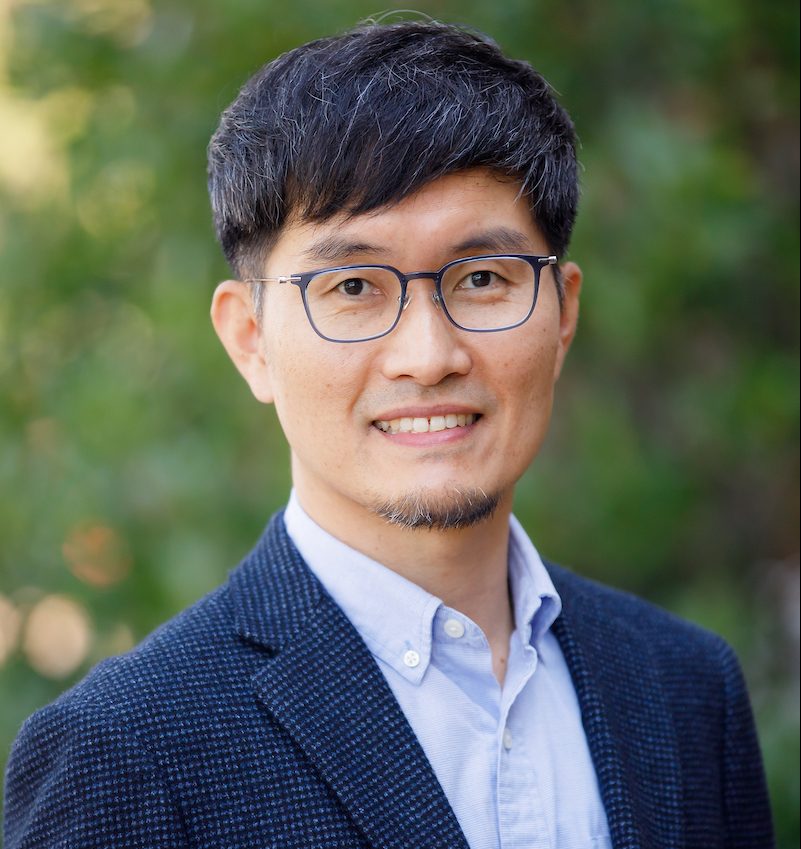
Dr. Bryan J. Steward is a Research Professor at the Air Force Institute of Technology (AFIT) and a member of the Center for Technical Intelligence Studies & Research (CTISR) . His work focuses on applied research for the Department of Defense (DoD) and Intelligence Community (IC), with expertise in space surveillance, remote sensing, and exploitation of imagery and time-resolved data from visible, infrared, and spectral sensors.
Dr. Stephen C. Cain is an Associate Professor in the Department of Electrical Engineering at the Air Force Institute of Technology (AFIT), located at Wright-Patterson Air Force Base, Ohio. He is affiliated with the Graduate School of Engineering and Management and conducts research in optical engineering, image processing, and space-based sensing systems. Education: Ph.D. in Electrical Engineering, University of Dayton (2001), with focus on Image Processing and Remote Sensing M.S.E.E., Michigan Technological University (1993), funded by AFRL/DE assistantships B.S.E.E., University of Notre Dame (1992), funded by AFROTC Scholarship Argonne National Lab Student Exchange Program (1992), including study at the Mexican Nuclear Research Institute His research interests include photodetector calibration , space object detection , image restoration , and optical system modeling . He has developed algorithms for blind deconvolution, phase error reduction, and parallax-based detection, contributing significantly to remote sensing and defense modeling. His work bridges theoretical optics and practical aerospace applications, particularly in satellite guidance and LADAR systems. The recent publications (2019–2024) reflect a consistent focus on optical sensing , image processing under low-light conditions , and statistical calibration methods . These works span disciplines such as astronomy, defense modeling, photonics, and signal processing, showcasing interdisciplinary innovation in photonic systems and space surveillance. Scientific Awards: No awards explicitly mentioned in the provided text. Advising and Grants: While no named students are listed, as an Associate Professor at AFIT, Dr. Cain likely supervises graduate research in electrical engineering and optics. His doctoral work was supported by an NSF Research Assistantship, and his master’s by AFRL/DE funding, indicating a long-standing connection with defense and federal research support. Current research appears to be aligned with Air Force mission needs in space domain awareness. Labs and Teams: Though specific lab names are not provided, Dr. Cain’s research is likely conducted within AFIT’s electro-optics or remote sensing laboratories, possibly in collaboration with Air Force Research Laboratory (AFRL) divisions. His work on satellite guidance and space object detection suggests integration with broader defense modeling and simulation initiatives.
Dr. Sanjeev Gunawardena is a Research Associate Professor in the Department of Electrical Engineering at the Air Force Institute of Technology (AFIT), part of Air University at Wright-Patterson Air Force Base, Ohio. His work focuses on advanced GNSS receiver design, software-defined radio, and signal processing for navigation systems. Education: PhD in Electrical Engineering, Ohio University (2007) MS in Electrical Engineering, Ohio University (2000) BS in Electrical Engineering, Ohio University (1997) BS in Engineering Physics, Ohio University (1997) Dr. Gunawardena's research interests center on GNSS signal processing , software-defined navigation receivers , multipath mitigation , deeply integrated GPS/INS systems , and signal quality monitoring . His work enables high-fidelity monitoring and robust navigation in challenging environments. He has developed toolboxes and standards to support education and research in GNSS. The recent publications reflect a strong trend in software-defined radio for satellite navigation , metadata standardization , interference and anomaly detection , and high-precision receiver design . These works span applications in aviation, defense, and critical infrastructure protection. Scientific Awards: Best Paper of Session, ION GNSS+ 2013 (x2) Northrop Grumman Appreciation Award, 2011 NASA Turning Goals into Reality Aviation Safety Award, 2001 William E. Jackson Award, RTCA, 2008 Ohio University 10-Year and 5-Year Service Awards Innovation Recognition Award, Ohio University Best Paper of Session, ION GPS 2001 Dr. Gunawardena has been actively involved in research grants and projects related to GPS anomalous event monitoring, synthetic vision systems, and GNSS security. He has collaborated with the FAA, NASA, and industry partners. His work has led to technology transfer, including the deployment of the GPS Anomalous Event Monitor at major airports. He has contributed to labs and research teams such as the Avionics Engineering Center at Ohio University and the GNSS research group at AFIT. His current work includes developing next-generation software-defined GPS payloads and interference detection systems using global data networks.
New Mexico Institute of Mining and TechnologyUnited States
Harald Edens is an Assistant Professor in the Department of Physics at New Mexico Institute of Mining and Technology. His office is located in Workman 343, and he can be contacted via email or phone (575-835-5423). His research focuses on atmospheric electricity phenomena, including: Lightning dynamics and mapping technologies Storm electrification processes Atmospheric physics instrumentation
Nathan Jeong is an Associate Professor in the Department of Electrical and Computer Engineering at The University of Alabama, College of Engineering. He leads the Intelligent Sensor and Wireless System Lab (ISWS), where he conducts cutting-edge research at the intersection of artificial intelligence, wireless systems, and sensor technologies. His work is supported by major federal grants, including a $3 million project from the Federal Transit Administration and the U.S. Department of Transportation for autonomous bus safety. Ph.D., Electrical and Computer Engineering, Purdue University, 2010 Visiting Scholar, Georgia Institute of Technology, 2010 M.S., Electrical and Electronic Engineering, Yonsei University, 2002 B.S., Radio Sciences and Engineering, Korea Maritime University, 2000 Dr. Jeong's research spans artificial intelligence, wireless power transfer, millimeter-wave systems, vehicle-to-everything (V2X) communication, adaptive RF front-ends, and biomedical electronics. His lab focuses on developing intelligent sensor systems for applications in healthcare, agriculture, transportation, and public safety. He integrates machine learning with electromagnetic and RF technologies to create innovative solutions for real-world challenges. The recent publications from Dr. Jeong and his team reflect a strong trend toward intelligent sensing systems using microwave and millimeter-wave technologies. These works span domains such as non-invasive food quality inspection, wearable biomechanical monitoring, autonomous vehicle safety, and UAV-based remote sensing. The integration of machine learning with electromagnetic wave-based sensing is a unifying theme, demonstrating a multidisciplinary approach to solving complex engineering problems. National Academy of Inventors Inductee Award Faculty and Staff Innovation Pitch Competition Award IEEE Distinguished Microwave Instructor Ambassador Alabama Society of Professional Engineers Graduate Student Engineer of the Year (advised student) Randall Outstanding Undergraduate Research Award (multiple students) Most Innovative Award, Crimson Startup Academy (student award) Dr. Jeong has successfully advised numerous graduate and undergraduate students, many of whom have gone on to win prestigious awards and publish high-impact research. He has secured significant external funding, including a $3 million federal grant for autonomous bus safety systems, demonstrating strong grant-writing capabilities and leadership in large-scale research initiatives. His work bridges industry and academia, leveraging over eleven years of industrial experience at Samsung, BlackBerry, and Qualcomm. The Intelligent Sensor and Wireless System Lab (ISWS) is a vibrant research group under Dr. Jeong’s leadership, actively engaged in projects involving AI-driven sensor networks, wireless power, V2X communication, and biomedical electronics. The lab fosters innovation through hands-on research and collaboration, welcoming motivated students at all levels.
Ke Chen is a Research Professor in the Physics Department at Temple University. His research focuses on electron tunneling phenomena, superconductivity, and advanced superconducting devices. He specializes in fabricating and studying tunnel junctions involving superconductors like MgB₂ and exploring their applications in electronics and quantum devices. Key areas of investigation include the physics of two-band superconductivity in MgB₂, Josephson junctions for high-speed circuits, and graphene-based sensors for chemical detection. His work involves experimental studies of superconducting materials' properties using tunneling spectroscopy, and he has pioneered techniques such as sandwich-type MgB₂/TiB₂/MgB₂ Josephson junctions. He also develops superconducting quantum interference devices (SQUIDs) and explores applications in high-frequency electronics and magnetic field sensing. Collaborations include advancements in MgB₂ thin films for superconducting radiofrequency cavities and graphene tunnel junctions for chemical sensing. Notable contributions include revealing momentum-dependent energy gaps in MgB₂ through tunneling experiments and demonstrating MgB₂-based devices operating at elevated temperatures. His research bridges fundamental condensed matter physics with applied technologies, addressing challenges in superconducting electronics and material innovation.
Thaddeus A. Roppel is an Associate Professor in the Department of Electrical and Computer Engineering at Auburn University's College of Engineering. His work spans teaching, research in robotics and sensor systems, and academic outreach. He is actively involved in curriculum development, senior design coordination, and lab leadership. University: Auburn University School: College of Engineering Department: Electrical and Computer Engineering Position: Associate Professor His research focuses on cooperative robotics, sensor fusion, MEMS sensors, and neural network applications in odor analysis. He leads the Sensor Fusion Laboratory and has contributed to interdisciplinary projects involving intelligent systems and technology readiness assessment. His educational initiatives include Java-based electronics demos, wireless curriculum development, and capstone design mentoring. The recent publications reflect a strong trend in intelligent sensing, robotics, and engineering education. Key themes include real-time signal processing, neural networks for pattern recognition, technology maturity assessment (TRL), and innovative teaching tools. His work bridges theoretical research with practical implementation in academic and outreach contexts. Scientific Awards: No formal awards listed in available texts. Dr. Roppel advises students through senior design and graduate research, particularly in robotics and sensor systems. He has led projects funded through academic and outreach grants, including senior design initiatives and the proposed Auburn Technology Museum. He is also involved in service, such as coordinating Engineers Without Borders and maintaining educational web resources. He leads the Sensor Fusion Laboratory at Auburn University, which focuses on integrating sensor data using neural networks and intelligent algorithms. The lab supports student research in mobile robotics, odor detection, and cooperative systems. He also promotes broader engineering outreach through virtual museum development and safety education.
Seokhyun Chung is an Assistant Professor at the University of Virginia, located in Lab 257 of Olsson Hall. His research focuses on IoT-enabled systems, leveraging data-driven methods such as federated learning, multi-task learning, and Bayesian probabilistic modeling to address challenges in statistical heterogeneity, scalability, and personalization in connected systems. Applications span smart healthcare and manufacturing systems, emphasizing reliability and efficiency. Research Interests: Chung's work integrates IoT, machine learning, and systems engineering to develop collaborative analytics frameworks. He explores federated learning architectures for distributed data fusion, probabilistic modeling for uncertainty-aware predictions, and optimization techniques for resource allocation in edge computing environments. His healthcare focus includes gait analysis and load estimation for wearable devices, while manufacturing applications involve job scheduling and additive manufacturing quality control. Key Contributions: Recent work highlights include federated multi-output Gaussian processes for heterogeneous systems, real-time adaptation of time-series predictions, and fairness-aware machine learning for load carriage tasks. His interdisciplinary projects address both technical and operational challenges, such as emergency department layout optimization and toxic gas monitoring networks. Labs & Infrastructure: Chung's research is conducted in Olsson Hall's advanced labs, leveraging IoT sensor networks, edge computing setups, and collaborative simulation environments to prototype innovative smart systems solutions.
University of Maryland, Baltimore CountyUnited States
Thomas Cronin is a Professor in the Department of Biological Sciences at the University of Maryland, Baltimore County (UMBC), within the College of Natural and Mathematical Sciences. His research focuses on visual ecology, investigating how diverse animals—from mantis shrimps to whales—have evolved specialized visual systems adapted to their environments. Education: Postdoc, Yale University (1982) Ph.D., Duke University (1979) M.S., Duke University (1969) B.S., Dickinson College (1967) His research spans physiology, marine science, and neuroscience, with a strong emphasis on sensory adaptations in extreme environments. He teaches courses such as Vision Science, Physiology of Marine and Estuarine Animals, and Neurobiology, mentoring numerous graduate students. The recent articles highlight a strong trend in crustacean vision, particularly in stomatopods (mantis shrimps), exploring topics like polarization sensitivity, neural processing, navigation, and spectral discrimination. His work increasingly integrates molecular biology, behavioral experiments, and optical physics to understand how complex visual systems evolve and function. Themes include the use of polarized light for communication, retinal metamorphosis during development, and the role of opsins in color vision. Scientific Awards: No awards explicitly listed in the provided text. Dr. Cronin has successfully secured multiple research grants, including funding from the Air Force Office of Scientific Research for projects such as 'Re-engineering the stomatopod eye' and 'Polarization and multispectral vision in mantis shrimp.' He has advised several students, including Rickesh N. Patel, Mary W. Donohue, and Chan Lin, many of whom have co-authored publications with him. His lab collaborates extensively on interdisciplinary projects involving biomimetic imaging, neural processing, and marine animal behavior. He is affiliated with a research team that investigates visual systems in marine organisms, often working with colleagues such as Megan Porter, Viktor Gruev, and Roy Caldwell. His lab contributes to understanding how vision drives ecological interactions and inspires bio-inspired technologies.
Massachusetts Institute of TechnologyUnited States
Aggelos Bletsas is an Assistant Professor at the Technical University of Crete (TUC), Department of Electrical and Computer Engineering. He holds a PhD in Media Arts and Sciences from MIT's Media Lab (2005) and a Master's from MIT (2001), with undergraduate studies in Electrical & Computer Engineering from Aristotle University of Thessaloniki (AUTH, 1998). His research focuses on cooperative wireless communications, distributed sensor networks, RFID technology, and nanotechnology. He has held postdoctoral roles at MERL and MIT, and a visiting scientist position at AUTH's Radiocommunications Lab. Education: PhD (MIT), M.S. (MIT), Diploma (AUTH) Research Interests: Backscatter communication, opportunistic relaying, low-cost hardware design, and signal processing. Awards: Best Paper Award at IEEE ISWCS 2009, Ericsson Best Thesis Award (1999). Teaching includes graduate courses on Detection & Estimation Theory and undergraduate modules on Computer Networks and Telecommunications. His work emphasizes practical implementations, such as the RF-Beatles hardware platform and the Esopos Greek TTS system. Projects span viral communication systems, autonomous timekeeping in sensor networks, and nanoscale interface design.
Maicol Ochoa is a Researcher affiliated with the University of Maryland College Park's Department of Chemistry & Biochemistry and the National Institute of Standards and Technology (NIST). His research focuses on quantum science, nanoscale systems, and applied mathematics, with applications in silicon-based quantum devices and quantum simulations. He holds a B.S. in Chemistry and M.S. in Mathematics from Universidad Nacional de Colombia, and a Ph.D. in Chemistry and Chemical Biology from Cornell University. His postdoctoral work included roles at UC San Diego and the University of Pennsylvania. Affiliations: IPST (Institute for Physical Science and Technology), Department of Chemistry & Biochemistry, NIST Research Themes: Quantum thermodynamics, nanoelectronics, electronic structure calculations, and many-body theory in silicon quantum devices His work explores phenomena such as energy conversion in nanoscale systems, quantum coherence effects, and the development of protocols for Fermi-Hubbard model parameter extraction. He has presented at leading conferences like the APS Global Physics Summit and the Silicon Quantum Electronics Workshop, and authored over 20 peer-reviewed publications in journals like Physical Review B and Journal of Applied Physics . He was honored with the 2022 PML Distinguished Associate Award for his contributions to quantum science. He collaborates internationally, including with the Nicolaus Copernicus University in Poland, and mentors students through the MathQuantum RTG and TREND REU programs, focusing on computational methods in quantum device modeling and nanoscale transport.
Pavlos Kollias is a Professor of Atmospheric Sciences at Stony Brook University with a joint appointment at the Department of Environmental and Climate Sciences at Brookhaven National Laboratory . He serves as the Director of the Center for Multiscale Applied Sensing (CMAS) at Brookhaven and contributes to major international projects like the European Space Agency's EARTHCARE Mission . Education: Ph.D. (2000) from the University of Miami. His research spans cloud microphysics and dynamics , radar meteorology and technology , and environmental remote sensing . He pioneered advancements in phased-array and space-borne radars for weather and climate studies, with over 150 peer-reviewed publications. Recent articles highlight trends in cloud and precipitation observation using ARM radar networks, Doppler spectral analysis for Arctic systems, and millimeter-wavelength radar innovations. His work emphasizes data quality control , polarimetry , and vertical air motion retrievals in convective clouds. Kollias led the ARM Radar Science Group for six years (2012–2018) and served as Associate Chief Scientist for US DOE's ARM program (2007–2009). He actively engages in international conference sessions and short courses on radar applications in atmospheric research.
Millersville University of PennsylvaniaUnited States
Dr. Maria V. Schiza is a faculty member in the Department of Chemistry at Millersville University, part of the College of Science and Technology. She has been with the institution since August 2005 and teaches a wide range of undergraduate chemistry courses, from introductory levels to advanced analytical and forensic chemistry. Her educational background includes a B.S. in Chemistry from Roosevelt University (1995) and a Ph.D. in Analytical Chemistry from the University of South Carolina (2001), followed by postdoctoral research at the same institution focusing on thin film fabrication and optical sensing. Dr. Schiza's research centers on the development and characterization of nanomaterials for analyte sensing and photocatalytic degradation of organic pollutants such as organochlorides and organophosphides. She employs the sol-gel process for nanoparticle synthesis and investigates their chemical and physical properties using advanced spectroscopic techniques including Raman, FTIR, fluorescence, and UV-visible spectroscopy. Surface morphology and structural analysis are conducted via TEM, SEM, AFM, and STM. The publications listed reflect a strong focus on optical and electrochemical sensing, nanomaterials, and spectroscopic instrumentation, with a peak output between 2001 and 2007. Her work bridges analytical chemistry, materials science, and environmental applications, particularly in detection and remediation technologies. She is a member of several professional organizations, including the American Chemical Society (ACS), the Middle Atlantic Association of Liberal Arts Chemistry Teachers (MAALACT), the Pennsylvania Academy of Science (PAS), and the Southeastern Pennsylvania Section of the ACS (SEPSACS). Dr. Schiza has supervised independent research through Chem 498 and continues to mentor students in laboratory-based inquiry. While no specific grants are mentioned, her research has led to multiple peer-reviewed publications and presentations at national and international conferences. Her work contributes significantly to the development of novel sensing platforms and functional materials. Her laboratory activities involve the synthesis and characterization of functional inorganic nanoparticles and thin films, particularly for sensing applications and environmental photocatalysis. The integration of optical and electrochemical methods suggests a multidisciplinary approach to materials development and analysis.
Alexandre Brandwajn is a Professor of Computer Engineering at the Jack Baskin School of Engineering, University of California, Santa Cruz, where he has been active in both research and teaching. His career spans over four decades, blending academic rigor with industrial insight gained at Amdahl Corporation and research institutions in France. Education B.A. – University of Paris IV Sorbonne Docteur-Ingénieur – University of Paris VI (UPMC) Docteur d’État – University of Paris VI (UPMC) Ingénieur Civil des Télécommunications – ENST, Paris Research Interests Brandwajn’s research lies at the intersection of computer systems, performance evaluation, and stochastic modeling. He investigates efficient solution methods for large-scale queueing systems, focusing on circumventing the combinatorial explosion of state space. Recent emphases include: Efficient solutions for Ph/Ph/c-like queues using numerically stable recurrent schemes Application of conditional probability to performance models Models of virtualized systems and cloud computing infrastructures Optical networks and I/O subsystem performance Automated calibration and selection of performance models from observed data His work often combines theoretical advances with practical relevance to storage systems, network protocols, and enterprise transaction processing. Publication Trends Across more than 50 refereed journal and conference papers, Brandwajn demonstrates a sustained focus on queueing-network-based performance evaluation. Recent publications (2008-2011) highlight collaborative efforts with Thomas Begin on state-space reduction, model calibration, and the analysis of general arrival/service distributions. Earlier work (1970s-1990s) established foundational techniques in equivalence and decomposition methods for complex systems. Awards & Invited Presentations While specific awards are not listed, Brandwajn has delivered numerous invited talks worldwide, including seminars at LINCS Paris, CMG panels, and international workshops, underscoring his recognized expertise in performance modeling. Teaching & Mentoring He teaches a comprehensive set of courses at UC Santa Cruz: Probability and Statistics for Engineers (undergraduate) Computer Architecture (undergraduate) Performance Evaluation (graduate) Advanced Topics in Performance Evaluation (graduate) Network Engineering Project (graduate capstone) He has advised doctoral work, notably that of Thomas Begin (UPMC), extending his methodologies to automatic model calibration. Laboratory & Collaborations Brandwajn has collaborated with researchers at INRIA, LIP (ENS Lyon), LIP6 (UPMC), ENST Paris, and Telecom SudParis, fostering interdisciplinary projects in network modeling, storage performance, and cloud computing.
Steven Yalisove is a Professor in the Department of Materials Science & Engineering at the University of Michigan. His research focuses on atomic structure and materials properties at surfaces and interfaces, utilizing ultrafast laser techniques and advanced characterization methods. Education: M.S. in Mechanical and Aerospace Science from the University of Rochester (1979) Ph.D. in Materials Science and Engineering from the University of Pennsylvania (1983) Professor Yalisove's research centers on the relationships between atomic structure and materials properties at surfaces and interfaces. His group engineers epitaxial and textured growth to produce nanostructured films for electronic, optical, and tribological applications. They employ femtosecond lasers for film deposition and to control surface kinetics, and study ultrafast laser-material interactions to understand ablation mechanisms in metals and semiconductors. Additional areas include metal/semiconductor interfaces using molecular beam epitaxy on silicon, and the amorphous to crystalline transformation in low temperature Si(100) homoepitaxy. The group utilizes advanced characterization techniques such as pump-probe ultrafast microscopy, fsLIBS, TEM, SEM, and in-situ probes. Professor Yalisove has mentored over a dozen PhD students, many of whom now hold prominent positions in national laboratories and industry. His research group has been involved in significant projects, including the Department of Defense MURI project on Hyperspectral and Extreme Light Diagnostics for Defense-Critical Advanced Materials and Processes. The Yalisove Research Group operates advanced laboratories for ultrafast laser processing, including femtosecond laser systems, and utilizes a wide array of characterization tools such as transmission electron microscopy, scanning electron microscopy, and in-situ surface analysis techniques.