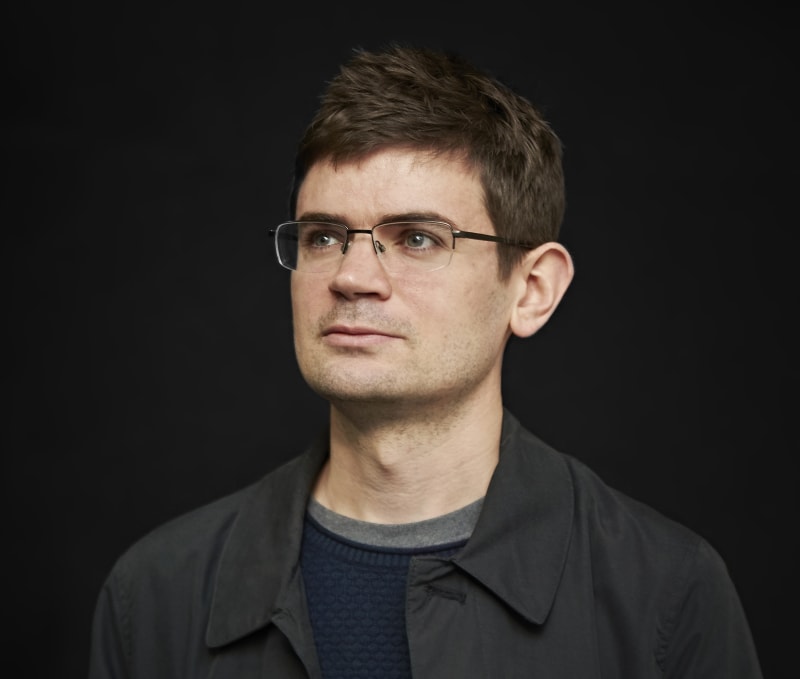
Lewis Bush is a Senior Lecturer (part-time/online) in MA Photojournalism and Documentary Photography at London College of Communication, part of the University of the Arts London. He holds an ESRC-funded PhD in Media and Communications at the London School of Economics, researching AI's impact on photojournalism. His practice bridges photography, writing, and curation to explore power structures, history, and technology. He has taught at over 10 institutions globally, including LSE, Royal Academy of Art (Netherlands), and École Cantonale d'Art de Lausanne (Switzerland). Education: BA History (Warwick University), MA Documentary Photography (LCC) Research focuses on visualising contemporary power systems through projects like Depravity’s Rainbow (linking rocketry history to modern space exploration) and Metropole (documenting London’s gentrification). His works are held in major collections including British Library, Tate Group, Victoria & Albert Museum, and Smithsonian Air & Space Museum. Awards include Archisle Residency (2018) and BMW Residency (2019). Current exhibitions include An Infinitely Dark Legacy (2025–2026 tour), combining cyanotype prints with archival research. His PhD research examines how AI reshapes photojournalism’s role in democracy.
Patrick Healy serves as an Associate Professor in the Department of Computer Science & Information Systems within the Faculty of Science and Engineering at the University of Limerick. He is an active member of Lero – the Irish Software Research Centre , contributing to Ireland's national software research initiatives. His research spans Information Visualization, Graph Drawing, Combinatorial Optimization, and Routing/Scheduling problems. He specializes in developing algorithms for graph layout, table formatting, and upward planarity testing, with recent work expanding into machine learning robustness, medical AI diagnostics, and occlusion handling in computer vision. His fingerprint analysis reveals deep expertise in digraph theory (100%), planarity (76%), edge optimization (71%), and combinatorial optimization (51%). Current research trends show a significant shift toward applied AI since 2022, with 12 of his 15 most recent publications focusing on neural network robustness, medical diagnostics, and data augmentation techniques. Earlier work established foundations in graph theory and document engineering. He has supervised numerous research projects through Lero and maintains active collaborations across European institutions, particularly in software engineering and AI applications. His laboratory work centers on the Visualisation and Algorithm Design Group at UL, focusing on interpretable AI systems and robust visualization frameworks.
Associate Professor Jim Hogan is an academic leader in the School of Computer Science at Queensland University of Technology (QUT), serving as Academic Lead for Learning and Teaching. He holds a PhD in Computer Science (QUT) and a BSc (Hons) in Mathematics (University of Queensland). His expertise spans Bioinformatics, Visualization, Machine Learning, and Software Engineering (Agile Methodologies). He has secured $2M+ in research funding and authored over 100 publications, including works on sequence analysis, bioinformatics visualization, and cloud computing education. Teaching contributions include pivotal roles in modernizing software engineering curricula (e.g., introducing Agile Methodologies and Australia’s first Cloud Computing course). Awards include the QUT Distinguished Teaching Award and a Federal Carrick Institute Citation. He supervises student projects in bioinformatics, visualization, and computational methods. Collaborations with industry (Microsoft, AWS, CSIRO) and leadership in projects like the ARC Linkage-funded 'Visual Analytics for Next-Gen Sequencing' highlight his interdisciplinary impact. Education: PhD (QUT), BSc(Hons) & BSc (UQ) Awards: QUT Distinguished Teaching Award, Carrick Citation Industry: Agile course materials used to train hundreds of engineers Research focuses on sequence analysis, bioinformatics visualization, and applications in genomics. Recent work includes signature-based clustering for metagenomic data and protein interaction prediction using machine learning. He leads student projects in bioinformatics visualization, cloud computing, and genomic network analysis.
Mitchell Whitelaw is an Associate Professor in Design at the Australian National University (ANU), based in the College of Arts and Social Sciences. His work bridges creative practice and theoretical inquiry in digital design and culture. Education: PhD (University of Technology Sydney), Bachelor of Creative Arts (Hons) (University of Wollongong) Research Interests: Whitelaw’s research focuses on digital heritage through "generous interfaces" that reimagine archival exploration, data aesthetics examining the creative and critical potential of generative systems, and digital materiality exploring the physical foundations of digital culture. His projects combine practice-led experimentation with theoretical analysis. Key Projects: Funded collaborations include the Visible Archive (Ian Maclean Award 2008), Interactive Visualisation for Memory of a Nation (National Archives of Australia), and Digital Treasures Flagship Program with major cultural institutions. He has developed tangible data representations for exhibitions and reimagined digital interfaces for cultural collections. Scientific Awards: Ian Maclean Award (2008) - National Archives of Australia Collaborations: Whitelaw works with institutions like the Asia Art Archive, State Library of Queensland, National Gallery of Australia, and researchers across digital humanities, computer science, and creative practice.
Erandi Hene Kankanamge is a Senior Lecturer in Computer Science at the University of New South Wales, Canberra (UNSW Canberra), working within the School of Systems & Computing. Her academic career spans over a decade with significant contributions to artificial intelligence research and education. Her educational background includes: BSc (hons) in Computer Science at the University of Colombo, Sri Lanka (First Class) PhD in Computer Science at UNSW Canberra (2014) Dr. Kankanamge's research focuses on the intersection of artificial intelligence and human-computer interaction, with expertise in multi-agent systems, computational intelligence, multi-objective optimization, human-computer interfaces, and games for health. Her work bridges theoretical AI advancements with practical applications in defense, healthcare, and gaming contexts. She employs computational intelligence approaches to model complex behaviors and develop systems that enhance human performance and wellbeing through digital interactions. Her publication record shows a clear evolution from foundational work on behavior modeling to sophisticated applications in human-swarm interaction, trust architectures, and exergaming interfaces. The research demonstrates consistent emphasis on practical implementations of AI techniques in real-world scenarios, particularly in board games, military applications, and health-focused digital experiences, with strong interdisciplinary connections between computer science, psychology, and health sciences. Dr. Kankanamge has secured significant research funding through multiple competitive grants: Model Abstractions for Military Wargaming ($220,000, DSTG) Actionable Cyber Security Intelligence from Big Data ($75,000, Industry Grant) Simulation and Visualisation Using Data Farming ($350,000, DSTG) Game Master: Improved player mental and physical wellbeing ($50,000, Rector's Start-up Grant) As an academic advisor, Dr. Kankanamge supervises multiple PhD candidates across diverse research topics including human-swarm interaction, motive profile compositions for cooperative teams, stress detection during gameplay, and reinforcement learning for complex board games. Her professional service includes roles as Secretary of IEEE CIS ACT Chapter, conference organization roles, and journal reviewing activities across multiple prestigious publications in AI and gaming. Dr. Kankanamge's research contributes to multiple interdisciplinary teams focusing on AI-enabled analysis, human-machine teaming, and serious games development. Her work with the Defence Science and Technology Group demonstrates strong connections between academic research and defense applications, while her interest in games for health shows commitment to societal impact through technology.
Nicholas Walton is a Research Fellow at the Institute of Astronomy , University of Cambridge, with affiliations across astrophysics, cosmology, and medical imaging. His work bridges cutting-edge astronomy projects like ESA’s Gaia mission with biomedical initiatives. PhD in Physics from Imperial College London MBA from the Open University BSc (Hons) in Physics from the University of Nottingham Research interests include: Assembly history of the Milky Way Supernova cosmology and alerts Exoplanet-host star connections Spatial molecular profiling in tumors Development of medical imaging platforms His recent publications focus on astrophysics and biomedical data analysis, reflecting his dual expertise. Awards include the Breakthrough Prize in Fundamental Physics (2015) and the Gruber Prize for Cosmology (2007). Key projects: Lead of the UK Gaia project (2021–present) Chair of the COST Action CA18104/MW-Gaia (2019–2023) Co-Investigator in the IMAXT Cancer Research UK Grand Challenge Team (2017–2024) Director of the PathGrid medical imaging project
Dr. Abdoulaye Diakite is a researcher at the University of New South Wales (UNSW), affiliated with the Arts, Design & Architecture faculty. He is a member of the Geospatial, Research, Innovation and Development (GRID) lab where he leads the Digital Twins R&D with a focus on 3D indoor modelling and navigation, and BIM/GIS integration. Dr. Diakite completed his MSc in Computer Sciences in 2012 from the University of Burgundy (France), followed by a PhD in computational geometry in 2015 at the LIRIS lab (University of Lyon 1, France). Prior to joining UNSW, he worked at Delft University of Technology (2015-2018) on the SIMs3D project for emergency responders' indoor navigation systems and the GeoBIM project for BIM and GIS integration. His research expertise spans across Smart Cities with a strong focus on 3D data technologies including 3D Digital Twins, 3D GIS, BIM/GIS integration, 3D indoor modelling and navigation, 3D analytics and visualization, and IoT Digital Twin integration. His work bridges computational geometry with practical applications in urban environments. As an active member of the Open Geospatial Consortium (OGC), Dr. Diakite co-leads the development of the IndoorGML standard, contributing significantly to international geospatial standards. His research has practical applications in emergency response systems, facility management, and urban planning, with a particular emphasis on creating seamless indoor/outdoor navigation experiences and integrating heterogeneous spatial data sources.
Professor Paul Kennedy is the Head of the School of Computer Science at the University of Technology Sydney (UTS) Faculty of Engineering and Information Technology. He has made significant contributions to data analytics education, receiving a 2013 OLT Citation for Outstanding Contributions to Student Learning and multiple UTS teaching awards. His research focuses on biomedical data analytics, particularly in pediatric cancer treatment outcomes, bioinformatics pipelines for vaccine discovery, and visual analytics for explainable AI in healthcare. His recent publications highlight advancements in multi-criteria decision-making for vaccine candidates, edge-cloud frameworks for omics data, and immersive VR environments for genomic data visualization. He leads the Biomedical Data Science Laboratory at UTS Australian Artificial Intelligence Institute and co-directs the UTS-Queens University AI-driven clinical tools initiative. A key collaborator with the Children’s Hospital at Westmead, he has secured over $2.4 million in research funding and served on international data mining conference committees since 2006. Scientific Awards: 2013 OLT Citation for Outstanding Contributions to Student Learning 2012 UTS Learning and Teaching Award 2020 Team Teaching Award 2019 Team Teaching Citation His methodological innovations span topological data analysis for stress detection, feature-ranking in RNA sequencing, and domain-adaptation techniques in machine learning. He also contributes to global AI ethics standards through ISO/IEC SC42 committee membership.
Dr. Andrew Robert Lilja is a Research Fellow at the 3D Visualisation Aesthetics Lab within the University of New South Wales, School of Arts, Design & Architecture . With a background in biomedical science from the University of Melbourne and expertise in 3D visualization and virtual reality, he focuses on creative solutions for complex visualizations and interactive VR content development. Bachelor of Biomedical Science (Hons), University of Melbourne Doctor of Philosophy, University of Melbourne His research spans Computer Gaming and Animation, Electronic Media Art, Digital Design , and Virtual Reality , combining technical rigor with artistic innovation. At UNSW, he contributes to the lab’s work on pre-rendered content and immersive technologies, though specific scientific awards or student mentorship details are not provided in the available information.
Dr. Adnan Adnan is a Senior Lecturer at the School of Architecture Computing and Engineering (ACE) at the University of East London (UEL), affiliated with the Department of Engineering & Construction. His expertise spans manufacturing outsourcing, mathematical modeling, and renewable energy technologies. He holds a Master of Arts (Education) from UEL (2016) and a Postgraduate Certificate in Learning and Teaching in Higher Education (2012). Education: Master of Arts (Education), 2016 Postgraduate Certificate in Learning and Teaching in Higher Education, 2012 His research focuses on optimizing manufacturing outsourcing through methodologies like Analytical Hierarchy Process (AHP), Lean Philosophy, and Theory of Constraints. He also explores renewable energy systems, ICT adoption challenges in emerging economies, and secured internet protocols for global outsourcing. Adnan has published extensively on topics including supplier selection for mining companies, benchmarking frameworks, and game theory applications in communication systems. His work bridges operational efficiency, cybersecurity, and sustainable energy solutions. He teaches modules such as Spatial Communication and Visualisation , Analytical Skills in Built Environment , and Mental Wealth across various academic levels.
Dr. Amjad Fayoumi is a Senior Lecturer (Associate Professor) in Information Systems at the Department of Management Science, Lancaster University Management School, since 2017. He directs the MSc in Digital Business, Innovation and Management and previously led the MSc in E-business and Innovation Programme. He co-leads the Advanced Manufacturing Theme in LiRA (Lancaster Intelligent, Robotic and Autonomous Systems Centre) and participates in multiple research groups. PhD in Information Systems from Loughborough University Senior Fellow of Higher Education Academy (SFHEA) Professional memberships: BCS, MIEEE, IEEE Computer Society, Operational Research Society, AIS, and Association for Enterprise Architects His research focuses on two main themes: Advanced Manufacturing Systems and Digital Transformation of Healthcare . He applies enterprise modelling/simulation, design science, and socio-technical approaches to bridge strategy execution gaps in talent acquisition, healthcare IT, and manufacturing agility. Recent publications span digital business startups, healthcare apps, cyber-physical frameworks, and Industry 4.0 innovations. His work integrates enterprise architecture , digital twins , and privacy-preserving systems across industries. Advising expertise in enterprise information systems, knowledge engineering, and strategic IS Editorial roles in journals like Journal of Information Technology , IEEE Access , and Expert Systems with Applications Peer-review activities for multiple international conferences and journals Dr. Fayoumi leads projects such as IAA: Transforming Data into Decisions and Healthcare Systems Analysis, while participating in events like the International Conference on Information Systems 2024 and Cyber Leadership Symposium 2022.
Gavin Brown is a Professor of Computer Science at the University of Manchester, affiliated with the Data Science Institute and the Machine Learning and Optimisation group. His research focuses on machine learning theory, ensemble methods, feature selection, and hardware-accelerated learning. He holds roles in interdisciplinary initiatives like the Centre for Digital Trust and Society, EnnCore project (privacy-preserving neural architectures), and the Robotics and Artificial Intelligence Centre. Education: PhD in Computer Science from the University of Birmingham (2003), with a thesis on 'Diversity in Neural Network Ensembles'. Research interests span theoretical foundations of machine learning, including bias-variance decomposition, ensemble diversity, and algorithmic stability. Applications include healthcare (e.g., outlier detection in vital signs), robotics (low-cost prediction hardware), and ethical AI (conceptual guarding of neural networks). He has pioneered work on feature selection for resource-constrained systems and neuromorphic computing. Recent articles emphasize unifying ensemble theory, hardware-efficient learning (FPGA-based feature selection), and clinical applications of machine learning. Projects include EnnCore (privacy-preserving AI), RAI Centre (robot-AI ethics), and Data Visualisation for clinical trials. He leads or co-leads 8 major projects, including £multi-million initiatives in digital trust, robotics, and AI. Supervised 24 doctoral students, with a focus on interdisciplinary work combining theory and applied machine learning.
Dr. John Stavrakakis is a Lecturer at the School of Computer Science within the University of Sydney. His research focuses on machine learning , graph algorithms , and 3D graphics optimization , particularly in developing efficient computational methods for spectral clustering , deep learning architectures , and network-aware visualization systems . Current research emphasizes random projection techniques for graph convolutional networks and topology-aware clustering methods Specializes in 3D graphics streaming and distributed visualisation environments Collaborates on network security behavior through computational models of protection motivation His recent publications highlight innovations in graph construction , k-NN search efficiency, and parameter-free optimization frameworks. Dr. Stavrakakis supervises PhD students including Michael Ashshiddiq Podbury, with expertise spanning data mining , network security , and interactive visualization . Contact: john.stavrakakis@sydney.edu.au
Sam Jacoby is Professor of Architectural and Urban Design Research at the Royal College of Art, where he serves as Research Lead of the School of Architecture and Director of the Laboratory for Design and Machine Learning. With extensive research leadership experience, he is responsible for School-wide research strategy and management, while also innovating in research-led teaching through unique programs that equip graduates with knowledge and design research skills to address emerging challenges in both practice and academia. Dr. Jacoby earned a Dr.-Ing. from the Technische Universität Berlin and an AA Diploma from the Architectural Association School of Architecture. He has taught in 12 academic programs across 6 architectural schools in the UK and Germany, directing PhD, MPhil, and MRes research-degree programs, and leading postgraduate design studios and history and theory seminars. He was founding Director of the MPhil in Architecture and Urban Design: Projective Cities program at the Architectural Association School of Architecture (2009–19) and Professor of Architecture, Design, and Building Typology at the Staatliche Akademie der Bildenden Künste Stuttgart (2016). As a design researcher, Jacoby advances socio-spatial impact through mixed methods informed by architecture, architectural history, urban design, and interdisciplinary approaches. His work examines spatialized governmentality, socio-spatial histories, housing design standardization, typological analysis, data-driven methods, and community-led development. Current research focuses on data-driven and evidence-based design, innovations in design research, and intergenerational problems like wellbeing, climate crisis, and social justice in relation to social values created by the built environment. His publication portfolio demonstrates strong trends toward machine learning applications in architecture, comparative housing studies (particularly England-Chile-China), pandemic housing impacts, and the integration of computational methods with traditional architectural research. Professor Jacoby has secured significant research funding including projects on managed coastal retreat, housing standardization, architectural typologies through machine learning, collective forms in China, and spatial design and wellbeing. His research collaborations span multiple international institutions including Pontificia Universidad Católica de Chile, Huazhong University of Science & Technology, Shanghai University, and Stavros Niarchos Foundation. He supervises research students including Raül Avilla Royo (completed) and Yakim Milev (current), and leads the Laboratory for Design and Machine Learning, which conducts experimental research into new methodologies at the intersection of machine learning, data processing, and visualisation for emerging design processes. The Laboratory's projects include the London Housing Data Visualisation Platform, The Home, the Household, and Covid-19, Hong Kong Housing, and London Housing policy research.
Musaab Garghouti is a Lecturer in 3D Visualisation, Immersion, and Simulation at the University of Plymouth's School of Art, Design and Architecture, which falls under the Faculty of Arts, Humanities and Business. His work focuses on cutting-edge visualization technologies and immersive simulation environments. Contact: +44 1752 585244. Research interests include advancing 3D modeling techniques, virtual reality applications, and simulation design methodologies. His expertise bridges digital art practices with computational technologies. No specific grants, awards, or lab affiliations are detailed in the provided information. Teaching responsibilities likely include courses related to digital design, immersive technologies, and simulation systems.