Dr. Yanhua Hong is a Reader in the School of Computing and Engineering at Bangor University. His research focuses on nonlinear dynamics of semiconductor lasers, chaos theory, and their applications in optical communications and microwave photonics. He leads projects such as 'Microwave Photonics Generation Using Low-Cost VCSELs' and has published extensively in journals like Optics Express and Photonics. Key areas of expertise include semiconductor laser dynamics under optical feedback, secure communication systems leveraging chaotic signals, and the design of photonic microwave generation systems. Hong collaborates internationally with institutions like Southwest University (China) and the Universitat Politècnica de Catalunya (Spain). He actively supervises PhD students and examines external theses. Recent work highlights include high-speed secure stream ciphers using synchronized chaos, optimization of multimode fiber imaging systems, and analysis of intermittent laser dynamics via reservoir computing. His contributions bridge fundamental research with applied photonics, contributing to advancements in optical security, signal processing, and next-generation communication networks.
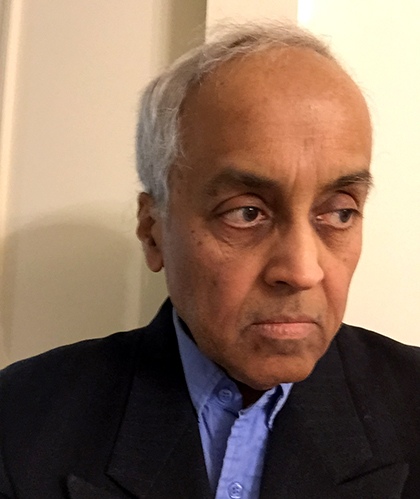
Professor P. S. Krishnaprasad is a faculty member at the University of Maryland, holding positions in Electrical and Computer Engineering and the Institute for Systems Research. He leads the Intelligent Servosystems Laboratory and has joint affiliations with Applied Mathematics and Neuroscience programs. His research focuses on geometric control theory, robotics, and smart materials, with contributions to nonlinear systems, formation control, and biological signal processing. Elected an IEEE Fellow in 1990, he has received prestigious awards including the 2007 Hendrik W. Bode Prize. His work spans theoretical advancements and experimental robotics, emphasizing interdisciplinary applications. Education: Ph.D. in Electrical Engineering, Harvard University, 1977 Research Interests: Geometric control theory, robotics (mobile and collective systems), nonlinear dynamics, smart materials, semiconductor manufacturing, and biomimetic control strategies. His lab explores experimental implementations of theoretical concepts, such as motion camouflage and swarm behavior validation using Vicon motion capture systems. Key Awards: IEEE Bode Lecture Prize (2007) IEEE Fellow (1990) Grover E. Bell Award (2002, team) Outstanding Systems Engineering Faculty Award (1990-1991, 2008-2009) Advising & Grants: Guided notable students like Naomi Leonard (Bellman Award winner) and Fumin Zhang (IEEE Fellow). His grants include projects on smart materials, control networks, and semiconductor processing. Experimental work in ISL includes robotics, motor networks, and collective behavior validation. Lab & Teams: The Intelligent Servosystems Lab (ISL) focuses on mobile robotics, formation control, and smart material actuators. Current projects emphasize collective robotic systems and software for multi-agent coordination, supported by advanced motion capture infrastructure.
Ourania Theodosiadou is a Researcher at the Department of Mathematics, Aristotle University of Thessaloniki (since Oct 2024). Previously, she served as a Postdoctoral Researcher at the Institute of Information and Communication Technologies (CERTH) from 2019 to 2024 and held multiple contracted lecturer roles at Aristotle University and the University of Macedonia. She earned a PhD in Mathematics (2019) and a Master's in Statistics and Modeling (2014), both from AUTH, with a focus on stochastic processes and financial applications. Her doctoral thesis explored latent stochastic processes with jumps in finance under Prof. Georgios Tsaklidis. Her research interests span stochastic modeling, time series analysis, computational statistics, and machine learning. Recent work includes real-time threat assessment using Hidden Markov Models (2023), cryptocurrency transaction analysis for illegal activity detection (2023), and centrality-based network node identification (2022). Methodological contributions include state space modeling with constraints (2021) and Kalman filter applications for jump detection in financial markets (2017-2019). Publications reflect interdisciplinary applications in finance, security, and computational methods. Current work extends AI-driven solutions against terrorist financing and explores blockchain forensics through time series analysis.
Paweł Wachel is a researcher at the Department of Control Systems and Mechatronics within the Faculty of Information and Communication Technology at Wrocław University of Science and Technology. He is actively engaged in research and academic activities, with recent publications spanning from 2022 to 2024. Research Interests: His primary research areas include control theory, system identification, signal processing, and nonlinear systems. He specializes in the modelling and identification of complex systems such as Wiener, Hammerstein, and infinite memory nonlinear systems, employing advanced techniques like kernel-based methods, aggregative modelling, and exponential excitations. The recent publications indicate a strong focus on both theoretical and applied aspects of control systems, with increasing integration of learning-based and data-driven approaches. Topics such as safe learning, decentralized diffusion, and dual averaging algorithms reflect modern trends in adaptive and robust control. The interdisciplinary reach extends into neural networks and materials science, particularly in using fractal analysis for material hardness estimation. Scientific Awards: No awards or fellowships are mentioned in the provided text. Advising and Grants: While no specific students or grant funding are listed, Paweł Wachel collaborates extensively with researchers such as Krzysztof R Kowalczyk, Cristian R Rojas, Koen Tiels, and others, suggesting active participation in research teams and potential supervision roles. His consistent publication output indicates sustained research activity, likely supported by institutional or project-based funding. Labs and Teams: As a member of the Department of Control Systems and Mechatronics, he is likely involved in research laboratories focused on control systems, system identification, and mechatronic applications, though specific lab names or team structures are not detailed in the provided content.
Baltasar Enrique Beferull Lozano is a tenured Professor at the University of Agder , leading the Center Intelligent Signal Processing and Wireless Networks (WISENET) since 2015. With a PhD in Electrical Engineering from USC (2002) and prior roles at EPFL, AT&T Shannon Labs, and University of Valencia, his career spans 20+ years of academic and industrial research in signal processing, wireless systems, and AI. Education: PhD (USC), MSc (USC), MSc (University of Valencia) Expertise: Data Science, Machine Learning, Graph Signal Processing, Cyber-Physical Systems His research focuses on AI-driven wireless networks and in-network collective intelligence , addressing fundamental and applied challenges in smart water systems , energy management , and next-gen 5G/6G . He has secured 20+ international projects including 10 EU-funded initiatives (HYDROBIONETS, SENDORA) and 5 RCN-funded projects. Recent publications emphasize dynamic graph learning from time series data, quantized graph filters , and multi-agent reinforcement learning for networked environments. Awards include IEEE Best Paper Awards (2012, 2021), TOPPFORSK Grant (2015), and Ramón y Cajal Program Rank #1 (2005). As a Senior IEEE Member , he serves as Area Editor for IEEE Transactions on Signal Processing and evaluates research proposals for the European Commission , NSF , and Qatar National Research Fund . His lab has produced 15 PhD graduates and collaborates with 12+ industry partners including Telenor, IBM, and SINTEF.
Assistant Professor Emine ÇELİK is affiliated with the Faculty of Science at Sakarya University , Turkey, where she serves in the Department of Mathematics . She holds a doctorate from Texas Tech University (2016) and has conducted postdoctoral research at the University of Nevada, Reno (2016-2018) . Research Interests : Nonlinear partial differential equations (PDEs) with focus on degenerate/singular parabolic equations Fractional calculus applications to differential equations Fluid dynamics in porous media including Forchheimer-Ward models and Navier-Stokes coupling Structural stability and data assimilation algorithms Article Trends : Her recent publications (2022-2025) emphasize fractional diffusion operators , time-delay data assimilation , and compressible Forchheimer flows . Earlier works (2015-2018) focused on mixed flow regimes and nonlinear parabolic equations in porous media. Collaborators include Luan Hoang , Yulong Li , and Edriss Titi . Administrative Roles : Served as Deputy Head of Department (2023-2024) and Board Member (2023-2026).
Professor Ewaryst Rafajłowicz is affiliated with the Faculty of Information and Communication Technology at Wrocław University of Science and Technology, serving as Head of the Department of Control Systems and Mechatronics. His research spans control systems, pattern recognition, image processing, and spatio-temporal dynamics, with recent work focusing on iterative learning control, signal classification, and vibration analysis in industrial systems. Control systems System identification Pattern recognition Image processing Statistical process control Mechatronic control Recent publications highlight his expertise in functional data analysis, Bernstein polynomial applications, and shape-preserving descriptors for classification tasks. He has contributed to both theoretical advancements in control algorithms and practical implementations in industrial settings, particularly in vibration damping and mechatronic systems.
Przemysław Śliwiński serves as a Professor at Wroclaw University of Science and Technology within the Faculty of Information and Communication Technology, specifically in the Department of Control Systems and Mechatronics. His academic credentials include DSc, PhD, and Engineering degrees, reflecting extensive expertise in advanced computational methodologies. His research spans three primary domains: Image Processing focusing on object detection, 3D mapping, and autofocusing algorithms Autistic Behavior Modeling utilizing stochastic frameworks, emotion detection, and augmented reality applications Nonlinear System Identification specializing in nonparametric algorithms and computational methods for complex systems His work demonstrates consistent innovation in bridging theoretical mathematics with practical engineering solutions. His publication trends reveal increasing focus on intelligent systems and machine learning applications since 2019, with particular emphasis on event processing, neural network implementations, and real-time system identification. Earlier work centered on foundational nonlinear system modeling techniques. While no formal awards are listed in available documentation, his research has consistently appeared in high-impact journals including IEEE Transactions and Springer proceedings. Professor Śliwiński maintains active supervision of research projects with collaborators including Wachel P., Lagosz S., and Helt K., though formal student advising relationships aren't explicitly documented. His laboratory work appears centered on control systems validation and image processing applications within the Department of Control Systems and Mechatronics infrastructure.
Paweł Drąg, PhD, is an active researcher at the Department of Control Systems and Mechatronics within the Faculty of Information and Communication Technology at Wrocław University of Science and Technology. Based in Wrocław, Poland, he maintains regular office hours in building C-3, room 217, and engages in both teaching and research activities focused on advanced engineering systems. His primary research encompasses: Process Control and Simulation Nonlinear Optimization Differential-Algebraic Equations Thermal Systems Engineering Heat and Mass Transfer Evaporative Cooling Technologies These interests drive innovations in energy-efficient HVAC systems, water desalination, and sustainable thermal solutions. Recent work emphasizes algorithmic approaches for complex engineering constraints. Analysis of his 2020-2023 publications reveals a strong trajectory in optimization techniques for differential-algebraic systems applied to thermal engineering. His research demonstrates progression from theoretical algorithm development (e.g., α-model parametrization, chain smoothing Newton methods) to practical implementations in evaporative cooling and water recovery systems. A significant portion addresses the Maisotsenko cycle for energy-efficient air conditioning across diverse climates including Central Europe and humid regions. Scientific awards: No honors or fellowships were documented in available sources. Advising and grants: While specific student supervision details are unavailable, his collaborative publications indicate active research partnerships. Grant funding information is not specified in current documentation. Laboratory work appears centered on thermal engineering and control systems facilities at Wrocław University of Science and Technology, with research directly applicable to industrial HVAC optimization and sustainable water technologies.
Dr.-Ing. Philipp Sieberg serves as a Researcher at the Chair of Mechatronics within the Faculty of Engineering at the University of Duisburg-Essen, Germany. His research focuses on intelligent transportation systems, vehicle dynamics, and applied artificial intelligence, with particular emphasis on hybrid methodologies that integrate physical models with machine learning approaches. Based in Room MD-226, he actively contributes to both academic and industrial advancements in automotive engineering through his publications and research projects. His research interests span intelligent transportation systems, vehicle dynamics control, machine learning applications, and hybrid estimation methods. Sieberg specializes in developing reliable AI-based virtual sensors for vehicle state estimation, creating model-based predictive control systems for active roll stabilization, and applying neural networks to complex automotive challenges. His work consistently addresses the critical balance between AI innovation and system reliability in safety-critical automotive applications, with significant contributions to steering system dynamics, wear mechanism classification, and autonomous vehicle development. Sieberg's recent publications (2022-2025) demonstrate a clear trajectory toward increasingly sophisticated hybrid AI methodologies in vehicle dynamics. His research shows growing emphasis on reliability assurance of AI components, multi-fidelity simulation approaches, and practical implementation of machine learning in hardware-in-loop test environments. The work spans fundamental research in neural network-based state estimation to applied solutions for steering systems, wear analysis, and autonomous inland waterway vessels, reflecting both theoretical depth and real-world applicability. Award for Particularly Outstanding Graduation, Department of Engineering, University of Duisburg-Essen Award for Outstanding Completion of Master's Program in Mechanical Engineering, Faculty of Engineering, University of Duisburg-Essen First Prize for Outstanding Master's Thesis 2017, Alumni Chair of Mechatronics eV, University of Duisburg-Essen Active involvement in IEEE Germany Section and Chair of IEEE ITSS German Chapter Sieberg contributes significantly to research projects including AutoBin (Autonomous Inland Waterway Vessel), driving simulators for the Chair of Mechatronics, and machine learning algorithms for mobile state prediction applications. His leadership extends to committee activities as Student Activities Chair of the IEEE ITSS German Chapter, where he bridges academic research with professional society engagement. Current teaching responsibilities include courses on highly automated driving systems and technical fundamentals of future vehicle systems for the Master's program in Automotive Engineering & Management Executive. Working within the Chair of Mechatronics research group, Sieberg collaborates extensively with colleagues including Dieter Schramm, Christian Hürten, and Alexander Haas. His research leverages advanced driving simulators and hardware-in-loop test benches, with strong connections to the AutoBin project consortium developing autonomous inland vessel technology. The research environment emphasizes interdisciplinary collaboration between mechanical engineering, computer science, and control systems specialists to address complex mobility challenges.
Theresa Lange is a postdoctoral researcher at Scuola Normale Superiore di Pisa working under Prof. Dr. Franco Flandoli within the ERC grant NoisyFluids. She will assume an Emmy Noether group leader position at the Max Planck Institute for Mathematics in the Sciences in Leipzig starting March 2026. Her academic background includes a PhD in Mathematics from Technical University Berlin (2021), where her thesis focused on stochastic analysis of ensemble-based Kalman-type filtering algorithms. Lange's research centers on stochastic fluid dynamics, investigating how different noise types affect physically motivated mathematical models. She employs stochastic analysis tools with emphasis on stochastic partial differential equations, bridging probability theory, mathematical physics, and applied analysis to study well-posedness and solution behavior in fluid systems. Her publication record reveals two dominant research strands: (1) non-uniqueness phenomena in stochastic fluid equations (Euler/Navier-Stokes with transport noise) and (2) theoretical foundations of ensemble Kalman filters for data assimilation. Recent work demonstrates how noise perturbations can both regularize and destabilize solutions in supercritical regimes. Scientific recognition includes: Emmy Noether Grant (DFG) Current research is funded by the ERC NoisyFluids grant, with future work supported by her Emmy Noether group. She actively contributes to the academic community as co-organizer of the December 2025 Lorentz Center workshop on stochastic differential equations. Lange operates within Prof. Flandoli's research group at Scuola Normale Superiore, collaborating on ERC-funded stochastic fluid dynamics projects while preparing to establish her independent research team at the Max Planck Institute.
Professor Damiano Brigo holds the Chair in Mathematical Finance at Imperial College London, part of the Faculty of Natural Sciences and the Stochastic Analysis research group. He has held academic roles including co-head of the Mathematical Finance group at Imperial (2012-2019) and previously led the Financial Mathematics group at King's College London. His research spans counterparty credit risk, funding costs, interest rate models, liquidity risk, and algorithmic trading. He has authored over 130 works and four influential books, including Interest Rate Models: Theory and Practice and Counterparty Credit Risk, Collateral and Funding . Education: PhD in Stochastic Filtering (Free University of Amsterdam, 1996) Laurea (BSc/MSc) in Mathematics cum laude (University of Padua) Research Interests: Focuses on valuation and pricing under funding constraints, credit risk, nonlinear valuation via PDEs/FBSDEs, and applications of stochastic processes and information geometry. Current work includes liquidity risk, default modeling, and differential geometric approaches to statistical manifolds. Awards: Most cited author in Risk Magazine (1998-2017) H-index 42 (2023) Key Contributions: Pioneered frameworks for Counterparty Credit Risk (CCR) with funding and collateral considerations. Developed the Counterparty Risk and Funding: A Tale of Two Puzzles model. Editorial roles include International Journal of Theoretical and Applied Finance and Mathematics of Control, Signals, and Systems. Labs/Teams: Co-director of the CFM-Imperial Institute of Quantitative Finance and collaborator with the Centre for Cryptocurrency Research and Engineering.
Thomas Cass is a Professor of Mathematics at Imperial College London, affiliated with the Department of Mathematics within the Faculty of Natural Sciences. He directs the EPSRC Centre for Doctoral Training (CDT) in Mathematics of Random Systems, a collaboration with the University of Oxford, and leads DataSig II, an EPSRC Programme Grant focusing on streamed data analysis using rough path theory. His research bridges pure and applied mathematics, emphasizing stochastic analysis, rough path theory, and their applications in machine learning and finance. He holds a PhD from the University of Cambridge and previously worked at the University of Oxford, where he was a Fellow and Member of Christ Church’s Governing Body. His academic leadership includes editorial roles at journals like the Journal of the London Mathematical Society and the Bulletin of the London Mathematical Society. He has organized major conferences on stochastic analysis and computational data science at institutions like the Oberwolfach Research Institute and ICERM. His work on signature methods from rough path theory has advanced mathematical data science, with applications in radioastronomy and molecular biology. Recent EPSRC grants support foundational research in rough analysis and its integration with Large Language Models. Cass’s contributions span theoretical developments, open-source software tools, and interdisciplinary collaborations.
Oana Lang is a Lecturer in Mathematics at Babeş-Bolyai University and a former STUOD Research Associate at Imperial College London. Her research focuses on stochastic analysis, particularly nonlinear stochastic partial differential equations (SPDEs) and their applications in fluid dynamics and data assimilation. She holds a PhD from Imperial College London (2020), with a thesis on stochastic transport equations and data assimilation. Affiliations: Academic Women in Mathematics, Mathematics of Planet Earth, Stochastic Analysis Research Group at Imperial Education: PhD in Mathematics, Imperial College London (2016–2020) MRes in Mathematics of Planet Earth, Imperial College London (2015–2016) MSc in Applied Mathematics, University of Bucharest (2013–2015) BSc in Mathematics, University of Bucharest (2010–2013) Her research interests emphasize SPDEs driven by transport noise, particularly in ocean and climate modeling. She has developed analytical frameworks for stochastic Euler equations, rotating shallow water models, and their applications in data assimilation. Key contributions include proving well-posedness for transport SPDEs and advancing calibration methods for stochastic fluid models. She organizes the Stochastic Analysis Seminar at Imperial College and the STUOD SPDEs Seminar. Recent work includes invited sessions on stochastic models in fluid dynamics at international conferences and editorial roles for Emergent Scientist . Awards: MRes degree with distinction (Imperial College London, 2016), multiple conference organization roles, and active grant-funded research in stochastic fluid dynamics. Labs/Teams: STUOD research group, Mathematics of Planet Earth Centre for Doctoral Training (MPE CDT), and collaborations with institutions like Reading University and the University of Aachen.
Işın Erer is a Professor at the Department of Electronics and Communication Engineering, Faculty of Electrical and Electronic Engineering, Istanbul Technical University (ITU). She is actively involved in research on radar signal processing, artificial intelligence, and image analysis, with a focus on ground-penetrating radar (GPR) and remote sensing applications. University: Istanbul Technical University School: Faculty of Electrical and Electronic Engineering Department: Department of Electronics and Communication Engineering Academic Rank: Professor Email: ierer@itu.edu.tr Her research interests span signal processing, radar systems, clutter removal, target detection, deep learning, vision transformers, U-Nets, and vital signs detection using stepped-frequency radar . She applies advanced machine learning techniques to enhance radar imaging and improve performance in challenging environments such as debris fields and outdoor conditions. The recent publication trends indicate a strong focus on integrating deep learning models (e.g., Vision Transformers, YOLOv5, U-Net) with radar signal processing for clutter removal, image restoration, and segmentation . Her work combines low-rank approximations, autoencoders, B-spline activation functions, and attention mechanisms to improve accuracy and robustness in GPR and remote sensing imagery. Applications include parcel boundary delineation, road segmentation, and life detection in search-and-rescue scenarios. She has received notable recognition for her academic mentorship: Best PhD Thesis Advisor in Telecommunications Engineering Program, 2018 She leads multiple active research projects funded by TÜBİTAK and ITU-BAP, focusing on real-time AI-based radar systems, through-wall vital sign detection, and clutter removal in GPR. She has supervised numerous graduate students, with 47 theses in progress or completed. Her research group works on both theoretical algorithm development and practical system implementation, bridging the gap between academia and real-world deployment. Current projects include developing integrated AI models for real-time GPR systems and ultra-wideband radar methods for behind-obstacle detection.